Category: Mexican Tourism

  • Good Friday Procession of Silence, Morelia :: Viernes Santo Procesión del Silencio, Morelia, Michoacán

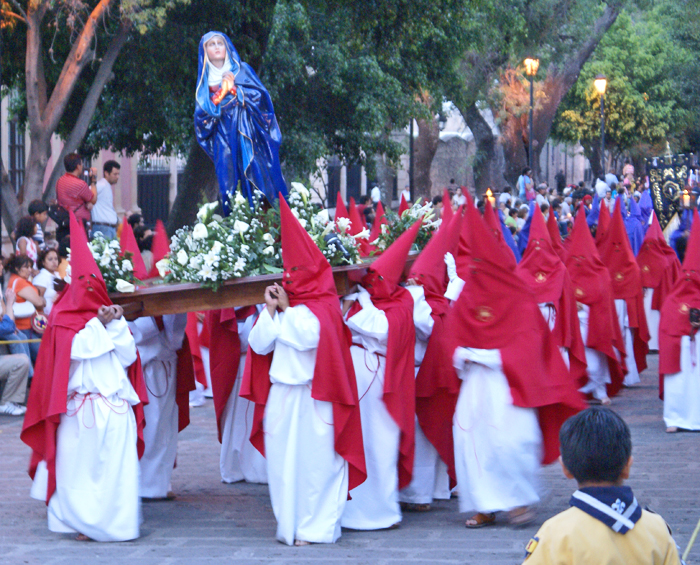
    Dolores 1
    Nuestra
    Señora de Dolores
    (Our Lady of Sorrows) leads the procession.  Hooded members of various
    Catholic cofradías (confraternities, or religious organizations founded in Europe in
    the 15th Century) carry life-size statues on their wooden
    platforms approximately three kilometers through Morelia's Centro
    Histórico
    .

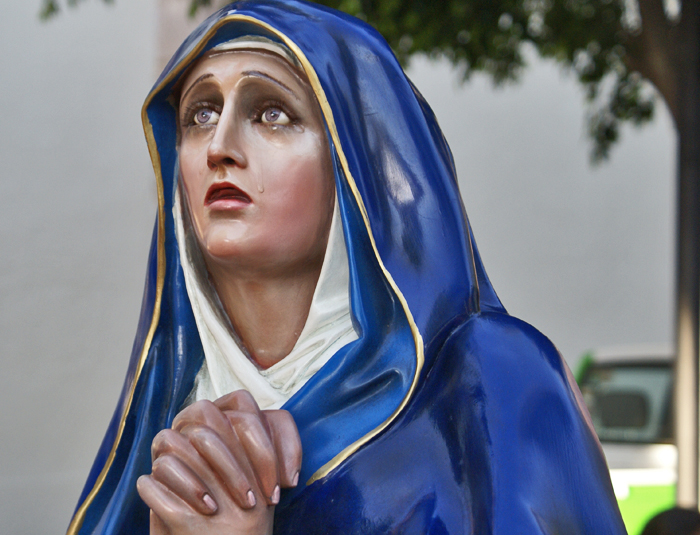
    Nuestra Señora de los Dolores
    Nuestra Señora de Dolores (detail).

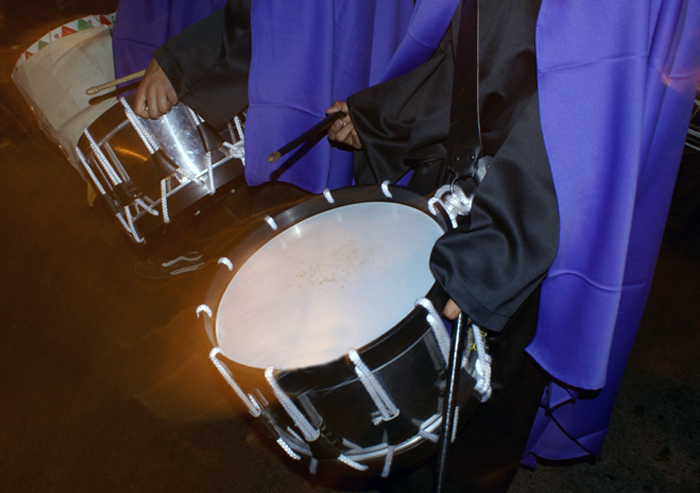
    Procesión Tambores
    Drummers marked the beat of Morelia's penitential Procesión del
    Silencio
    : Good Friday's silent procession commemorating both the
    crucifixion of Christ and his Mother's grief.  Only the drumbeat broke
    the silence along the route.

    Rezando en la
Huerta
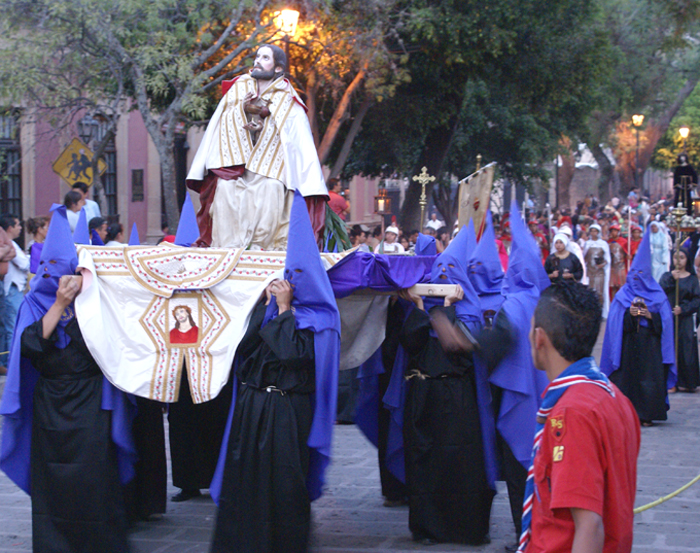
    Jesus
    during la Oración en el Huerto (praying in the Garden of
    Gethsemane), just prior to his arrest on Holy Thursday night.  Boy
    Scouts (the young man in red at the right of the photo) hold the
    protective rope all along the route of the procession.

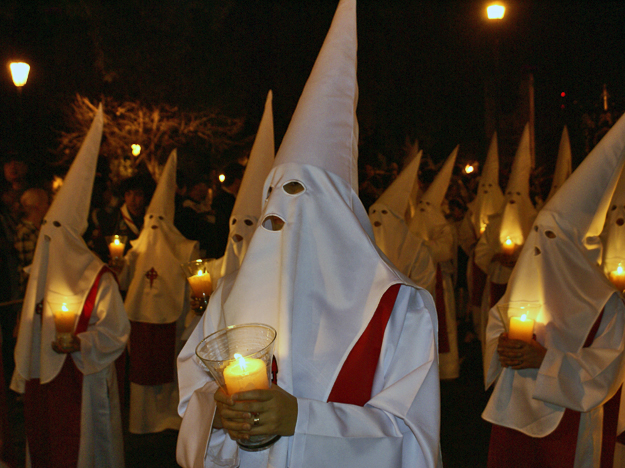
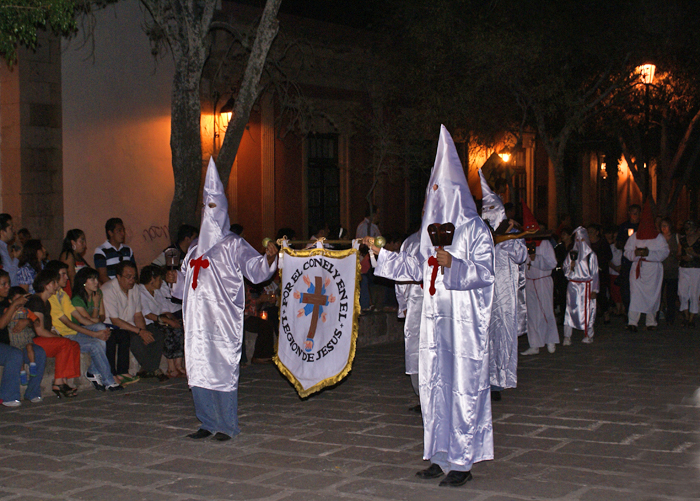
    Procesión Cofradía de Blanco
    Hundreds of cofradía
    members marched in the still of this Good Friday night.  Foreigners,
    particularly those from the United States, are often shocked by the
    hoods, which to them are cultural reminders of the Ku Klux Klan.  In
    Mexico, there is no association between the two.  The procession is
    penitential and the hoods are a guarantee of anonymity and humility for
    the cofradía members.  They believe that humility and works of charity are best practiced anonymously.

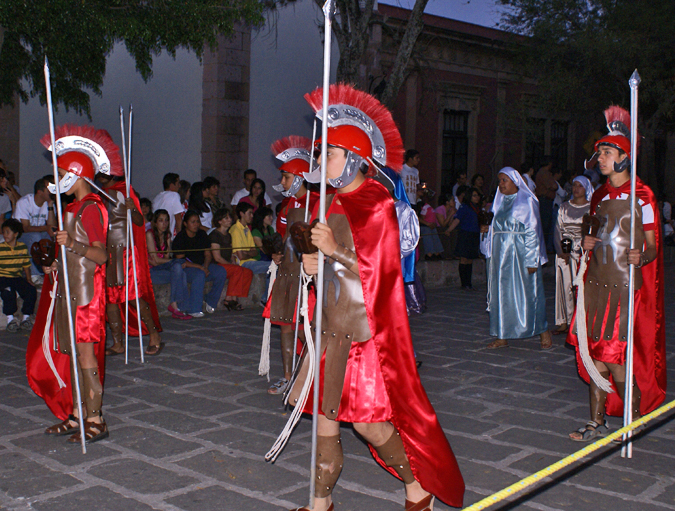
    Soldados Romanos
    Roman
    soldiers.

    Procesión Veladora 1
    The
    majority of Morelia's Procesión del Silencio takes place after
    dark, by candlelight.  For the first time in 2009 and again in 2010, city street
    lamps were left on due to security issues.

    Legion de Jesús
    The
    Legion of Christ carry their banner and their lamps.  The Procesión
    del Silencio
    lasts about five hours.  During that time, all of
    Morelia's Centro Histórico is closed to vehicular traffic.

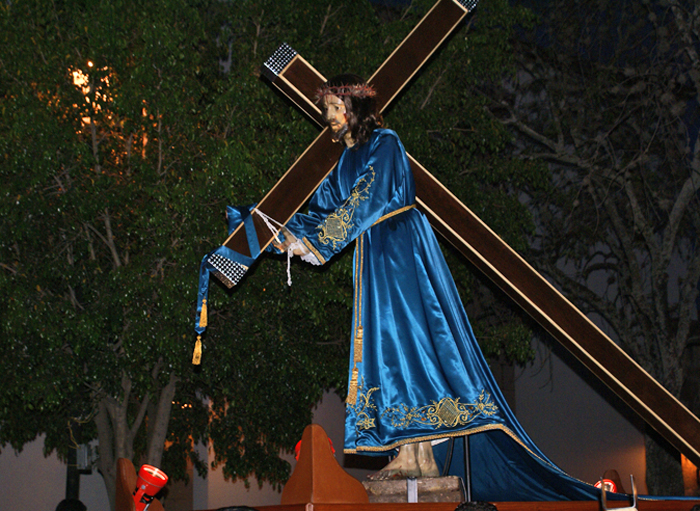
    La Cruz a Cuestas
    Jesus
    carries the cross a cuestas (on his back) to Calvary.  More than
    50,000 spectators stood along the entire route of Morelia's Procesión
    del Silencio
    .

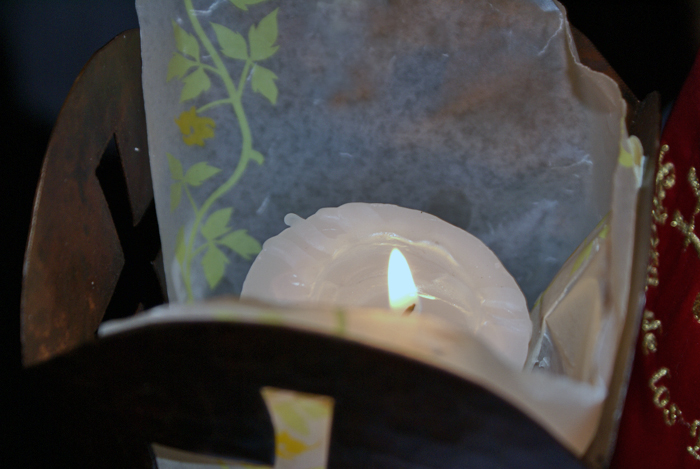
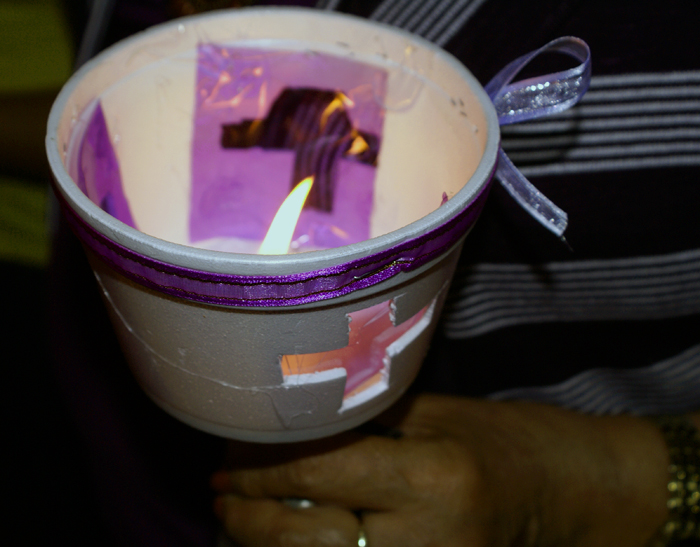
    Procesión Veladora 3
    Candle holders are made of many materials, from crystal to styrofoam to metal.

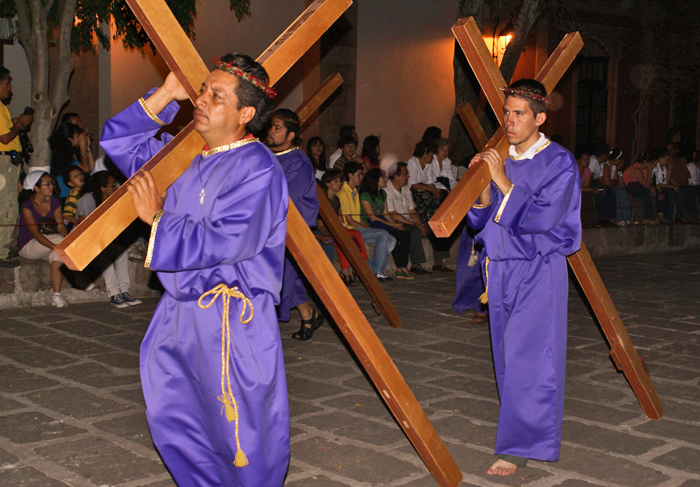
    Cargando la Cruz 2
    Penitents
    from one of Morelia's confraternities carry their crosses the length of
    the procession.  Many march barefoot through the city streets.  The
    procession celebrated its thirty-seventh anniversary this year.

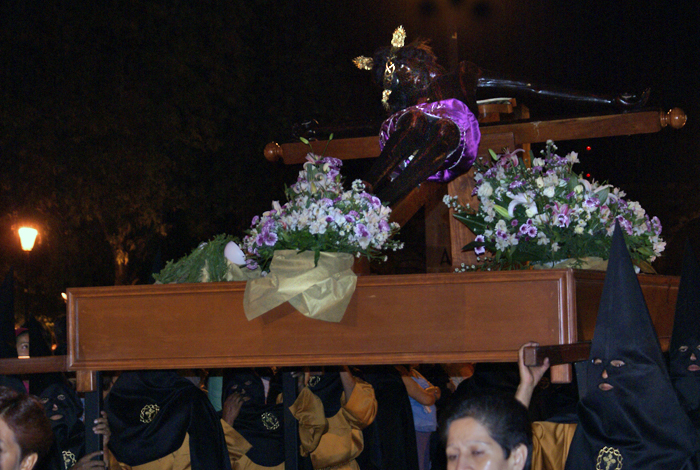
    Procesión Cristo Negro en la Cruz
    Robed
    and hooded members of another Catholic confraternity carry this
    image of the Cristo del Entierro (Christ of the Burial), nailed to the cross prior to his elevation.  Hoods cover the faces of those who march
    as a sign of penitence.

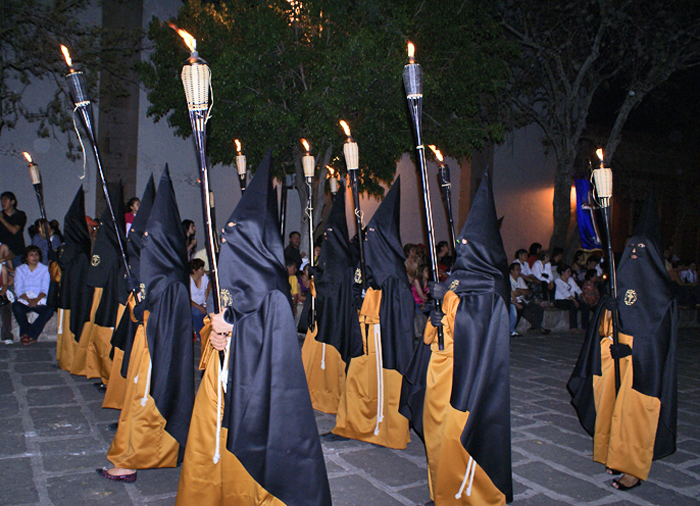
    Antorchas
    Clothed
    in gold and black, these marching penitents carry huge metal torches.

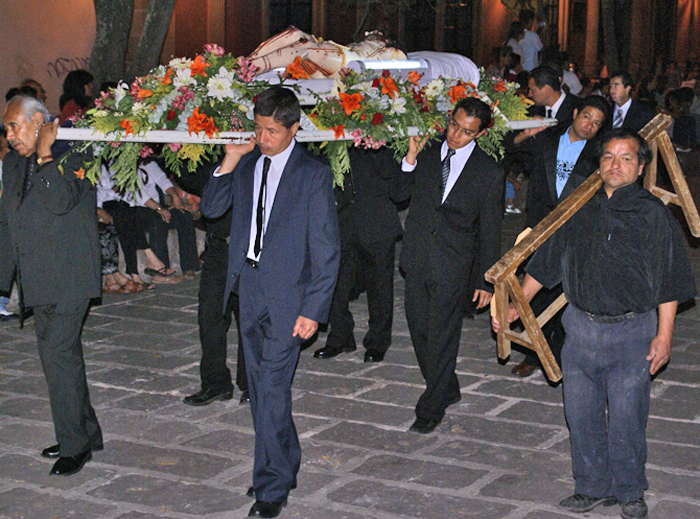
    Cristo Muerto
    Six
    men of all ages carry Cristo Muerto (the dead Christ), while six
    others follow as relief when the burden of the image, the platform, the
    lights, and the flowers becomes too heavy.  The man at the far right of
    the photo carries one of two saw horses used to support the platform
    during occasional pauses in the procession.

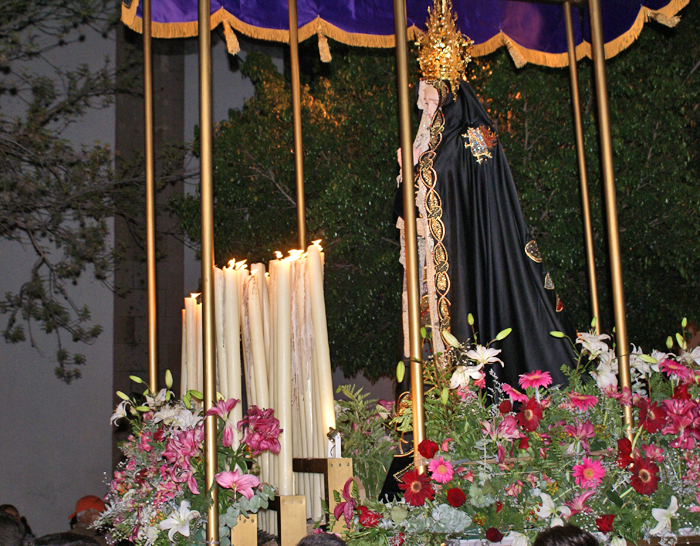
    Nuestra Señora de
Soledad
    At
    the end of the Procesión del Silencio, la Virgen de la Soledad
    (Our Lady of Solitude) follows the body of her crucified Son.  The
    platform bearing her image holds burning candles, a purple and gold
    velvet canopy, and banks of fresh flowers.

    Looking
    for a tailored-to-your-interests specialized tour in Mexico? Click
    here:
    Tours.

  • Palm Sunday Artisans’ Fair, Uruapan, Michoacán :: Tianguis Artesanal Domingo de Ramos

    Originally published on May 9, 2009, this article takes us to the annual all-Michoacán Tianguis Artesanal Domingo de Ramos (Palm Sunday Artisans' Fair)  in Uruapan, MichoacánThe 2013 fair opens today (March 23) and runs until April 6.

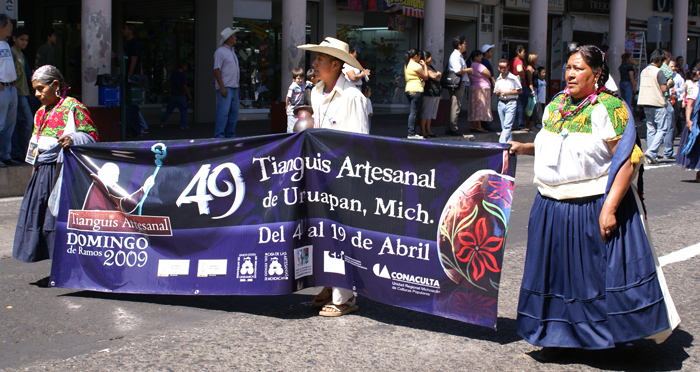
    Banderitas 2009
    Waving papel picado (cut paper) dance sticks and elegantly
    dressed in red velvet aprons trimmed with lace , these Purhépecha women
    danced their way through the opening day parade at the annual
    statewide Feria de Artesanías.

    Mexico Cooks! has attended the Feria de Artesanía de Domingo de Ramos
    (Palm Sunday Artisans' Fair) in Uruapan, Michoacán, every year for
    nearly 15 years.  The two-week-long fair is always the same and yet
    never boring, a remarkable combination.  This largest artisans' fair in
    Mexico draws more than 1200 vendors and contestants for the
    best-of-the-best from all over the state of Michoacán.  It attracts
    international tourism: we've heard languages from all over the globe as
    we walk the vendors' aisles.

    Delantal y Rebozo
    Purhépecha women's festive ropa típica (native dress) includes a knife-pleated skirt, a hand-embroidered guanengo (blouse), a cross-stitch apron, and the long, rectangular blue, black, and white striped rebozo (shawl) that is typical to the region.

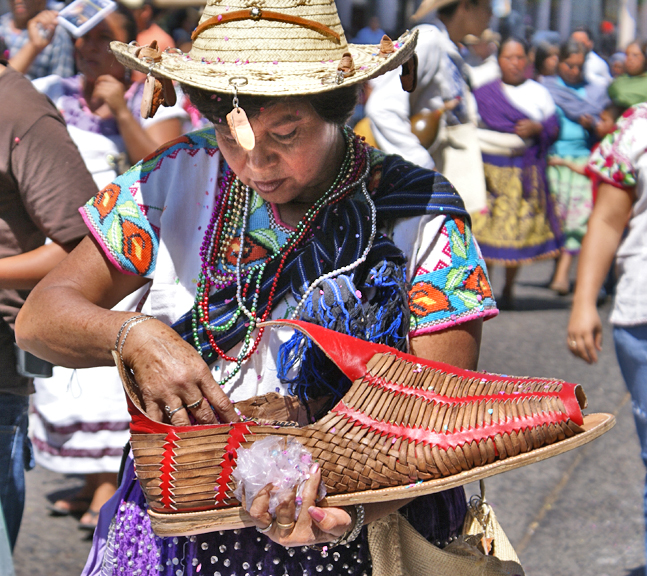
    Huarache 2009
    This woman marched while carrying an enormous huarache
    (shoe made of woven leather strips) representing the goods that her
    region of the state produces.  She's also carrying a bag of souvenir key
    chains that she tossed to individuals in the crowd.  Look closely and
    you'll see the tiny huarache key chains that decorate her sombrero de paja (straw hat). 

    Pink Tuba 2009
    Clarinets, trumpets, trombones, and a pink tuba–what a great band!

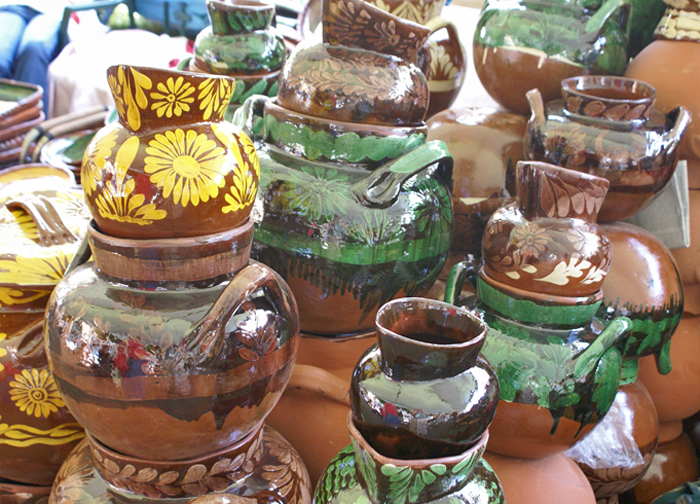
    Ollas Tzintzuntzan 2009
    Artisans hawk thousands of traditional low-fired clay pots and pitchers.  These are from Tzintzuntzan, Michoacán.

    Michoacán is famous world-wide for its traditional arts and crafts. 
    For hundreds of years, artisans in this state have produced highly
    decorated articles made from locally found materials: clay, wood,
    lacquer, textiles, copper, reedwork, and paper maché, among others.

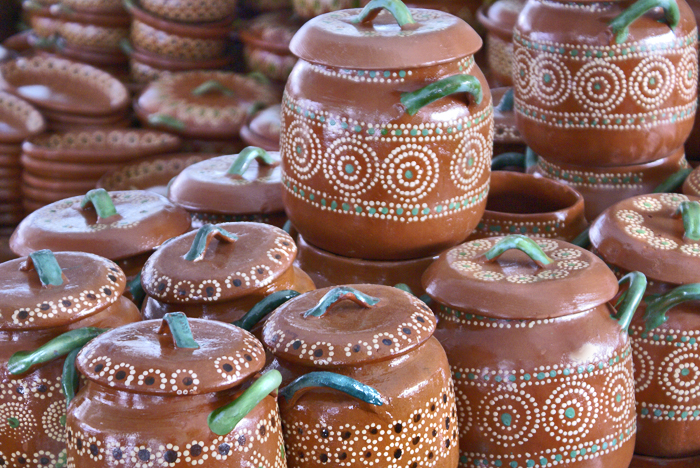
    Ollas pa'frijoles Capula 2009
    Ollas para frijoles (clay pots for cooking beans) from Capula, Michoacán.

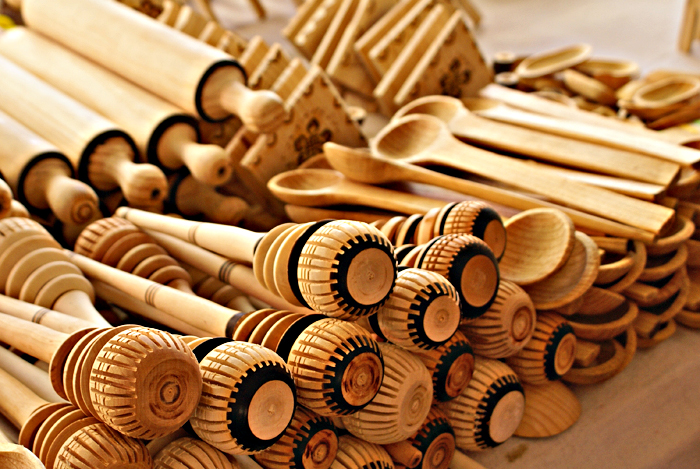
    Molinillos 2009
    Molinillos (little mills) are used for whipping chocolate caliente (hot chocolate) to a thick froth.
    For more about Michoacán-style, hand-made Mexican chocolate, look here: chocolate Joaquinita.

    Jarras de Capula 2009
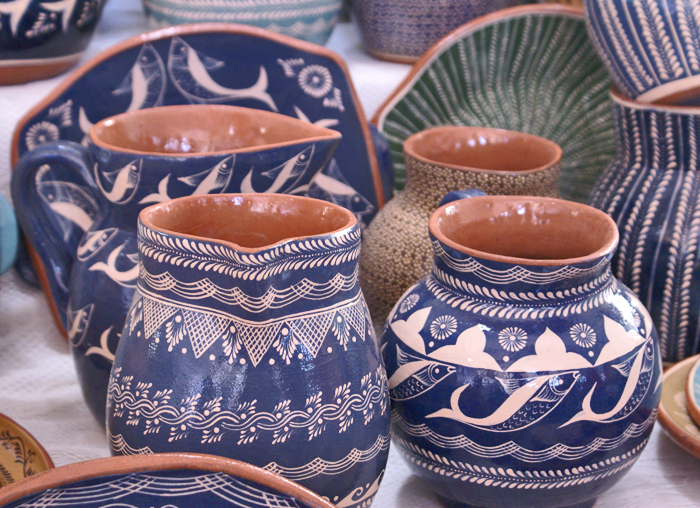
    These blue jarras y platones (pitchers and platters) with their finely painted, intricate white designs come from one family workshop in Capula.  Mexico Cooks! does not…DOES NOT…have room in the house for more pottery.  Well, maybe just one more piece!  These glorious jarras were all but impossible to resist.

    Ocumicho 2009
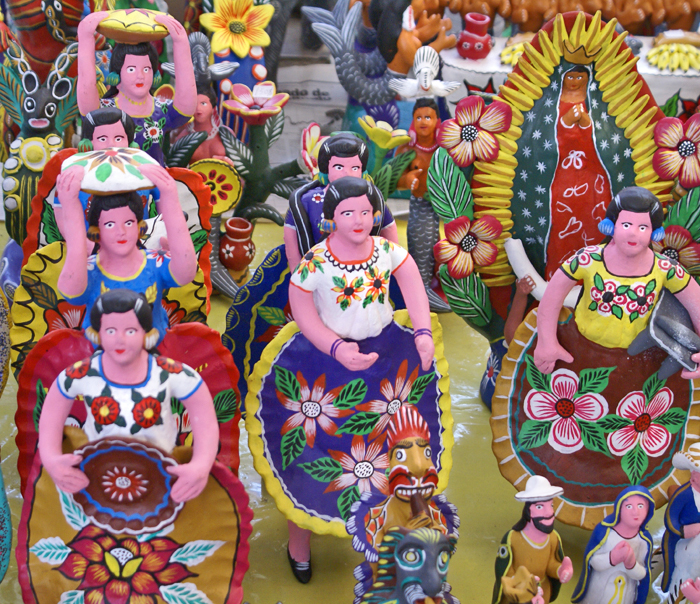
    Clay sculptures from Ocumicho, Michoacán, are full of whimsy and bright colors.  Among all of these guaris (Purhépecha word for women), did you notice Our Lady of Guadalupe, in the upper right corner?

    Huipiles 3 2009
    Hand-embroidered traditional cotton guanengos (blouses) are so important and finely made that they have their own concurso (competition) at the Feria de Artesanía (Artisans' Fair).

    Inicio Desfile 2009
    2014 will be the 55th anniversary of the Artisans' Fair in Uruapan.  Come see it with us!

    Looking for a tailored-to-your-interests specialized tour in Mexico? Click here: Tours.


  • Chilaquiles Caseros con Huevo :: Home-Style Chilaquiles with Egg

    Chilaquiles Ingredients 1
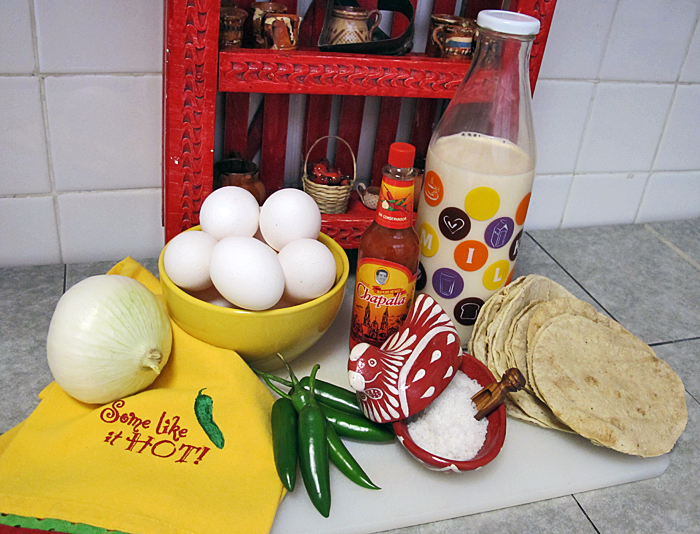
    The ingredients for home-style chilaquiles with egg are very simple.  This easy-to-prepare, traditionally Mexican dish makes a perfect lunch or supper for a Lenten Friday, or for any day.

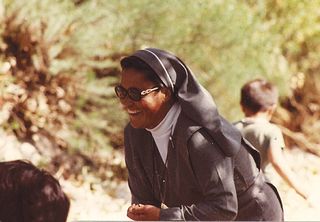
    Many years ago, long before the Internet burst onto the world scene and long before Mexico Cooks! was even a glimmer in my eye, a close friend from Michoacán taught me to prepare several platillos mexicanos estilo casero (home-style Mexican dishes).  I've written about my dear friend Sister Celia Gutiérrez Cortés before; more than 30 years ago, she introduced me to many of Mexico's joys that continue to reward me today. 

    Chilaquiles Celia
    Sister Celia Gutiérrez Cortés in 1982

    Chilaquiles are one of Mexico's most comforting of comfort foods.  A mere mention of the word in casual conversation with Mexican friends will bring forth memories, stories, and recipes for their favorite ways of preparing them.  They can be como mi mamá los hacía (like my Mom used to make them),  estilo el restaurante en donde almorzábamos en aquel entonces (the way the restaurant where we had brunch in the old days prepared them), or–like these–como me los enseñó mi querida amiga (like my dear friend taught me).  Enjoy!

    Chilaquiles Caseros con Huevo
    (Home-Style Chilaquiles with Egg)

    Ingredients
    10-12 eggs
    1/4 cup milk
    Sea salt to taste
    Bottled red salsa to taste (the salsa in the photo is Chapala brand, but you can use salsa Cholula, Tabasco or something similar)   
    2 fresh chiles serrano (use just one, if you prefer your food less picante (spicy)
    1 medium white onion
    16-20 stale tortillas, the staler the better.
    Vegetable oil

    Utensils
    12" non-stick skillet
    Mixing bowl
    Wire whisk
    Spatula

    Procedure

    Chilaquiles Huevo Sazonado
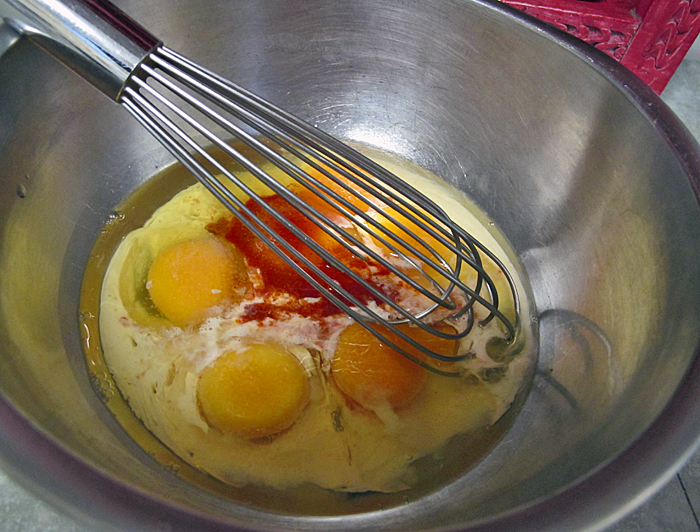
    Break eggs into your mixing bowl.  Add milk, sea salt, and bottled salsa.  (I give the bottle 6-8 thumps on the bottom.)  Whisk thoroughly until all ingredients are completely mixed together.

    Chilaquiles Cebolla y Chile Picado
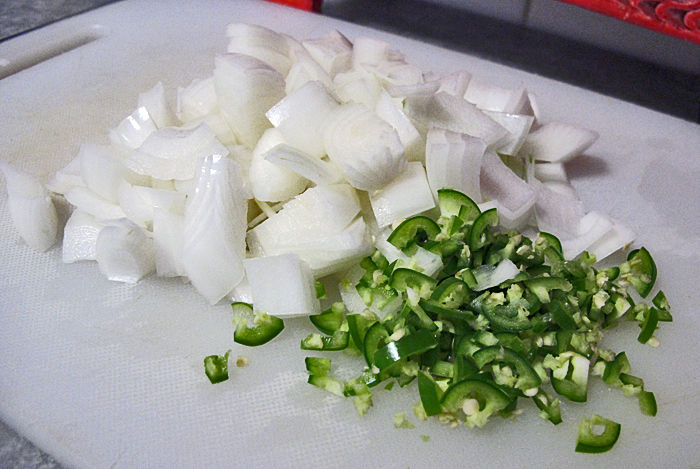
    Finely mince the chiles.  Cut the onion into 1/2 inch dice. 

    Chilaquiles Cebolla y Chile Acitronado
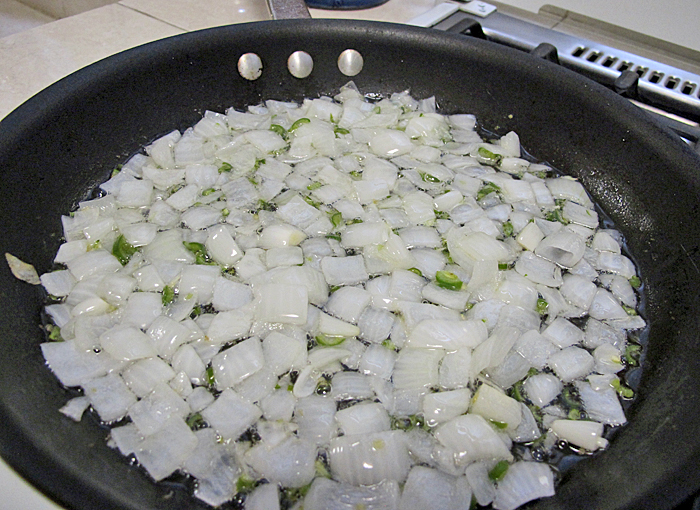
    In your skillet, heat oil until it shimmers.  Add the diced onion and minced chiles and sauté until the onions are soft and translucent, but not browned.

    Chilaquiles Tortilla Cortada
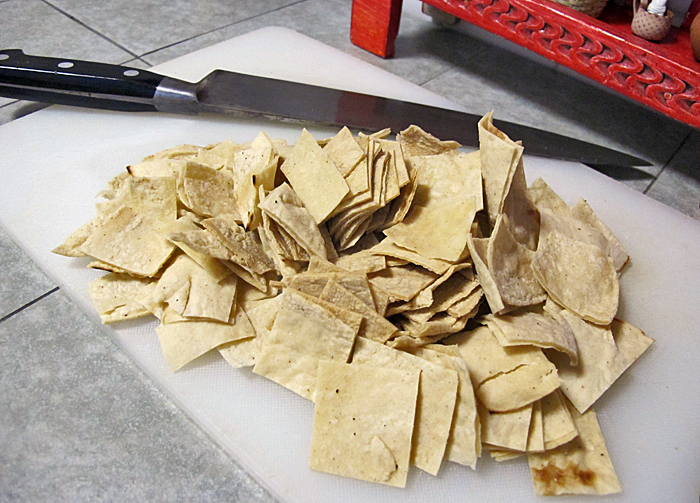
    While the vegetables are cooking, cut or rip the tortillas into 1.5" squares, into triangles, or into 2" X 3/4" rectangles.  The shape doesn't matter and each tortilla piece does not have to be exactly the same as the other.

    Chilaquiles Listo pa' el Huevo
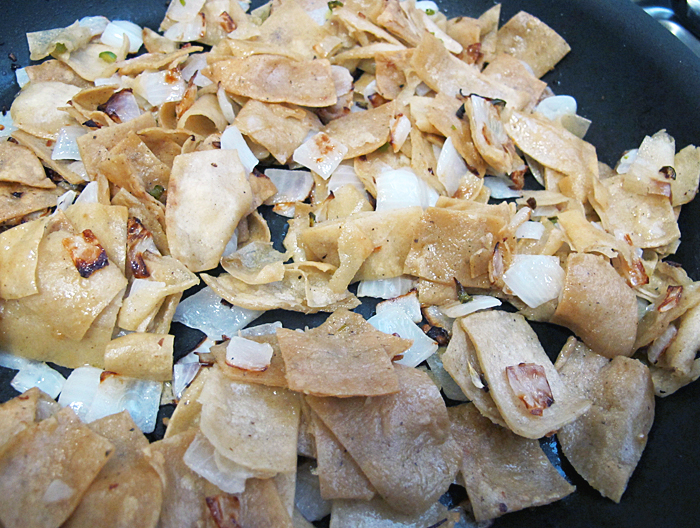
    Once the vegetables are soft, add the tortilla pieces to the skillet and sauté until they are browned and moderately crunchy.  The onions will caramelize during this step.

    Chilaquiles Huevo en la Sartén
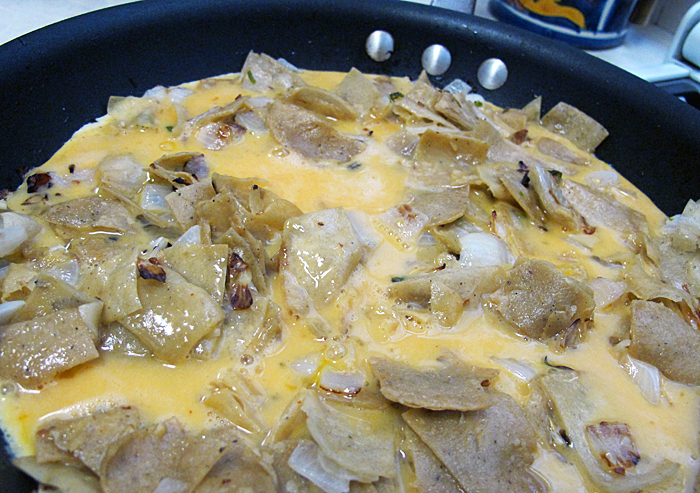
    When the tortillas are moderately crunchy–and they don't need to be as hard as packaged chips, just nicely crisped–add the beaten egg mixture to the skillet. 

    Chilaquiles Listos pa'el Plato
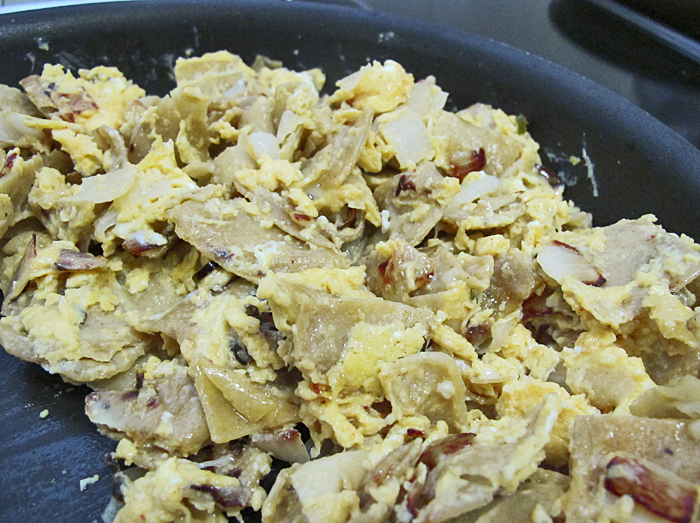
    Cook over medium heat until the eggs are well-set but not hard.  You will notice that, as the eggs begin to cook, the surfaces of the tortillas will appear to be slick and shiny.  That's the egg mixture.  The tortillas will lose that shine; when it's gone, you'll know that they are done.

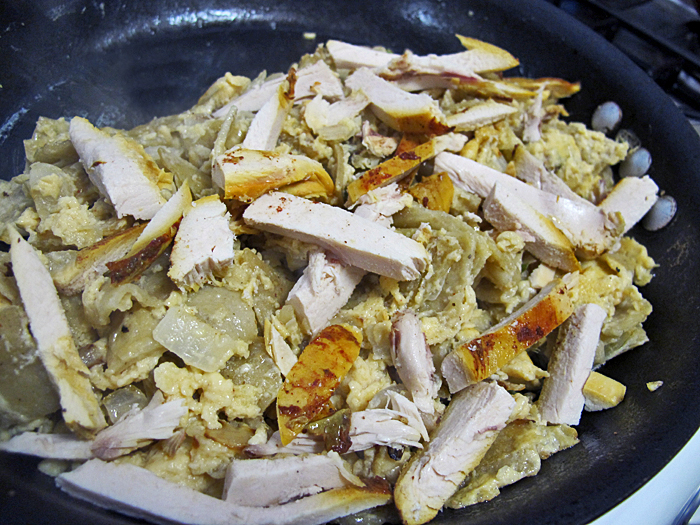
    Chilaquiles con Pechuga de Pollo
    If there is half a chicken breast left over from a previous meal, you can cut it into strips and toss it into the chilaquiles.

    Chilaquiles A Comer
    Divide the chilaquiles onto four plates.  Drizzle with Mexican crema para la mesa (table cream–NOT sour cream), if you can find it.  Serve with refried beans, sliced ripe avocado, and a refreshing cold beverage.

    Makes four generous servings.  Provecho!

    Looking for a tailored-to-your-interests specialized tour in Mexico? Click here: Tours.

  • Día Mundial del Payaso (World Clown Day) in Morelia

    Mexico Cooks! is repeating this post (originally published in January 2010) because World Clown Day's 2013 festival, recently celebrated again in Morelia, is such a lot of fun!  Enjoy.

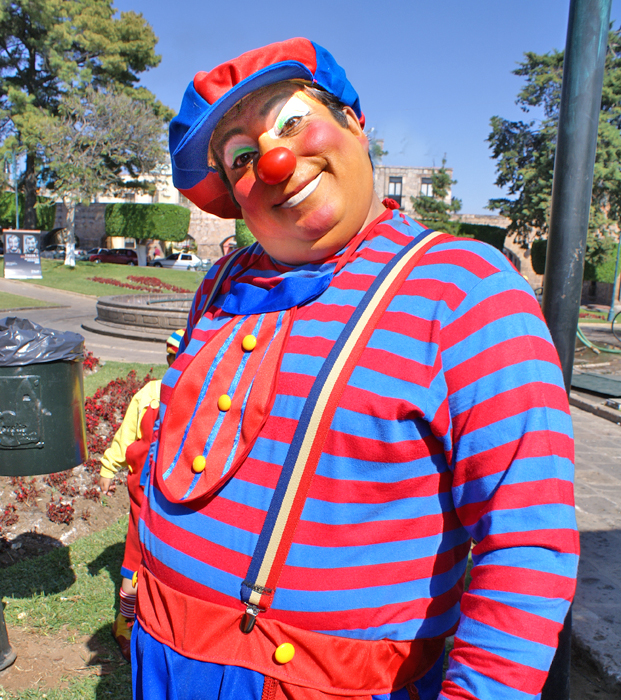
    Payaso Beto Botones
    Morelia's well-known Mario Galván is Beto Botones (Bert Buttons).  Don't be frightened–these Mexican clowns are completely harmless!

    One sunny Saturday not too long ago, Mexico Cooks! hopped into the car and headed for downtown Morelia: it was the annual Día Mundial del Payaso
    (World Day of the Clown) and we wanted to see the local clown parade as
    it trouped west on Avenida Madero from Plaza Villalongín to the
    Cathedral.

    Nearly 100 payasos (clowns) form Morelia's
    clown community.  Entire families, in colorful wigs and ear-to-ear
    painted smiles, pass the joy of laughter and delight from one generation
    to the next.  The patriarch among them is Beto Botones,
    personified by Mario Galván.  His 23 years as a clown and magician make
    him one of the elder statesmen in the Morelia clown community.  Now his
    sons, 11-year-old Oscar Eduardo (Bombonetto) and 14-year-old Mario
    Alberto (Beto Bettín) are also part of the group. 

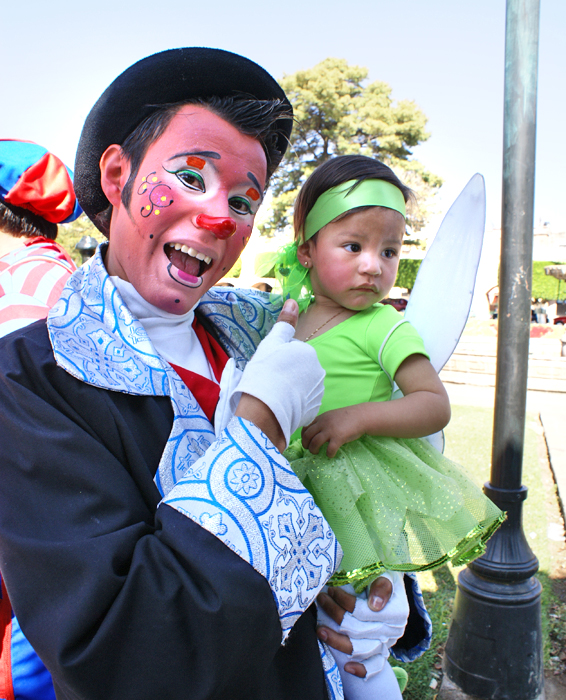
    Payaso con su Hija
    This
    beautifully made-up clown has also drawn his family into the act: his
    wife and his gorgeous baby daughter have joined the fun.  His young wife
    said, "Most of the women who are clowns are here because of our
    husbands.  They were clowns when we married them, so we got involved,
    too."

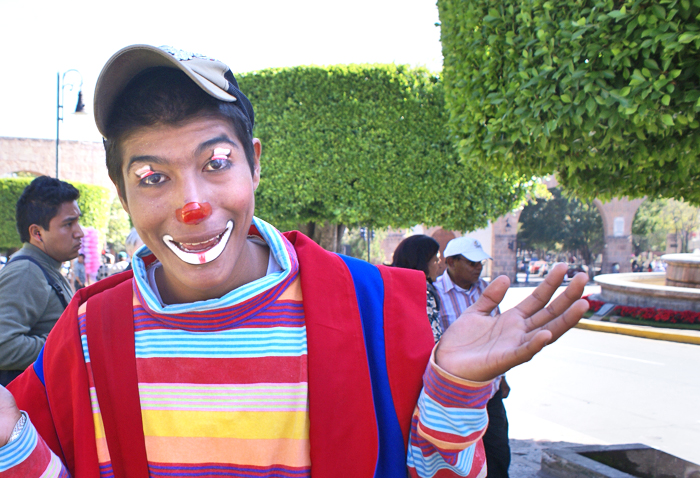
    Payaso Manos Arriba
    A
    relative newcomer to Morelia's clown community.  Learning to be a true
    clown is a lifetime occupation.  Some boys start clowning as early as
    age four or five.

    There's more to becoming a clown than simply
    putting on makeup and a
    red nose.  For the professional clown, the work of laughter is serious
    business.  Most attend clown conventions and workshops, where they learn
    new routines and participate in competitions.  It's not cheap to be a
    clown: the right costume and makeup can cost more than 7000 pesos
    (approximately $600 USD).  Many clowns have a profession in addition to
    clowning: Eduaro Espinaza (Tornillito), one of Morelia's most
    sought-after clowns, is also an auto mechanic.
      Beto Botones said, "In other big cities, a clown can charge 1000 pesos
    or more for working a party.  Here in Morelia, most charge 600 to 650."

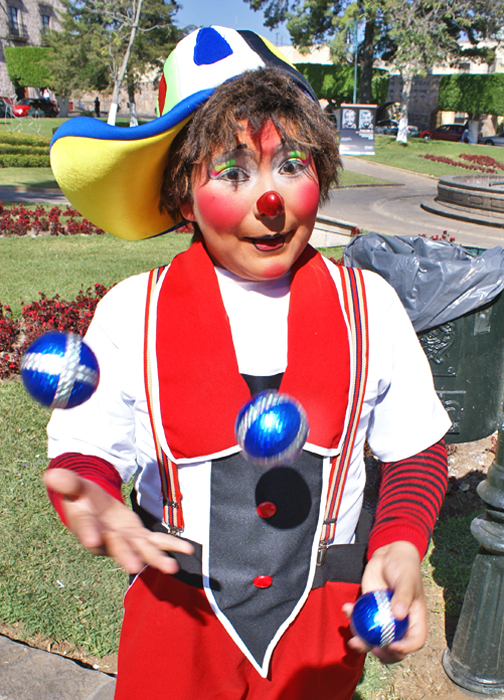
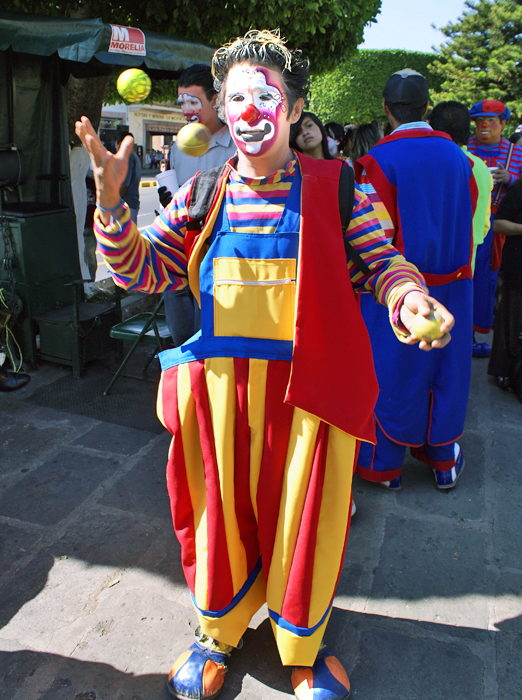
    Payasito Malabarista
    A malabarista (juggler) shows off his skill.

    In
    the worldwide clown community, there are a number of types of clowns. 
    Mexico's professional clowns adhere to the same fascinating guidelines.

    • CLOWN: he's also known as Carablanca (Whiteface), Pierrot, Enharinado (Flourface)and Listo
      (Clever).  Normally he's made up in whiteface and wears an elegant,
      shiny costume.  When there's a clown confrontation among the various
      types, he always wins–always!  He represents law and order and the
      adult world.
    • AUGUSTO: He's also known as Tonto (the Fool).  He's more naive than all the rest and he's always on the receiving end of any joke.

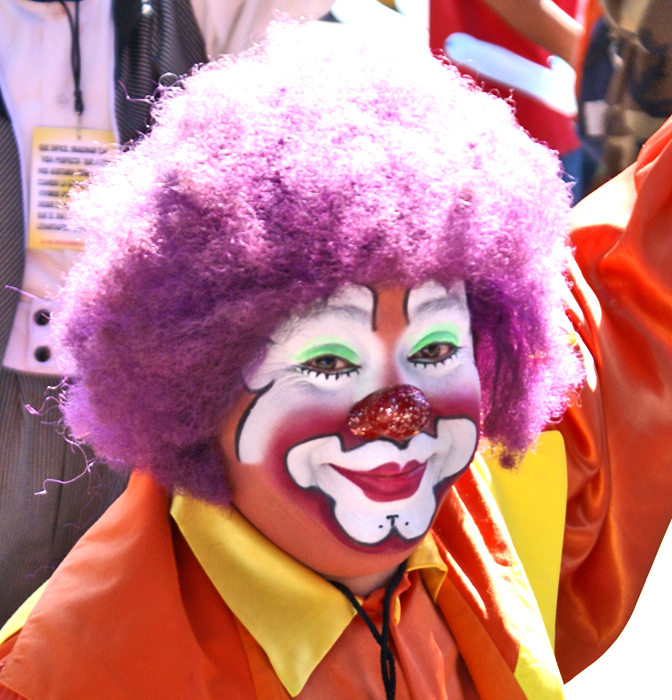
    Payaso Peluca Morada
    Purple wig, green eye shadow, glittery nose, and orange suit–brilliant!

    • SEGUNDO AUGUSTO: He's also known as "Contraugusto" or "Trombo".  He's the third figure in a trio of clowns and is often also a musician.
    • EXCENTRICO: This clown has evolved from the role of 'Augusto'.  He is normally mute and sometimes uses musical instruments or other objects like juggling pins or balls.

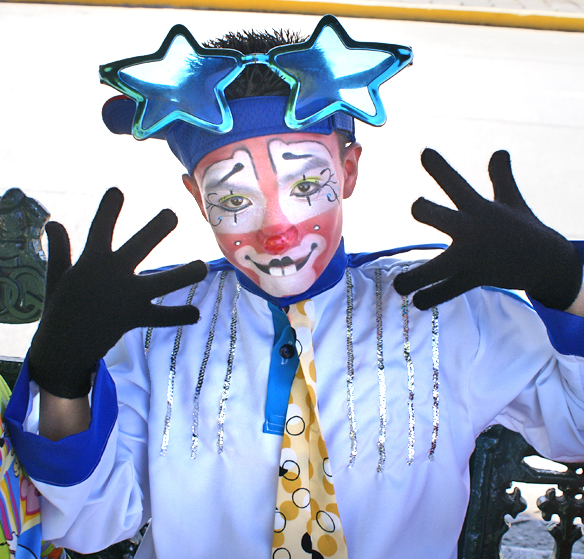
    Payasito con Lentes Estrella
    Buck teeth, spiky hair, and starry glasses!

    • VAGABUNDO (or TRAMP): His character is sad, oppressed, and abandoned.
    • PAYASO DE SOIRÉE: This clown is normally an 'augusto'.  He acts out his specialty in the entrance to events.
    • MIMO-CLOWN: This guy is a variation on the first
      clown category.  He's usually mute, but he has a lot of tricks up his
      sleeve.  He can juggle, he's sometimes an acrobat, and he can often play
      a musical instrument or two.

    Payaso Malabarista
    Another juggler, in full regalia.

    • MESIÉ LOYAL: He's the ringmaster and the director of the show–the ultimate authority.
    • CLOWN DE PERSONAJE: We can identify this clown by
      his character or profession.  He might be a fireman, a sailor, a doctor,
      or a cowboy.  Or, he might take on the role of a policeman, a child, or
      someone from a familiar story.

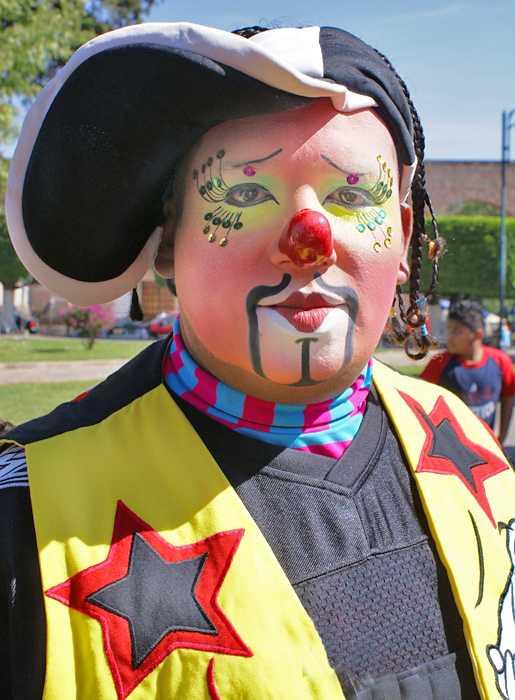
    Payaso Gorrita
    This clown's face makeup is superb.  Mexico Cooks! particularly loved his eyelashes and golden tears.

    In
    addition to this time-honored hierarchy of clowns, Mexico is home to
    many informal and little-trained stoplight clowns who work our cities'
    street corners.  You saw some of them in the January 16, 2009, Mexico Cooks! article Lo Que Se Ve En El Crucero
    Beto Botones said, "These street clowns wear jeans, they don't follow
    the norms of real clowns, they think it's too costly to train and work
    professionally.  But it's important to follow clown traditions.  It's
    not right that they don't know our history, our theories, and that they
    don't want to act like professionals."

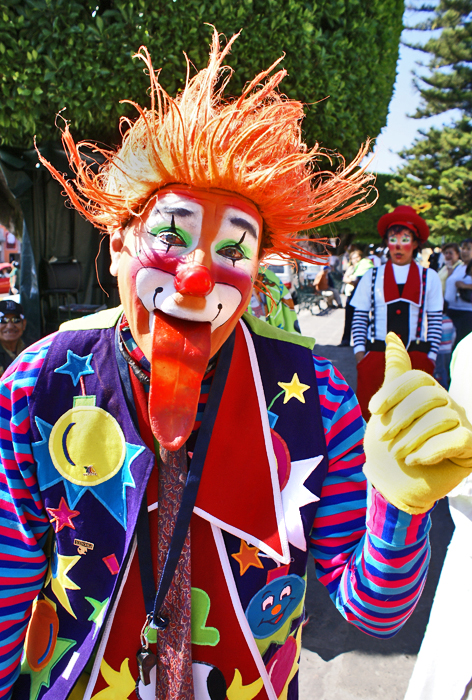
    Payaso Peluca Color Naranja
    The wig!  The tongue!  The gloves, the shirt, the vest!  Who could resist him?

    The trained clown always has a red nose, a bright plastic sign that this is a real clown
    His wig can be any color he wants, as long as it goes with his
    personality.  Today, his makeup is usually airbrushed onto his face in
    the style that suits him best.  Usually he wears gloves; the "Augusto"
    generally uses a dandy's white gloves. 

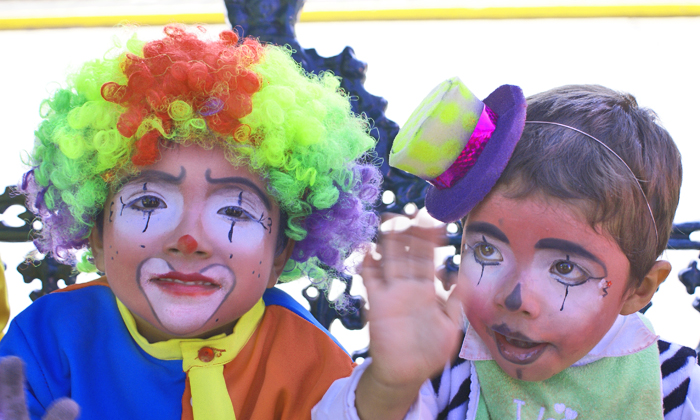
    Payasititos Dos
    These payasitos–baby clowns–are totally adorable.  The little guy on the right sports a wonderful hat.

    The
    shoes: a clown, especially an "Augusto", is notable for his gigantic,
    bulbous, and colorful footwear that serves to call attention to his
    character.  A clown's suit is almost always copious, with big hidden
    pockets filled with balls, juggling pins, hats, and handkerchiefs: the
    stuff of magic, jokes, and laughter.

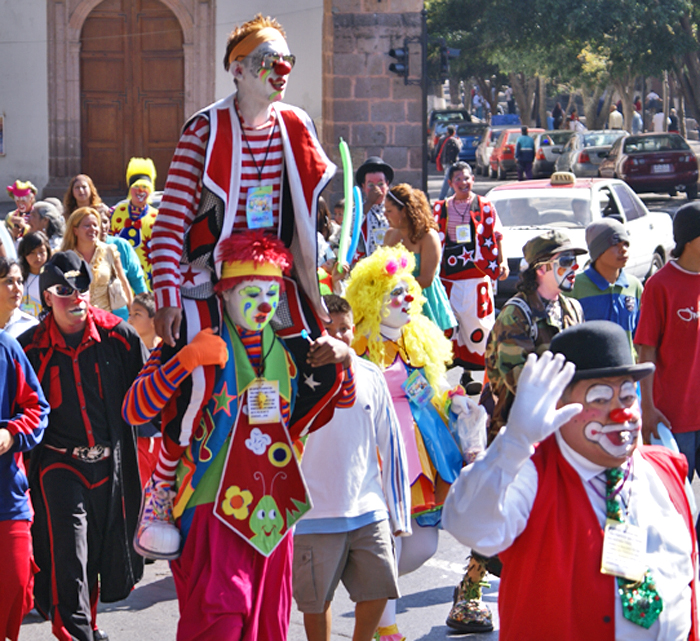
    Payasos Desfilándose
    At last, the desfile de payasos (clown parade) turned the corner onto Avenida Madero!  Even with the difficult economic situation in today's Mexico, Morelia's payasos haven't lost their sense of humor, their smiles, or their optimism.

    Morelia's professional payasos
    are available to work all kinds parties and other special events. 
    Nothing enlivens a child's birthday party like a clown; nothing but a
    clown takes a suddenly too-serious event to another level of fun.  How
    wonderful to know that Mexico's traditional clowns live on for future
    generations' laughter.

    Looking for a tailored-to-your-interests specialized tour in Mexico? Click here: Tours.

  • Fresh Blackberries Grown in Michoacán :: Rica Zarzamora Producto de Michoacán

    Yoghurt 11 Zarza
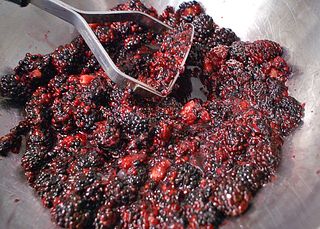
    Blackberries are one of the staples of the Mexico Cooks! kitchen.  In season nearly year-round, Mexico's blackberries are primarily grown in the state of Michoacán.  This bowlful of delicious blackberries is being crushed with Splenda® and a pinch of salt to add to breakfast yoghurt

    In 1994, the commercially cultivated blackberry first arrived in the area around Los Reyes, Michoacán.  High in the mountains, Los Reyes offered a perfect climate for the Brazos variety of erect blackberries.  Originally, the commercial growers planted only three hectáreas (about 6 acres) of berries.   Developed at Texas A&M University and
    introduced in 1959, 'Brazos' has been the Texas standard
    for years and is still a great variety. The berries are
    large and the plants produce heavily.  In Michoacán, this variety starts ripening early in May. 
    The berries are a little acid and are better for cooking
    and canning than fresh eating. This variety has more
    thorny plants and larger seeded fruit than many of the
    improved varieties.  In fact, the blackberries offered in Mexico's markets are huge, about an inch long by half an inch in diameter–as big as the ball of my thumb.

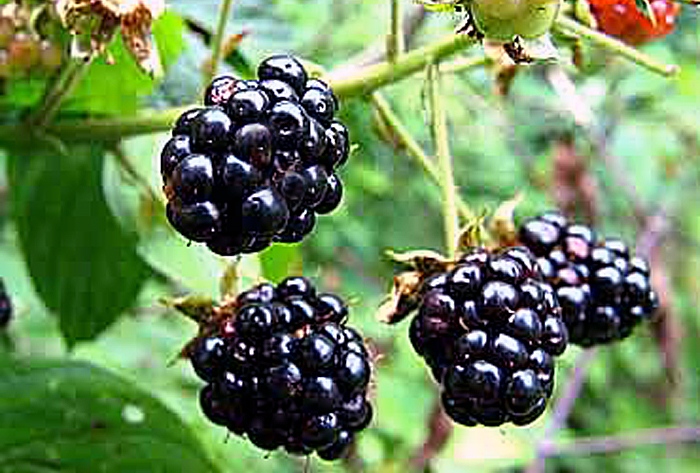
    Cobbler Blackberries on the Hoof
    Brazos blackberries 'on the hoof'.

    Since those 1994 beginnings, local growers have learned a tremendous amount about the cultivation of blackberries.  Today, the fruit fields cover more than 4,500 hectáreas in the area of Los Reyes, Tocumbo, and Peribán–almost all in the west-central highlands of Michoacán.  The 2009 production reached a weight of 30,000 tons of blackberries–tons!  Ninety percent of those were exported to the United States, the primary foreign market.  The rest went to Europe and Japan.  This quantity of blackberries represents 95% of those grown in Michoacán and 90% of those grown anywhere in Mexico.  This rinconcito (tiny corner) of Mexico produces more blackberries than anywhere else in the world.

    Cobbler Blackberries
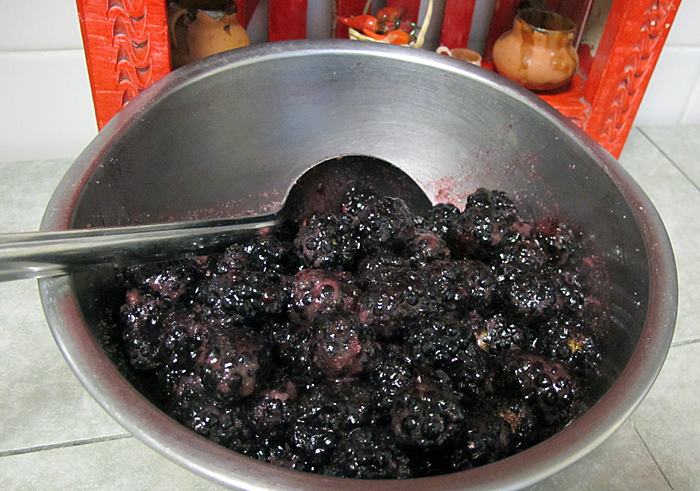
    Shortly before Christmas, Mexico Cooks! was unable to find unsweetened, unflavored yoghurt in our neighborhood shops–and there was a liter of blackberries in the refrigerator that needed to be eaten immediately.  They had been destined for breakfast, but one morning se me prendió el foco (the light bulb went on in my brain) and I thought: COBBLER!  In the bowl is the entire liter of berries, mixed with sugar, the juice and some grated zest of a limón (key lime), and a bit of cornstarch.

    Cobbler Assorted Ingredients
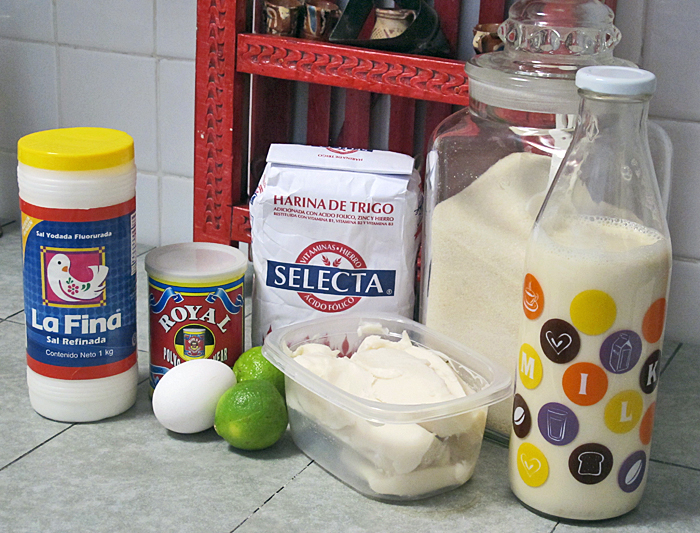
    Blackberry cobbler, as you might have guessed, is not in the Mexican food repetoire.  However, when all of the ingredients are grown or made in Mexico, maybe it should be.  In the photo are salt, baking powder, an egg, two limones, standard-grade sugar, milk, and freshly rendered pork lard.  Lard, so shoot me!

    Cobbler Buttered Pan
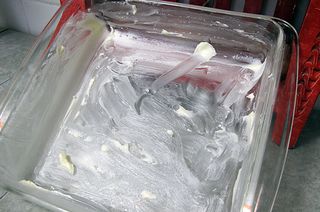
    Pre-heat the oven to 425ºF and butter a glass baking dish.

    Cobbler Blackberries in Pan
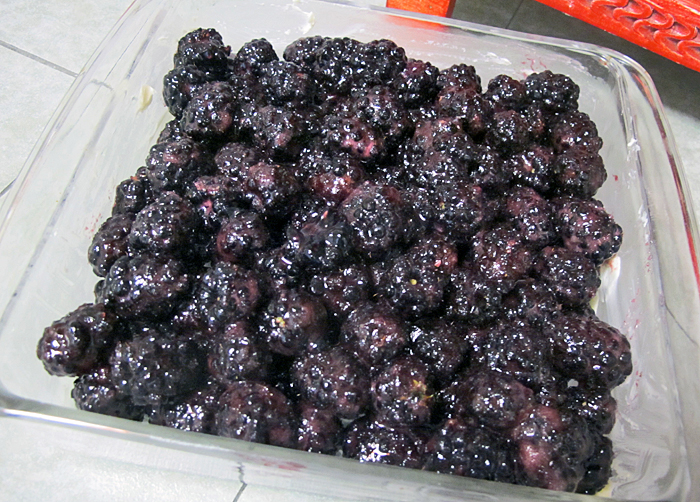
    Scoop the blackberry mixture into the pan and gently even it out.

    Cobbler Measuring Shortening
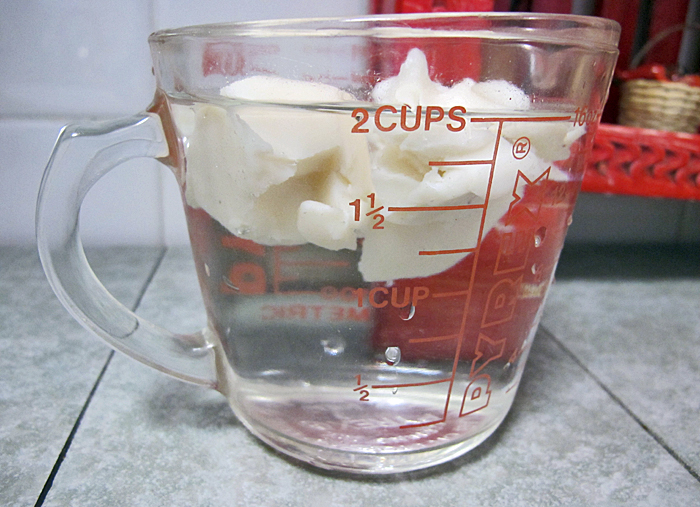
    Measure the shortening (you can use solid vegetable shortening if you prefer not to use lard).  I always use the displacement method to measure solid shortening: for this 1/4 cup of lard, I started with 1 3/4 cups of cold water in this clear measuring cup.  I added lard until the water rose to the two-cup level, then emptied out the water.  Bingo, 1/4 cup of lard and no mess.

    Cobbler Shortening and Flour
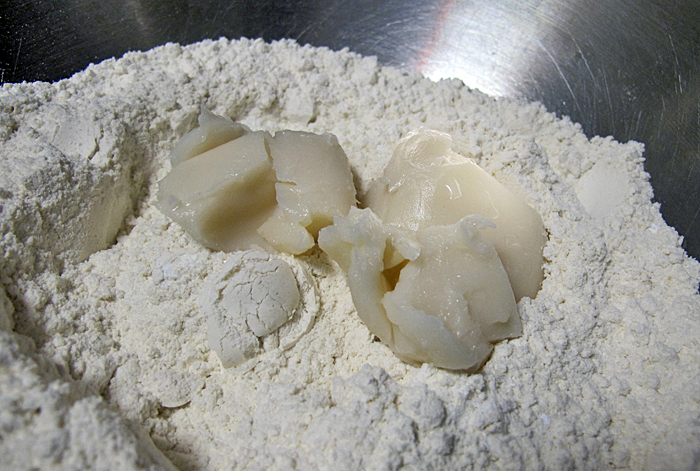
    The flour mixture that will become the dough for topping the cobbler.  You see the lard on top of the flour mixture, ready to be worked into it.

    Cobbler Shortening and Flour Finished
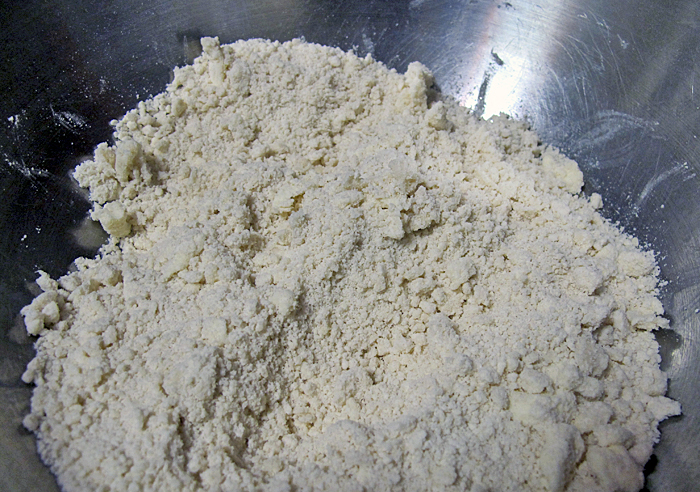
    The flour mixture should look like this when you finish working the lard into it.

    Cobbler Milk and Egg
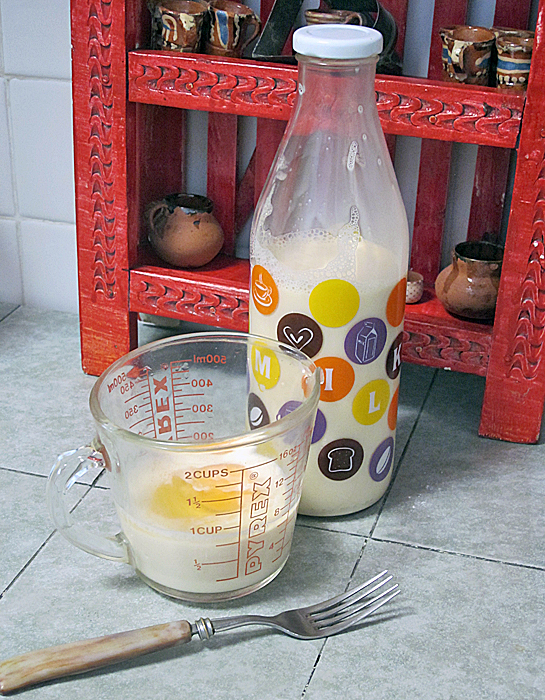
    Break an egg into the milk and beat with a fork till blended.

    Cobbler Ready for Oven
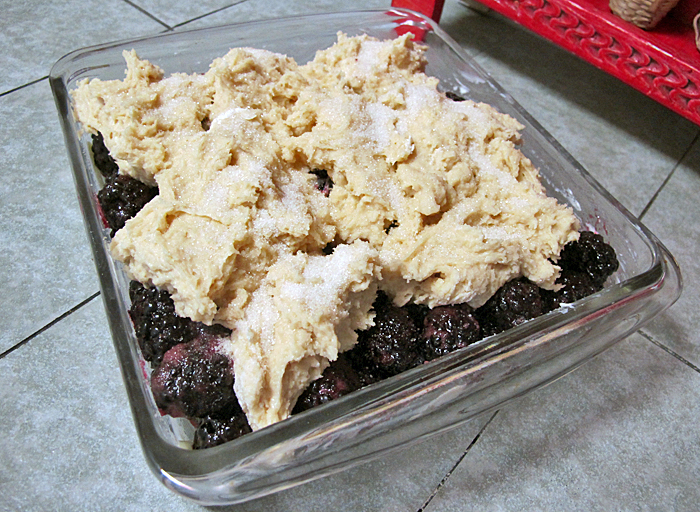
    The cobbler, topped with raw dough and ready for the oven.  Sprinkle the raw dough with sugar to give it a finished look after baking.  The cornstarch that I mixed with the raw blackberries and sugar thickens the juices as the cobbler bakes.

    Cobbler Ready to Eat
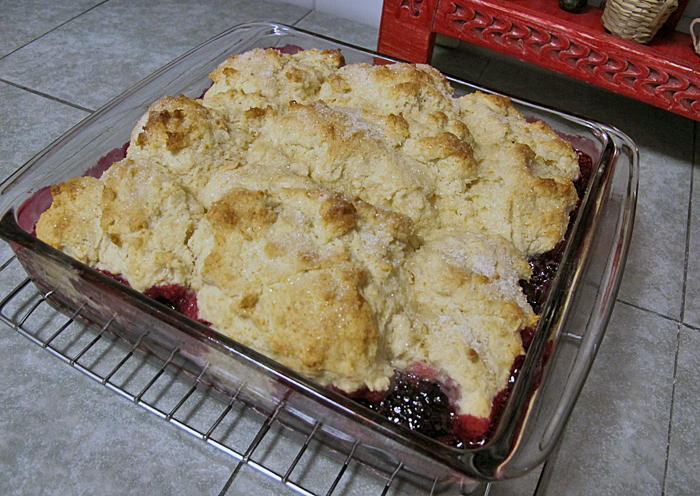
    Bake the cobbler for about half an hour, or until the dough is light golden brown.  Your house will smell heavenly!

    Here's the entire recipe:

    Blackberry Cobbler
    Ingredients
    4-6 cups fresh blackberries
    3/4 cup sugar, divided use
    1 Tbsp lemon juice
    zest of 1/2 lemon
    1 Tbsp cornstarch

    2 cups all-purpose flour
    1/4 tsp salt
    1 Tbsp baking powder
    1/4 cup shortening–in this instance, lard
    4 Tbsp butter
    1 whole egg
    1/2 cup milk

    Preparation
    Preheat your oven to 425ºF.

    Butter the glass baking dish.  Mix blackberries, 1/2 cup sugar, cornstarch, lemon juice, and lemon zest in a large mixing bowl.  Reserve.

    In a separate bowl, mix the flour, salt, baking powder, and 1 or 2 Tbsp sugar.  Add the shortening and butter and work them into the flour with your fingers, until the mixture looks like coarse corn meal. 

    Measure 1/2 cup milk into a large measuring cup; break the egg into the milk.  Beat with a fork until well blended.  Pour the milk/egg mixture into the flour/shortening mixture and stir until smooth.  The dough should not be sticky; if you need to add more flour, start with just an additional tablespoon.  When the dough is smooth but still quite damp, it's ready.

    Pour the blackberry mixture into the glass baking dish and gently even out the berries with your fingers.  Put large spoonfuls of dough all over the berries, leaving some small spaces on top for the juice to bubble through.  Flatten the dough a little–use your fingers, and don't worry about how it looks.  Sprinkle the top of the dough with a tablespoon or two of sugar.

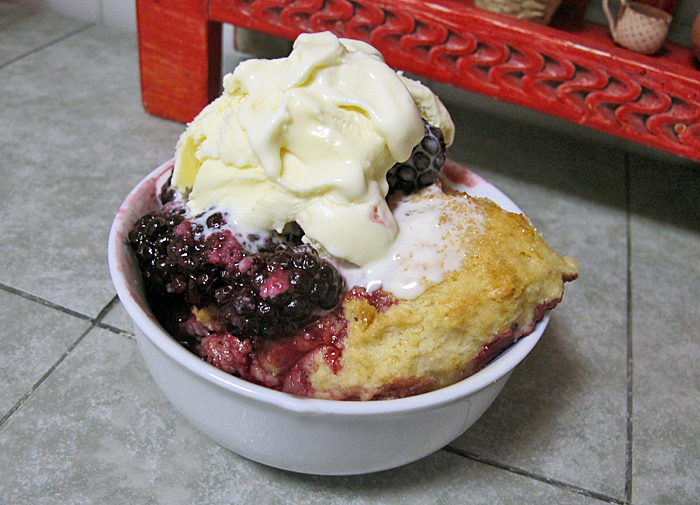
    Bake until golden brown, about 30 minutes.  A serving of your cobbler, topped with a scoop of vanilla ice cream, will look like this–truly a thing of beauty.

    Cobbler Serving Dessert
    The finished product: blackberry cobbler, hot out of the oven and topped with rich real-cream vanilla ice cream.

    What could be better on a chilly winter evening–a taste of Mexican blackberries, from a recipe straight out of your grandmother's kitchen! 

    Looking for a tailored-to-your-interests specialized tour in Mexico? Click here: Tours.


  • Touring with Mexico Cooks! in 2012…and Beyond! Oh, The Places You’ll Go…

    Tours Cristina en Pátzcuaro con Charlotte and Donna Nov 15 2012
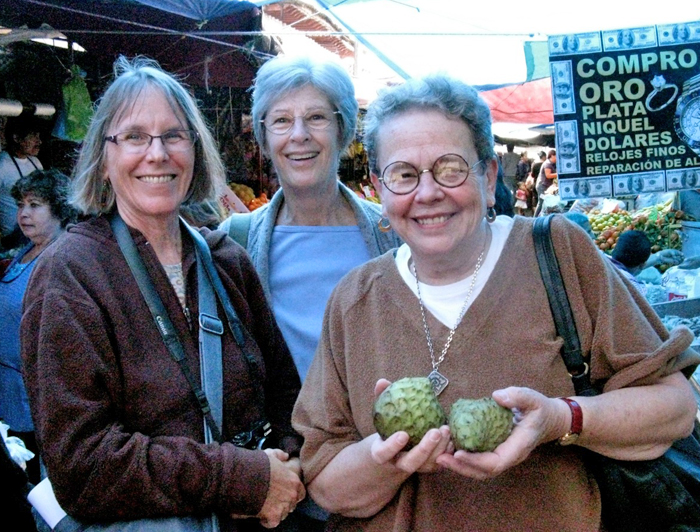
    A November market tour on a chilly morning  in Pátzcuaro, Michoacán: from left, Charlotte Ekland, Donna Barnett, and Mexico Cooks!.  Marvey Chapman, the other member of this tour group, took the picture.  I'm holding two Michoacán-grown chirimoyas (Annona cherimola), known in English as custard apples.

    One of the great pleasures of 2012 was the number of tours Mexico Cooks! gave to lots of excited tourists.  Small, specialized tours are a joy to organize: the participants generally have common interests, a thirst for knowledge, and a hunger for–well, for Mexico Cooks!' tour specialty: food and its preparation.  Touring a food destination (a street market in Michoacán, an enclosed market in Guadalajara, a crawl through some Mexico City street stands, or a series of upscale restaurants) is about far more than a brief look at a fruit, a vegetable, or a basket of freshly made tortillas.

    Tamal de Trigo Pátzcuaro 2012
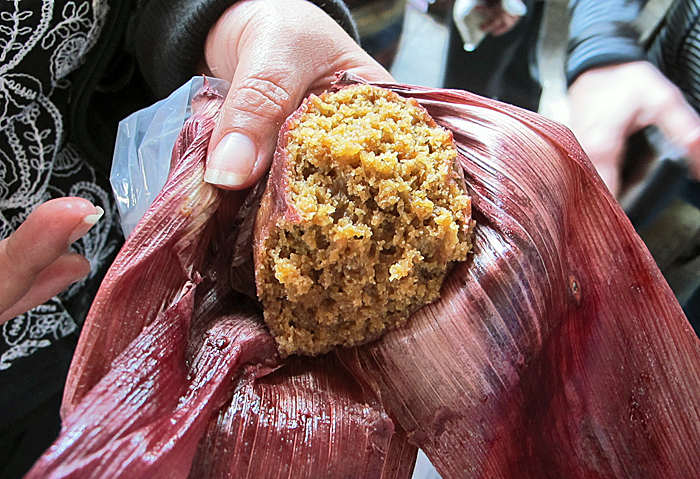
    A Pátzcuaro street vendor holds out a partially unwrapped tamal de trigo (wheat tamal).  It's sweetened with piloncillo (Mexican raw sugar) and a few plump raisins, wrapped in corn husks, and steamed.  Taste?  It's all but identical to a bran muffin, and every tour participant enjoyed a pinch of it.

    Tours Donna and Adobe in Tzintzuntzan
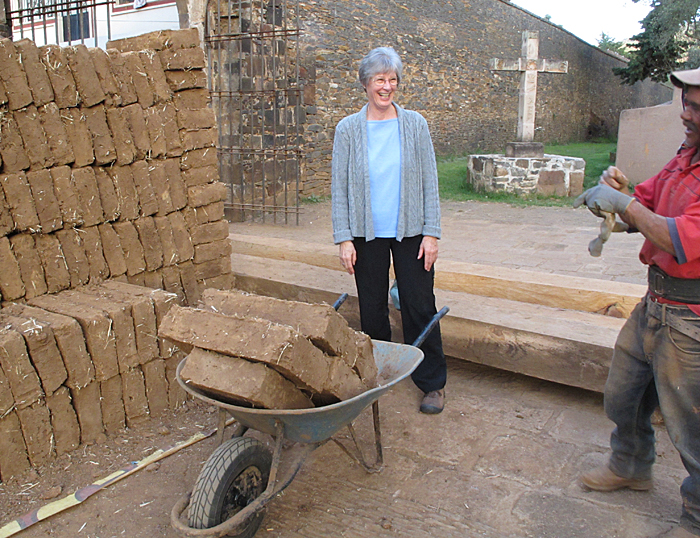
    A tour planned to your specifications can lead you to places you didn't know you wanted to go, but that you would not have missed for the world.  Here, Donna talks with the man who makes these enormous adobe bricks.  He let her try to pick up the laden wheelbarrow.  She could barely get its legs off the ground!  He laughed, raised the handles, and whizzed away with his load.

    DF La Ideal 3
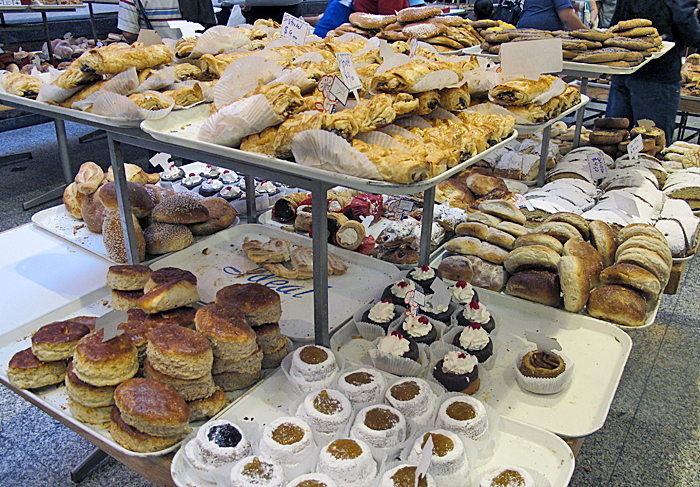
    Twice in 2012 small groups wanted to tour traditional bakeries in Mexico City.  The photo shows one tiny corner of the enormous Pastelería La Ideal in the Centro Histórico.  Just looking at the photo brings the sweet fragrances back to mind.

    Tours Ramon and Annabelle Canova GDL Tianguis del Sol
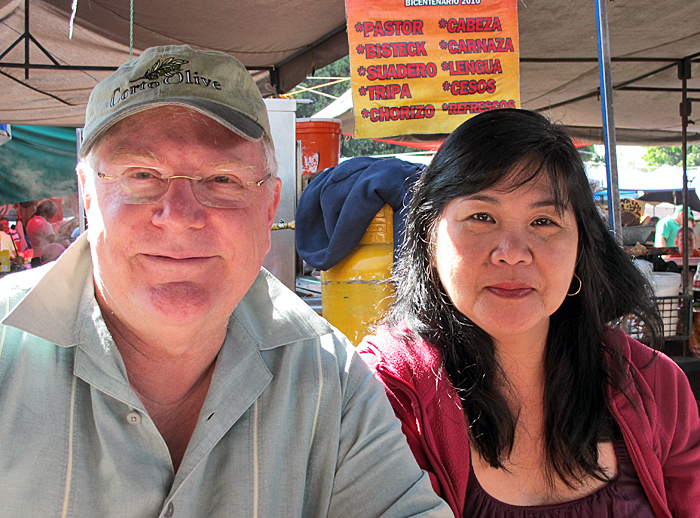
    Ramon and Annabelle Canova wanted an introduction to how ordinary people live and shop in Guadalajara.  We spent a highly entertaining morning at the Tianguis del Sol, a three-times-a-week outdoor market in Zapopan, a suburb of Guadalajara.  Our first stop was for breakfast, then we shopped for unusual produce, fresh spices, and other goodies that the Canovas don't often see in their home town.  Annabelle said she felt right at home because so much of the style and flavor of this market was similar to what she experienced in the markets near her home town in the Phillipines.

    Ramon and Annabelle Karne Garibaldi GDL
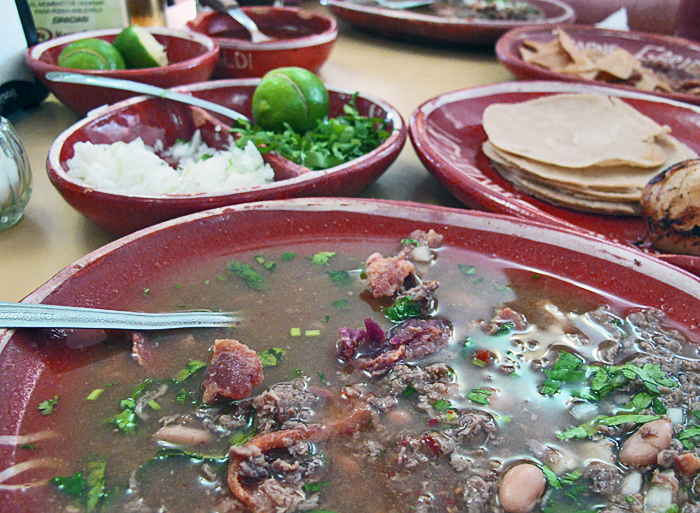
    We went to the original location of Guadalajara's Karne Garibaldi for comida (main meal of the day).  The restaurant does one thing–carne en su jugo (meat in its juice)–and does it exceptionally well.  The food is plentiful, delicious, and affordable.  The place is always packed, and usually has a line to get in!

    Tours Ramon and Annabelle Tejuinero Tlaquepaque
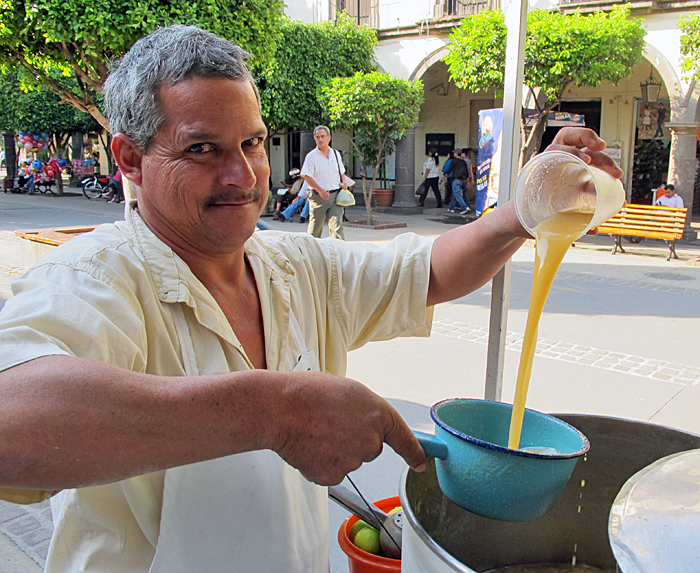
    Ramon wanted to try tejuino, a regional specialty in the Guadalajara area.  Mixed when you order it, the refreshing, lightly fermented drink is thickened with masa de maíz (corn dough) and served with a pinch of salt and a small scoop of lemon ice. 

    Recorrido Nopales Encimados
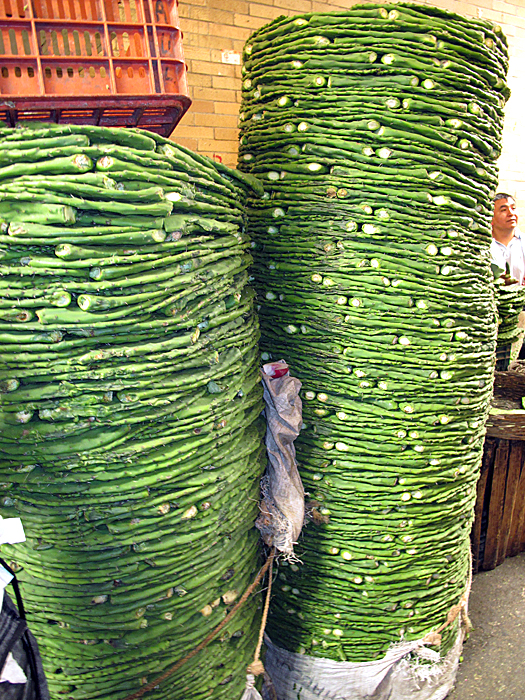
    Pillars of nopal cactus paddles, taller than a man, at Mercado de la Merced, Mexico City.   La Merced is the largest retail market in Mexico, if not in all of Latin America.  It's the ultimate market experience and just a partial tour takes the best part of a morning.  Comfortable walking shoes are a necessity–let's go!

    Mercado SJ Lechón
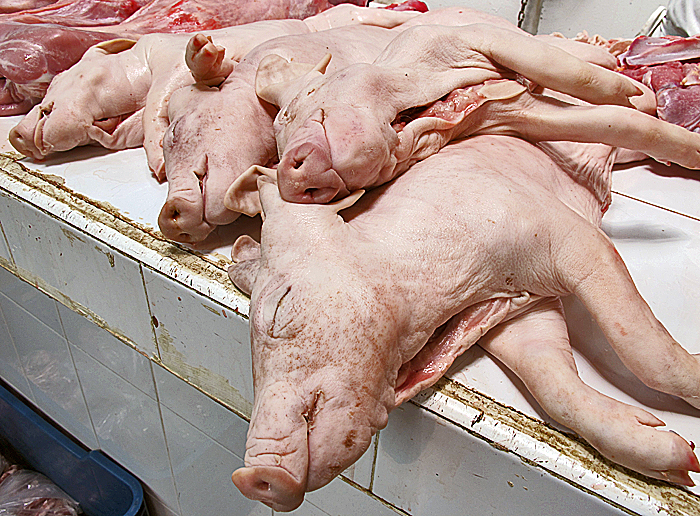
    A more intimate, up-close-and-personal Mexico City market tour takes us through the Mercado San Juan.  The San Juan is renowned for its gourmet selection of meats, fish and shellfish, cheeses, and wild mushrooms–among a million other things you might not expect to find.

    Bazar Sábado Pepitorias 2
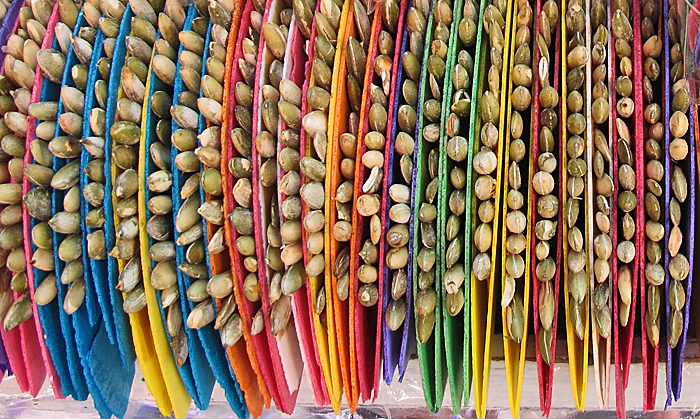
    Pepitorias are a sweet specialty of Mexico's capital city.  Crunchy and colorful obleas (wafers) enclose sticky syrup and squash seeds.  Mexico Cooks!' tour groups usually try these at the Bazar Sábado in San Ángel.

    Tours Charming Woman and Piano Tapetes Morelia
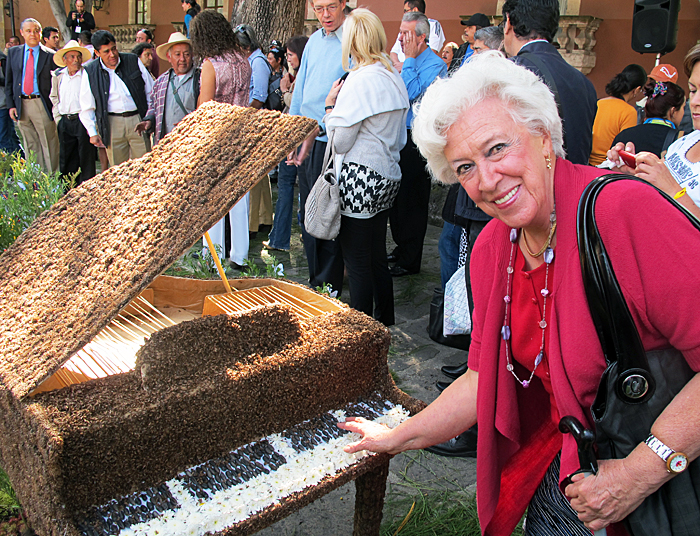
    Lovely and fascinating people and events are around almost any Mexican corner.  The annual Festival Internacional de Música de Morelia opens every year with several blocks of carpets made of flowers.  Residents of Patamban, Michoacán work all night to create the carpets for the festival.  This piano is made entirely of plant material.  Enlarge any picture for a closer view.

    Tours FIMM Tapete Blanco y Rojo 2
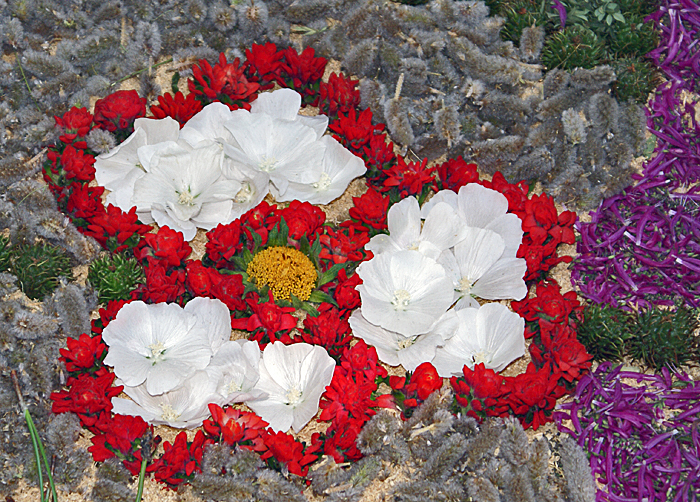
    Entire flowers, fuzzy pods, and flower petals are used to create the carpets' ephemeral beauty and design; these carpets last two days at most. 

    Tours Rosalba Morales Bartolo con Tania Libertad Morelia 11-17-2012
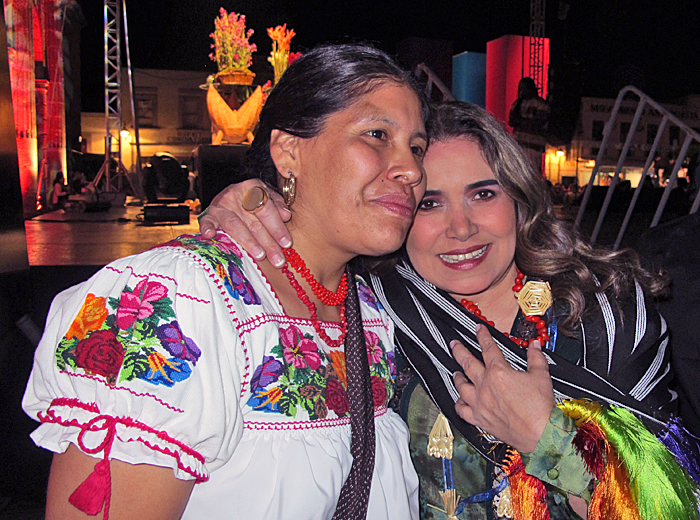
    In November 2012, one of Mexico Cooks!' tours was dazzled by a special Morelia concert given by Tania Libertad.  With Tania is Rosalba Morales Bartolo from San Jerónimo, Michoacán, who presented the artist with various handcrafted items from the state.

    Tours Marvey on the way to Janitzio
    No matter where we start our tour and no matter what we plan together for your itinerary, a Mexico Cooks! tour always includes a terrific surprise or two, special memories to take home, and the thirst for more of Mexico.  Marvey Chapman had a wonderful time!  By all means come and enjoy a tour!

    Looking for a tailored-to-your-interests specialized tour in Mexico? Click here: Tours.

  • Tamales, Tamales, and More Tamales in Mexico City

    Tamales Tamalera Tamales Méndez
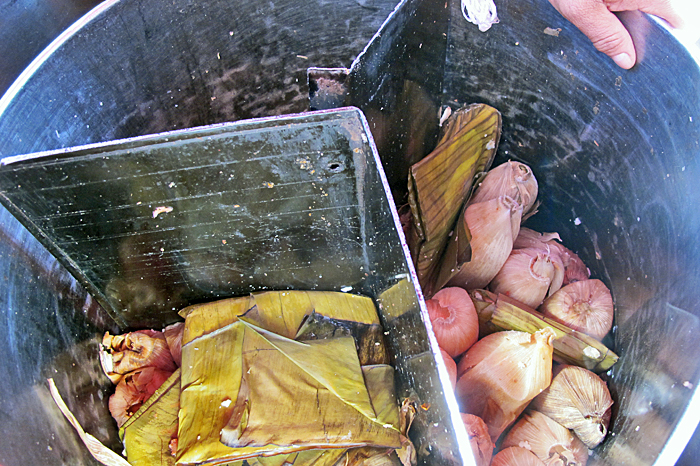
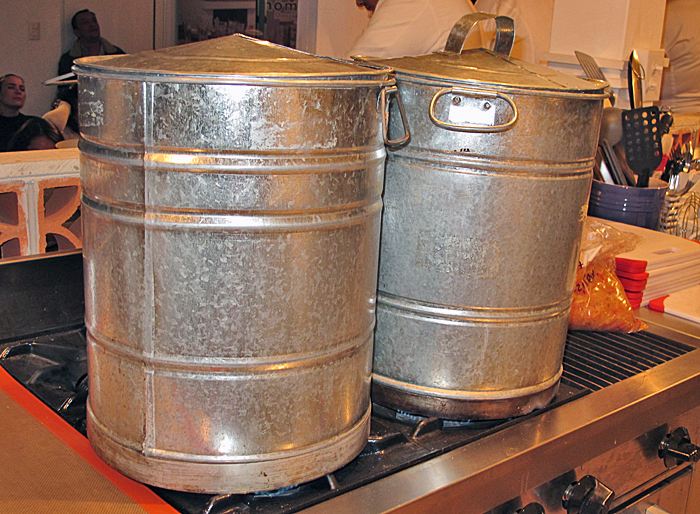
    Tamales in the tamalera (the steamer) at Tamalería (tamales shop) Méndez, on the street at the corner of Av. Baja California and Av. Insurgentes, Colonia Condesa, Distrito Federal.  You can see that the tamalera is divided into three sections.  Each section can hold a different kind of tamal (that's the word for ONE of a group of tamales).  In this case, the tamales at the bottom left of the photo are Oaxaqueños (Oaxaca-style).  On the right of the divider are tamales rojos (with a red chile sauce) and tamales de mole (both with pork meat).  The third section of the tamalera holds just-out-of-sight tamales verdes (with chicken, in green chile sauce) and tamales con rajas y queso (with cheese and strips of chile poblano).

    Older than
    an Aztec pyramid and fresh as this morning’s breakfast, a pot of newly-steamed
    tamales whets Mexico City’s appetite like nothing else in town.  Dating to pre-Hispanic times—most historians
    say tamales date to the time before the Christian era—the tamales of New Spain (now
    Mexico) were first documented in the Florentine Codex, a mid-16th century
    research project crafted by Spanish Franciscan monk Fray Bernadino Sahagún.

    Tamales Titita Manos en la Masa
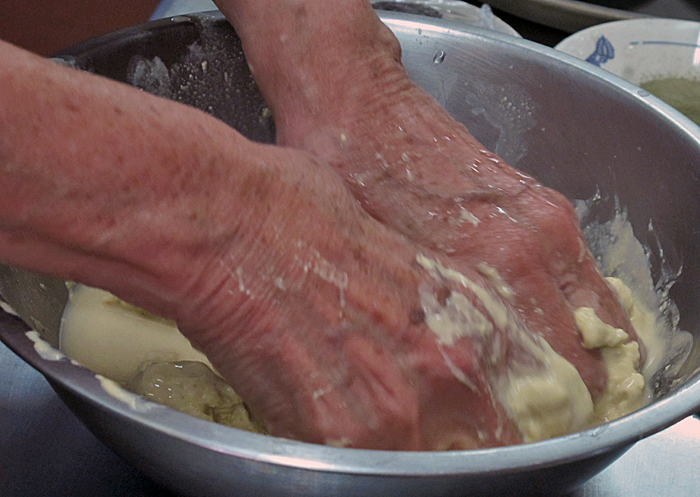
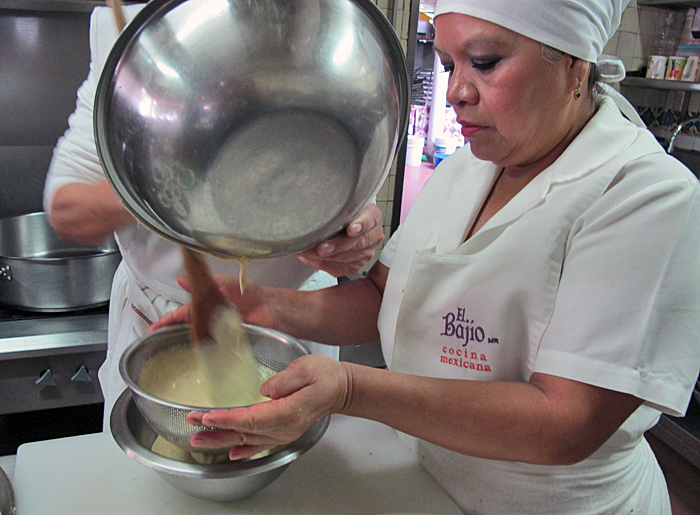
    Traditionally, tamales are made by hand, not by machine.  At first, they seem to be exhaustingly labor-intensive and difficult.  Just as with most wonderful food, once you learn the techniques and tricks of making the various styles, they're not so hard to prepare–and they are so worth the time and effort!  Here, Carmen Titita Ramírez Degollado, owner of Mexico City's Restaurante El Bajío, preparaes masa cocida (cooked corn dough) for her special tamales pulacles from Papantla, Veracruz.

    The
    ancients of the New World believed that humankind was created from corn.  Just as in pre-history, much of Mexico’s traditional and
    still current cuisine is based on corn, and corn-based recipes are still
    creating humankind.  A daily ration of corn
    tortillas, tacos, and tamales keeps us going strong in the Distrito Federal,
    Mexico’s capital city of more than twenty million corn-craving stomachs.  Tamales are created from dried corn
    reconstituted with builder’s lime and water. 
    The corn is then ground and beaten with lard or other fat into a thick,
    smooth masa (dough).  Filled with sauce and a bit of meat or
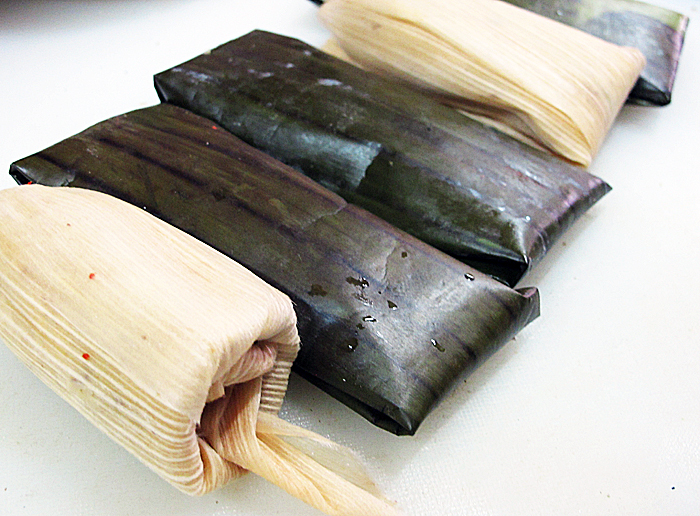
    vegetable, most tamales are wrapped in dried corn husks or banana leaves and steamed, to fill Mexico
    City’s corn hunger and keep her hustling.

    Tamales de Pollo Guajillo Cebolla Titita
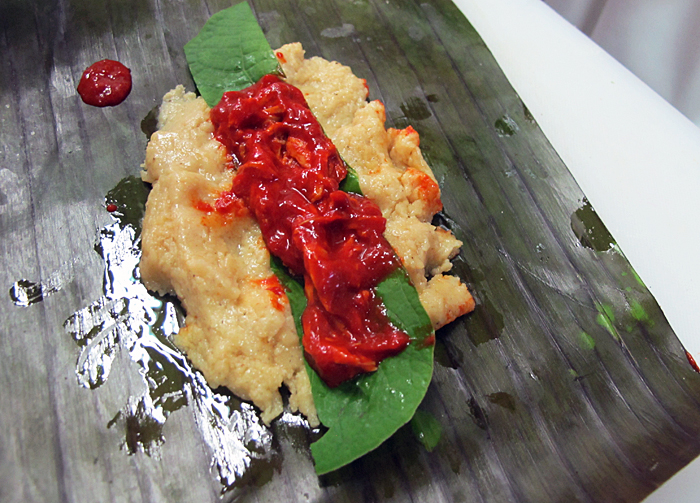
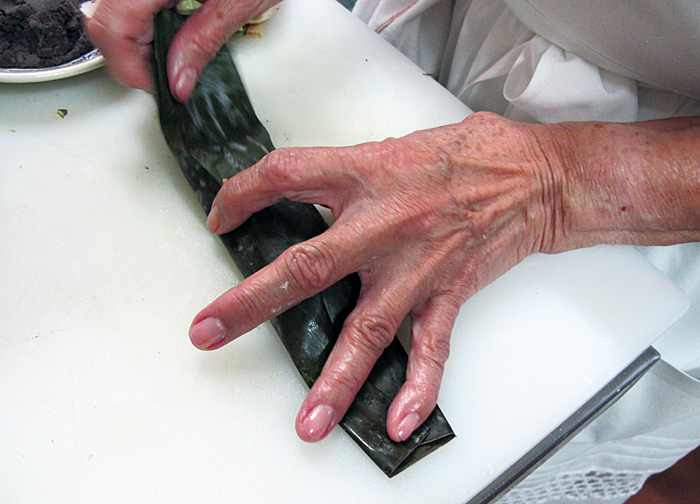
    Tamal-to-be: cut the banana leaf to the size and shape of the tamal you're making, then lightly toast each leaf.  On the banana leaf, place a layer of masa, a strip of hoja santa (acuyo) leaf, and a big spoonful or two of cooked, shredded chicken in a sauce of chile guajillo, onion, and garlic.

    Mexico’s capital city makes it easy to buy tamales any time the craving
    hits you.  Every day of the week, nearly
    five million riders pack the Metro (the city’s subway system) and are disgorged
    into approximately 200 Metro stations. 
    At any given Metro stop, a passenger is likely to find a tamales vendor.  Her huge stainless steel tamalera (tamales steamer) hisses heartily over a low flame until
    the tamales are sold out.  Each steamer
    can hold as many as two hundred tamales, and the vendor may preside over two or
    three or more of these vats.

    Tamales Técnica Titita
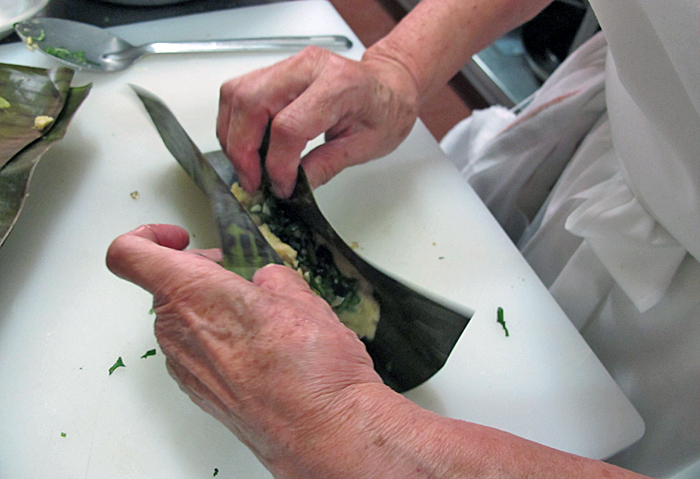
    Titita folds the tamal so that the banana leaf completely wraps the masa and filling.

    Hungry
    students on the way to and from classes, office workers with no time to eat
    breakfast at home, construction workers looking for a mid-morning pick-me-up:
    all line up at their favorite vendor’s spot on the sidewalk closest to a
    Metro exit.  Near the vibrant
    Chilpancingo Metro station at the corner of Av. Insurgentes and Av. Baja California, Sra. María de los Ángeles Chávez Hernández sells tamales out of two huge pots.  “Qué le doy?”
     (‘What’ll you have?’) she raps out
    without ceremony to every hungry comer. 
    The choices: rojo  (with pork and spicy red chile); verde (with chicken and even spicier
    green chile); rajas con queso (strips
    of chile poblano with melting white
    cheese); mole (a thick spicy sauce
    with a hint of chocolate); some Oaxaca-style tamales wrapped in banana leaves; and
    dulce (sweet, usually either
    pineapple or strawberry).  The stand
    sells about 200 tamales a day.  Sra.
    Chávez’s father, Ángel Méndez Rocha, has been selling tamales on this corner for
    more than 60 years.  Even at age 80, he alternates
    weeks at the stand with his brother, selling tamales by the hundreds.  

    Tamales Técnica Titita 2
    The masa and filling are centered in the banana leaf.  Titita is simultaneously pressing the masa toward the middle of the leaf and folding each end of the banana leaf toward the middle.

    Tamales Listos pa Tamalera Titita
    The pair of tamales in the center of the photo are filled with chicken and chile guajillo sauce.  The tamal closest to the bottom is made with black beans crushed with dried avocado leaves.  Avocado leaves give a delicious anise flavor and fragrance to the beans.  These tamales are ready to be steamed in the tamalera.

    Tamales de Pollo Guajillo Etc Cocidos
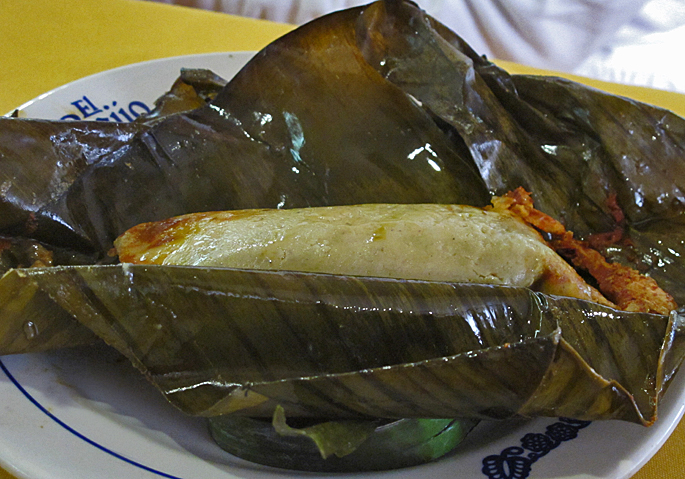
    The tamal de chile guajillo, fresh out of the tamalera and unwrapped on my plate.

    Tamales Méndez Guajolota Verde
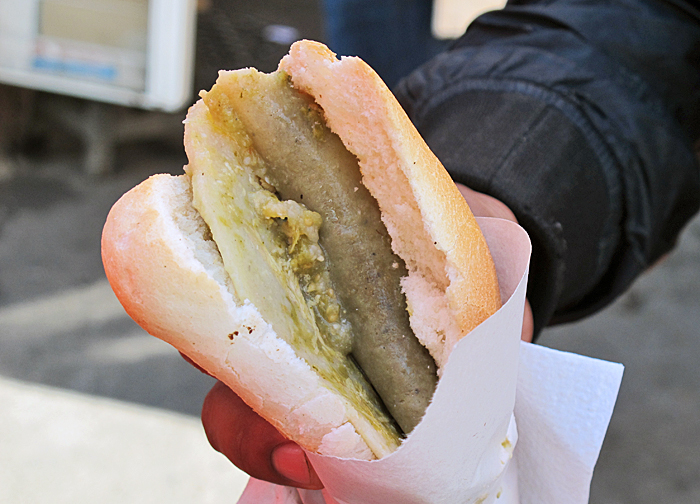
    A specialty breakfast, unique to Mexico City, is the guajolota: a steaming hot tamal, divested
    of its corn husks and plopped into a split bolillo,
    a dense bread roll.  Folks from outside
    Mexico City think this combo is crazy, but one of these hefty and delicious
    carbohydrate bombs will easily keep your stomach filled until mid-afternoon,
    when Mexico eats its main meal of the day.  When I asked Sra. Chávez Hernández about the name of the sandwich, she laughed. “Nobody knows why this
    sandwich is called guajolota—the word
    means female turkey.  But everybody wants
    one!” 

    Tamales Méndez Tres Pa' Llevar
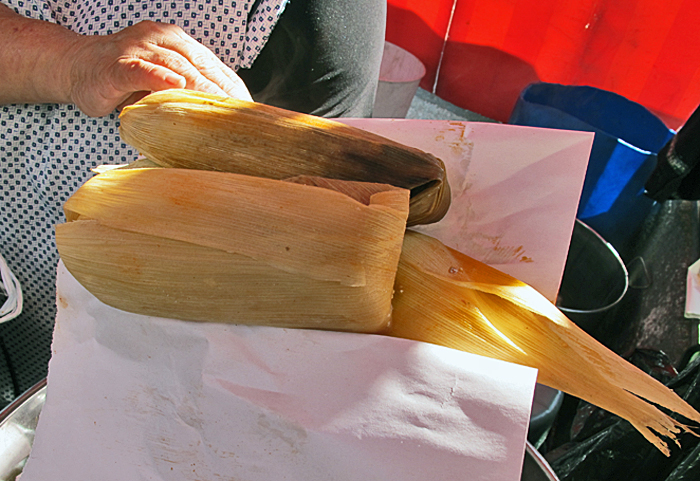
    If you'd rather take your tamales home to eat them, Sra. Chávez of Tamalería Méndez or her employee, Sra. Lucina Montel, will gladly wrap them in paper and send them along in a bag.

    Tamales Tamaleras
    For steaming tamales, the bottom portion of a tamalera is filled with water.  Add a coin to the water and put the tamales vertically into the steamer, atop the perforated base that rests just above the water.  When the water boils, the coin will rattle.  When the rattle slows or stops, add more water.

    Tamales Gerardo Platillo Degustación
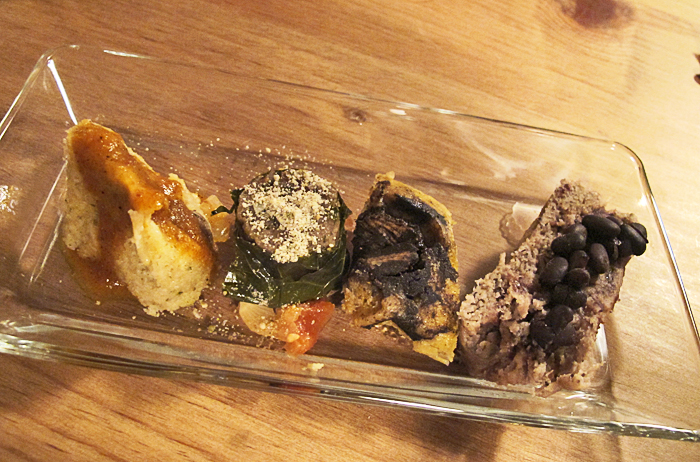
    Tamales can be a massive guajolota to eat on the street or the most delicate, upscale meal in a restaurant.  These, prepared by chef Gerardo Vázquez Lugo of Restaurante Nicos, are a degustación (tasting) at the Escuela de Oficios Gastronómicos operated by online magazine Culinaria Mexicana, where chef Vázquez recently offered a workshop teaching the history, ingredients, and preparation of tamales.  From left to right, the four tamales are: carnitas de pato en salsa de cítricos y chile chipotle (shredded duck confit in a citrus and chile chipotle sauce), tamal de tzotolbichay (with the herb chaya), tamal de mole negro (black mole),and tamal de frijol (beans).

    Tamales Gerardo Vazquez Lugo
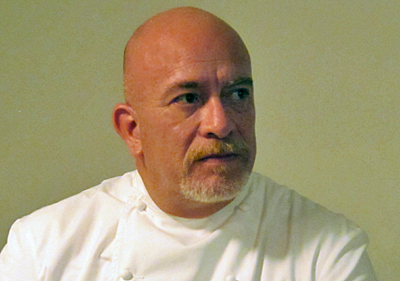
    Chef Gerardo Vázquez Lugo of Mexico City's Restaurante Nicos.

    In
    addition to being daily sustenance, tamales are a fiesta, a party. 
    In Mexico City and every other part of Mexico, Christmas isn’t Christmas
    without tamales for the late-night family feasting on Christmas Eve.  Gather the women of the family together, grab
    the neighbors, and the preparation of tamales becomes a party called a tamalada.  Mexico City chef Margarita Carrillo tells us,
    “Mexican grandmothers from time immemorial say that the first ingredient for
    great tamales is a good sense of humor. 
    Tamales like it when you sing while you prepare them, they love to hear a
    little friendly gossip while you work, and if you make tamales in the good
    company of your family and friends, they’re sure to turn out just the way you
    want them: with fluffy, richly flavored corn dough on the outside and a delicious filling
    on the inside.”

    Tamales Tamal de Chocolate Gerardo
    A small and elegant tamal de chocolate for dessert, prepared by Restaurante Nicos for the tamales workshop.

    Tamales Doña Elia Colando Masa
    Señora Elia Rodríguez Bravo, specialty cook at the original Restaurante
    El Bajío, strains masa cocida for tamales.  She
    gently shook a wooden spoon at me as she proclaimed, “You can’t make tamales
    without putting your hands in the masa (corn
    dough).  Your hand knows what it
    feels.  Your hand will tell you when the masa is beaten smooth, when the tamales
    are well-formed in their leaves, and when they have steamed long enough to be
    ready to eat.  Your hand knows!”

    Tamales Sra Chávez
    Señora María de los Ángeles Chávez Hernández (left) and her longtime employee Señora Lucina Montel (right) sell tamales at the street booth Tamalería Méndez seven days a week.  They and Sra. Chávez's staff prepare hundreds of tamales every night, for sale the next day.

    Let's go on a Mexico City tamales tour!  Let Mexico Cooks! know when you're ready, and we'll be on our way.

    Looking for a tailored-to-your-interests specialized tour in Mexico? Click here: Tours.


  • Día de la Candelaria : February 2 : Candlemas Day in Mexico

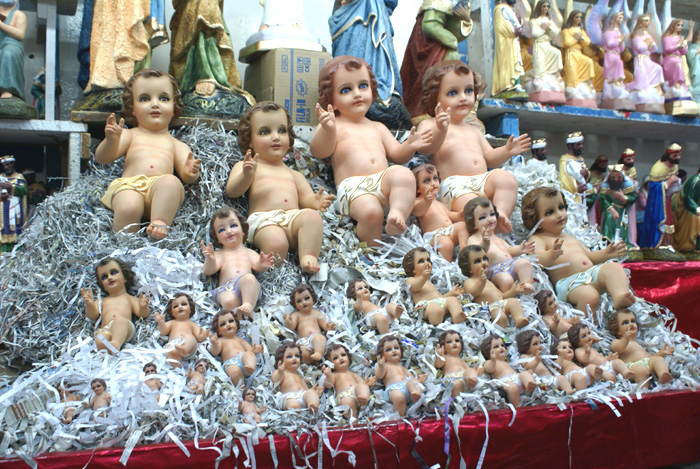
    Niño Dios Todos Tamaños
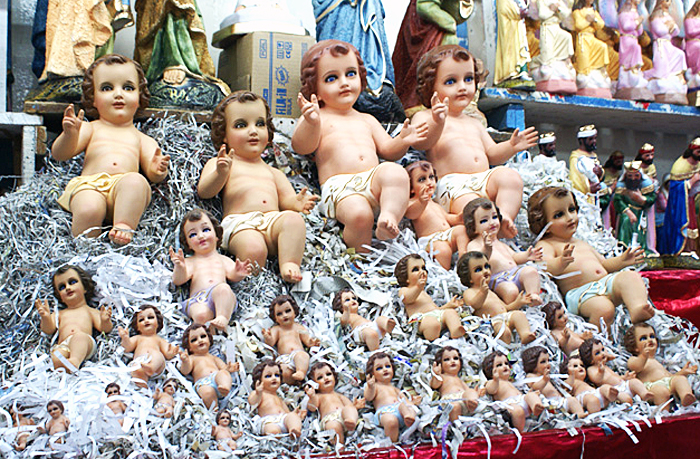
    For about a month prior to Christmas each year, the Niño Dios (baby Jesus) is for sale everywhere in Mexico.  Mexico Cooks! took this photograph in 2006 at the annual tianguis navideño (Christmas market) in front of Templo San José in Guadalajara.  These Niños Dios range in size from just a few inches long to nearly the size of a two-year-old child.  They're sold wrapped in only a diaper.

    When does the Christmas season end in your family?  When I was a child, my parents packed the Christmas decorations away on January 1, New Year's Day.  Today, my wife and I like to enjoy the nacimientos (manger scenes), the Christmas lights, and the tree until January 7, right after the Feast of the Three Kings.  Some think that date is scandalously late.  Other people, particularly our many Mexican friends, think that date is scandalously early.  Christmas in Mexico isn't over until February 2, el Día de la Candelaria (Candlemas Day), also known as the Feast of the Presentation.

    Nacimiento Misterio 1
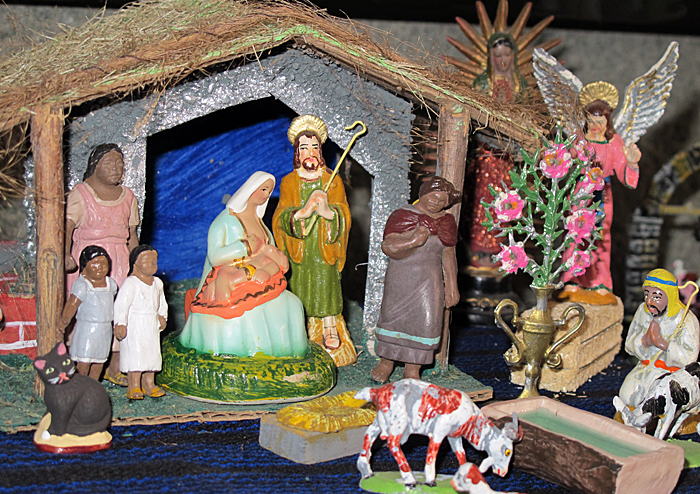
    The Holy Family, a shepherd and some of his goats, Our Lady of Guadalupe, an angel, a cat, and some indigenous people form a small portion of Mexico Cooks!' nacimiento.  Click on the photo to get a better look.  Note that the Virgin Mary is breast feeding the infant Jesus while St. Joseph looks on.

    Although Mexico's 21st century Christmas celebration often includes Santa Claus and a Christmas tree, the main focus of a home-style Christmas continues to be the nacimiento and the Christian Christmas story.  A family's nacimiento may well contain hundreds–even thousands–of figures, but all nacimientos have as their heart and soul the Holy Family (the Virgin Mary, St. Joseph, and the baby Jesus).  The nacimiento is set up early–in 2012, ours was out at the end of November–but the Niño Dios does not make his appearance until the night of December 24, when he is sung to and placed in the manger.

    Niño Dios Grupo Vestido
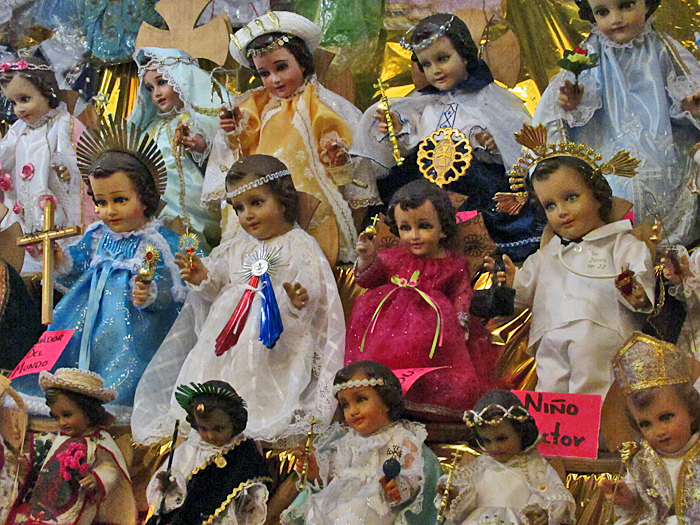
    Niños Dios at Mexico City's Mercado de la Merced.  The figures are dressed as hundreds of different saints and representations of holy people and ideas.  The figures are for sale, but most people are only shopping for new clothes for their baby Jesus.  All photos copyright Mexico Cooks! except as noted.

    Between December 24, when he is tenderly rocked to sleep and laid in the manger, and February 2, the Niño Dios rests happily in the bosom of his family.  As living members of his family, we are charged with his care.  As February approaches, a certain excitement begins to bubble to the surface.  The Niño Dios needs new clothing!  How shall we dress him this year?

    Niño Dios Ropa Tejida
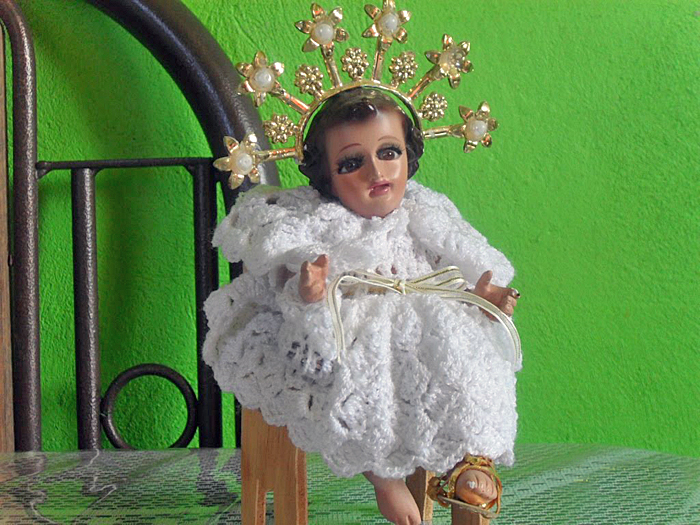
    The oldest tradition is to dress the Niño Dios in hand-crocheted garments.  Photo courtesy Manos Mexicanos

    According to Christian teaching, the Virgin Mary and St. Joseph took the baby Jesus to the synagogue 40 days after his birth to introduce him in the temple–hence February 2 is also known as the Feast of the Presentation. What happy, proud mother would wrap her newborn in just any old thing to take him to church for the first time?  I suspect that this brand new holy child was dressed as much to the nines as his parents could afford.  

    Niño Dios San Juan Diego
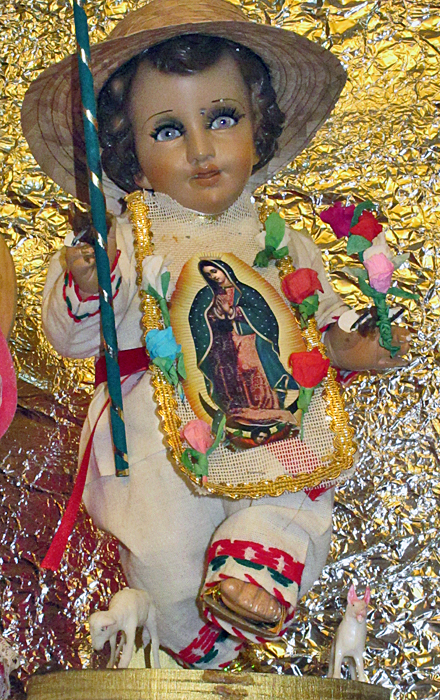
    The Niño Dios dressed as San Juan Diego, the indigenous man who brought Our Lady of Guadalupe to the Roman Catholic Church.

    Every February 2, churches are packed with men, women, and families carrying their Niños Dios to church in his new clothes, ready to be blessed, lulled to sleep with a sweet lullaby, and tucked gently away till next year.

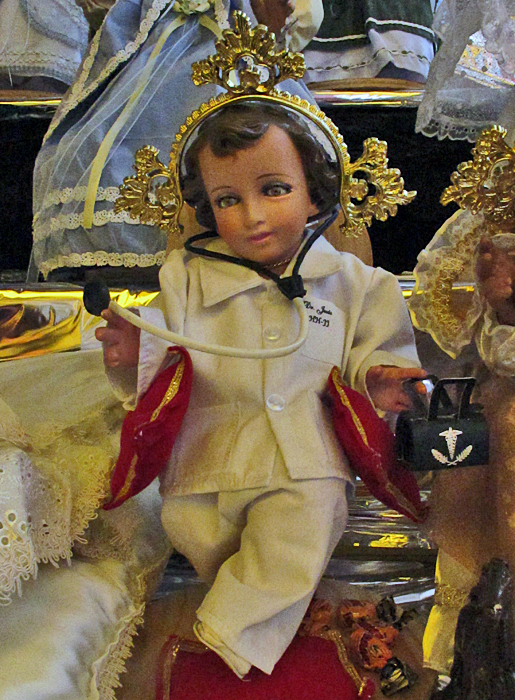
    Niño Dios Doctor
    The Niño Dios as el Santo Niño Doctor de los Enfermos (the holy child doctor of the sick).  He has his stethoscope, his uniform, and his doctor's bag.  This traditionally dressed baby Jesus has origins in mid-20th century in the city of Puebla.

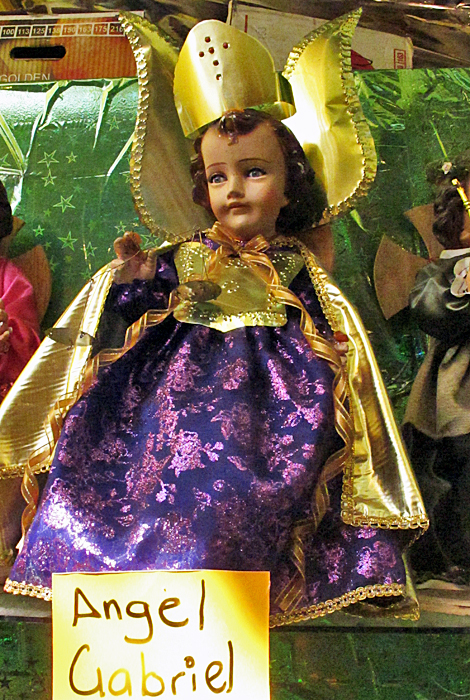
    Niño Dios Ángel Gabriel
    Every year new and different clothing for the Niño Dios comes to market.  In 2011, the latest fashions were those of the Archangels–in this case, the Archangel Gabriel.

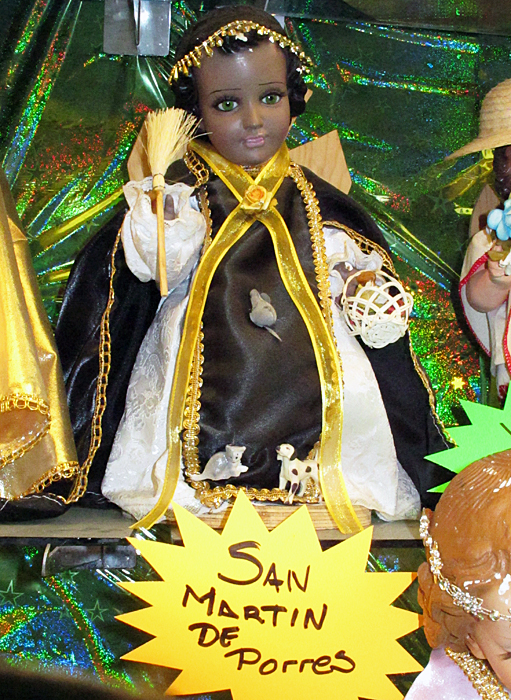
    Niño Dios San Martín de Porres
    The Niño Dios dressed as Peruvian San Martín de Porres, the patron saint of racially mixed people and all those seeking interracial harmony.

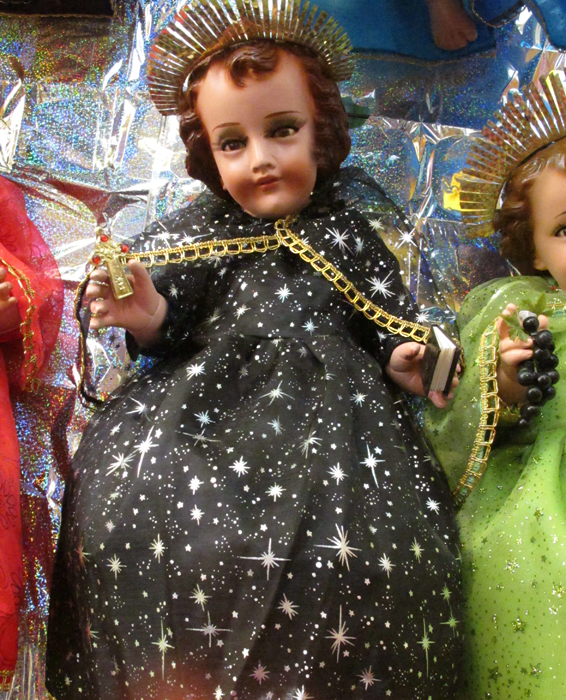
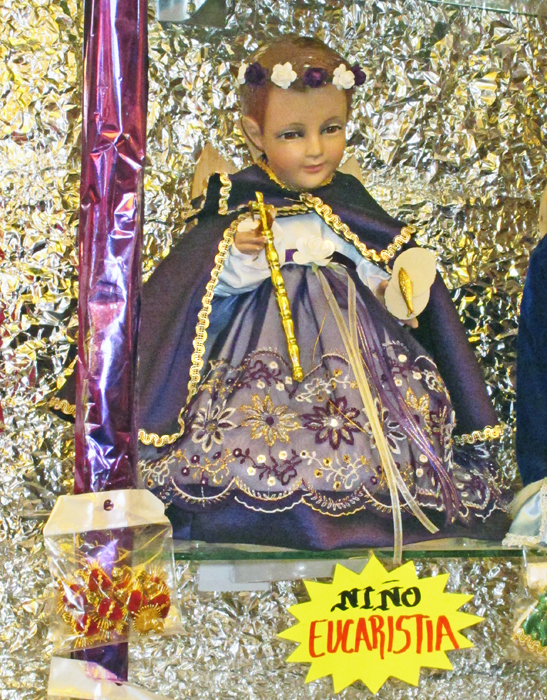
    Niño Dios de la Eucaristía
    Niño Dios de la Eucaristía (Holy Child of the Eucharist).

    Niño Dios San Benito
    Niño Dios dressed as San Benito, the founder of the Benedictine Order.

    Niño Dios del Chinelo
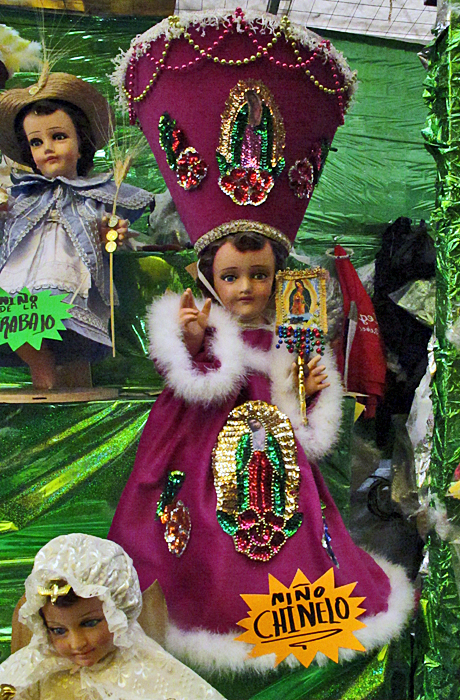
    Niño Dios dressed as a Chinelo (costumed dancer from the state of Morelos).

    Niño Dios de la Abundancia
    Niño Dios de la Abundancia (Holy Child of Abundance).

    The ceremony of removing the baby Jesus from the nacimiento is called the levantamiento (lifting up).  In a family ceremony, the baby is raised from his manger, gently dusted off, and dressed in his new finery.  Some families sing:

    QUIERES QUE TE QUITE MI BIEN DE LAS PAJAS, (Do you want me to brush off all the straw, my beloved)
    QUIERES QUE TE ADOREN TODOS LOS PASTORES, (Do you want all the shepherds to adore you?)
    QUIERES QUE TE COJA EN MIS BRAZOS Y CANTE (Do you want me to hold you in my arms and sing)
    GLORIA A DIOS EN LAS ALTURAS.  (Glory to God on high).

    Niño Dios San Judas Tadeo
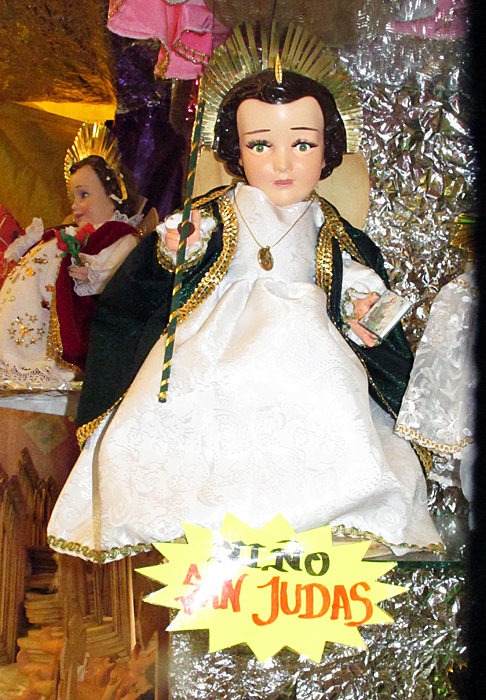
    One of the most popular 'looks' for the Niño Dios in Mexico City is that of San Judas Tadeo, the patron saint of impossible causes.  He is always dressed in green, white, and gold and has a flame coming from his head.

    Carefully, carefully carry the Niño Dios to the parish church, where the priest will bless him and his new clothing, along with you and your family.  After Mass, take the baby Jesus home and put him safely to rest till next year's Christmas season.  Sweet dreams of his next outfit will fill your own head as you sleep that night.

    Looking for a tailored-to-your-interests specialized tour in Mexico? Click here: Tours.

  • Los Reyes Magos to La Candelaria: Three Kings, Rosca de Reyes and Tamales!

    Rosca
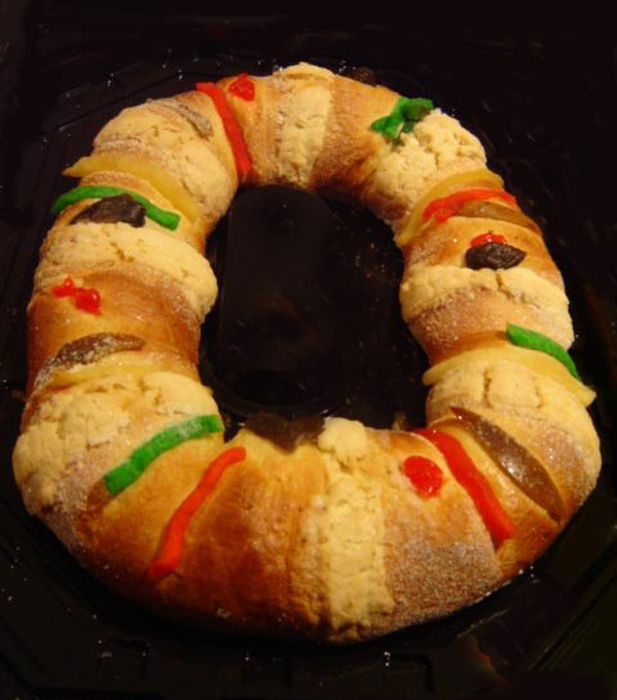
    Most Mexicans eat traditional rosca de reyes (Three Kings' Bread) on January 6.  Its usual accompaniment is chocolate caliente (hot chocolate).

    The Día de los Reyes Magos (the Feast of the Three Kings)
    falls on January 6 each year.  You might know the Christian feast day as
    Epiphany or as Little Christmas.  The festivities celebrate the arrival
    of the Three Kings at Bethlehem to visit the newborn Baby Jesus.  In
    some cultures, children receive gifts not on Christmas, but on the Feast
    of the Three Kings–and the Kings are the gift-givers, commemorating
    the gifts of gold, frankincense, and myrrh that they presented to the
    Baby Jesus. Many, many children in Mexico still receive special gifts of
    toys from the Reyes (Kings) on January 6

    Typically, Mexican families celebrate the festival with a rosca de reyes (Three Kings' Bread).  The size of the family's rosca
    varies according to the size of the family, but everybody gets a slice,
    from the littlest toddler to great-grandpa.  Accompanied by a cup of chocolate caliente (hot chocolate), it's a great winter treat. 

    Chef Arturo Camacho Domínguez
    Chef Arturo Camacho Domínguez of Tampico, Tamaulipas.

    My friend Chef Arturo Camacho Domínguez, who lives and works in
    Tampico, Tamaulipas, recently wrote a bit about the significance of the rosca.  He wrote, "The rosca de reyes
    represents a crown; the colorful fruits simulate the jewels which
    covered the crowns of the Holy Kings.  The Kings themselves signify
    peace, love, and happiness.  The Niño Dios hidden in the rosca
    reminds us of the moment when Saint Joseph and the Virgin Mary hid the
    Baby Jesus in order to save him from King Herod, who wanted to kill
    him.  The three gifts that the Kings gave to the Niño Dios represent the Kings (gold), God (frankincense), and man (myrrh).

    "In Mexico, we consider that an oval or ring shape represents the movement of the sun and that the Niño Dios represents the Child Jesus in his apparition as the Sun God.  Others mention that the circular or oval form of the Rosca de Reyes, which has no beginning and no end, is a representation of heaven–which of course is the home of the Niño Dios."


    Rosca morelia
    On January 6, 2009, Paty Mora de Vallejo, wife of Morelia's mayor Fausto Vallejo, served a slice of the enormous rosca de reyes monumental moreliana, prepared jointly by bakeries from everywhere in the city.

    Here in Morelia, Michoacán, bakers prepare an annual monumental rosca for the whole city to share.  The rosca
    contains nearly 3000 pounds of flour, 1500 pounds of margerine, 10,500
    eggs, 150 liters of milk, 35 pounds of yeast, 35 pounds of salt, 225
    pounds of butter, 2000 pounds of dried fruits, and 90 pounds of orange
    peel.  The completed cake, if stretched out straight, measures two
    kilometers in length!  Baked in sections, the gigantic rosca is
    the collaborative effort of ten bakeries in the city.  The city
    government as well as grocery wholesalers join together to see to it
    that the tradition of the rosca continues to be a vibrant custom.

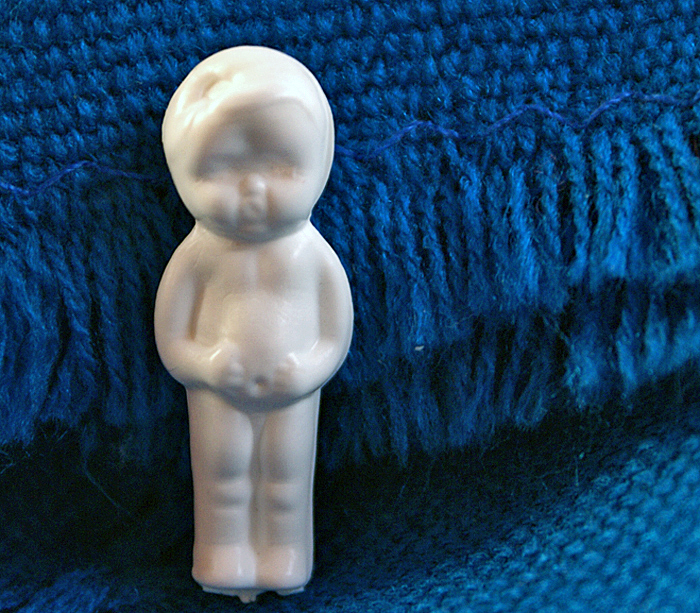
    Niño Dios from Rosca
    The plastic niño (baby) baked into our rosca measured
    less than 2" tall.  The figures used to be made of porcelain, but now
    they are generally made of plastic.  See the tooth mark on the head?  Mexico Cooks! is the culprit.  Every rosca de reyes baked in Mexico contains at least one niño; larger roscas can hold two, three, or more.  Morelia's giant rosca normally contains 10,000 of these tiny figures.

    Tradition demands that the person who finds the niño in his or her slice of rosca is required to give a party on February 2, el Día de La Candelaria (Candlemas Day).  The party for La Candelaria calls for tamales, more tamales, and their traditional companion, a rich atole
    flavored with vanilla, cinnamon, or chocolate.  Several years ago, an
    old friend, in the throes of a family economic emergency, was a guest at
    his relatives' Three Kings party.  He bit into the niño buried in his slice of rosca.  Embarrassed that he couldn't shoulder the expense of the following month's Candelaria party, he gulped–literally–and swallowed the niño.

    El Día de La Candelaria celebrates the presentation of Jesus in the Jewish temple, forty days after his birth.  The traditions of La Candelaria
    encompass religious rituals of ancient Jews, of pre-hispanic rites
    indigenous to Mexico, of the Christian evangelization brought to Mexico
    by the Spanish, and of modern-day Catholicism. 

    Baby Jesus Mexico Cooks
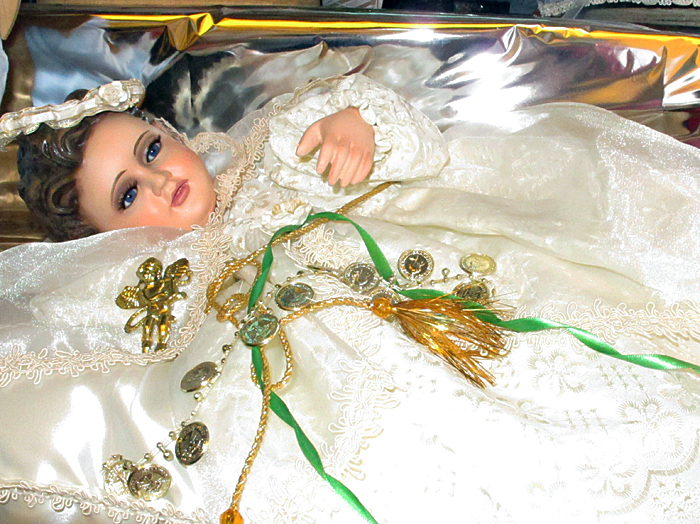
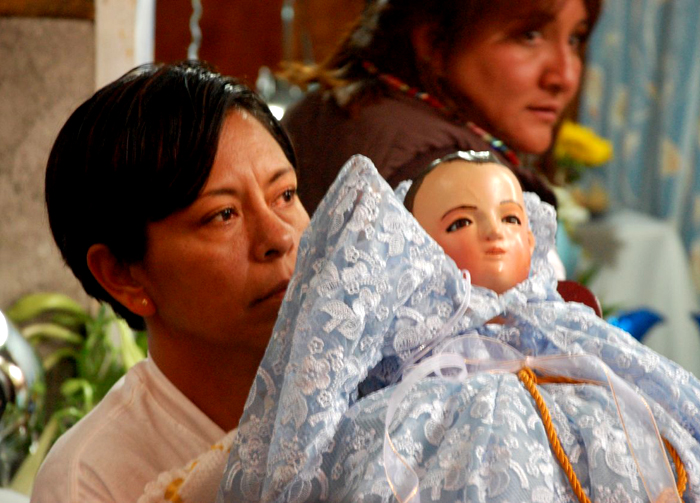
    In Mexico, you'll find a Niño Dios of any size for your home nacimiento (Nativity scene).  Traditionally, the Niño Dios is passed down, along with his wardrobe of special clothing, from generation to generation in a single family.

    The presentation of the child Jesus to the church is enormously
    important in Mexican Catholic life. February 2 marks the official end
    of the Christmas season, the day to put away the last of the holiday
    decorations.  On February 2, the figure of Jesus is gently lifted from
    the home nacimiento (manger scene, or creche), dressed in new
    clothing, carried to the church, where he receives blessings and
    prayers.  He  is then carried home and rocked to sleep with tender
    lullabies, and carefully put away until the following year. 

    Each family dresses its Niño Dios according to its personal
    beliefs and traditions.  Some figures are dressed in clothing
    representing a Catholic saint particularly venerated in a family;
    others are dressed in the clothing typically worn by the patron saints
    of different Mexican states.  Some favorites are the Santo Niño de Atocha, venerated especially in Zacatecas; the Niño de Salud (Michoacán), the Santo Niño Doctor (Puebla), and, in Xochimilco (suburban Mexico City), the Niñopa (alternately spelled Niñopan or Niño-Pa).

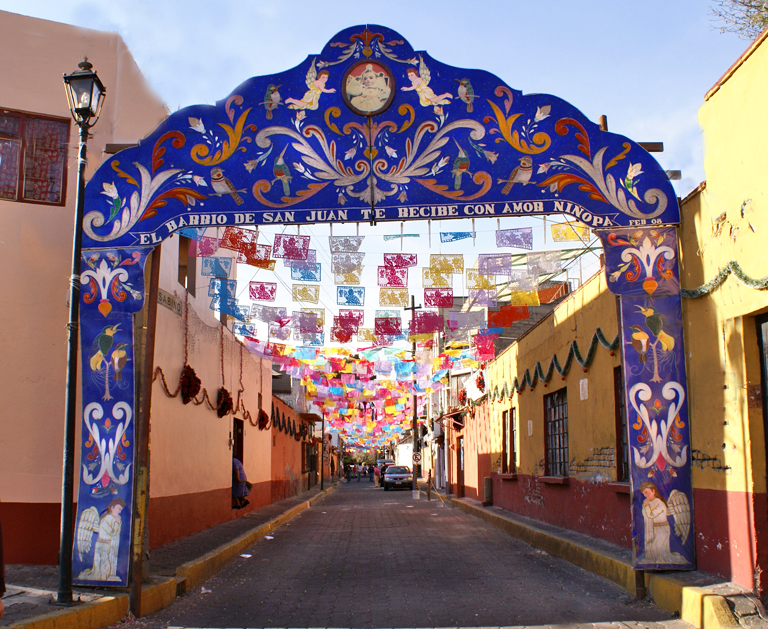
    Xochimilco Niñopan
    This Xochimilco arch and the highly decorated street welcome the much-loved Niñopan figure.

    The veneration of Xochimilco's beloved Niñopan follows centuries-old traditions.  The figure has a different mayordomo every year; the mayordomo is the person in whose house the baby sleeps every night.  Although the Niñopan (his name is a contraction of the words Niño Padre or Niño Patrón) travels from house to house, visiting his chosen hosts, he always returns to the mayordomo's
    house to spend the night.  One resident put it this way: "When the day
    is beautiful and it's really hot, we take him out on the canals.  In his
    special chalupita (little boat), he floats around all the chinampas (floating islands), wearing his little straw hat so that the heat won't bother him.  Then we take him back to his mayordomo, who dresses our Niñopan in his little pajamas, sings him a lullaby, and puts him to sleep, saying, 'Get in your little bed, it's sleepy time!"  Even though the Niñopan
    is always put properly to bed, folks in Xochimilco believe that he
    sneaks out of bed to play with his toys in the wee hours of the night.  

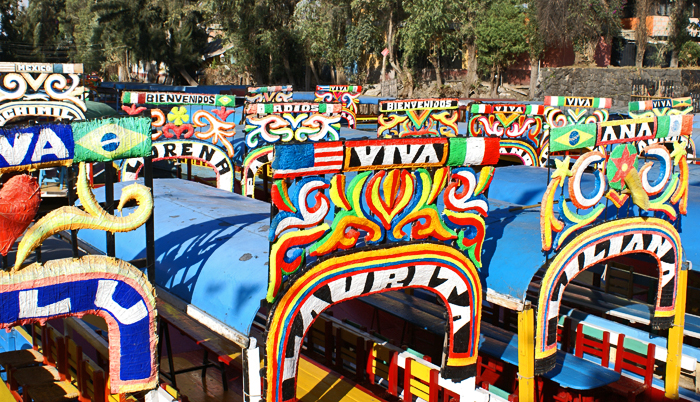
    Trajineras
    Trajineras (decorated boats) ready to receive tourists line the canals in Xochimilco.

    Although he is venerated in many Xochimilco houses during the course of every year, the Niñopan's
    major feast day is January 6.  The annual celebration takes place in
    Xochimilco's church of St. Bernard of Sienna.  On the feast of the
    Candelaria, fireworks, music, and dancers accompany the Niñopan as he processes through the streets of Xochimilco on his way to his presentation in the church.

    Niñopa Colibrí
    Gloria in Xochimilco with Niñopa, April 2008.  Photo courtesy Colibrí.

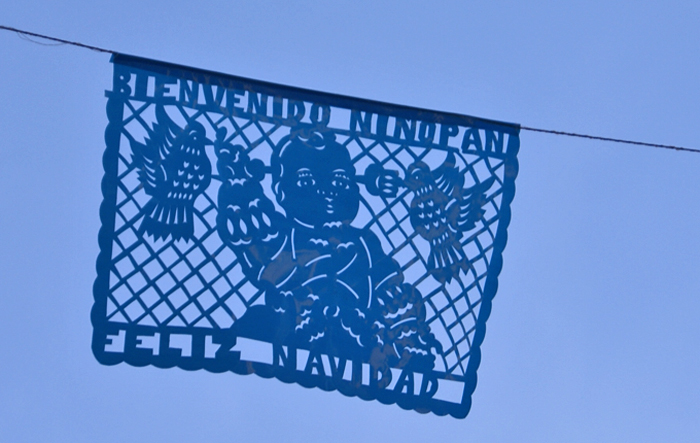
    Xochimilco Papel Picado Niñopa
    Blue papel picado (cut paper decoration) floating in the deep-blue Xochimilco sky wishes the Niñopan welcome and wishes all of us Feliz Navidad.

    Tamales
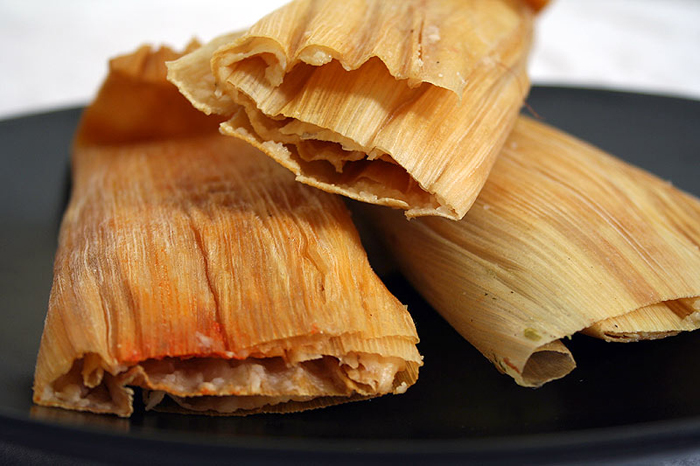
    El Día de La Candelaria means a joyful party with lots of tamales, coupled with devotion to the Niño Dios.  For more about a tamalada (tamales-making party), look at this 2007 Mexico Cooks! article.

    From the rosca de reyes on January 6 to the tamales on February 2, the old traditions continue in Mexico's 21st Century.

    Looking for a tailored-to-your-interests specialized tour in Mexico? Click here: Tours.

  • Las Apariencias Engañan :: Appearances Deceive (Frida Kahlo’s Recently Discovered Belongings)

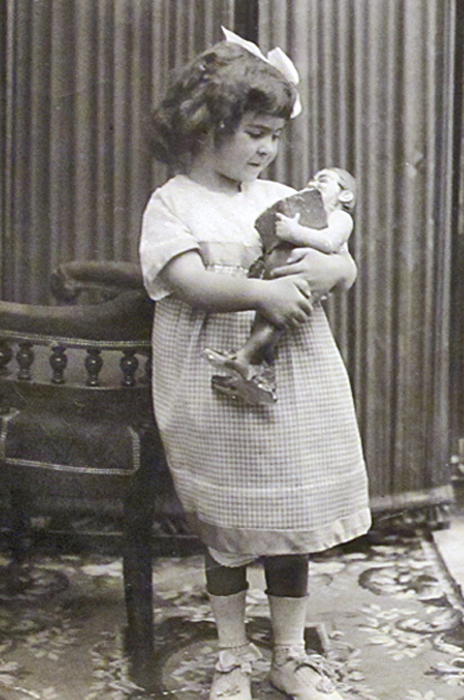
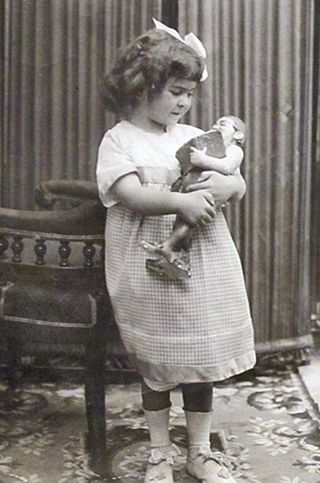
    Frida de Niña con Muñeca

    Magdalena Carmen Frida Kahlo y Calderón, age three or four, and friend.  Photo by her father, Guillermo Kahlo.

    Which is the Frida Kahlo who most touches your imagination?  The innocent toddler in her beribboned shoes? 
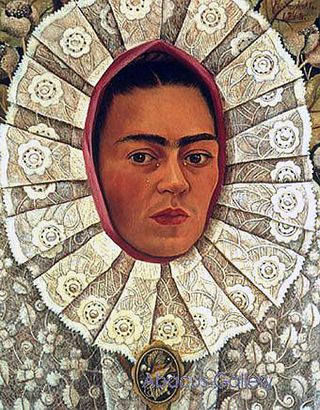
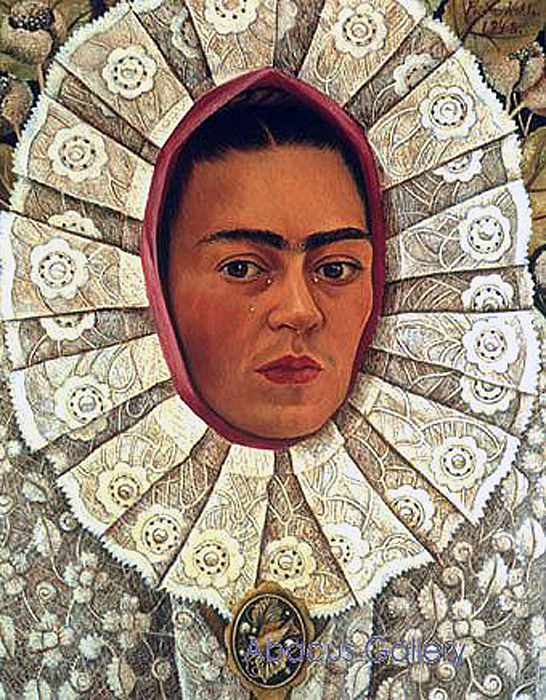
    Frida de Tehuana detalle
    The iconic self-portrait dressed as a Tehuana (woman from Oaxaca's Isthmus of Tehuantepec)?
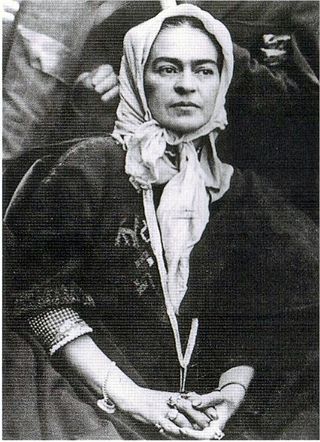
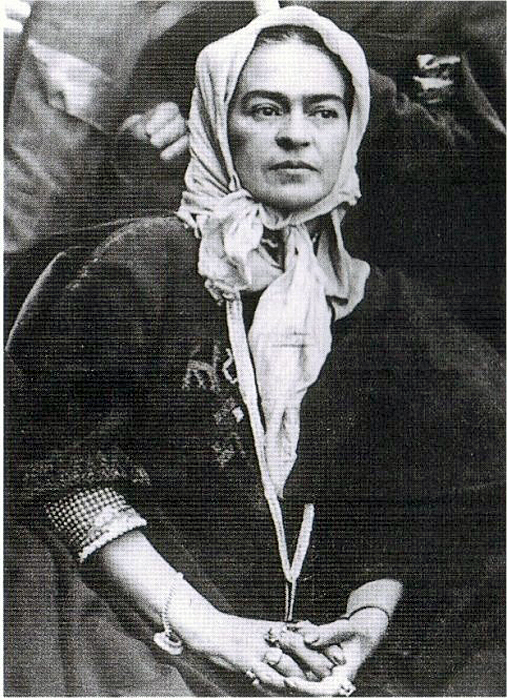
    Frida July 2 1954
    The pain-wracked, alcoholic, drug-addicted, unadorned, exhausted Frida?  This photo was taken on July 2, 1954, at her last public appearance.  She (in her wheelchair), Diego Rivera, and a group of friends and colleagues marched in Mexico City to protest the involvement of the United States Central Intelligence Agency in the overthrow of Guatemala's president.  Frida Kahlo died on July 13, 1954.

    There was a time, and not too long ago, when I thought I understood the moments that these photos purport to reveal.  Photos and self-portraits are a record of life, just as black-and-white as the first and last of these three. Except–perhaps not.  Perhaps, as the on-going exhibit at Casa Museo Frida Kahlo is titled, las apariencias engañan.  Appearances deceive.  What we see is tricky.  Appearances are as fluid as blood in the veins, as liquor down the throat, as dye seeking fabric, as paint on a palette.  And as Anais Nin is alleged to have said, "We do not see things as they are.  We see things as we are."
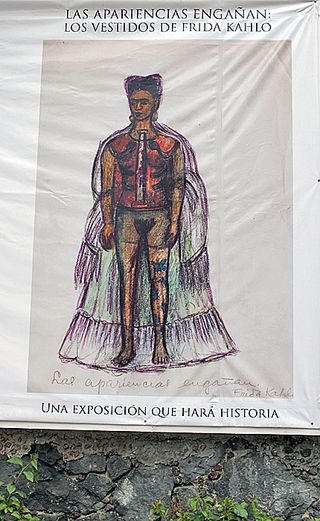
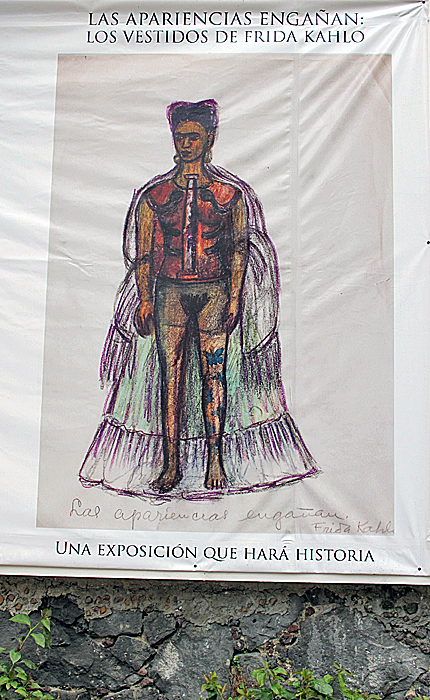
    Frida Cartel Las Apariencias Engañan
    The original drawing used for the exhibit poster is part of Frida Kahlo's diary.

    When Frida Kahlo died, Diego Rivera insisted that the places in her home where the majority of her personal effects were stored (two bathrooms, some trunks and closets) be sealed for the following 50 years.  In 2004, under the close supervision of museum directors, workers knocked down bathroom walls and pried open long-locked doors.  They found literally thousands of items belonging to the couple, including more than 300 of Frida Kahlo's dresses, some of her jewelry, some hair ornaments, shoes, and orthopedic appliances.
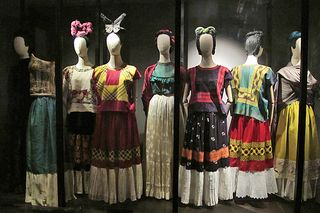
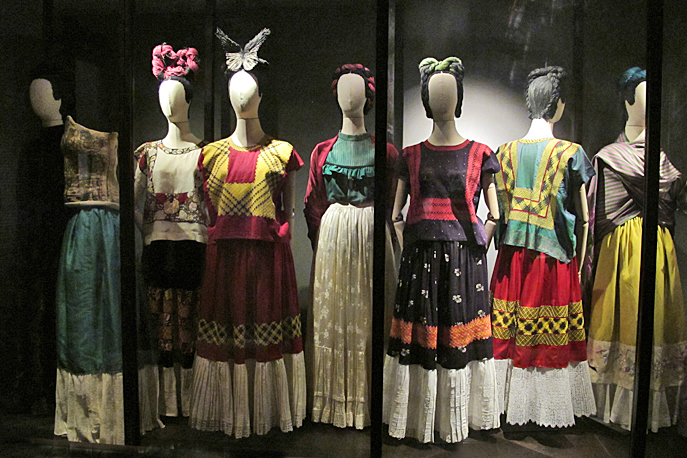
    Frida Vestuario
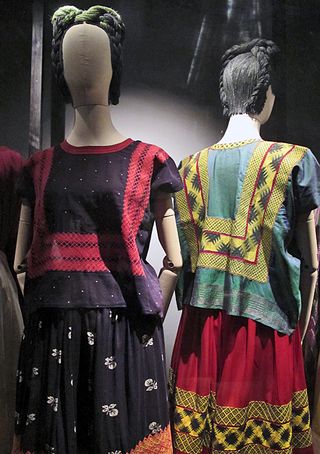
    A few of the Oaxaca-style skirts and huipiles (blouses) from Frida Kahlo's closets and trunks, currently showing in Room 2 of the exhibit space.  If you are familiar with her paintings, you may recognize one or two.
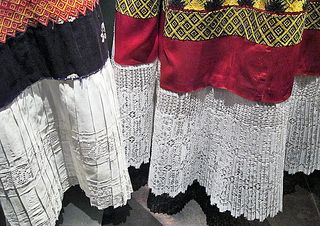
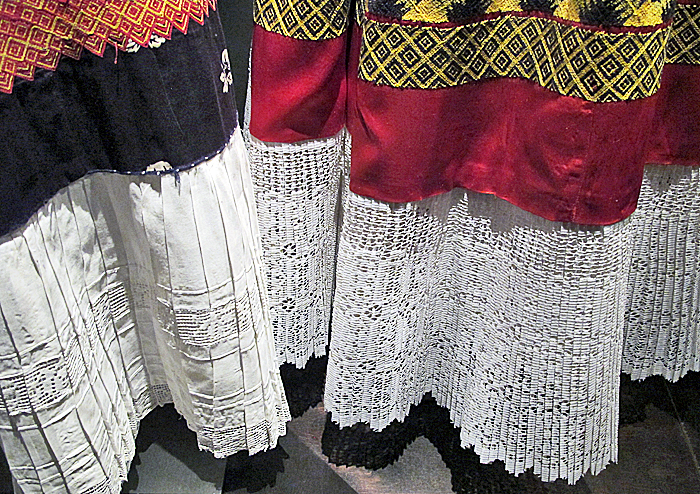
    Frida Faldas Encaje
    Detail of encaje (lace) and other fabrics from the skirts shown second and third from the right in the above photo.

    Las Apariencias Engañan opened in late November 2012.  According to museum personnel, the exhibit  will be on display for approximately one year, during which time the mannequins' clothing will be changed every three to four months. Not only will these changes give the public an opportunity to see more of the 300 dresses found when the walls were knocked down, but long-stored delicate fabrics will not be subjected to the stress of their own weight as they are displayed.
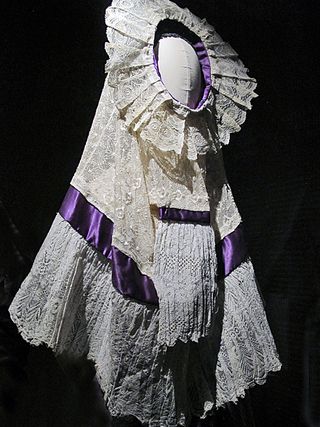
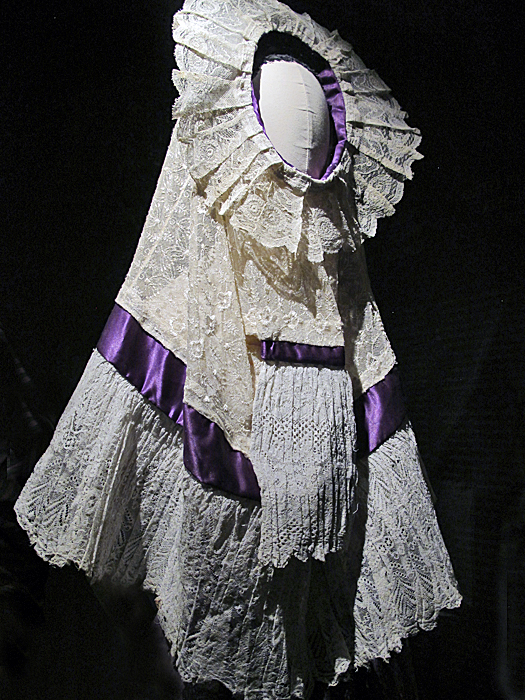
    Frida Vestuario Tehuana
    The Tehuana headdress from the self portrait shown above.  Click on any photograph to enlarge it for a better view.

    The restoration period has lasted nearly eight years.  Despite the conditions under which Frida's clothing and other belongings were stored for 50 years, what we see is a marvel of both natural preservation and expert resurrection.  The mounting of the exhibit, supervised by curator Circe Henestrosa and mounted by prominent British architect and designer Doctor Judith Clark, stuns with its mix of the lovely, the grotesque, and the matter-of-fact.
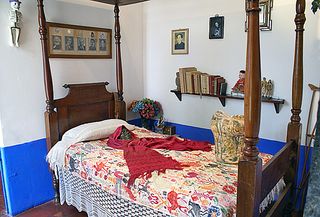
    Frida Death Mask y Corsé de Yeso febrero 2008
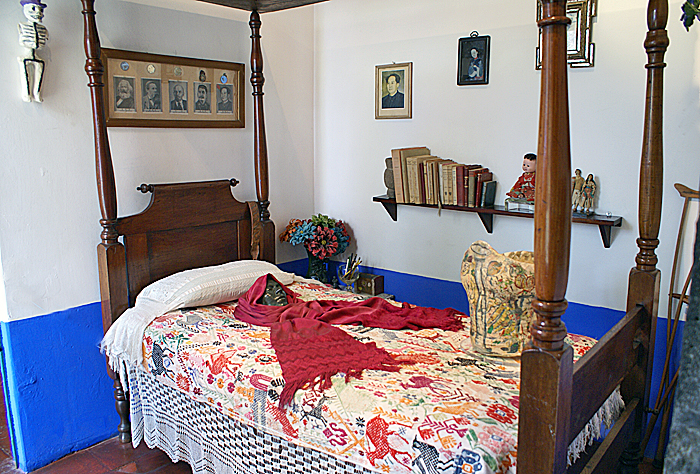
    You may well be familiar with some of Frida's famous hand-painted plaster of Paris corsets, decorated with her fabled fantastical flowers, animals, and even the Communist hammer and sickle.  They are beautiful.  About five years ago, the museum's exhibit of the artist's night bedroom included both her death mask, wrapped in a rebozo, and a plaster of Paris corset.
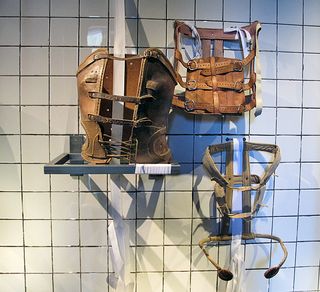
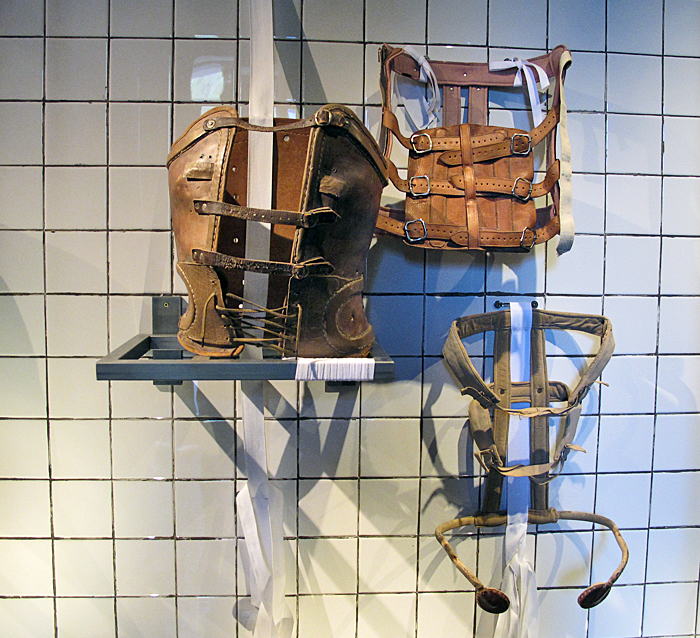
    Frida Corsets Varios
    These three corsets suspended (by white ribbons meant to evoke bandages) from white-tile walls that are symbolic of the bathrooms where the items were found, are not beautiful to any eye.  They are what they are: early 20th century medical appliances meant to bind, to support, and inevitably to inflict pain on the wearer. 
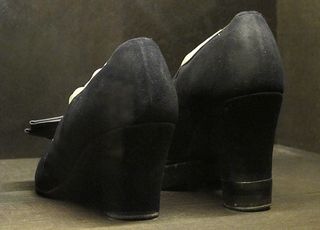
    Frida Pair Black Shoes
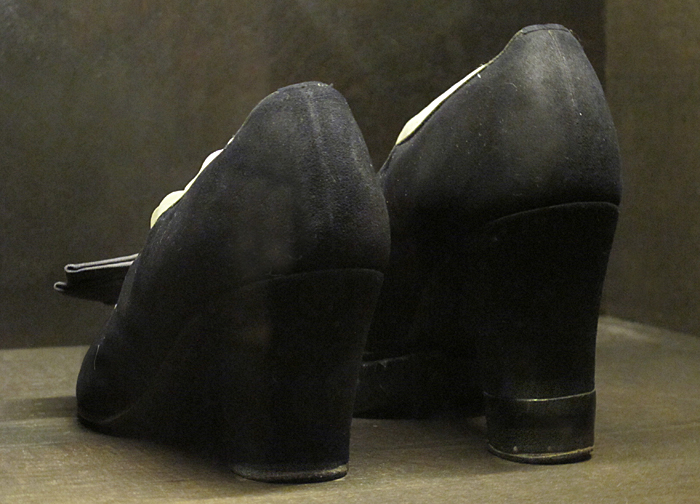
    A pair of Frida's black suede shoes.  Srta. Maricarmen Rodríguez López, my personal guide to the exhibit, said, "People ask why Dr. Clark insisted that we mount these shoes showing the back rather than the pretty front with bows on the toes.  Look closer.  The right shoe has an elevated heel to compensate for the shortness of Frida's right leg."  Srta. Rodríguez also mentioned that the entire exhibit is designed to emphasize the disabilities that Frida suffered from the time she was a child of six, when she had polio which left her right leg thinner and shorter than the left.
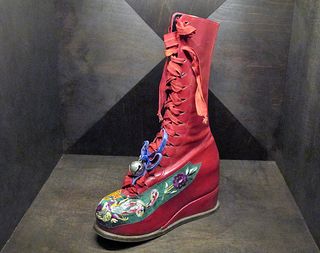
    Frida Red Boot Pair to Prosthesis
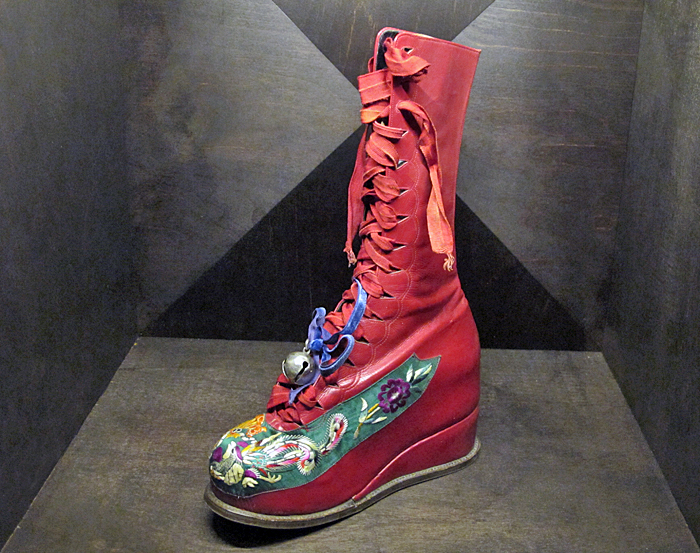
    Frida's calf-high, crimson leather lace-up boot–the left boot, with its wedge heel, decorated with panels of Chinese embroidery and a bell on a ribbon (…rings on her fingers, bells on her toes…).
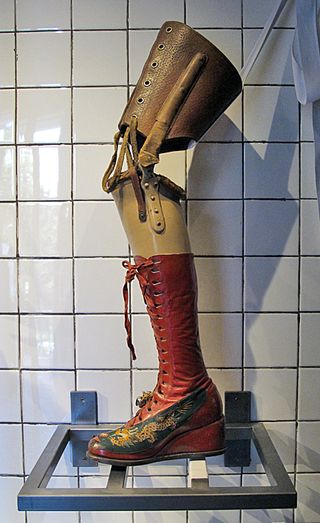
    Frida Prosthesis
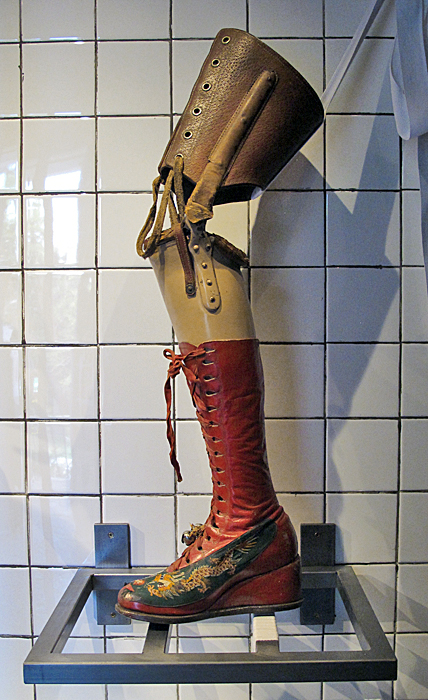
    The right boot and prosthesis, quite literally the other side of the story.  Compare the wedge heel on this boot with the wedge on the other.  Due to gangrene, doctors were forced to amputate Frida's long-injured right leg in 1953. 

    The metal supports for this and other items in the exhibit symbolize the iron handrail that pierced her abdomen and uterus in the 1925 trolley-car accident in which she suffered other serious injuries: a broken spinal column, a broken collarbone, broken ribs, a broken pelvis,
    eleven fractures in her right leg, a crushed and dislocated right foot,
    and a dislocated shoulder.
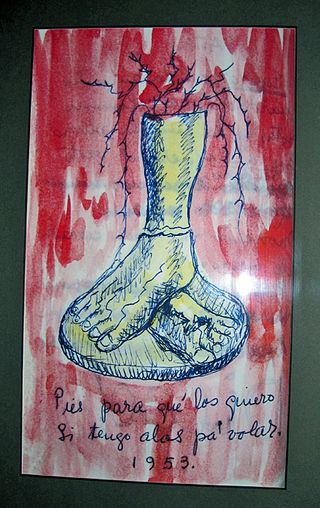
    Frida Píes para qué los quiero
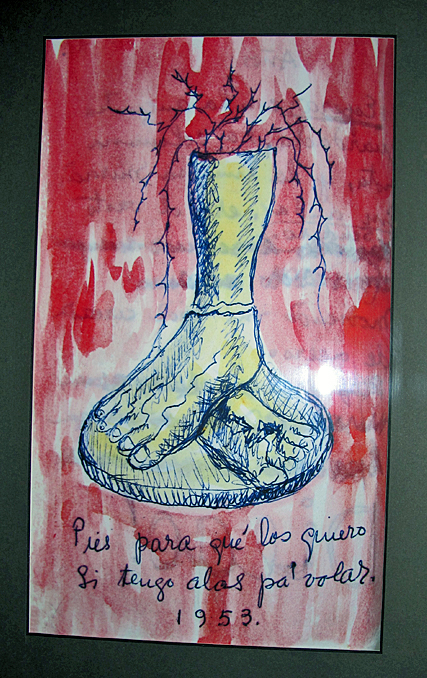
    Arguably the most famous page from Frida's diary: Pies para qué los quiero si tengo alas pa'volar. (Feet, what do I need them for, if I have wings to fly.)  Dated 1953 and painted just prior to the amputation of her right foot.

    Frida Hair Ornament
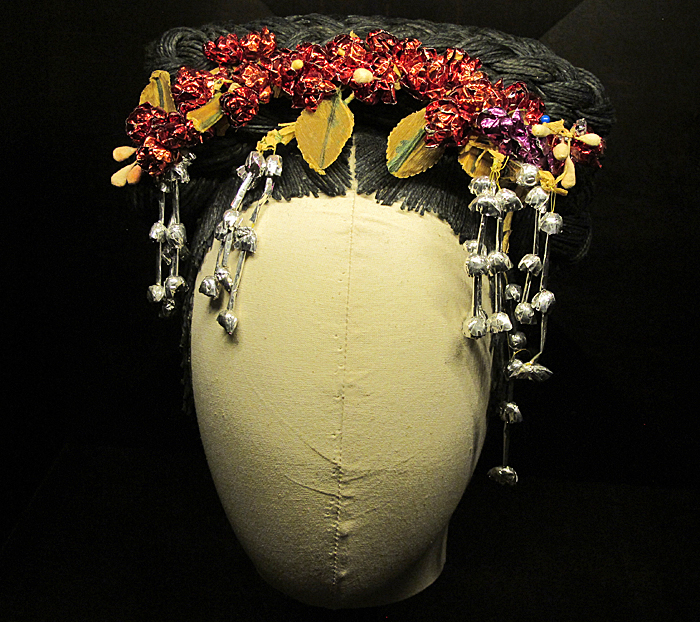
    From Frida's trunks, a hair ornament.  The tiara includes aluminum and textile flowers and green linen leaves.
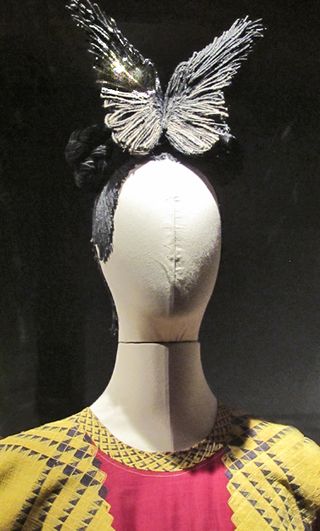
    Frida de Mariposa
    Another hair ornament, in the form of a butterfly.
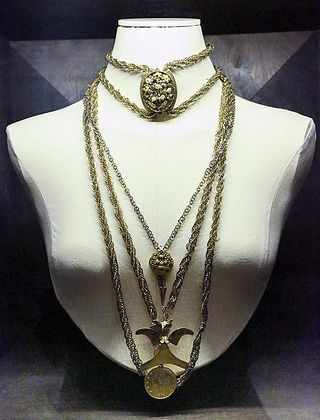
    Frida Collares
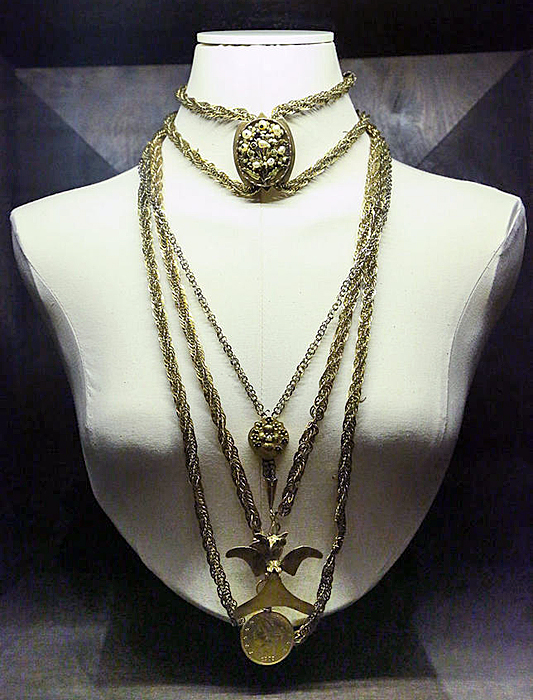
    Gold chokers and other necklaces.

    Frida Vestuario 2
    Who will see my brokenness, when the glory of my wardrobe hides my pain? In the exhibit, even the limbs of the mannequins resemble prostheses.
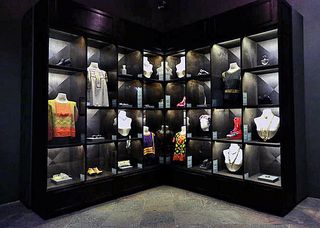
    Frida Gabinete
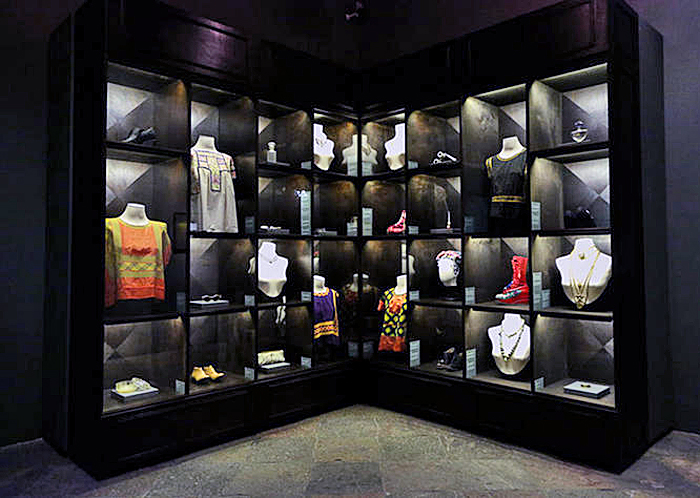
    A full cabinet of Frida's long-stored belongings: clothing, jewelry, shoes, even a pair of golden cat's-eye sunglasses came from the closets and trunks.

    Frida Los Angelitos RICCARDO TISCI
    Las Apariencias Engañan is intended to be a revolving, year-long exhibit.  Sponsored in large part by Vogue Magazine, as well as BMW, The Anglo Mexican Foundation, British Airways, The BBVA Bancomer Foundation, the Japan Foundation, Lasalle College of the Arts, Montblanc, the University of the Arts London, and Valentino Parfums, the exhibit also includes a roomful of newly created items of haute couture based very loosely on Frida's wardrobe.  This dress and jacket are by GQ's 2012 Designer of the Year Riccardo Tisci of Givenchy.  Still more designer dresses are by Costume National and Jason Wu, among the other couture houses involved in the show.
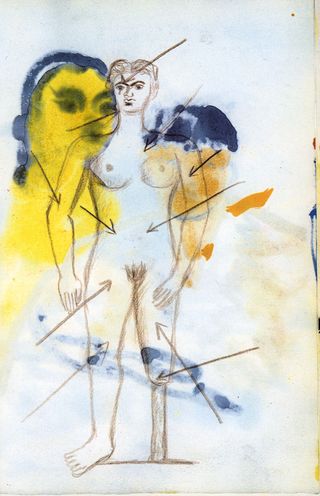
    Frida Diario Dibujo de Cirugías
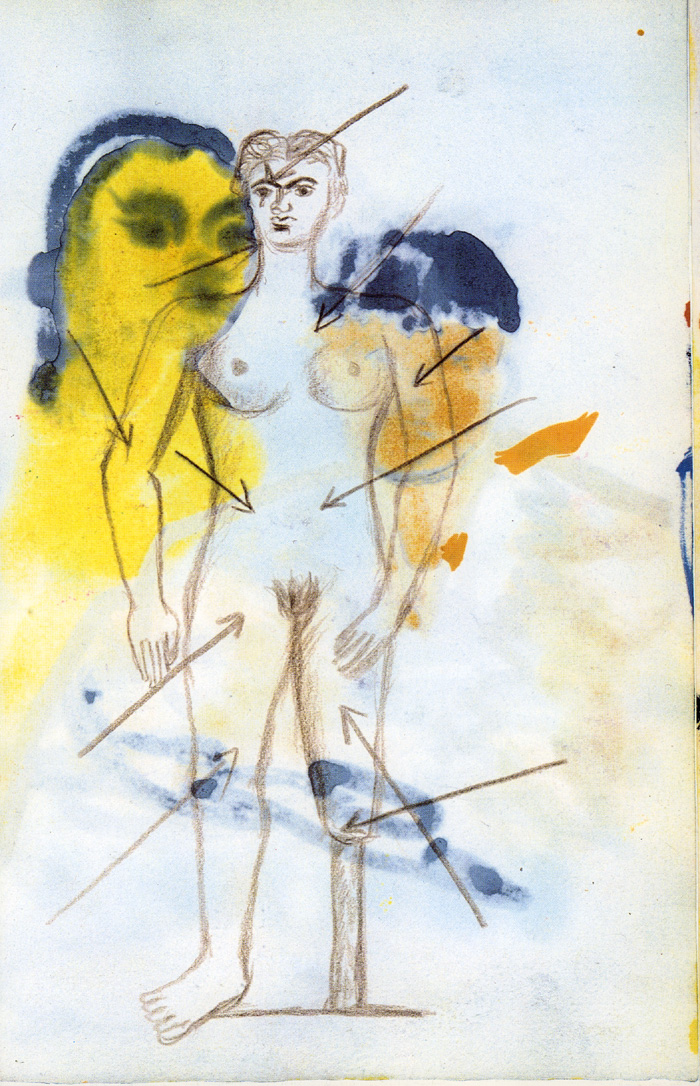
    From Frida's diary: arrows point to all of the parts of her body where she had surgeries.  A tear falls from her right eye.  I asked Srta. Rodríguez, "But she never had surgery on her head…?"  "No, la flecha esa simboliza el daño psicológico…" ('No, that arrow represents the psychological damage.')  Although the drawing shows only a few arrows, Frida actually had 22 or more surgeries.

    Frida Kahlo chose her very Mexican wardrobe with extreme care.  Each item was
    designed to flatter this part, cover that part, hide the other part. 
    Under her embroidered and boldly colorful square-cut huipiles
    (in this instance, Oaxaca-style blouses), terrible leather-and-metal
    corsets were barely noticable to others.  A maimed foot, a withered leg, a missing
    leg?  Let the boots take center stage, let the lace-bordered skirts be a
    frothy smoke screen.  Don't attend to my limp, look at the wreath of flowers in
    my hair.  Pay no attention to this wheelchair, raise your eyes to my multiple
    gold necklaces, the bracelets on my arms, the rings on my fingers.
    The exhibit reveals in a way that a photo, an article online, or a
    biography cannot show how and why Frida Kahlo invented the appearance of festive
    health for herself.  The psychology that moved her to create this way
    of life and this wardrobe, the fractures (both physical and mental) that shaped her need
    for window dressing: all is apparent in the exhibit, and we see both the color and the shadow, the harsh reality and the fugue of fashion.  Frida stands naked before us, a human being rather than a souvenir. ___________________________________________________
    With profound thanks to Hilda Trujillo Soto (Directora Casa Museo Frida Kahlo), Patricia Cordero (Coordinadora de Difusión y Contenidos Digitales, Casa Museo Frida Kahlo), and Maricarmen Rodríguez López (Redes Sociales y Difusión, Casa Museo Frida Kahlo) for their time and effort in arranging a private guided tour of Las Aparencias Engañan for Mexico Cooks!.

    Looking for a tailored-to-your-interests specialized tour in Mexico? Click here: Tours.