Category: Mexican Tourism

  • Hog Heaven: Mexico’s Love Affair with Pork

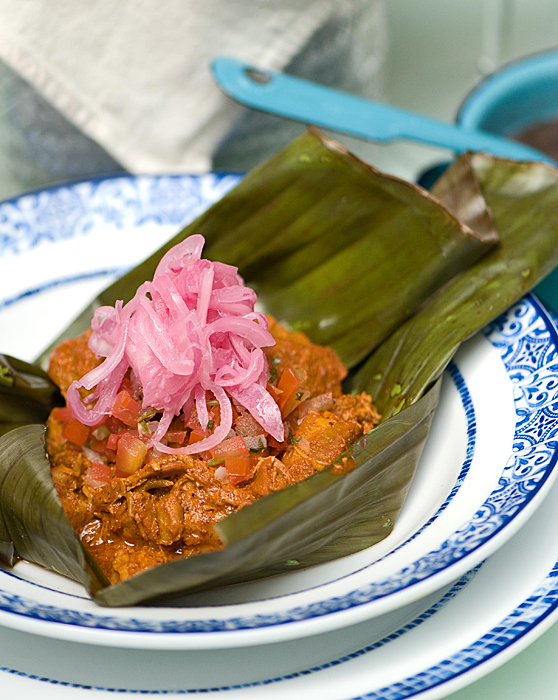
    Azul Cochinita
    Cochinita pibil from the Yucatán (seasoned pork, slow-cooked and then shredded), a specialty of Ricardo Muñoz Zurita's Restaurante Azul/Condesa.  It's a quick route from the farm to the plate.

    Mexico is one of the largest producers and consumers of pork in the world, second only to China.  In spite of the 'swine flu' crisis several years ago, Mexico continues to eat pork at a record-breaking pace and, every year, to export millions of tons of pork to other countries.  (FIRA

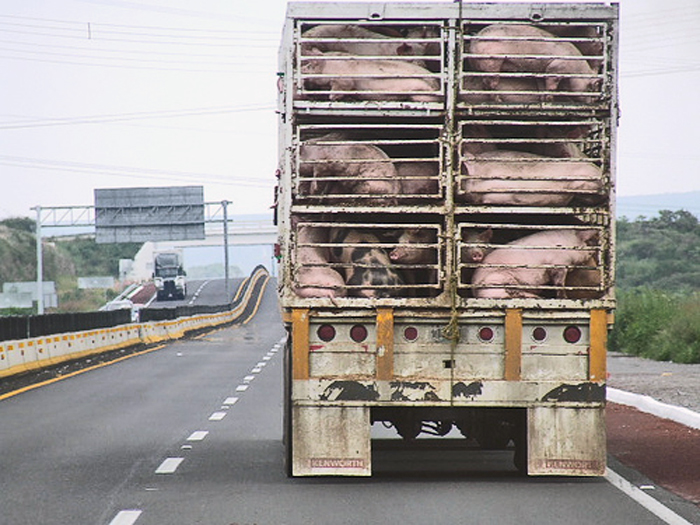
    Puercos en Camión
    From the growers' farms to a rastro (slaughterhouse) is a speedy ride along one of Mexico's super-highways.  A truck like this one, loaded with pigs, is an everyday sight throughout Mexico.  Photo courtesy ROTOV.

    Mexico is not nearly as squeamish as the United States in seeing where its carne de cerdo (pork meat) comes from.  In fact, a stroll through just about any city market or tianguis (street market) will give ample evidence that meat–including pork meat–comes from an animal, not from a sterile, platic-wrapped styrofoam meat tray at a supermarket. 
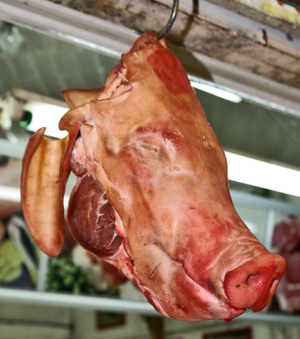
    Pig Head
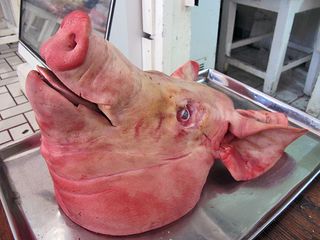
    Every part of the pig is used in Mexico's kitchens.  The head is ordinarily used to make pozole, a rich stew of pork meat, reconstituted dried corn, spices, and condiments. 

    No pork existed in Mexico until after the Spanish conquest; in fact, no domestic animals other than the xoloitzcuintle dog were used for food.  The only sources of animal protein were fish, frogs, and other water creatures, wild Muscovy-type ducks, the javalí (wild boar), about 200 varieties of edible insects, doves and the turkey, all native to what is now Mexico. 
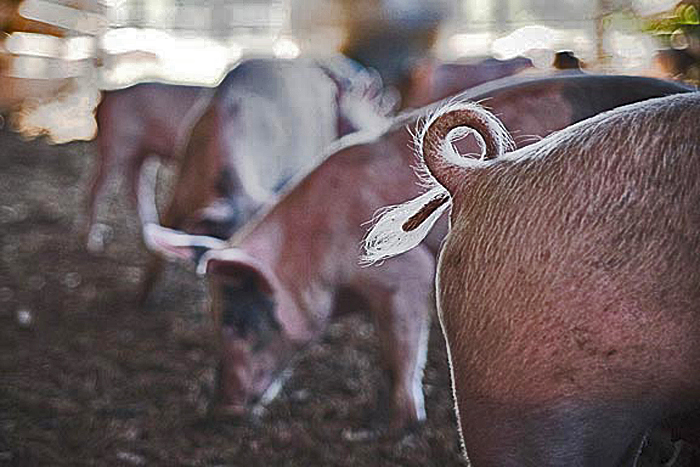
    Hog Heaven Pig Tails
    Mexico has been cooking head-to-tail since long before that notion came into international vogue.  Pig tails are used here for roasting–look for recipes for rabo de cerdo asado (roast pig tail).|
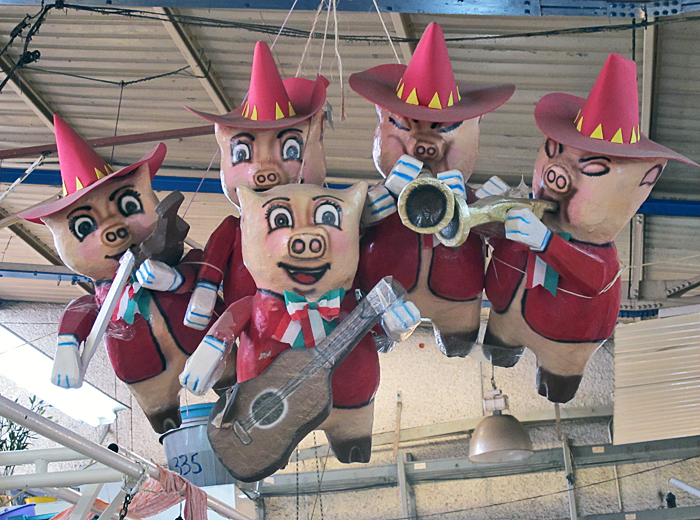
    Pig Mariachi Mercado de Jamaica August 2013
    No matter that just below these jolly mariachi pigs at Mexico City's Mercado de Jamaica, their once-live counterparts lie ready for the butcher's knife.  These fellows play on!
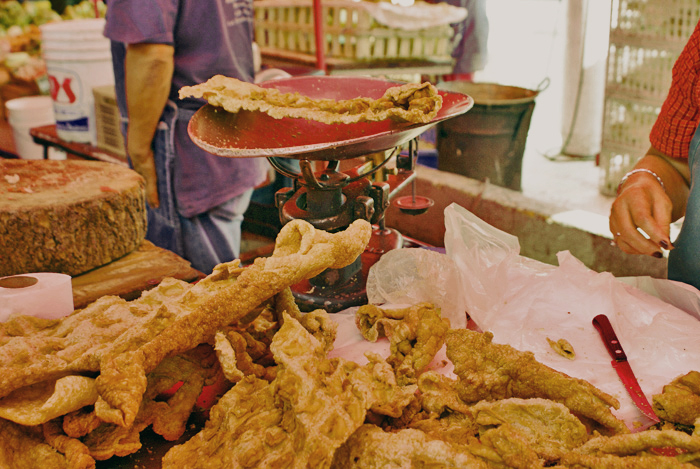
    Chicharrón 3
    Chicharrón (fried pig skin) is prepared fresh every day by butchers whose specialty is pork.  Nothing goes to waste.

    Just about any Mexican butcher worth his stripes can custom-cut whatever portion of the pig you need for meal preparation.  In case you're not 100% familiar with the names of Mexican cuts, here are two pork cut charts, first in English and then in Spanish for comparison.
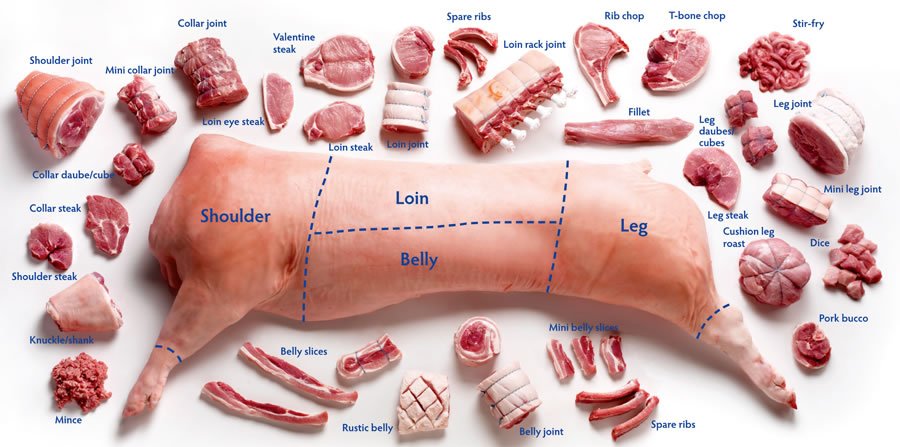
    Pork Cuts English
    Pork cuts chart in English.  Click to enlarge the image for better viewing.
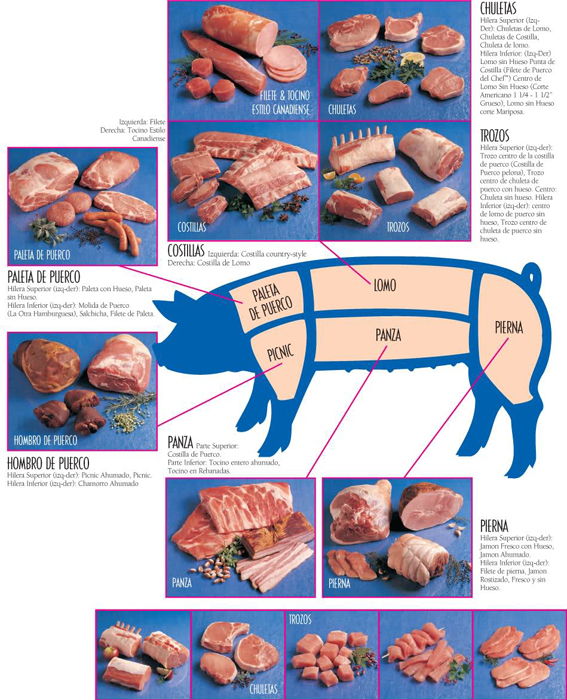
    Pork Cuts Chart Spanish
    Pork cuts chart in Spanish (for Mexican users).  Even in Spanish, many cuts have different names depending on which country names them.  Again, click to enlarge the image for a better view.
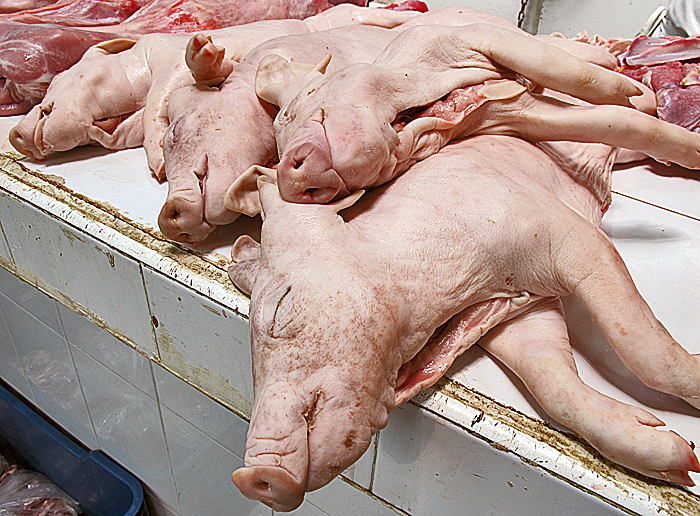
    Mercado SJ Lechón
    These suckling pigs were butchered at 6 weeks to 3 months old.  Known in Mexico as lechón, roast suckling pig is a delicacy by any name.  Many restaurants specialize in its preparation.
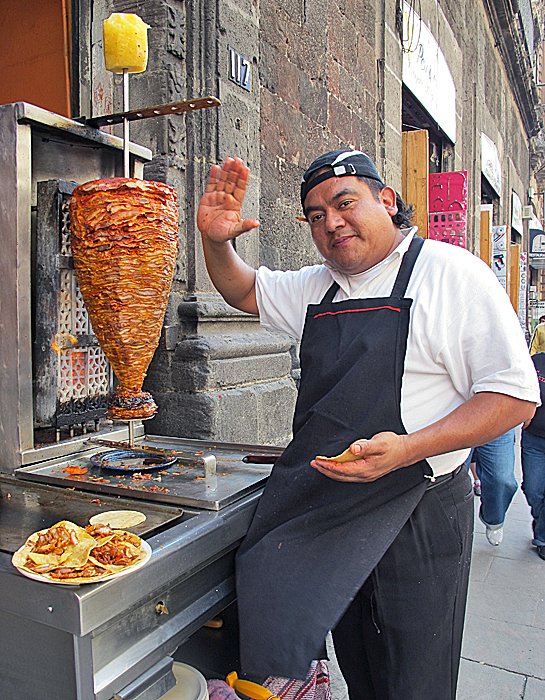
    Tacos al Pastor Calle Uruguay DF
    One of the most common and popular (and really delicious) kinds of street tacos is tacos al pastor (shepherd style tacos).  Marinate thinly sliced pork meat in a sauce made of chiles guajillo, vinegar, and tomato. Next, layer the slices on a vertical spit so that they form the shape of a spinning top.  At the top of the meat, place a pineapple without skin.  Light the fire in the grate behind the spit and allow a portion of the meat to cook until slightly caramelized on the edges and tender within.  Slice into very thin pieces, using them to fill a tortilla warmed on the flattop.  With your sharp knife, flick a small section of the pineapple into the taco.  Add the salsa you prefer, some minced onion and cilantro, and ahhhhh…the taste of Mexico!
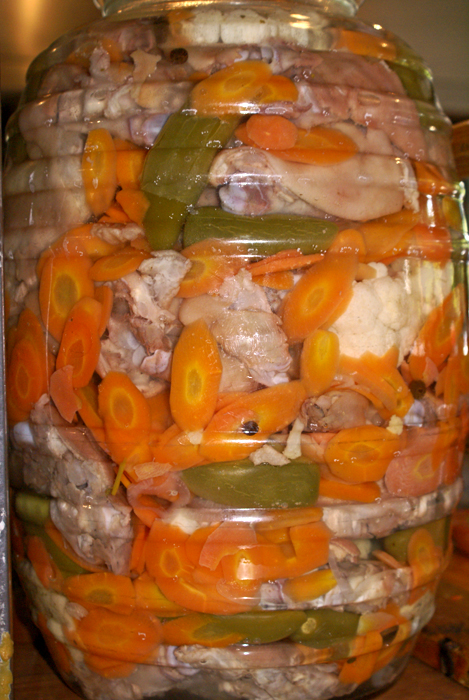
    Titita Manitas de Cerdo
    Manitas de cerdo: pickled pigs' feet.  The well-scrubbed feet are cooked in salted water, then added to vegetables cooked in a pickling solution of vinegar, chile, vegetables, and herbs.  In Mexico, manitas de cerdo can be eaten as either a botana (snack) or a main dish.
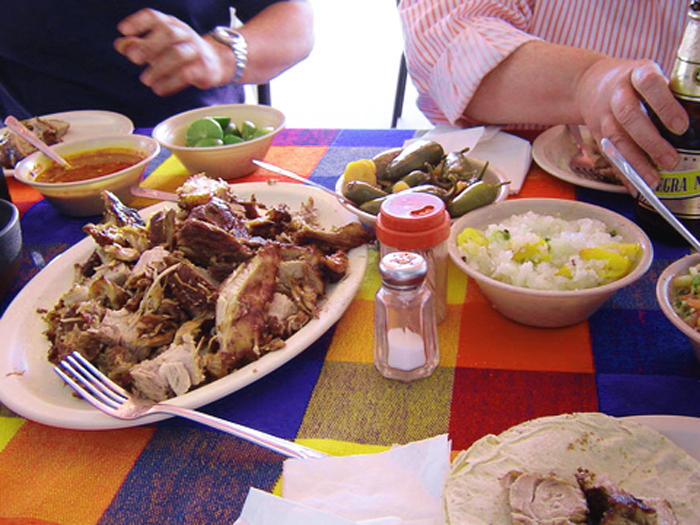
    Pátzcuaro Carnitas
    One of my personal favorite pork dishes: carnitas from Michoacán!  These carnitas in particular are the best I've ever eaten: large hunks of pork are boiled in lard until crispy on the outside, succulent and juicy on the inside.  Chopped roughly and served with various salsas, they're the best tacos I know.  Find them at Carnitas Aeropuerto, in Zamora, Michoacán.
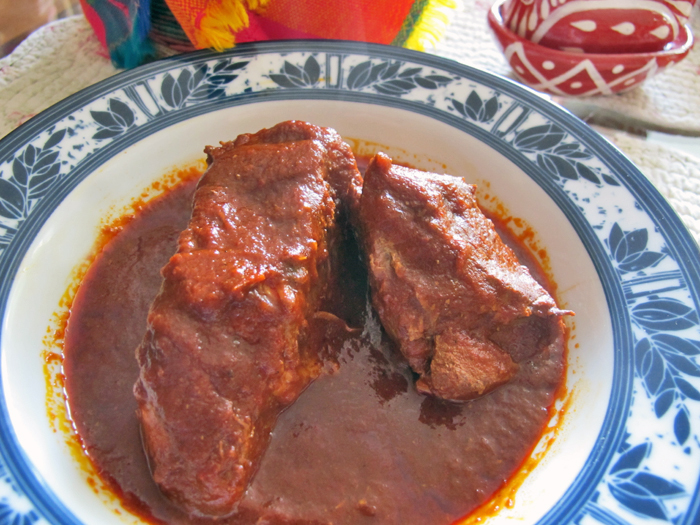
    Adobo en el Plato
    Adobo huasteco, another deliciously spicy pork dish.  It's been a while since this last appeared on our table–and it's high time we prepared it again.  Click on the link for the recipe.
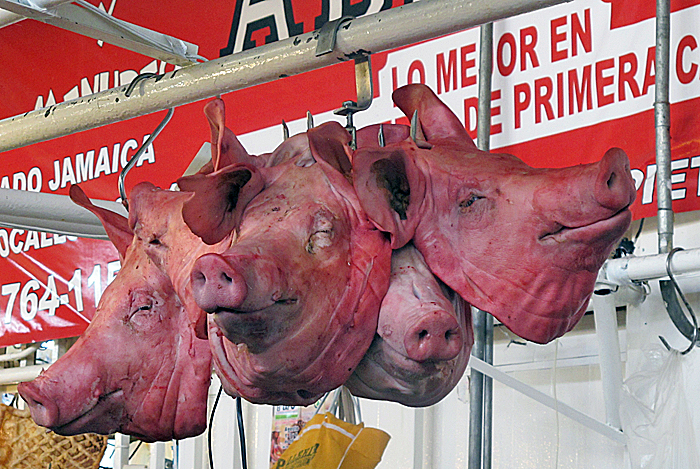
    Hog Heaven Bouquet de Cabezas
    Last but not least, here's a rosy bouquet of pig heads for sale at the Mercado de Jamaica in Mexico City.

    Looking for a tailored-to-your-interests specialized tour in Mexico? Click here: Tours.
  • La Teca–Isthmus of Tehuantepec Cooking in Oaxaca: Cocina Istmeña Oaxaqueña

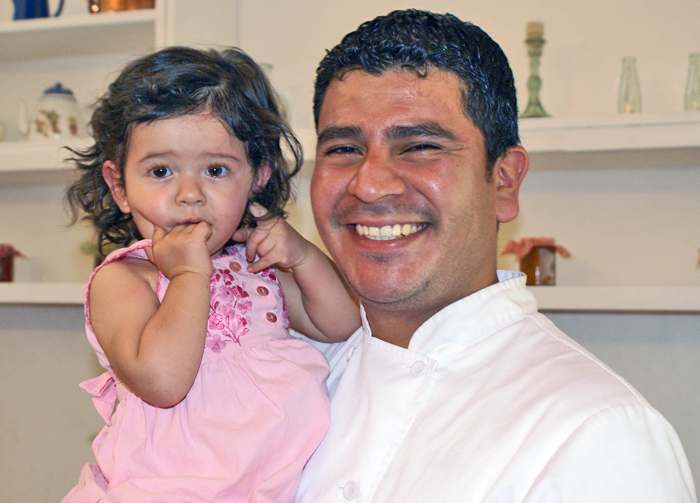
    Oaxaca Rodolfo con Elisa
    Good friend and chef Rodolfo Castellanos with his adorable daughter
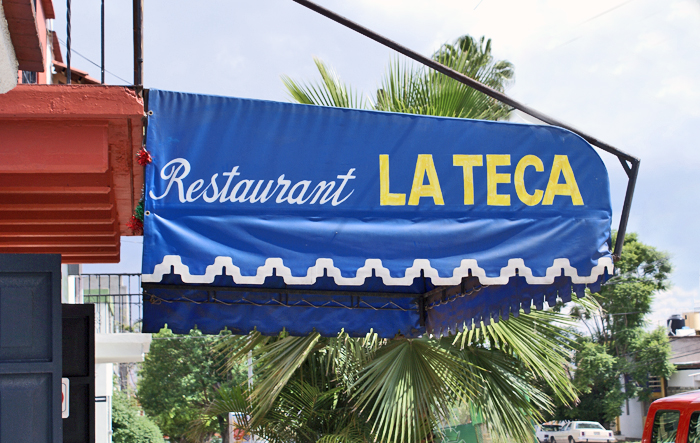
    Elisa.  Chef Rodolfo owns Restaurante Origen in Oaxaca.  He and his wife, Lisette, asked me to join them for comida (the main meal of the day) at Oaxaca's Restaurant La Teca, where chef Rodolfo ordered an incredible meal for us.

    While in Oaxaca with a writers' group, I took a little
    time away from that group to visit another group: several culinary-world
    friends who live and work in this southern Mexico city.   I played
    hooky to eat on Friday with Pilar Cabrera at her wonderful restaurant La Olla,
    and on Saturday with chef Rodolfo Castellanos and his family at La
    Teca, a restaurant specializing in cooking from the Isthmus of
    Tehuantepec.

    The Isthmus of Tehuantepec is the skinniest part of mainland Mexico,
    lying between the Pacific Ocean and the Gulf of Mexico.  Prior to the
    opening of the Panama Canal, it was the most important route for goods
    working their slow way across the relatively flat lands between the two
    bodies of water.  Partly in Oaxaca, partly in Chiapas, partly in Tabasco
    and partly in Veracruz, the territory has its own legends, its own
    history, and its own cuisines. 

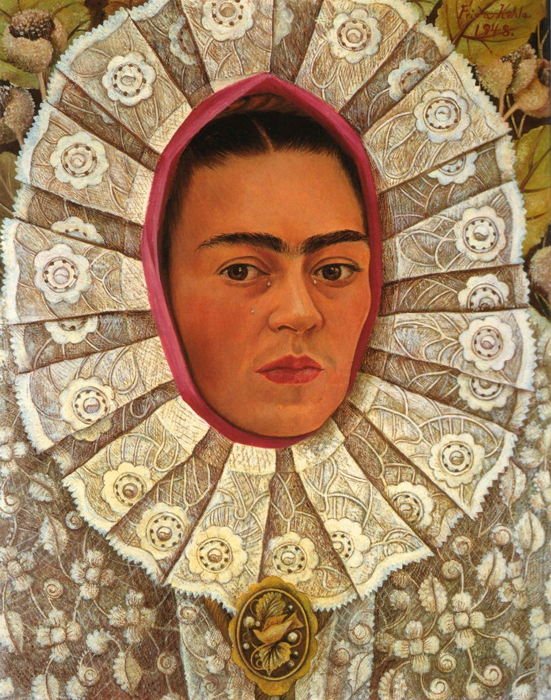
    Oaxaca 1948 Frida Tehuana
    You
    may not be aware that you are already familiar with the native dress of
    the Tehuanas, as the women of the isthmus are known.  Above, a Frida
    Kahlo 1948 self portrait, dressed as a Tehuana. Image courtesy of: http://www.earlywomenmasters.net

    Oaxaca Restaurante La Teca
    Just off the beaten tourist track in Oaxaca, Restaurant La Teca serves
    outstanding food from the Isthmus of Tehuantepec.  The welcoming owner
    and cook, Señora Deyanira Aquino, will make sure that you eat your fill
    of her marvelous regional cuisine.

    The cooking of the Isthmus is traditionally corn-based and
    idiosyncratic.  Most ingredients are indigenous to its hot lowlands (for
    example, armadillo and iguana) and its proximity to the sea: fresh and
    dried shrimp, fresh fish, and other creatures from the ocean depths.

    Oaxaca La Teca Garnachas Oaxaqueñas
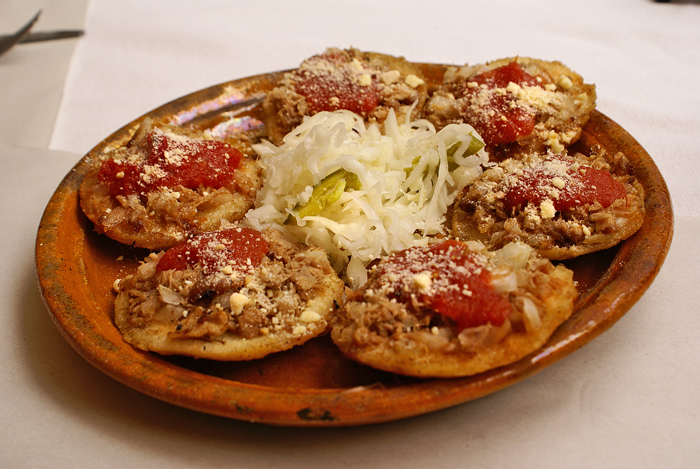
    At La Teca we shared a platter of garnachas, a traditional entrada or botana (appetizer or snack) based on a fried disk of corn dough and topped with a mixture of meat, vegetables, and salsa.

    Oaxaca La Teca Tamales de Cambray
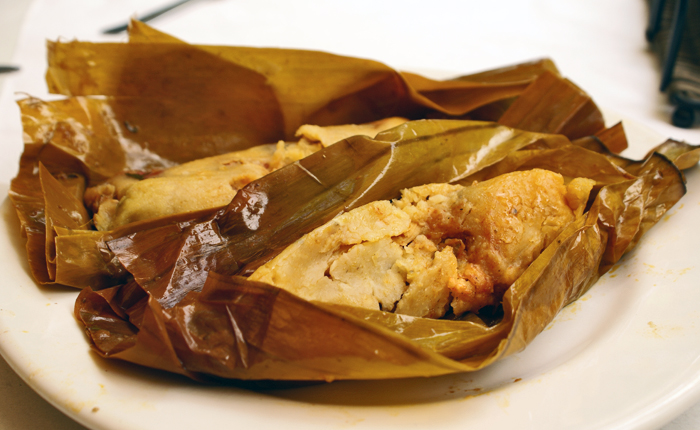
    Tamalitos de cambray from Tehuantepec, savory-sweet tamales made of chicken, raisins, olives, almonds, and capers.

    Oaxaca La Teca Molotes de Plátano Macho
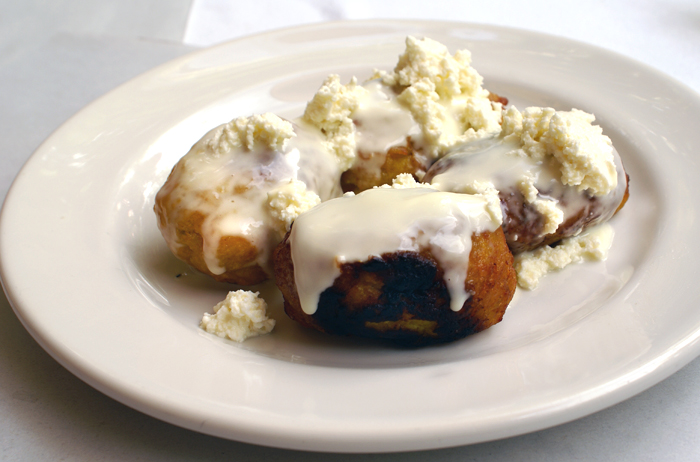
    These are molotes de plátano macho (small, sweetly ripe plantain croquettes) topped with crema de mesa (table cream) and queso fresco (fresh cheese).  The three of us shared an order of four molotes
    We kept dividing the last one into smaller and smaller pieces so that
    one of us did not hog the whole thing–although each of us would have!

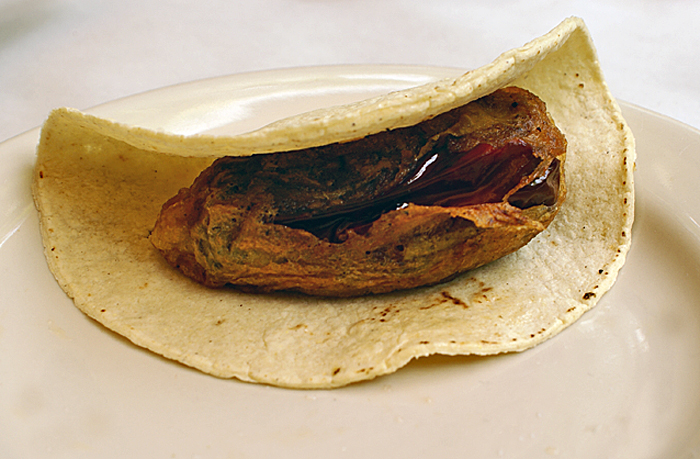
    Oaxaca La Teca Taco de Chile Relleno Pasilla Oaxaqueño
    Next course at La Teca: a taco filled with a small chile pasilla oaxaqueño relleno
    (a regional dried chile, reconstituted, stuffed, and fried).  It
    doesn't look like anything special, does it?  If you could just enjoy
    the fragrance, I assure you that you would want to lick your monitor.

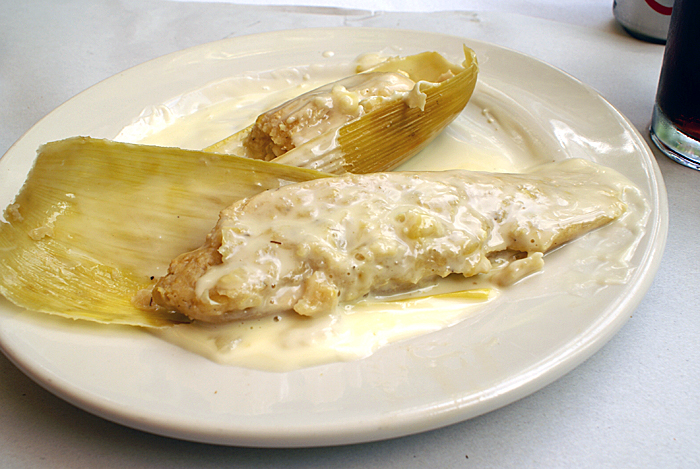
    Oaxaca La Teca Tamales de Elote 2
    Tamales de elote (fresh corn tamales) followed, served with crema de mesa.  These reminded me very much of Michoacán uchepos, another kind of fresh corn tamales.

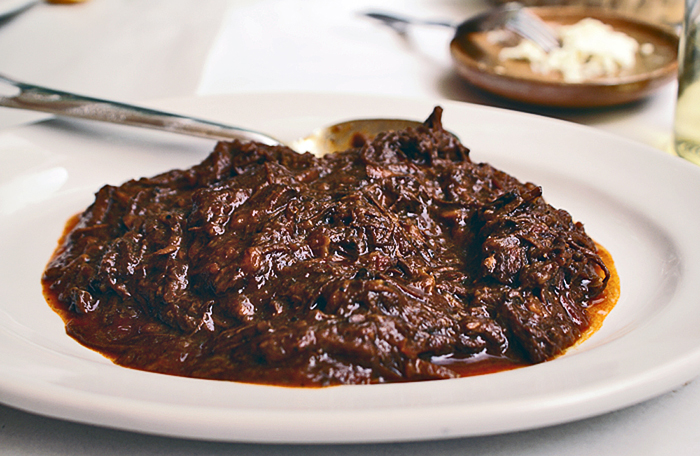
    Oaxaca La Teca Estofado de Bodas
    Another traditional dish from the Isthmus, estofado de bodas
    (wedding stew).  It's a delicious long-cooked combination of beef,
    fruits, chiles, and other spices, typically served at weddings.

    Oaxaca La Teca Purée de Papa
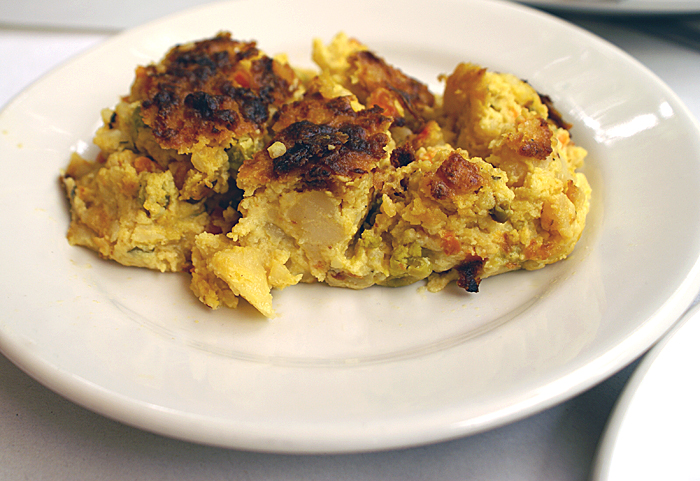
    Purée de papa, estilo Istmeño (potatoes, coarsely mashed and then baked, Isthmus style). 

    Oaxaca La Teca Carne de Cerdo
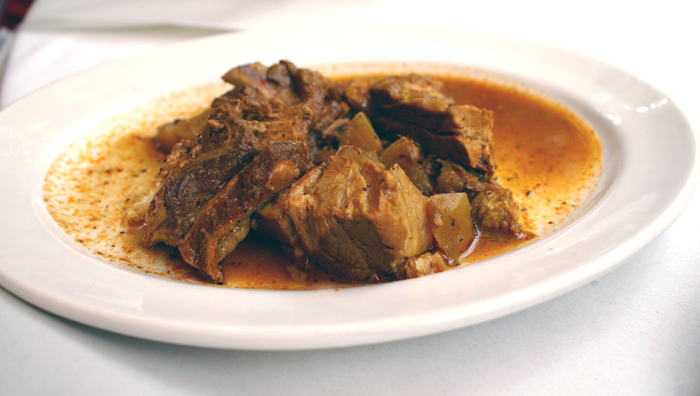
    Asado de puerco con mole (pork roasted with mole, from Tehuantepec).

    Oaxaca La Teca en Persona
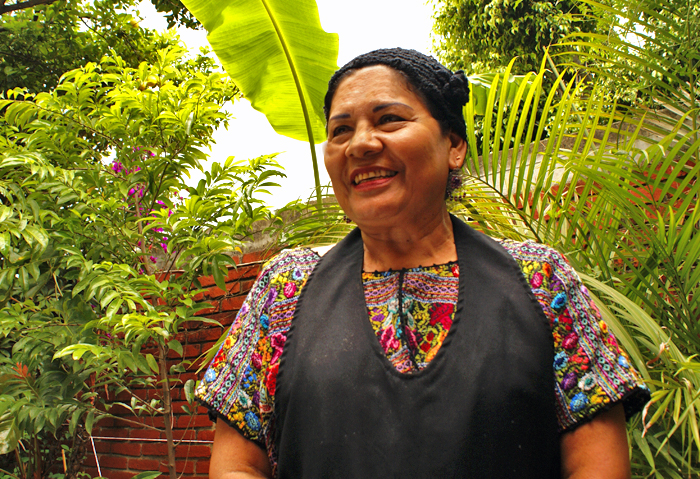
    The owner and chief cook at La Teca is Sra. Deyanira Aquino, born and raised in the Isthmus.  Women of the region are called 'tecas'–from Tehuantepec–hence the name of the restaurant.

    You are probably well aware of the mythical seven moles
    of Oaxaca, and although the state is best known for those, there are
    many other less-well-known but equally wonderful dishes available to
    visitors.  By all means go see Sra. Aquino at La Teca; you will be as
    thrilled by everything you eat as we were.  This is not fancy, high-end
    designer-plated food.  Your palate will be delighted by traditional
    Tehuantepec home-style cooking.  And oh my god, you might exclaim, did the three of you really eat all that?  We most assuredly did, every bite, and so will you.

    Restaurant La Teca
    Calle Violetas #200-A
    Colonia Reforma
    Oaxaca, Oaxaca
    01.951.515.0563 (from within Mexico)

    Looking for a tailored-to-your-interests specialized tour in Mexico? Click here: Tours.
  • Mercado 20 de noviembre, Oaxaca: Shop the 20 de noviembre Market with Mexico Cooks!

    For the next two or three weeks, Mexico Cooks! will take you on a virtual trip to Oaxaca.  Enjoy!

    Oaxaca Benito Juárez Mkt 5 Sal de Gusano
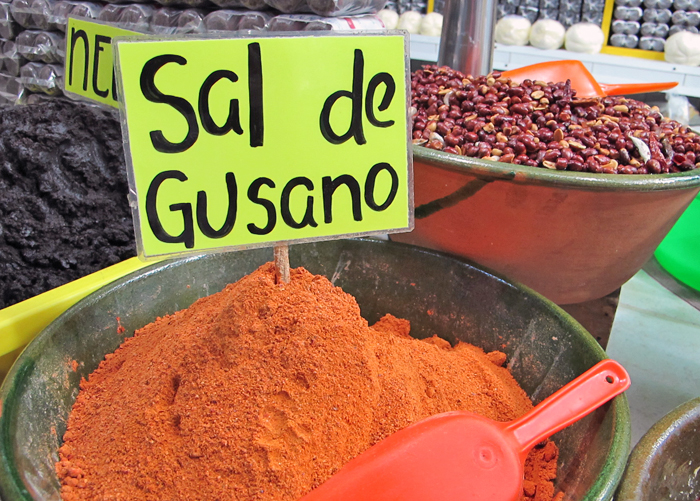
    Emblematic of Oaxaca and its mezcal culture, sal de gusano (worm salt) and a wedge of fresh orange are the truly Oaxacan accompaniments to a shot of what Mexicans call la bebida de los dioses (the drink of the gods).  And yes, sal de gusano is made with sea salt, ground chile, and dried, toasted and ground maguey worms.  I promise you that it is delicious.

    The last morning of Mexico Cooks!' recent stay in Oaxaca, I grabbed a friend and headed off to the city's famous Mercado Benito Juárez.  The market is in many ways similar to but in many ways different from  those that Mexico Cooks! knows best, the traditional markets of Mexico's Central Highlands.  Both my friend and I were fascinated by what we saw and learned while we were poking around among the stalls.

    Oaxaca Benito Juárez Mkt 10 Jícaras y Sonajas
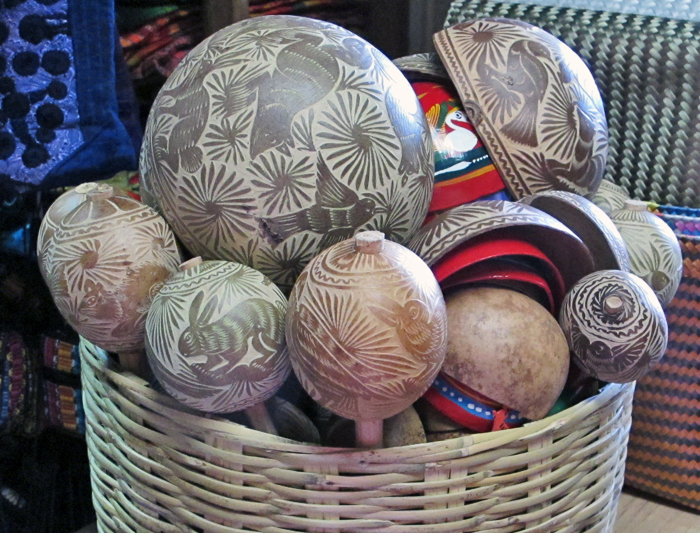
    The large carved bowls at the top of the basket and several of the smaller carved bowls to the lower right–including the laquered red ones–are actually jícaras (dried gourds).  Jícaras are traditionally used for drinking mezcal.  Around the edge of the basket you see sonajas (rattles), in this case whole dried gourds on sticks.  The seeds dry inside the gourds to provide the sound effects when you shake the stick.

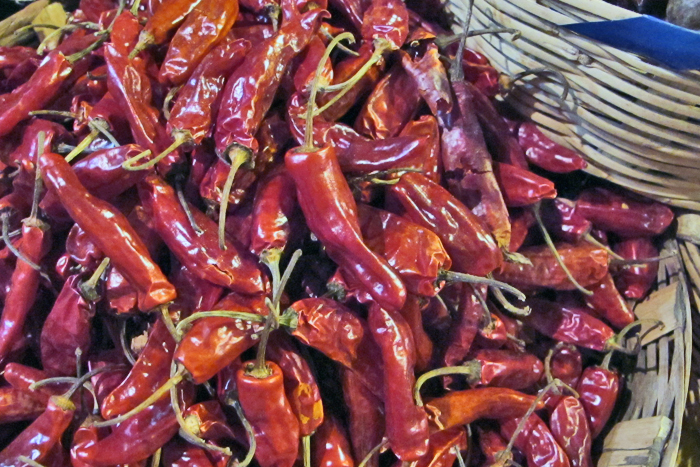
    Oaxaca Benito Juárez Mkt 6 Chilhuacle
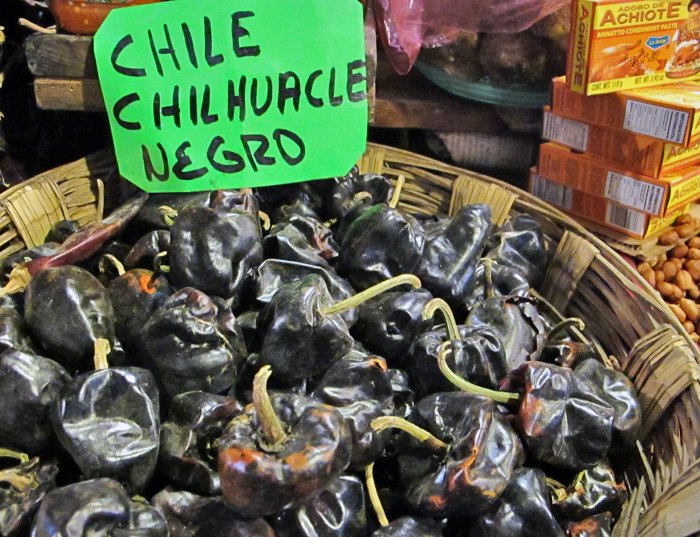
    Rural Oaxaca grows chiles of all kinds, including some that are unique to the state.  These are dried chile chilhuacle negro, arguably the most expensive chile in Mexico.  Retail price?  Eight hundred pesos the kilo–about $75 USD for 2.2 pounds, at today's exchange rate.

    Oaxaca Benito Juárez Mkt 1 Bolsas 1
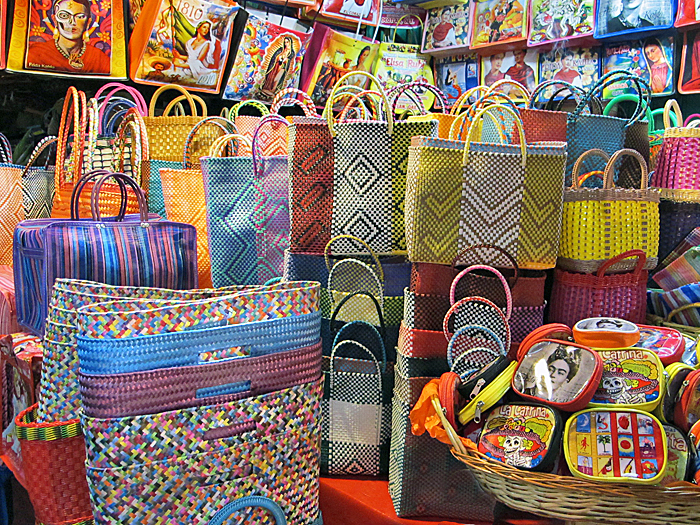
    Bags, bags, and more bags–all plastic–sell at two adjacent market stands.  The bolsas (bags) range from the little zipper change purses in the basket at lower right to the big woven market bags on the left and at the rear.  Mexico Cooks! came home with two of the big ones.

    Oaxaca Benito Juárez Mkt 8 Chiles Pasilla Oaxaca
    Mexican chile terminology is filled with contradictions.  These are chiles pasillas oaxaqueños (Oaxacan pasilla chiles).  Chiles pasillas are different sizes, shapes, colors, and flavors depending on where you are in Mexico, but these are unique to Oaxaca.

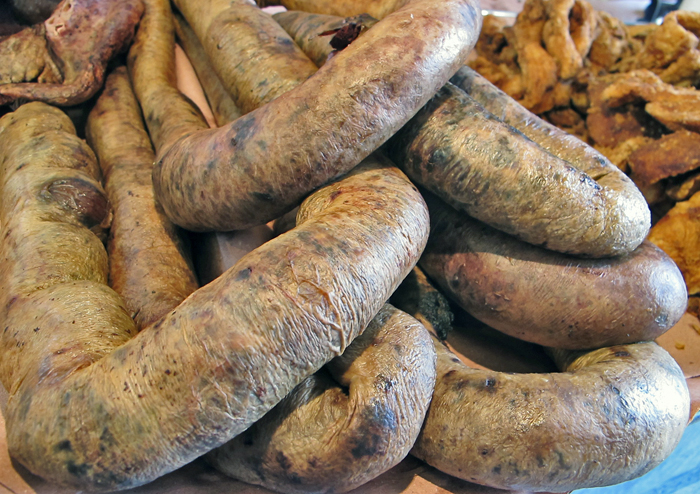
    Oaxaca Benito Juárez Mkt 16 Moronga
    Moronga is pork blood sausage.  The blood is heavily seasoned with ruda (rue), oregano, fresh  mint, onions and chile and then stuffed into pigs' intestines and boiled for as much as several hours. 

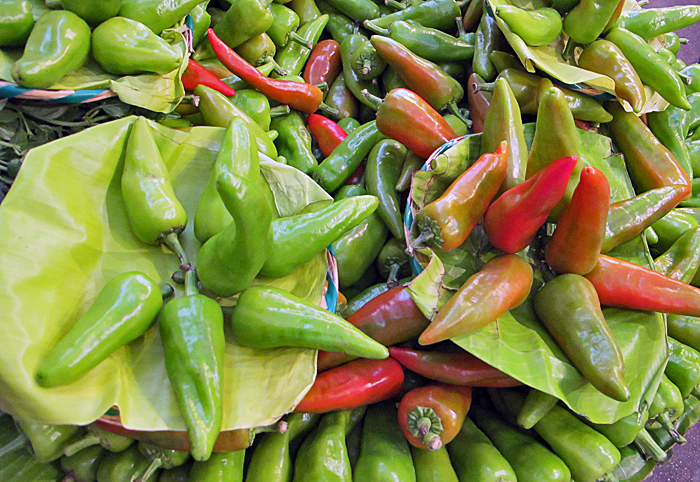
    Oaxaca Benito Juárez Mkt 11 Chiles de Agua
    Chile de agua (literally, water chile) is another specialty pepper from Oaxaca.  Some folks say its heat is medium, some folks swear it's hot as hell, and everyone agrees that it's very difficult to find outside Oaxaca.  Look back a few weeks on Mexico Cooks! to see a wonderful use for these small chiles.  I loved the flavor and the picor (heat factor).

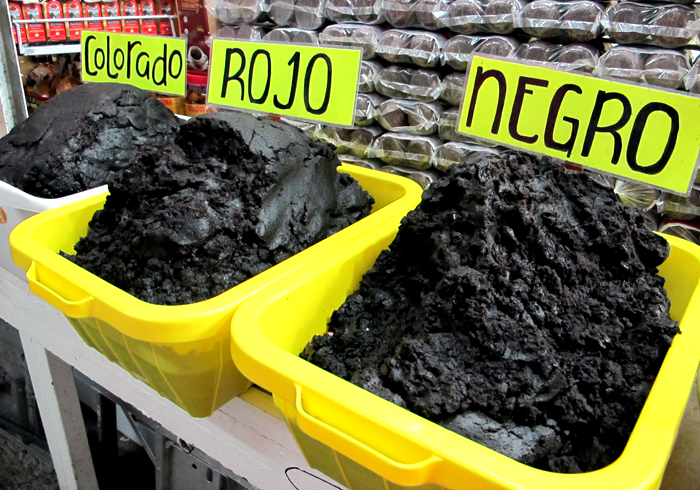
    Oaxaca Benito Juárez Mkt 21 Tres Moles
    Three of Oaxaca's famous moles.  These are sold as pastes, by weight.  You simply reconstitute them with chicken broth at home and serve them with the meat of your choice.  Mexico Cooks! is crazy about carne de cerdo con mole negro (pork with black mole).

    We'll come back to Oaxaca, just to give you a sample of marvelous food and drink–next Saturday morning, right here at Mexico Cooks!.  Be ready for more regional Oaxacan specialties.

    Looking for a tailored-to-your-interests specialized tour in Mexico? Click here: Tours.
  • La Feria del Chile (The Chile Fair) in Queréndaro, Michoacán

    This article, originally published in September 2008, is current once again.  The Feria del Chile de Queréndaro is happening this weekend, August 9-11, 2013.  If you're in the vicinity of Queréndaro, Michoacán, by all means get there.

    Folcloriquitos 1

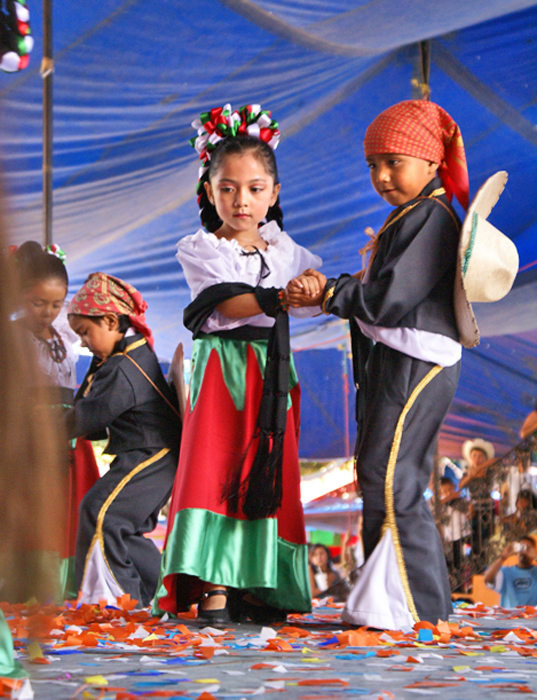
    We fell in love with these wee ballet folklórico performers, children no more than four years old.

    For
    the last seven years, just around the late July-early August harvest
    time, the town of Queréndaro, Michoacán, has celebrated the Feria del Chile (chile
    fair).  The center of town fills with rides for children, booths
    specializing in all sorts of food, games of chance, a big stage for
    daily ballet folklórico and nightly music, and all the usual whoopdedoo of fiesta time.  The star of the fiestas is, of course, the chile chilaca.

    Venta de Chiles Secos
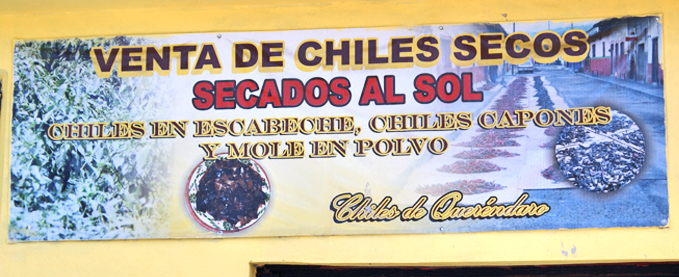
    In Queréndaro, Michoacán, daily work is all about locally grown chiles chilaca.


    About 3 thousand acres of chile chilaca are
    planted in the central Mexican states of
    Aguascalientes, Jalisco, Guanajuato, Zacatecas and Michoacán.  Many of
    the residents of Queréndaro, Michoacán commercially cultivate this
    particular chile

    Cerveza y Vino...
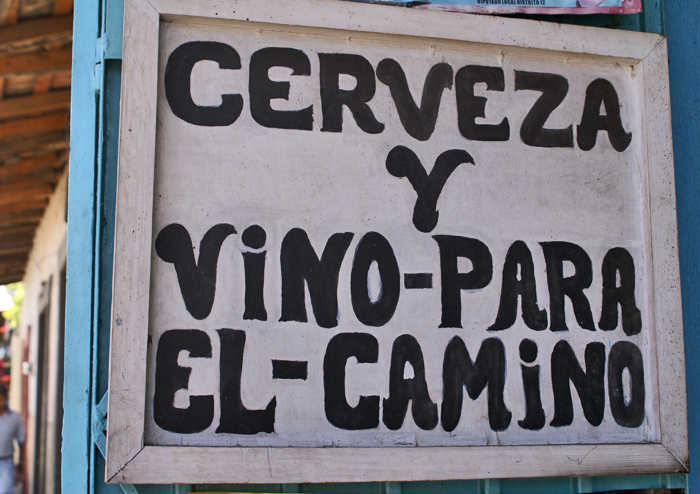
    All work and no play is no good, though.  This sign on a Queréndaro grocer's door says, "Beer and wine for the road".

    Chiles Chilaca
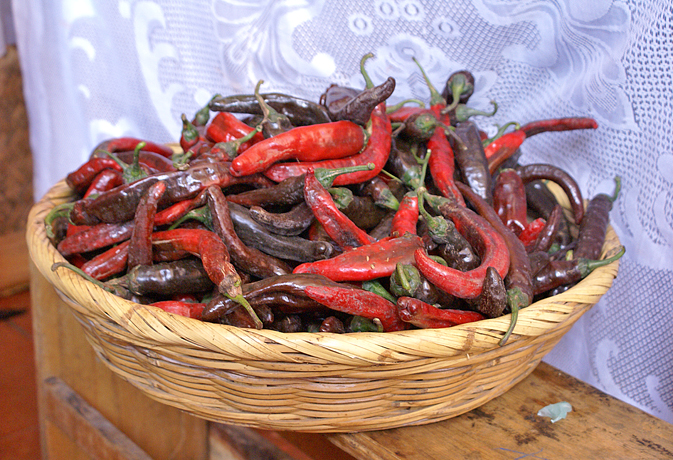
    These chiles chilaca matured to their ripe, deep-red color before harvest.

    The chile chilaca also has other
    names such as negro (black), prieto (dark), or, particularly here in Michoacán, chile para
    deshebrar
    (chile to tear in small strips). High quality chilaca is long, slender and
    undulated. Each chile can measure a foot long.  Before its fully-ripe state the chilaca is inky blue-green, with color and flavor similar to the chile poblano.  Here in Michoacán, where there are at least two names for every growing thing, the fresh chile chilaca is coloquially known as the cuernillo (little horn).  

    Queréndaro la Calle Principal
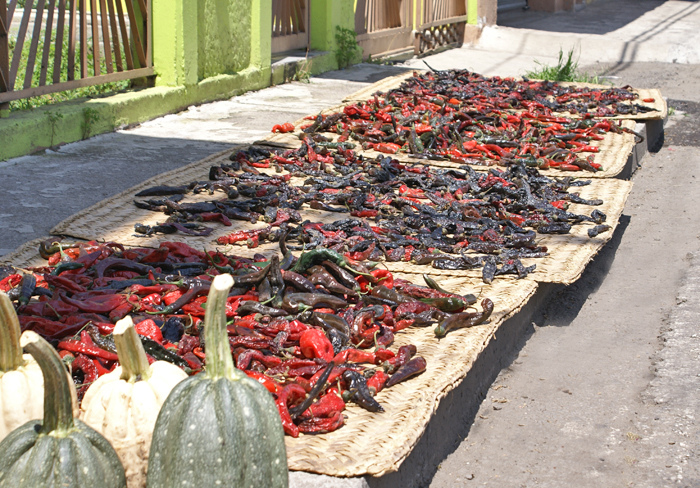
    Most of the locally grown deep-red chiles chilaca are dried in the sun.  These are spread out along a main street in Queréndaro.  The chiles are drying on petates, mats made of woven lake reed.

    The chilaca turns dark reddish-brown when it's allowed to ripen on the bush.  When ripe and then dried in the Queréndaro sun, the chilaca becomes very dark red and is called chile pasilla.  If the seeds are removed from the dried chile, its name is chile capónChiles capones literally means 'castrated' chiles.  This vegetable castration refers to the removal of the seeds prior to cooking.

    Productos Queréndaro
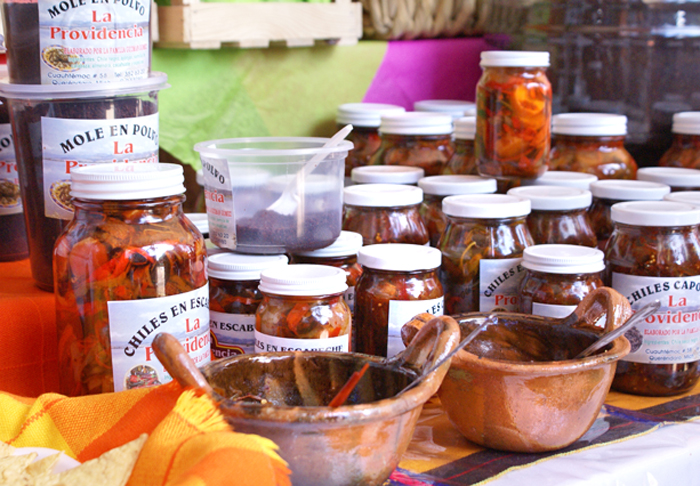
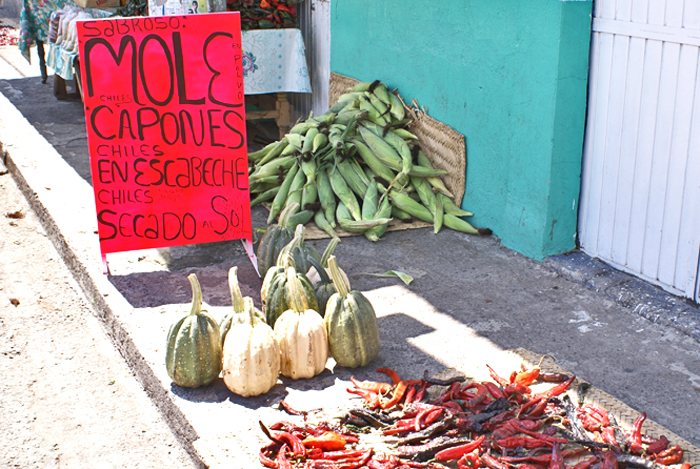
    Some chilacas are sold bottled, either en escabeche (pickled in vinegar) or as chiles capones (dried, seeded, soaked, toasted, and then cooked with onion), to be used as a botana or condimento (appetizer or condiment). 

    Chiles Chilaca Rellenos
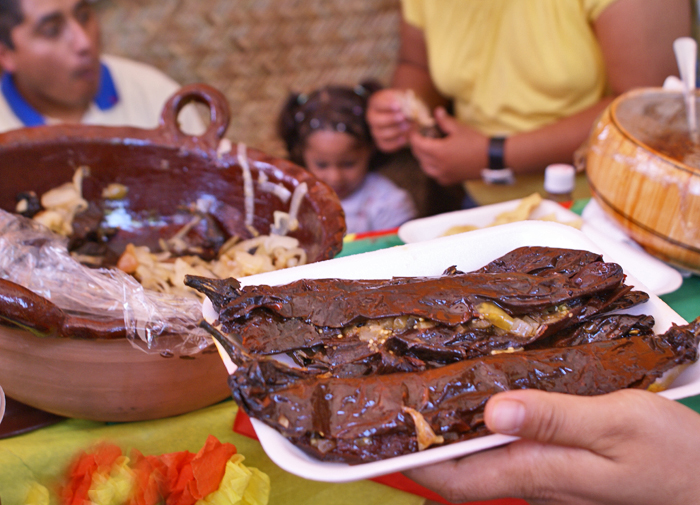
    These are chiles chilaca rellenoschiles capones stuffed with tomates verdes (tomatillos), onion, and garlic.  The chiles in the photo, prepared for carry-out at the Alberto Gómez family booth , still needed to be topped with shredded Oaxaca cheese.

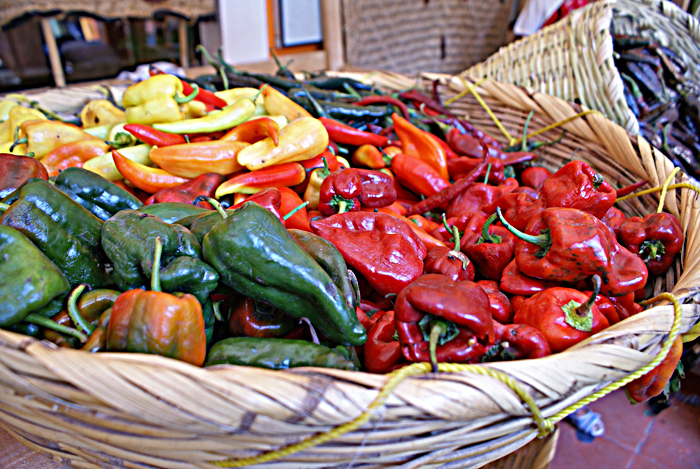
    Chiles Multicolores
    The Barajas family of Queréndaro offered this variety of freshly harvested chiles at their booth at the Feria del Chile.  Clockwise beginning with the dark green chiles at the bottom of the basket, they are:

    • chiles poblano…………14 pesos per kilo
    • chiles güero……………14 pesos per kilo
    • chiles chilaca verde……12 pesos per kilo
    • chiles cola de rata……..50 pesos per kilo (for dry chiles; the booth was out of fresh)
    • chiles poblano rojo…….14 pesos per kilo

    Queréndaro, Michoacán

    Mexico Cooks! bought a kilo of fresh mature (red) chiles chilaca
    We've been preparing them in various dishes.  The flavor they add is
    deeply sweet and deadly hot.  So far, our favorite recipe is with
    potatoes, onions, and flor de calabaza (squash blossoms).  Here's what to do:

    Papas con Flor de Calabaza y Chile

    Ingredients
    3 large white potatoes, russets if you can get them
    1 medium white onion
    2 fresh mature chiles chilaca
    1 large clove garlic
    2 bunches fresh flor de calabaza (squash blossoms)
    Flour
    Vegetable oil or freshly rendered lard
    Water
    Sea salt

    Utensils
    Large pot
    Colander
    Griddle
    Small plastic bag
    Large plastic bag
    Large sauté pan
    Spatula

    Procedure
    Peel
    and cube (approximately 3/4") the potatoes.  Bring salted water to boil
    in a pot large enough for them.  Boil the potatoes until tender
    (approximately 15 minutes) and strain.  Allow the potatoes to dry for 30
    minutes or more.

    Wash and rough-chop the squash blossoms.  Discard their stems.

    Dice the onion to approximately 1/2".  Mince the garlic.

    Heat the dry griddle and roast the chiles until they are blackened.  Put them in the small plastic bag, twist it closed, and allow the chiles to "sweat" for about 10 minutes.  Peel and seed.  Slice the chiles in 1/2" rounds.

    Heat
    the oil or lard in the sauté pan.  While it heats, put approximately
    1/2 cup flour and a teaspoon of sea salt into the large plastic bag. 
    Add the potatoes to the bag and shake until the potatoes are dredged
    with flour and salt.

    Sauté the onions, garlic, and chiles
    Add the potatoes and continue to sauté until the potatoes are golden
    brown.  Add the squash blossoms and sauté briefly–the blossoms will
    wilt.  Add sea salt to taste.

    Serves 3 or 4 as a side dish.

    ¡Provecho!

    Looking for a tailored-to-your-interests specialized tour in Mexico? Click here: Tours.
  • Home Cooking–Traditional Mexican Food, Just Like Mamá Used to Make

    Big Pink Pig Head Mercado San Juan Morelia
    Carnicería (meat market), Mercado San Juan, Morelia, Michoacán.  Would you consider this big pink pig head to be 'authentic' Mexican food?  It truly is; every part of the head is used in Mexico for preparing one dish or another.  Most commonly, the head is used for making pozole.

    More and
    more people who want to experience "real"Mexican food are asking about the
    availability of authentic Mexican meals outside Mexico
    .  Bloggers and posters on food-oriented websites have vociferously
    definite opinions on what constitutes authenticity.  Writers' claims range from the uninformed
    (the fajitas at such-and-such a restaurant are totally authentic, just like in Mexico
    ) to the ridiculous (Mexican cooks in Mexico can't get good ingredients, so
    Mexican meals prepared in the United States
    are superior).

    Much of
    what I read about authentic Mexican cooking reminds me of that old story of the
    blind men and the elephant. "Oh," says
    the first, running his hands up and down the elephant's leg, "an elephant is
    exactly like a tree."  "Aha," says the
    second, stroking the elephant's trunk, "the elephant is precisely like a
    hose."  And so forth. If you haven't experienced what most posters
    persist in calling "authentic Mexican", then there's no way to compare any
    restaurant in the United States
    with anything that is prepared or
    served in Mexico
    . You're simply spinning your wheels.

    Blind Men and Elephant
    The blind men and the elephant.

    It's my
    considered opinion that there is no such thing as one definition of authentic
    Mexican. Wait, before you start
    hopping up and down to refute that, consider that "authentic" is generally what
    you were raised to appreciate. Your
    mother's pot roast is authentic, but so is my mother's. Your aunt's tuna salad is the real deal, but
    so is my aunt's, and they're not the least bit similar.

    The
    descriptor I've come to use for many dishes is 'traditional'. We can
    even argue about  that adjective, but it serves to describe the
    traditional dish of–oh, say carne de
    puerco en chile verde
    –as served in the North of Mexico, in the Central
    Highlands, or in the Yucatán. There may
    be big variations among the preparations of this dish, but each preparation is
    traditional and each is authentic in its region.

    I think
    that in order to understand the cuisines of Mexico
    , we have to give up arguing about
    authenticity and concentrate on the reality of certain dishes.

    Restaurante Los Tacos Al Pastor
    Traditional Mexican pork tacos al pastor (shepherd-style tacos) are a derivation of shawarma, traditional Middle Eastern spit-roasted lamb, chicken, or beef, imported to Mexico by Lebanese immigrants during the 19th century.

    Traditional
    Mexican cooking is not a hit-or-miss let's-make-something-for-dinner
    proposition based on "let's see what we have in the despensa (pantry)." Traditional Mexican cooking is as complicated and precise as traditional
    French cooking, with just as many hide-bound conventions as French cuisine imposes. You can't just throw some chiles and a glob of chocolate into a
    sauce and call it mole. You can't simply decide to call something Mexican salsa when it's not. There are specific recipes to follow,
    specific flavors and textures to expect, and specific results to attain. Yes, some liberties are taken, particularly
    in Mexico
    's new alta
    cocina
    (haute cuisine) and fusion
    restaurants, but even those liberties are generally based on specific traditional recipes.

    In recent
    readings of food-oriented websites, I've noticed questions about what
    ingredients are available in Mexico
    . The posts have gone on to ask
    whether or not those ingredients are up to snuff when compared with what's
    available in what the writer surmises to be more sophisticated food sources
    such as the United States.

    Frijoles y Chiles Sartén
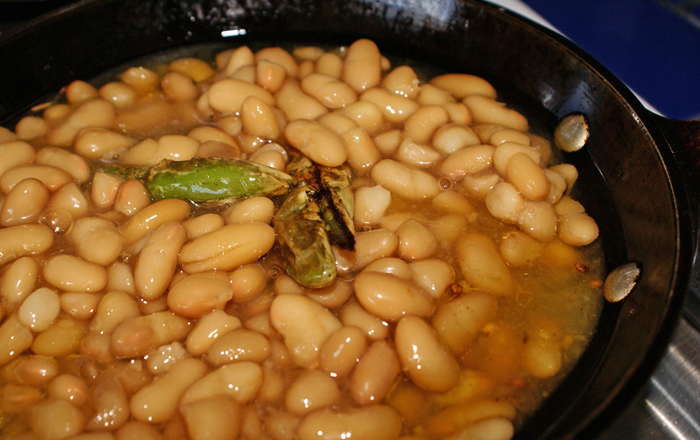
    Frijoles peruanos (so-called Peruvian beans) heating in lard, almost ready to be mashed with a blackened chile serrano, resulting in Mexico's ubiquitous and iconic frijolitos refritos (well-fried beans).

    Surprise,
    surprise: most readily available fresh foods in Mexico
    's markets are even better than similar
    ingredients you find outside Mexico
    . Foreign chefs who tour with me to visit Mexico's stunning produce markets are inevitably
    astonished to see that what is grown for the ordinary home-cook user is
    fresher, more flavorful, more attractive, and much less costly than similar ingredients
    available in the United States
    .

    It's the
    same with most meats: pork and chicken are head and shoulders above what you
    find in North of the Border meat markets. Fish and seafood are from-the-sea fresh and distributed every day, within just a
    few hours of any of Mexico
    's coasts.

    Chiles Rellenos Conde Pétatl
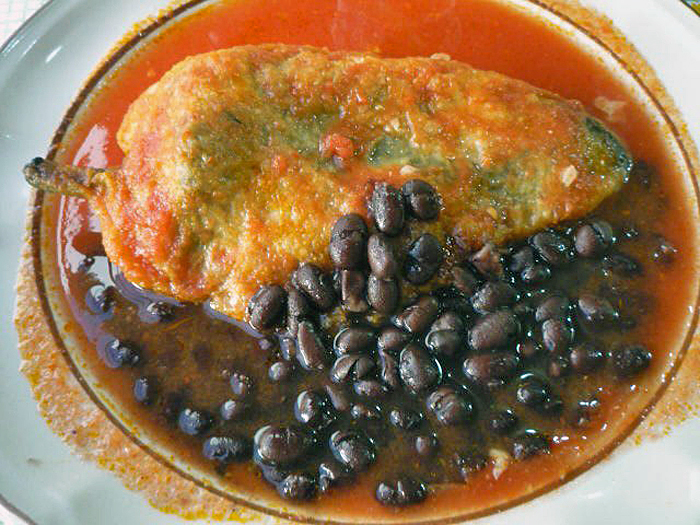
    A traditional way to prepare and plate chiles poblano rellenos
    (stuffed poblano chiles): a poblano chile, roasted, peeled, and seeded,
    then stuffed with a melting white cheese.  The chile is then dredged
    with flour and covered with an egg batter and fried.  It's served
    floating in a pool of very light, mildly spicy caldillo (tomato broth).

    Nevertheless,
    Mexican restaurants in the United States
    make do with the less-than-superior
    ingredients found outside Mexico
    . In fact, some downright delicious traditional Mexican meals can be had
    in some North of the Border Mexican restaurants. Those restaurants are hard to find, though,
    because in the States, most of what has come to be known as Mexican cooking is
    actually Tex-Mex cooking. There's
    nothing wrong with Tex-Mex cooking, nothing at all. It's just not traditional Mexican cooking.  Tex-Mex is great food
    from a particular region of the United States
    . Some of it is adapted from Mexican cooking and some is the invention of
    early Texas
    settlers. Some innovations are adapted from
    both of those points of origin.  Fajitas, ubiquitous on Mexican
    restaurant menus all over the United States, are a typical Tex-Mex
    invention.  Now available in Mexico's restaurants, fajitas are offered to the tourist trade as prototypically authentic. 

    You need to
    know that the best of Mexico
    's cuisines is not found in
    restaurants. It comes straight from
    somebody's mama's kitchen. Clearly not
    all Mexicans are good cooks, just as not all Chinese are good cooks, not all
    Italians are good cooks, etc. But the
    most traditional, the most (if you will) authentic Mexican meals are home
    prepared.

    Pollo en la Olla
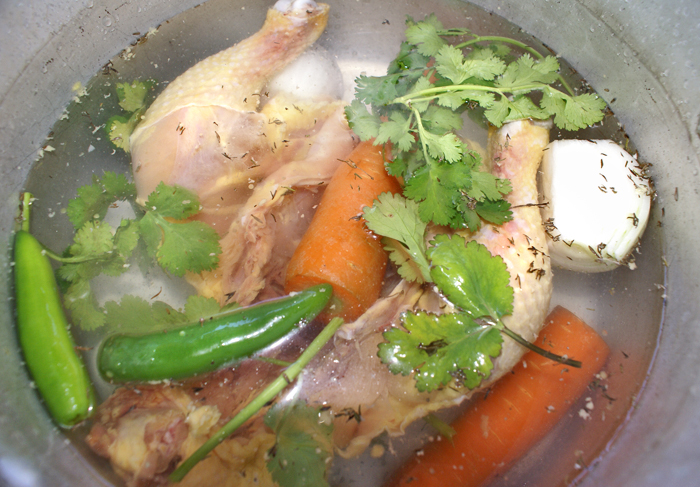
    The simple ingredients of caldo de pollo (Mexican chicken soup) may vary in one or two aspects from region to region, but the traditional basis is what you see: the freshest chicken, onion, carrots, chile, and cilantro give flavor to the broth.

    That
    reality is what made Diana Kennedy who she is today: for 50 years, she has taken the time to
    travel Mexico
    , searching for the best of the best of the
    traditional preparations. For the most
    part, she didn't find them in fancy restaurants, homey comedores (small commercial dining rooms) or fondas
    (tiny working-class restaurants). She found them as she stood next to
    the stove in a home kitchen, watching Doña Fulana (Mrs. So-and-So) prepare comida (the midday main meal of the day) for her family.  She took the time to educate her palate,
    understand the ingredients, taste what was offered to her, and learn, learn,
    learn from home cooks before she started putting traditional recipes,
    techniques, and stories on paper. If we
    take the time to prepare recipes from any of Ms. Kennedy's many cookbooks, we
    too can experience her wealth of experience and can come to understand what
    traditional Mexican cooking can be.  Her books bring Mexico's kitchens to us when we're not able to go to Mexico.

    DK Pensativa 2
    Diana Kennedy at the Universidad Nacional Autónoma Mexicana, June 2011.

    In order to understand the cuisines of Mexico, we need to experience
    their riches. Until that
    time, we can argue till the cows come home and you'll still be just another blind
    guy patting the beast's side and exclaiming how the elephant is mighty like a
    wall.

    Looking for a tailored-to-your-interests specialized tour in Mexico? Click here: Tours.
  • Everything But the Squeal: Chicharrón (aka Fried Pork Skin)

    Chicharrón 1
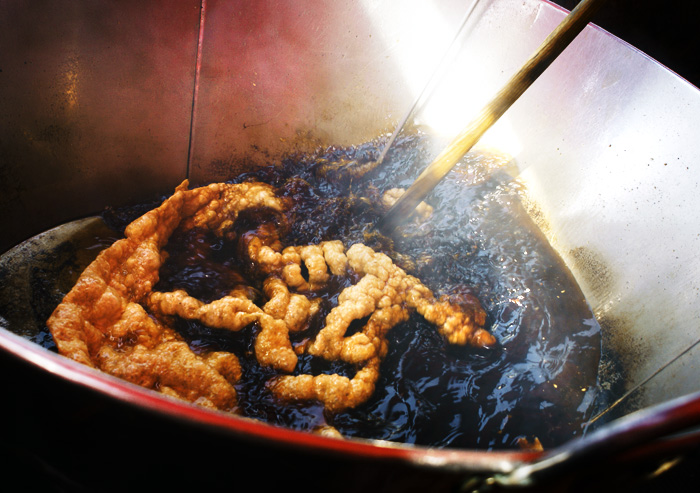
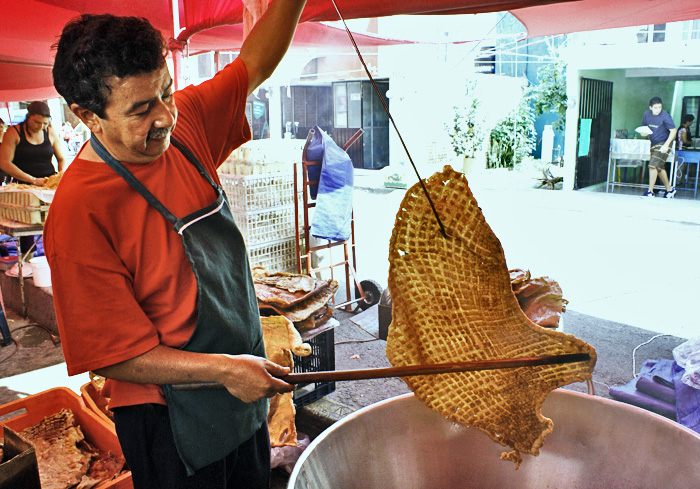
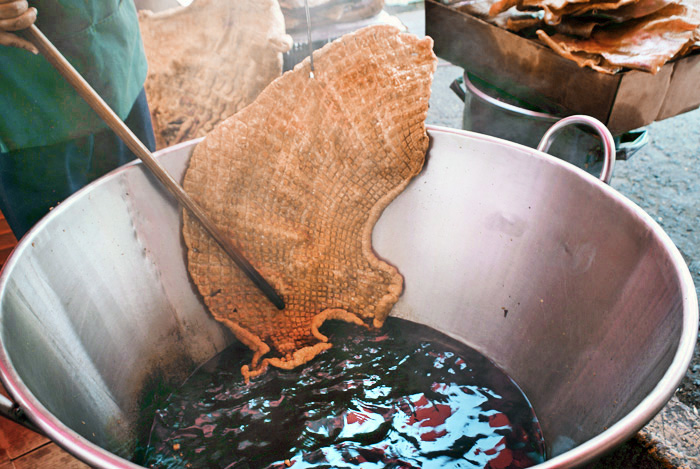
    Hot-out-of-the-grease porky deliciousness: chicharrón (chee-chah-ROHN, fried pork skin), as made at the Morelia tianguis (street market) where Mexico Cooks! shops every Wednesday.  The piece of just-made chicharrón in the photo above is about 60cm high by 45cm wide (two feet by one and a half feet).  The cazo (cooking vessel) in the photo is about three feet in diameter at the top.

    Mexico
    is a huge producer of pork, and not just any pork: the little piggy
    that goes to market here is usually finely grained, tender, and
    flavorful.  The meat has just enough fat-to-lean ratio for a wonderful
    feel in the mouth.  Every part of the pig is consumed, from the head (pozole) to the curlicue tail (cooked in a pot of beans).  Even the skin is eaten, in at least two forms: fried as chicharrón or sliced into thin strips and pickled as cueritos.

    Chicharrón 7
    Fresh chicharrón, almost ready to eat, gets a final dowsing with boiling oil.

    In the United States, pork
    rinds destined for the snack food aisle begin as hard, dry pellets made in a factory. Meat processing plants
    sell these pellets in bulk to snack food producers and individual pork rind vendors. The
    dehydrated pellets are placed in vats of hot cooking oil, maintained at a
    temperature around 400 degrees Fahrenheit (approximately 204 degrees
    Celsius). A consistent cooking temperature is crucial, since colder oil
    may not cause the pellets to puff out during the deep frying
    stage. The individual pork
    rind pellets are held
    down in the near-boiling oil with a metal screen to insure consistency; after about 60 seconds, they're ready for packaging.

    Pork Rind Packaging
    Typical
    pork rind marketing from the United States.  Crunchy pre-packaged pork
    rinds and NASCAR go together like gin and tonic, bread and butter, or
    mashed potatoes and gravy.

    In Mexico, very little processing takes place between the on-the-hoof pig and the cazo (huge metal pot used to make chicharrones). 
    The slaughterer skins the pig in as large a single piece as possible,
    soaks the skin briefly in brine, and sends it to market.  At the tianguis where I shop on Wednesdays, the chicharrón vendor's brother kills the pig at the rancho.  Another relative–the vendor next to the chicharrón
    purveyor–sells the rest of the freshly killed animal: ribs, tongue,
    liver, kidneys, legs, chops, tenderloin, etc.  Feet sell fresh or
    pickled, ears sell fresh or fried.

    Chicharrón 2
    In Mexico, customers usually wait in line for fresh chicharrón to come out of the cazo.  Although packaged chicharrón is available in supermarkets, freshly-made is infinitely better.  Truly, there is no comparison.

    Pork rinds, long a popular snack food in the southern United States, became
    popular country-wide with the advent of high-protein food plans such as
    the Atkins and South Beach
    diets. Unlike potato or corn chips, fried pork rinds have no
    carbohydrates at all. They are exceptionally high in protein, however,
    which makes them ideal for those who prefer snack foods that have no starch component.

    Chicharrón 3
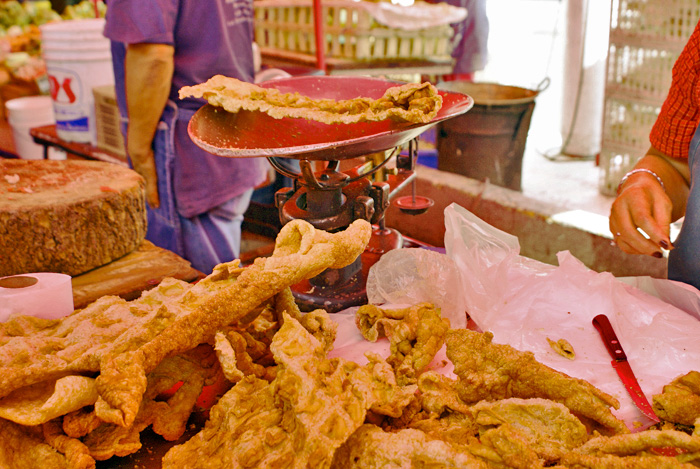
    Fresh chicharrón can be delgado (thin, above) or gordito (thick, below).  Chicharrón delgado is just the crispy, crunchy fried skin of the pig.  Ask the vendor to weigh out as much or as little as you need; in Mexico, chicharrón is sold by the kilo.  You can see the old-fashioned scale that my vendor uses in the photo above.  Other vendors at the tianguis use digital electronic scales.

    Chicharrón 5
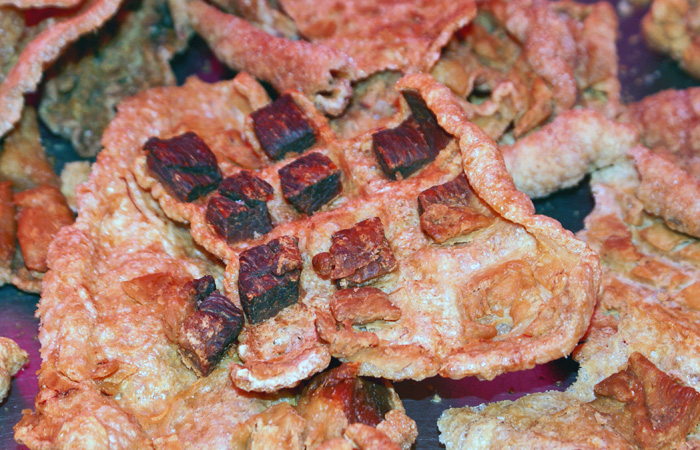
    Chicharrón gordito
    is fried with little squares of pork meat still attached to the skin. 
    The meat develops a creamy texture, which contrasts beautifully with the
    crunch of the crisp-fried skin.  The difference in color between this
    photo and the one above is due to the red lona (tarp) that hung above the first booth and the blue lona that hung over the second booth.

    The main concern about pork
    rinds, however, is their high sodium content.  Pork
    rinds can have up to three times as much sodium as regular potato
    chips.  In spite of their sodium content, pork rinds are usually less
    greasy than other snacks.

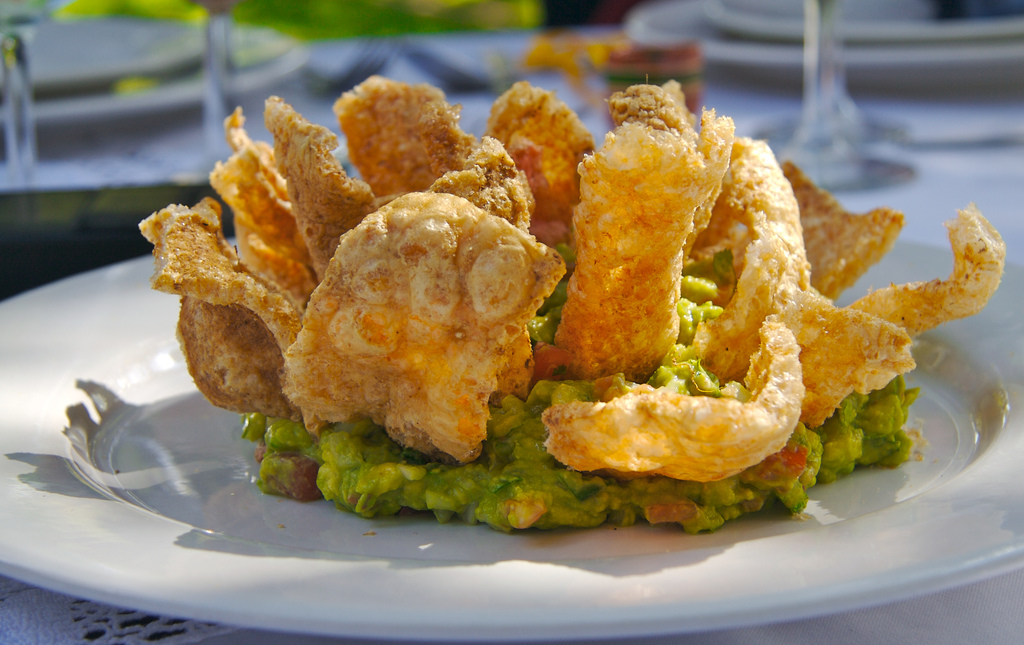
    Pork rinds and Guacamole
    In Mexico, guacamole is often served with chunks of chicharrón instead of totopos (tortilla chips).

    In addition to eating chicharrón as a snack food, most Mexicans also enjoy it as a high-protein yet inexpensive meal.  Served everywhere in Mexico, chicharrones en salsa verde is enormously popular.

    Chicharrones en Salsa Verde
    Fried Pork Skins in Green Sauce

    Sauce
    1 lb fresh tomatillos, husked and washed
    1 large bunch cilantro, washed well
    4 to 6 chiles serranos, depending on your heat tolerance
    Salt to taste

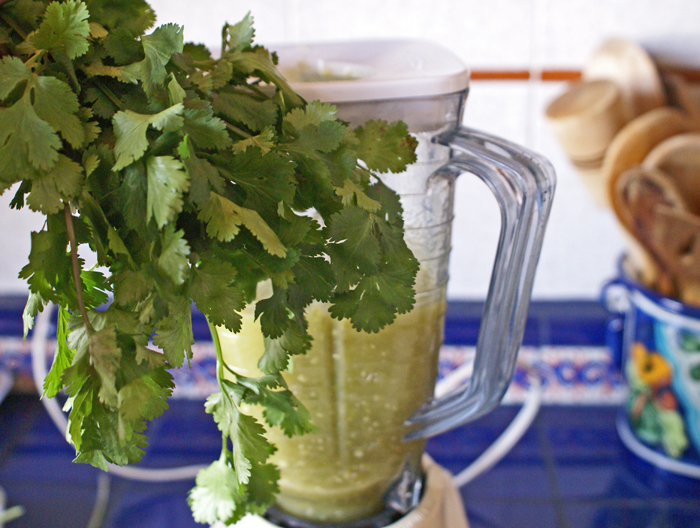
    Listo para Licuar 2
    Mexico Cooks! already ground the tomatillos and chiles in the blender.  The cilantro is ready to add.

    In
    a large, heavy saucepan, bring 4 quarts water to a boil.  Add the husked tomatillos and the
    chiles.  Allow to boil until the
    tomatillos begin to crack open.  As each
    one opens, remove it to your blender jar. 
    A few may not open; when the rest are done, just add the unopened
    tomatillos to the rest in the blender jar. 
    Add the chiles as well.  Blend
    until roughly chopped.  Using the hole in
    the center of your blender top, add the cilantro little by little , blending
    until the cilantro is finely chopped. 
    Add salt to taste.

    Heat the salsa verde in the large, heavy saucepan until the sauce is simmering.  Add six or so ounces of freshly-made crunchy chicharrón delgado.*  Allow the chicharrón and salsa to simmer for several minutes.  The texture of the chicharrón will change; during the simmer time, it will become soft and slippery.

    If you prefer, you can put a portion of chicharrón into a bowl and pour the heated sauce on top.  The chicharrón will stay crunchy. 

    *Don't try to make this recipe with pre-packaged snack food pork rinds; they will fall apart in the sauce. 

    Serve with hot tortillas, steamed rice, and a cold beer.

    Serves two or three. 

    Provecho!

    Looking
    for a tailored-to-your-interests specialized tour in Mexico? Click
    here:
    Tours.
  • On the Table: Mexico Cooks! Dines Out and Dines at Home

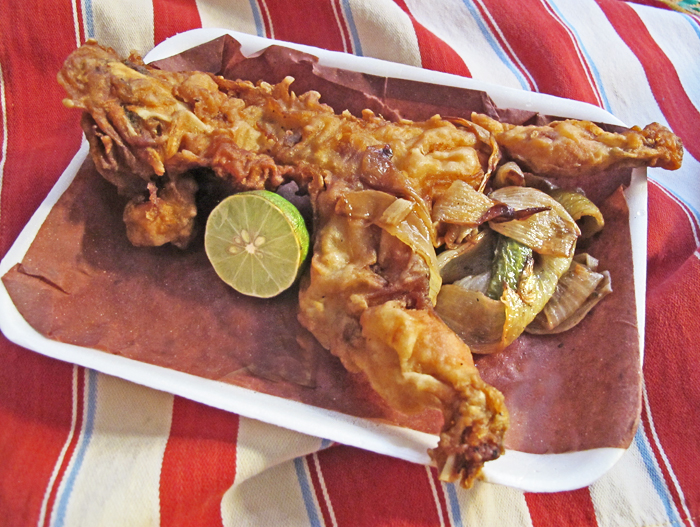
    Morelia Deep-Fried Whole Frog
    A whole frog, battered, deep fried and served with chiles toreados (chile serrano, rolled in oil and grilled or sautéed until soft), cebolla blanca (white onion, in this case caramelized), and limón to squeeze all over it.  Deep fried frogs are a specialty of Queréndaro, Michoacán.  It's a truly graphic presentation, but you only eat the legs–unless you care to nibble on other parts.

    DF Xochimilco Trajinera Cocinando 2
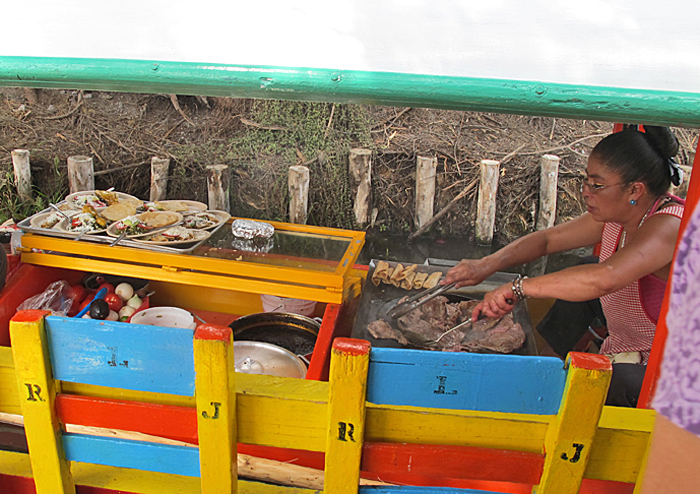
    A Sunday afternoon on the trajineras (boats) in Xochimilco requires a refueling stop at a 'restaurant' trajinera.  In this case, our midday meal was juicy carne asada (grilled meat) and quesadillas cooked to order, guacamole and tortilla chips, rice, beans, and hot-off-the griddle tortillas.  Delicious!

    Pan Manduca Pretzel Bread
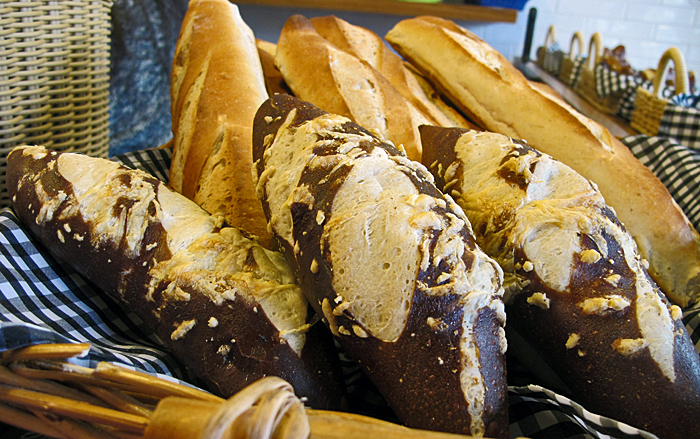
    Mexico Cooks! discovered Panadería Manduca at Av. Nuevo León #125-B during the November Col. Condesa bakery crawl and hasn't stopped buying their marvelous made-on-site pretzel bread.  The bread is dense, extremely flavorful, and just the way we like it.

    Pan de Romero Rosetta
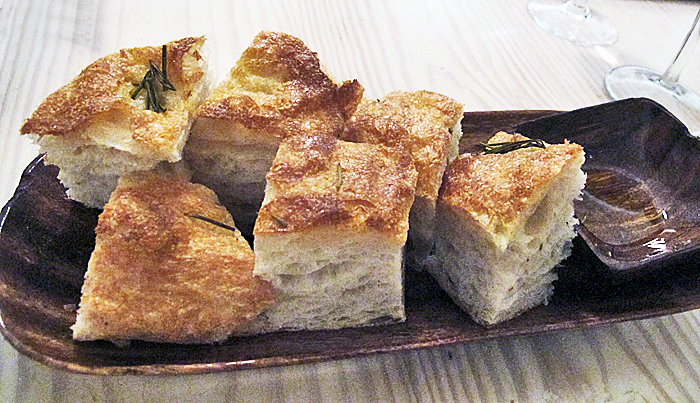
    Still on the bread theme, here's the pan de romero (rosemary bread) from Rosetta, a lovely Italian restaurant at Calle Colima 166, Col. Roma Sur, Mexico City.  Next time we eat there, I promise you a report on London-trained chef Elena Reygada's wonderful food.

    Italian Sausage and Peppers Sandwich 2
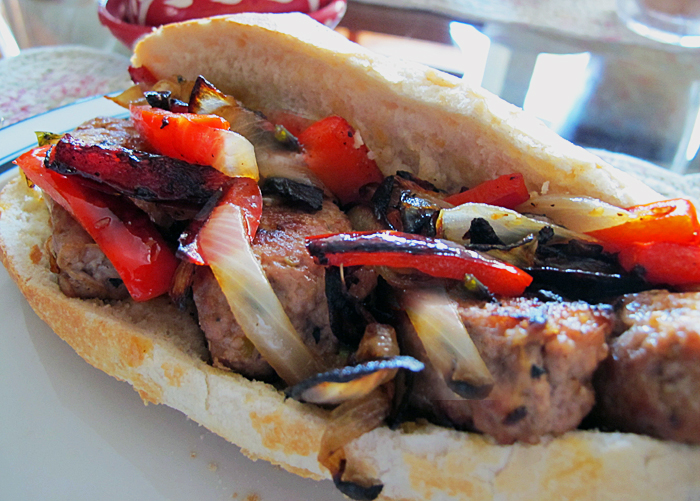
    Home cooking: Mexico Cooks! prepared the hot, fennel-y Italian sausage and then created sausage, peppers, and onion sandwiches for a recent meal at home. 

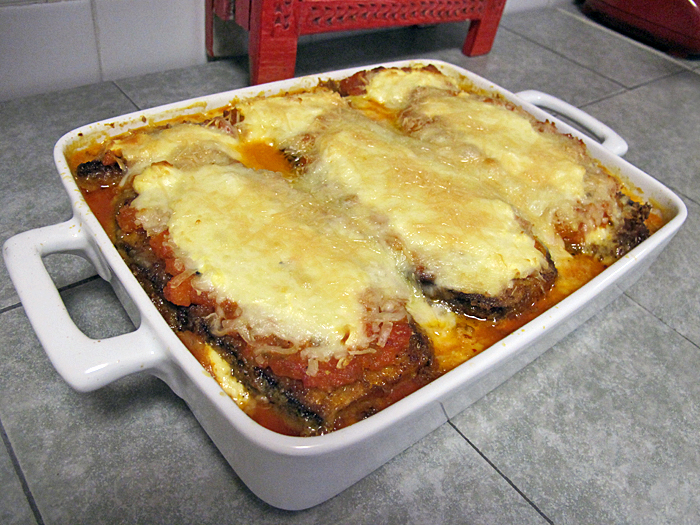
    Eggplant Parmagiana Out of the Oven
    Another home-cooked meal: eggplant parmagianaPeter Francis Battaglia, an Italian-American friend in New Jersey, keeps me inspired to try his recipes.  Once you've read his web page and seen his photos, you'll be equally inspired.

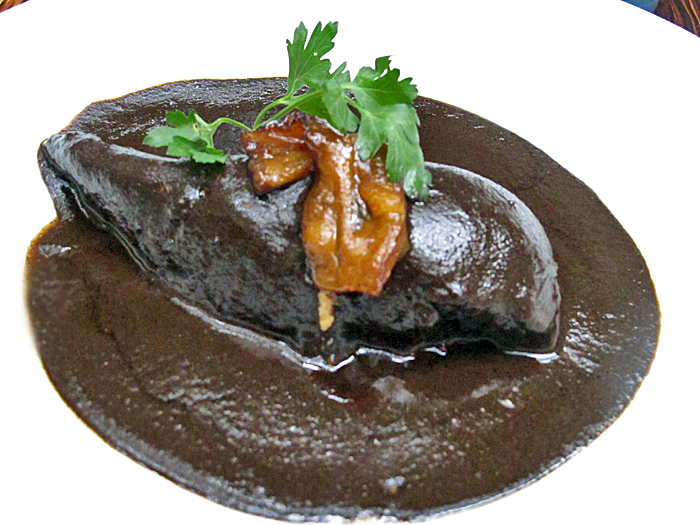
    Azul Histórico 8 Pechuga en Mole Negro
    Once every six weeks or so, Azul/Condesa or Azul/Histórico call out to us.  It's difficult for me to resist the pechuga de pollo en mole negro (chicken breast in black mole).  For me, Chef Ricardo Muñoz Zurita's mole negro recipe continues to be the gold standard for this dish.

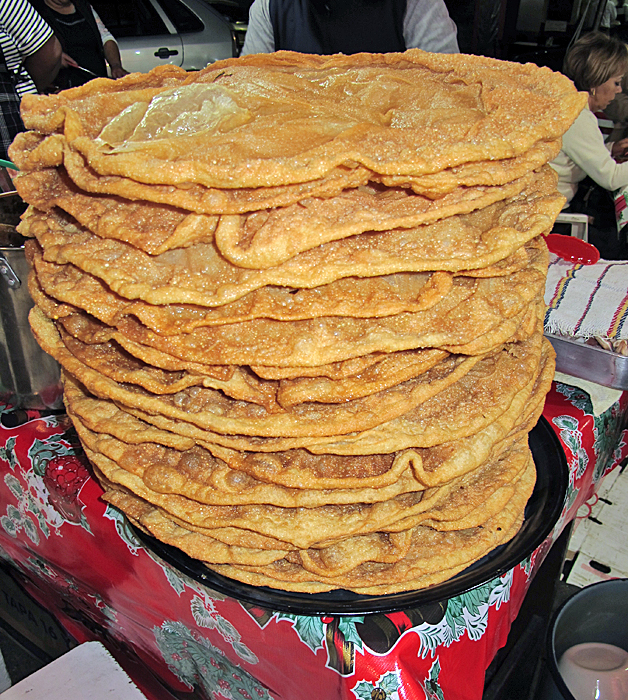
    Morelia Buñuelos
    To end on a sweet note: these buñuelos–foot-in-diameter deep-fried flour pastry, finished with a dash of granulated sugar and cinnamon, broken onto a plate or into a bowl and bathed with syrup made of piloncillo–were on the fonda table (small family food booth or restaurant) next to me the last time I was in Morelia, Michoacán.  Could you resist?  I couldn't.

    Looking for a tailored-to-your-interests specialized tour in Mexico? Click here: Tours.
  • Flaneur Redux: Mexico City Places to Go, People to See, Things to Eat and Drink…

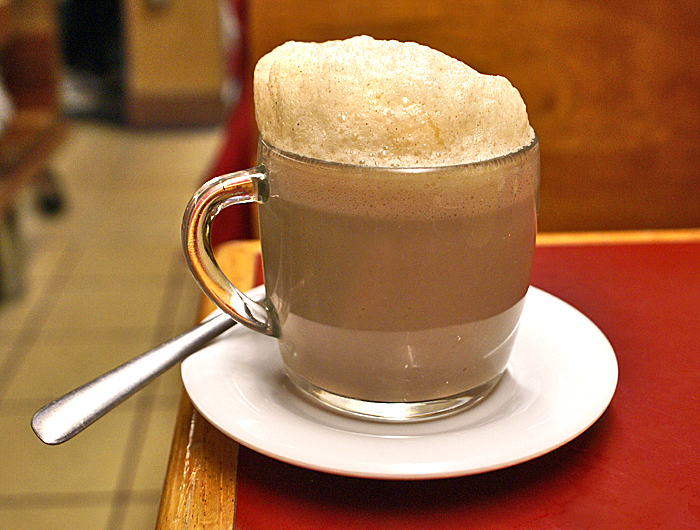
    Chocolate a la española, El Popular
    Chocolate a la española (Spanish-style hot chocolate), Café El Popular, 5 de Mayo #40, Centro Histórico.

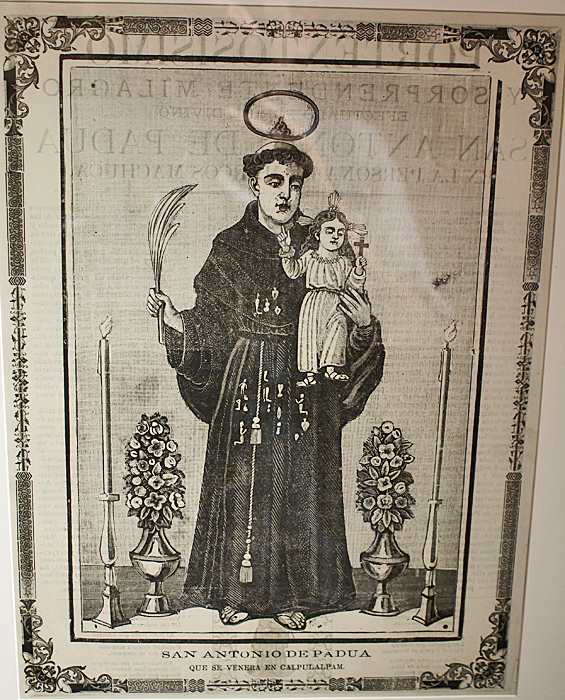
    Posada San Antonio de Pádua
    San Antonio de Padua
    (St. Anthony of Padua), José Guadalupe Posada.  Collection Carlos
    Monsiváis, Museo del Estanquillo, Isabel la Católica #26, Centro
    Histórico.

    Bazar Sábado Pepitorias 2
    Pepitorias for sale at San Ángel's delightful Bazar Sábado.

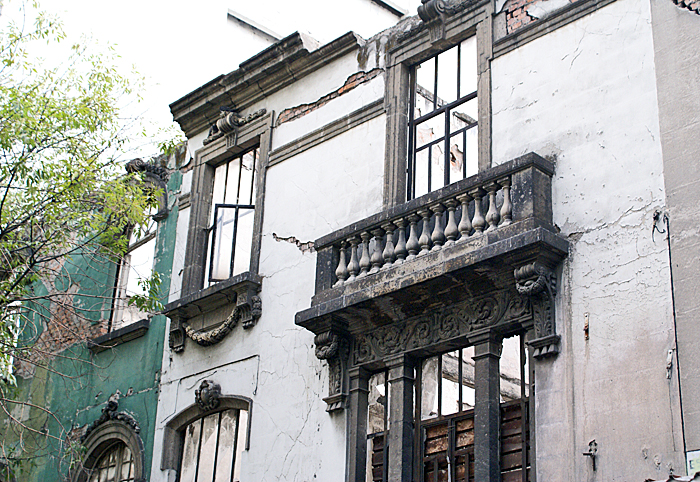
    Colonia Roma Wreck
    Just a shell of its former self, a shadow of its former glory.  Remains of private home, Colonia Roma.

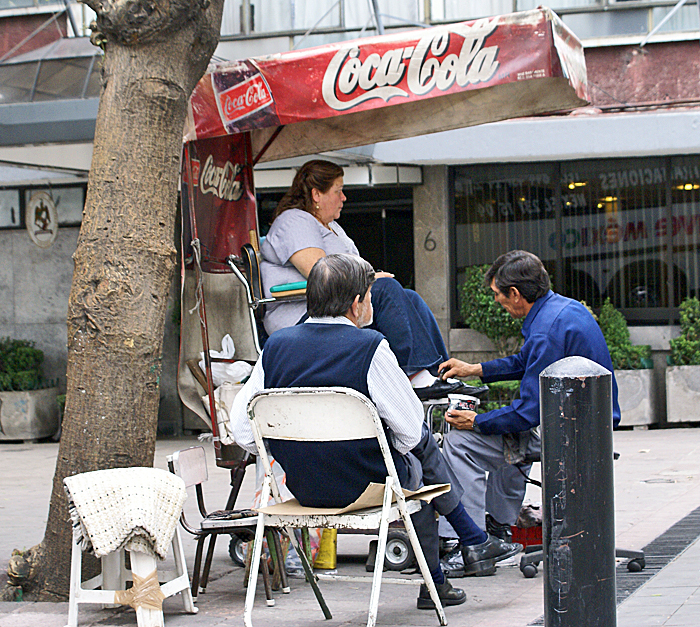
    DF Boleada Next...
    A bolero is not always a song.  Shoeshine stand, Centró Histórico, DF.

    DF Santuario San Charbel 1
    Santuario de San Charbel (Sanctuary of Saint Charbel), Calle Uruguay, Mexico City.

    La Lagunilla Metrobus Insurgentes
    MetroBús stop, Glorieta Insurgentes.  Another kind of shadow.

    La Lagunilla 1 MetroBus
    MetroBús, Glorieta Insurgentes.

    Stairway, Escuela de Gastronomía
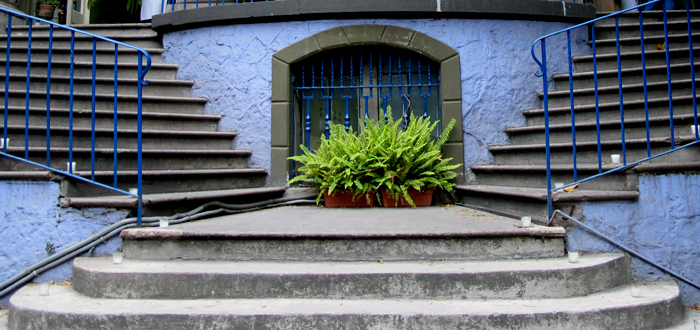
    Gradas al Atardecer (Stairway at Dusk), Escuela de Gastronomía Mexicana, Col. Roma.

    La Lagunilla Lentes
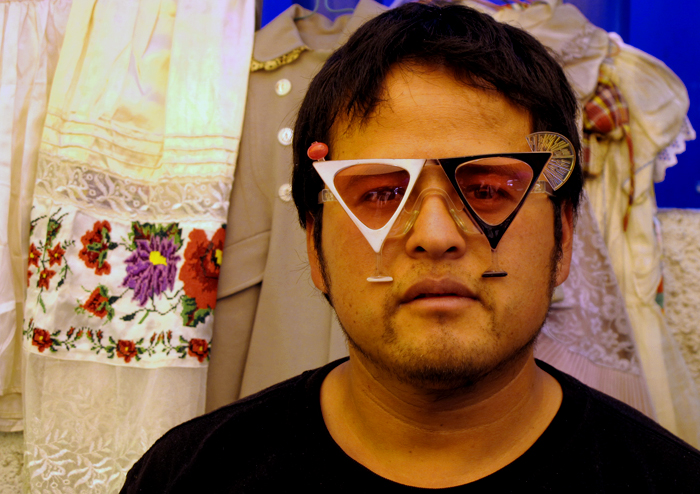
    Cocktail hour sunglasses from the 1960s, modeled by the vendor.  La Lagunilla.

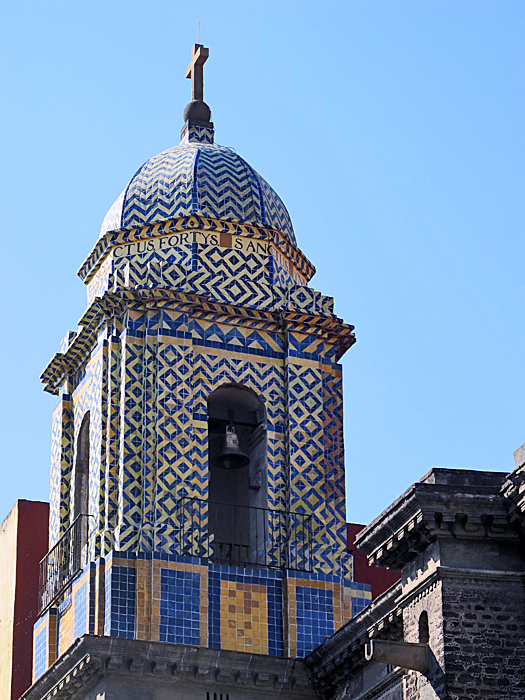
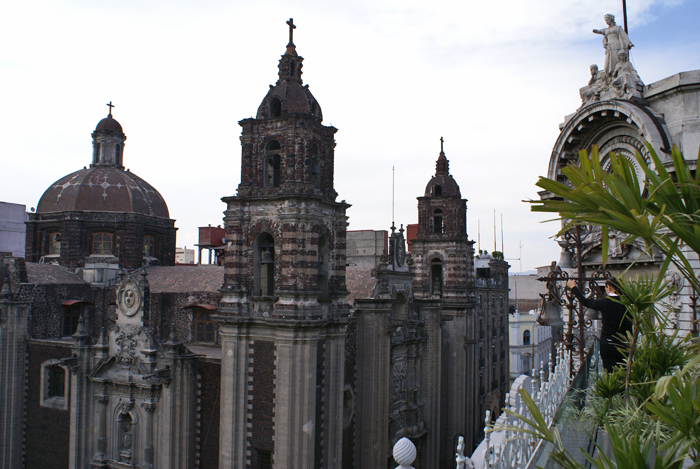
    Templo de la Profesa, Centro Histórico
    18th
    Century barroque Templo de la Profesa, Isabel la Católica esq.
    Francisco Madero, Centro Histórico.  From the rooftop, Museo del
    Estanquillo.

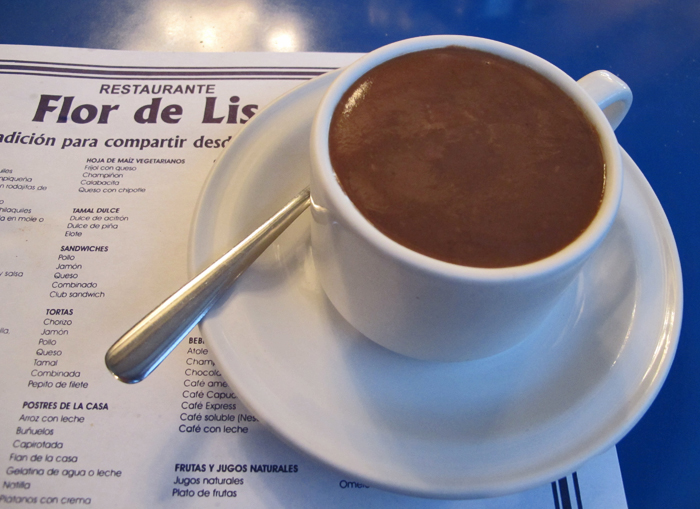
    Flor de Lis Champurrado
    Champurrado (atole, a thick, hot corn-based drink, in this instance made with chocolate), Restaurante Flor de Lis, Col. Condesa.

    Looking for a tailored-to-your-interests specialized tour in Mexico? Click here: Tours.
  • Izote de Patricia Quintana: History on Your Plate

    Izote, Patricia Quintana's groundbreaking Mexico City restaurant, will close permanently on June 30, 2013.  This article, originally published on November 19, 2011, recounts just one of Mexico Cooks!' wonderful experiences there.  Thank you, Chef Paty, for your incredible contribution to the cuisines of our beloved Mexico.  Adelante, amiga!

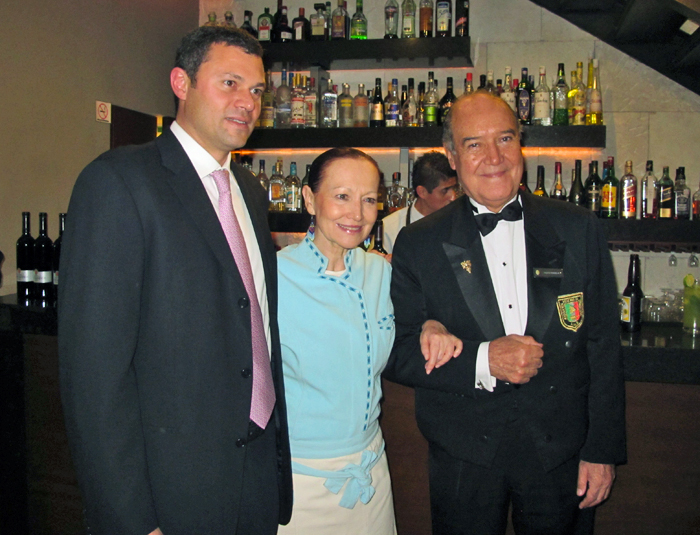
    IZOTE Patricia Quintana, Pedro Poncelis, Brandon Milmo
    Sr. Brandon Milmo, director of Casa Madero Winery (Parras, Coahuila,
    Mexico), chef Patricia Quintana, and don Pedro Poncelis, Mexico's
    premier sommelier, at Restaurante Izote de Patricia Quintana.

    Rain!  As Mexico Cooks! was leaving the house, as we finally
    grabbed a cab, while we were traveling (in rush hour traffic, of
    course) to Mexico City's upscale Colonia Polanco, the unseasonable rain
    bucketed down.  But like magic, just as we pulled onto slightly
    nose-in-the-air Av. Presidente Masaryk (Mexico City's equivalent to New
    York's Fifth Avenue) the rain–and the cab–stopped.  Respectably late,
    we strolled, blessedly dry and with umbrellas tightly furled, into
    Patricia Quintana's little piece of heaven: Restaurante Izote.

    IZOTE Diapositiva 1
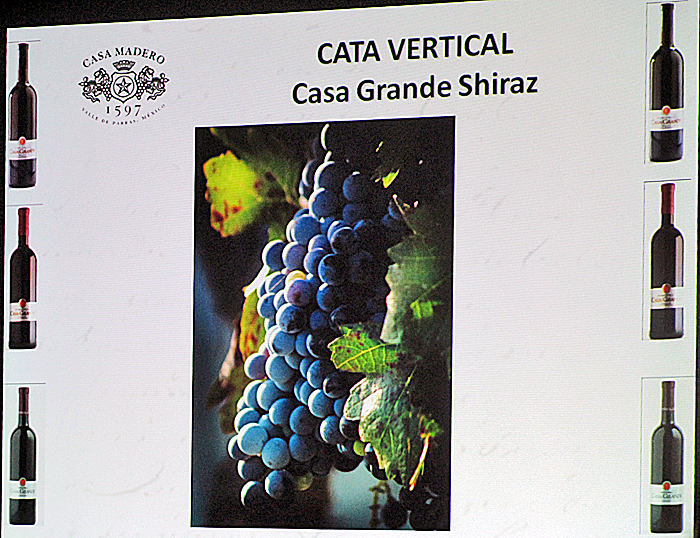
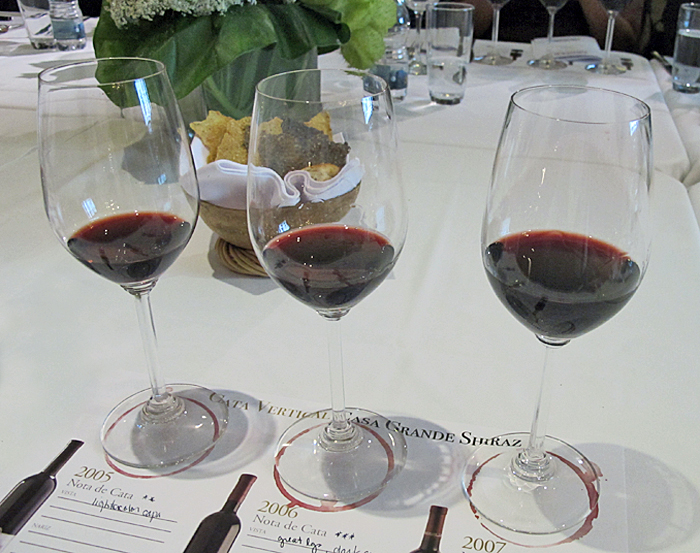
    Casa Madero sponsored the Casa Grande Shiraz cata vertical
    (vertical wine tasting).  In a vertical wine tasting, each of the wines
    served is the same, but from several different years.  In this case,
    the Casa Grande Shiraz was from 2005, 2006, and 2007.  Grown on the same
    vines but under slightly different climatic conditions, each year's
    crop had different fragrances, colors, and flavors.

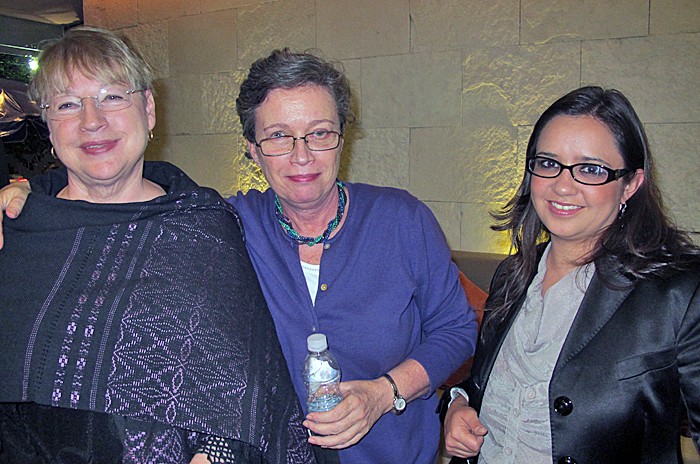
    IZOTE Judy, Rondi Frankel, Fabiola de la Fuente
    Judith
    McKnight, left, enjoys the company of Mexico City wine expert Rondi
    Frankel (center) and Fabiola de la Fuente, editorial director of
    Food+Travel México magazine.  We all found plenty to talk about before
    we were seated for the wine tasting and dinner pairings.  A tidbit of
    information: Casa Madero, founded in 1597, is the oldest winery in the
    New World.

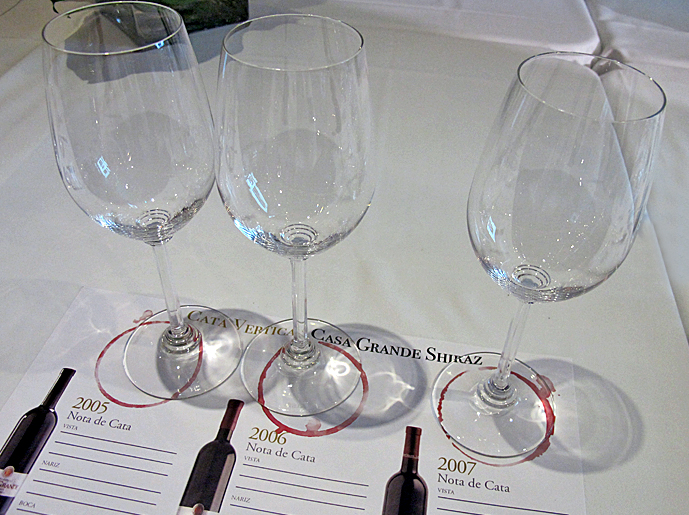
    IZOTE Mantelito Casa Grande
    At first glance, these Casa Madero placemats appeared to have been already used, stained by circles of vino tinto (red wine).  Several people (including Mexico Cooks!)
    not-so-surreptitiously touched the wine stains, only to discover that
    they were cleverly printed on the paper mat.  Below each supposed stain
    was space for notes about each year's wine.  Jorge Luis Trejo
    Villaseñor, Casa Madero's national sales manager, called my attention to
    the outstanding legend at the bottom of the placemat: A qué sabe un vino con 5 siglos de pasión? (What is the flavor of a wine with five centuries of passion?)

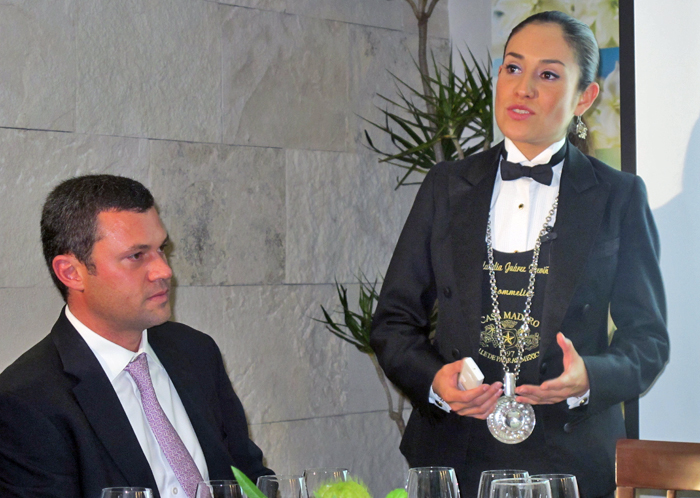
    IZOTE Brandon Milmo con Sommelier Claudia Juárez
    Casa
    Madero's director, Brandon Milmo, listens intently as elegant sommelier
    (highly trained wine steward) Claudia Juárez discusses the special
    characteristics of each of the three Shiraz wines.  She wears the
    sommelier's formal uniform, including the tastevin on its chain.

    The tastevin (saucer-like silver cup) was originally created
    by French winemakers to enable them to judge the clarity and color of
    wine that was stored in dim, candle-lit wine cellars. Regular wine
    glasses were too deep to allow for accurate judging of the wine's color
    in such faint light. Tastevin are designed with a shiny
    faceted inner surface. Often, the bottom of the cup is convex in shape.
    The facets, convex bottom, and the shiny inner surface catch as much
    available light as possible, reflecting it throughout the wine in the
    cup, making it possible to see through the wine.

    With the advent of modern electric lights, the tastevin has
    very little practical use, although sommeliers often wear them on a
    ribbon or chain around the neck as a nod to tradition and a symbol of
    pride in their profession.

    IZOTE Tres Copas
    The three Casa Grande Shiraz pours; from left to right, 2005, 2006, and 2007.

    While sommelier Claudia Juárez instructed us, we 50 guests of the house carefully tasted the three wines.  Mexico Cooks! is a relative neophyte in the world of oenology, but the lessons of the evening were well learned.  Really tasting
    wine isn't about pounding down a tumblerful of the rosé that you've
    poured from the cheap boxed wine in your refrigerator.  Instead, there
    are qualities to look for in your glass: how does the wine look, from
    its color to its 'legs'?  How does it smell–fruity, nutty, leathery,
    spicy?  How does it taste–floral, peppery, acidic, light, heavy?  Most
    important of all, of course, is whether or not you like what you're
    drinking.

    IZOTE Copa con Piernas
    A
    wine's 'legs' (also called 'tears') are the subtle traces left on the
    inner bowl of the glass after the wine is gently swirled around several
    times.  Once thought to be an indicator of quality, experts now say that
    the legs are in fact a product of surface tension and an indicator of
    alcohol content.  In the photograph, you have the best view of the legs
    at the bottom left corner of the flower arrangement.

    After carefully tasting each individual Shiraz and then comparing the
    various merits of the three years, we began to enjoy the food maridaje
    (pairings with the wines).  Chef Patricia Quintana, internationally
    known for Restaurante Izote, for her many cookbooks, her television
    shows, and her annual Aromas y Sabores tours, prepared a twelve-course tasting menu (yes, twelve courses!) consisting of eight savories and four sweets.

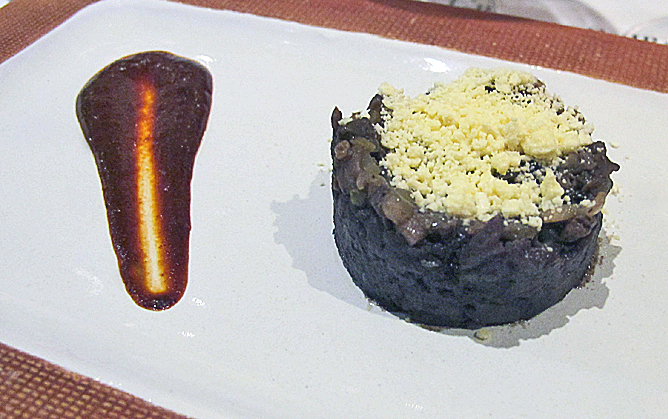
    IZOTE 1 Timbal de Frijol con Morilla
    First course: timbal de frijol con morillas, queso pijijiapan y chile ancho con mezcal
    In this case, the timbale is a cylindrical mold of beans filled with
    minced morel mushrooms and topped with cheese from Pijijiapan, Chiapas. 
    You can see the sauce on the side.

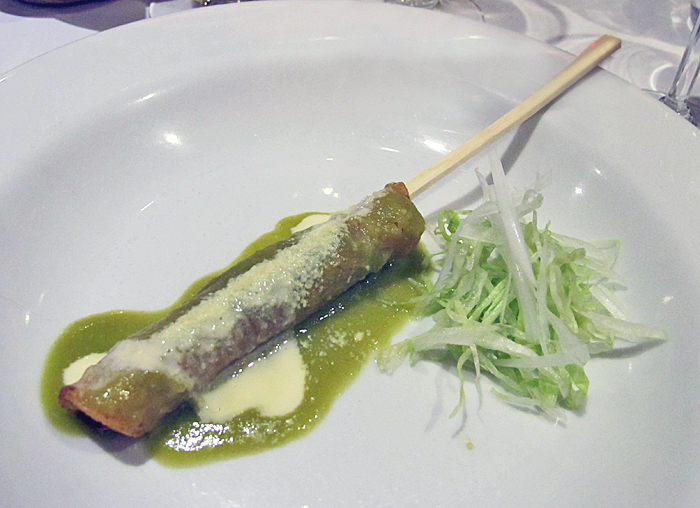
    IZOTE 2 Taquito de Cabrito en Salsa Verde
    Next, a taquito de cabrito con salsa verde–a
    freshly made corn tortilla wrapped around shredded goat meat, then
    fried and bathed with green sauce, Mexican table cream, and dusted with
    aged cheese.  A chopstick, inserted into one end of the taquito, made for ease of handling.

    IZOTE 3 Enchilada de Queso Asadero
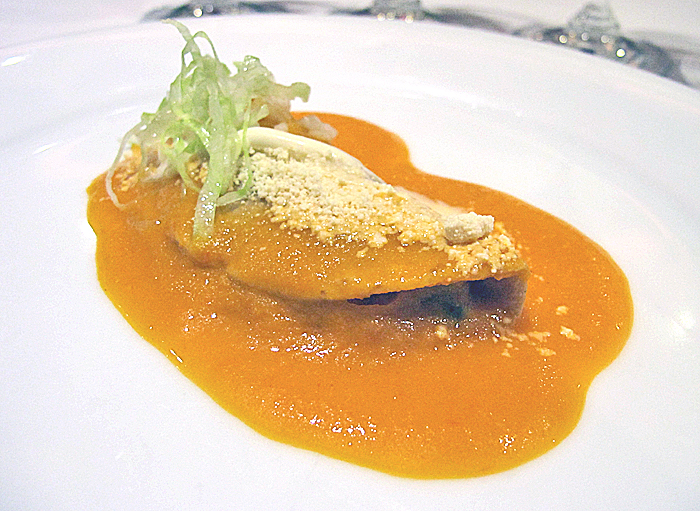
    Third course: enchiladas de queso asadero en salsa de jitomate con chile verdeQueso asadero
    is a melting cheese, used in this instance to fill the enchilada.  The
    tomato and green chile sauce, along with the topping of thinly sliced
    onion, finely grated aged cheese, and shredded lettuce, were traditional
    accompaniments raised to a celestial level.

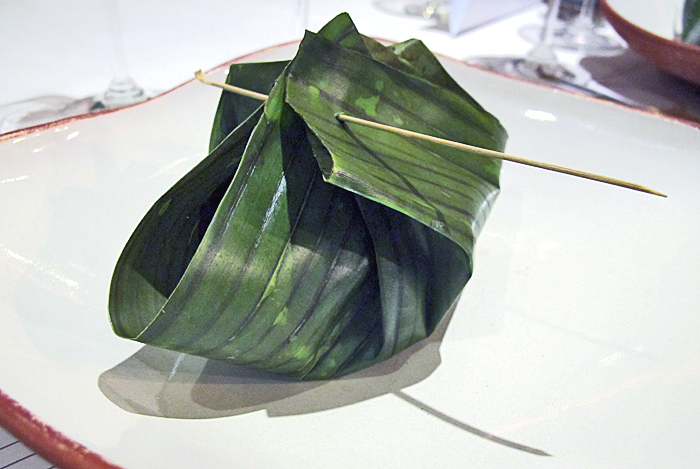
    IZOTE 4 Pescado al Vapor con Tinga Cerrado
    Fourth: pescado al vapor a la tinga con papa
    (steamed fish, in this case red snapper, in a spicy red sauce–all
    sitting on a slice of potato and wrapped for steaming in a banana leaf).

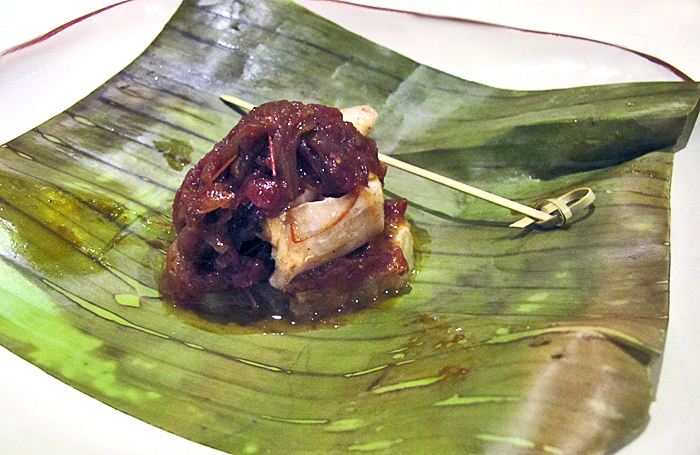
    IZOTE 4.5 Pescado al Vapor con Tinga Abierto
    The banana leaf spread open, showing the pescado al vapor a la tinga con papa.  This dish was my hands-down favorite.  The mixture of flavors in the tinga combined with the sweet tenderness of the fish to explode in a sensational fiesta in my mouth.

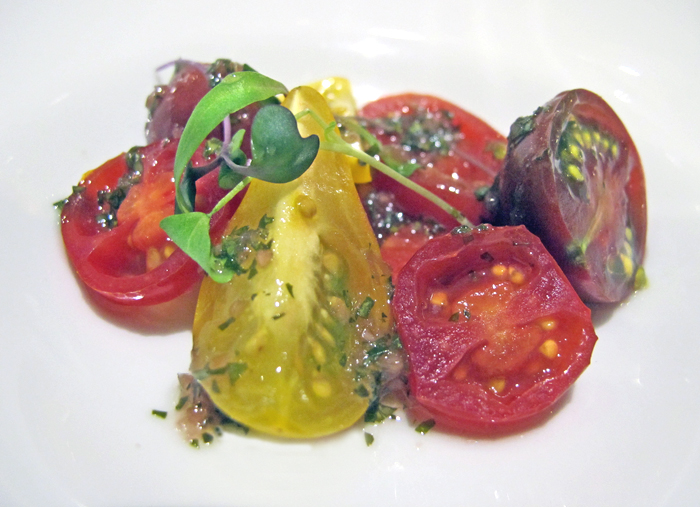
    IZOTE 5 Ensalada de Jitomatito
    Fifth course: ensalada de jitomatitos con vinagreta al Shiraz Casa Grande 2007
    This salad is made of tiny grape tomatoes dressed with a vinaigrette
    made with the 2007 wine we were tasting.  The presentation of this
    salad, as well as that of all the courses, was exquisite.

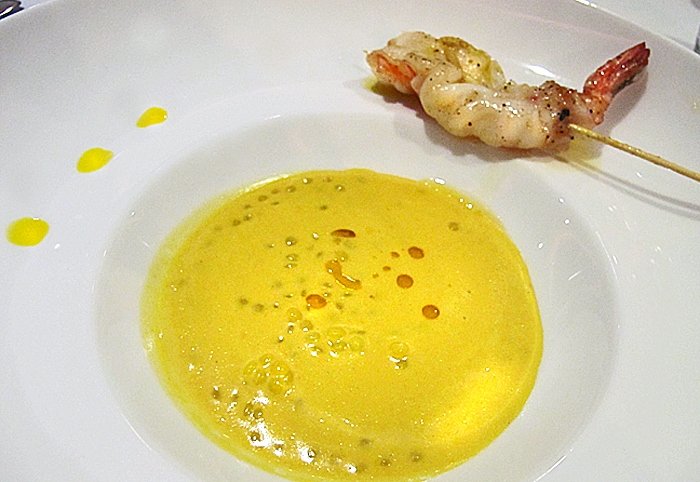
    IZOTE 6 Camarones con Municiones al Azafrán
    Sixth: camarones con azafrán y municiones
    (shrimp in saffron sauce with little pasta 'bullets').  Perfectly
    cooked shrimp-on-a-stick combined beautifully with the richly delicate
    flavor of saffron, but in my opinion the municiones were a mistake.  The pasta gave the dish a texture that reminded me–and not in a good way–of tapioca pudding.

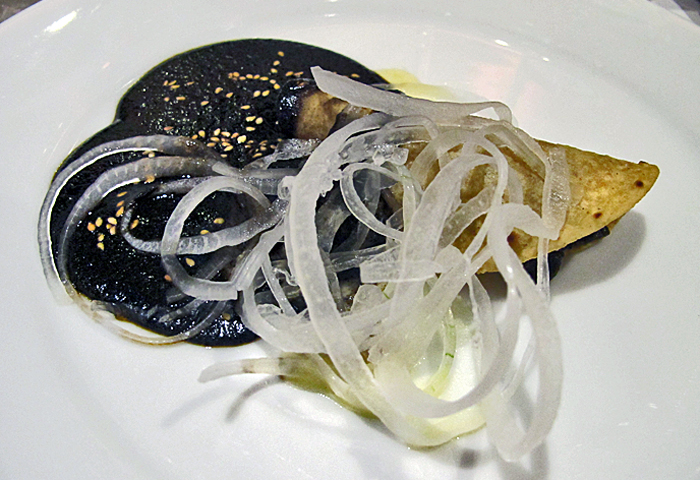
    IZOTE 7 Enchiladas de Mole Negro
    Seventh: enchiladas de mole negro
    (black mole enchiladas).  Black mole is one of Mexico's most delicious
    sauces and this one was no exception.  The combination of mole, sesame
    seeds, crisp tortilla, and shredded onions–wow!

    All of us guests were of different opinions about which of the three
    years' Shiraz wines paired better with each of the courses we were
    eating, but many preferred the 2006 to the earlier or later year.  The
    2006 was Mexico Cooks!' favorite.  Waiters circulated with
    bottles of each Shiraz, replenishing our wine glasses as we emptied
    them.  At this point in the meal–after most of the courses had been
    served–many of us began requesting water rather than more wine!

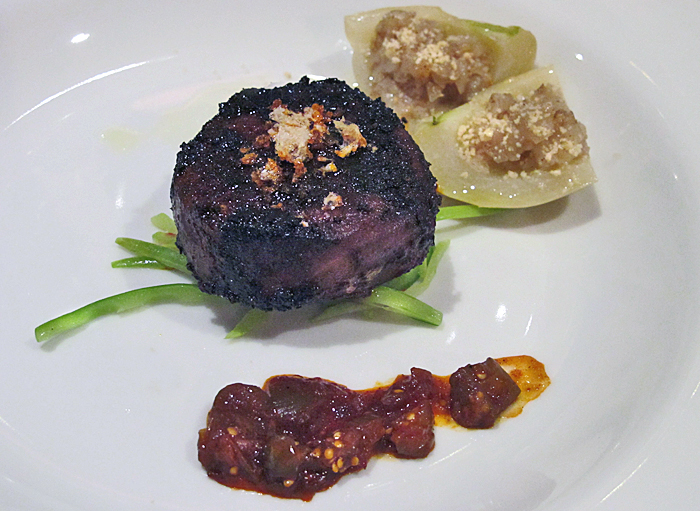
    IZOTE 8 Filete Manuelita estilo Parras
    Eighth: filete Doña Manuelita de Parras
    This seared and crusty filet mignon was cooked exactly to medium rare. 
    The accompaniments, including the stuffed chayote seen at the top, were
    excellent.

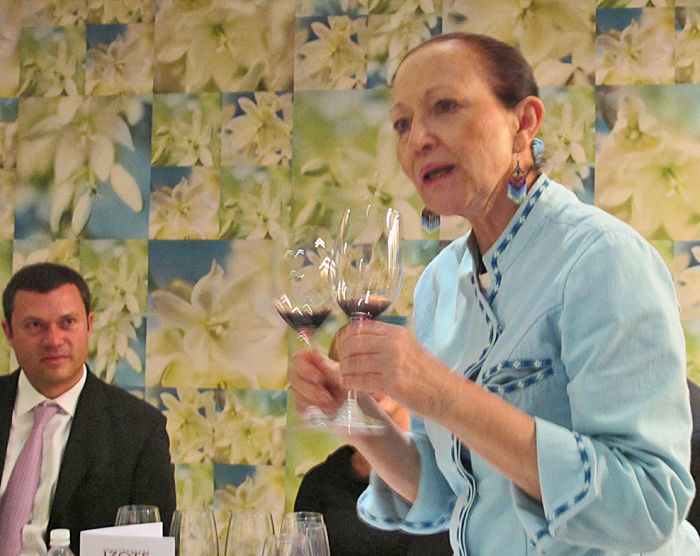
    IZOTE Brandon Milmo con Patricia Quintana
    Chef Patricia Quintana gently tapped two copas
    (wine glasses) together to quiet the crowd before she spoke to us about
    the meal in progress.  The flower in the photo's background images is
    the izote (the edible flower of the yucca cactus)for which she named her restaurant.

    After the first eight courses, which were of course accompanied by
    liberal pourings of each of the three wines, most of the invited guests
    were simply unable to continue to the four-course dessert menu.  Even
    though each of the savory courses was a small portion, their accumulated
    richness overpowered all but the most hardy souls.  In addition, we
    finished the last of the savories at midnight!  Reluctantly we
    congratulated the chef and kissed her goodbye, shook hands with the
    remaining guests, and made our way out into the starry late night, the
    chilly air cleansed by the earlier rain.

    Looking for a tailored-to-your-interests specialized tour in Mexico? Click here: Tours.
  • Passion and Metamorphosis: Travis Whitehead, Artisans of Michoacán

    Cuanajo Sillitas Pintadas
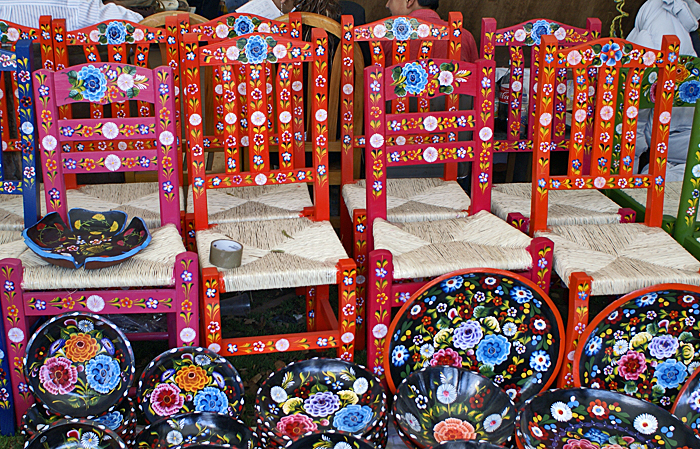
    Painted children's chairs from Quiroga, Michoacán.  All photographs by Mexico Cooks! unless otherwise noted.

    Today's Mexico Cooks! article celebrates the artisans, ancient traditions, and glorious representation of the state of Michoacán.  It also celebrates the recent publication of Artisans of Michoacán: By Their Hands, my friend Travis Whitehead's several-year-long project of interviews and photographs of Michoacán's artisans at work.  Rather than express my thoughts about Travis's passion and dedication to his work, Mexico Cooks! prefers to let him tell his own story.  He generously allows me to publish the text of the speech he gave earlier this year in Morelia, Michoacán.  I give you Travis Whitehead:
    _____________________________________________________________

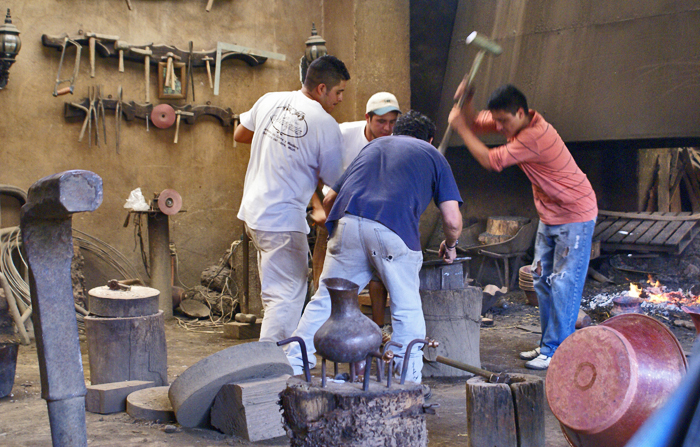
    Sta Clara Working the Copper 2
    Working copper, Santa Clara del Cobre, Michoacán.

    Forty-five years ago, I saw something that grabbed my attention and never let go: a caterpiller evolving into an elegant monarch butterfly.  Witnessing this display of metamorphosis would leave a lasting impression on me, one that would eventually lead me on an odyssey of change, of release, and of the discovery of identity.

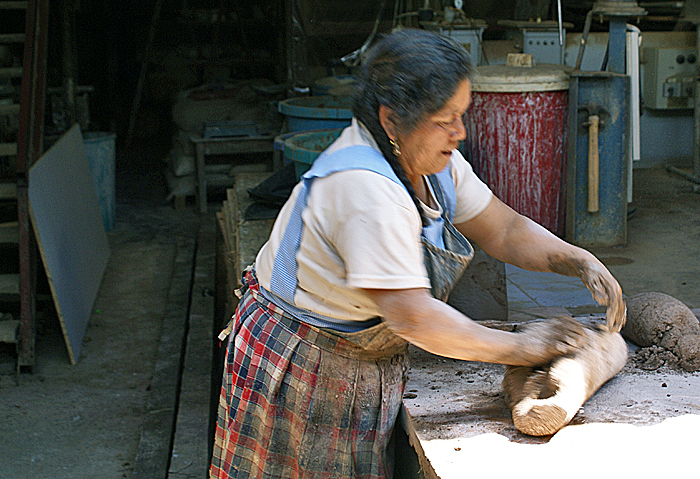
    Patamban Rolling Clay
    Rolling hand-ground clay for high-fired ceramics in Patamban, Michoacán.

    The journey toward that odyssey began the day my mother showed me how to remove a monarch caterpillar from the milkweed plant outside my Texas house, place it in a jar with plenty of leaves, and watch it grow.  Soon it would wrap itself into a green chrysalis, and I would wait anxiously for it to emerge into an entirely different form of life.  My curiosity was forever ignited by this process of change, and I kept a close eye on the milkweed plants so I could capture more caterpillers and observe this process again.

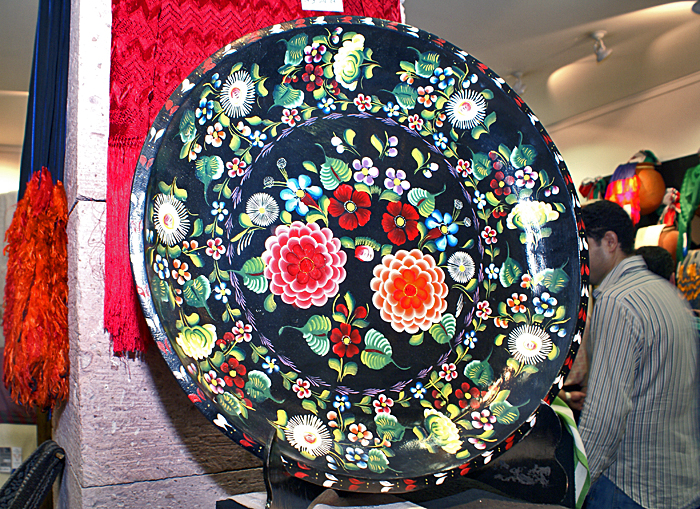
    Batea Pintada a Mano
    Hand-painted batea (wooden tray), state of Michoacán.

    When the butterflies finally emerged, I would take them outside and watch as they flew into the blue sky.  I didn't know then what we all know now: they were headed for Michoacán.  I wonder if perhaps the butterflies I released took a part of me with them, bringing a trace of myself into an enchanting place.  I wonder if perhaps that part of my soul born on the wings of the monarchs hibernated, even gestated, in the magical wonderland of Michoacán, awaiting my arrival when I would regain part of myself, taking full possession of my poetic voice.

    Pine Needle Hot Pad
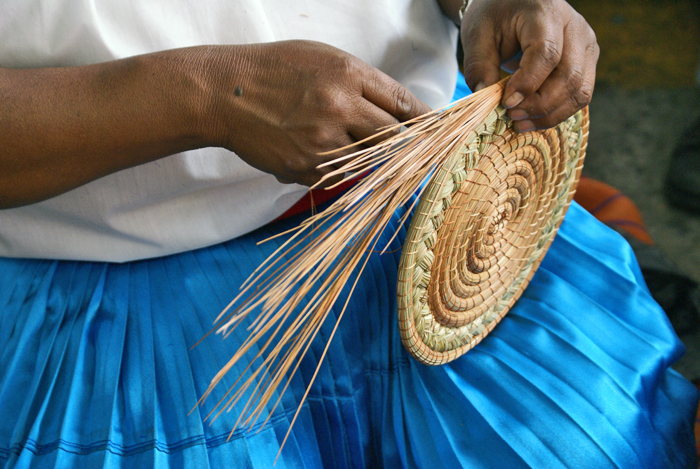
    Weaving a huinumo (pine needle) hot pad, Paracho, Michoacán.

    I found the place I'd been seeking my whole life quite by accident, stumbling across it while working on another project.  That project failed to materialize, but by then I had become intoxicated by the state's metamorphic personality.  That metamorphosis was everywhere, in the food, the language of the Purépecha indians, the crafts, and even the very landscape.  The state, I learned, even has two local varieties of the tamal–the corunda and the uchepo–and I discovered that in the Meseta Purépecha, even these and other regional recipes vary from one village to the next, and that the language has slight changes in communities only a short distance from each other: a metamorphosis taking place in food and words.  The very landscape itself is a metamorphic experience, ranging from pine-covered hills to stark deserts, from winding rocky shoreline to tropical jungles.

    Spoon Rack on Red Door
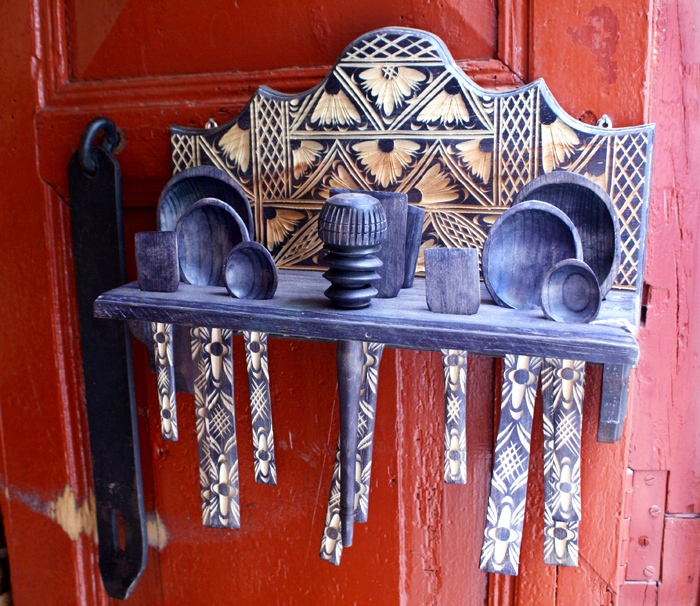
    Spoon rack on red door, Pátzcuaro, Michoacán.

    So strong was Michoacán's power over me that I felt compelled to spend an extended amount of time with her, so I moved there in 2008 and spent eight months visiting artisans in their homes and workshops.  I was quickly charmed by the way they welcomed me into their lives.  I was a stranger who came knocking on their doors, and they quickly extended their friendship to me.  They allowed me to observe them practicing their crafts and take as many pictures as I wanted.  They patiently answered my endless questions.  I was intrigued to discover that even their crafts were continuously evolving into innovative forms, revealing still another experience of metamorphosis.  With every Michoacán experience, my artistic life constantly split and then coalesced into an ever-evolving consciousness.  It was a revolving kaleidoscopic experience of dissonance and resolution, crescendo and diminuendo, soaring to enormous heights and then crashing miserably so that I would have to hibernate for a while until my previous perspective acquiesced to the new insights I had achieved.

    Loza Varios Capula
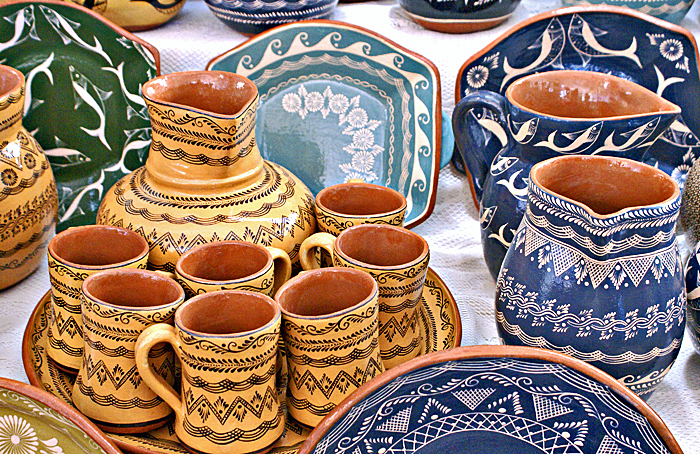
    Several types of hand-made, hand-painted clay tableware, Capula, Michoacán.

    However, as my poetic voice matured, so did my perspective about culture.  Initially, my experiences with the artisans were conduits through which I could communicate my ever-changing poetic voice.  The artisans, though, offered me genuine friendship and even a chance to participate in their daily lives.  I sat with them around their hearth fires; they shared their meals with me.  I took them to a cornfield so they could pick loads of corn; then I helped shuck that corn to make uchepos.  I watched with delight as their children laughed and played together, sneaking up behind me with their toy pistols–BOOM!  BOOM!  BOOM!–before giggling and running away.  I participated in one of their festivals, and soon 'my' project became less about me and more about giving them a voice to the rest of the world, sharing the story behind the crafts for which they are so famous.

    Paracho Contando Hilos
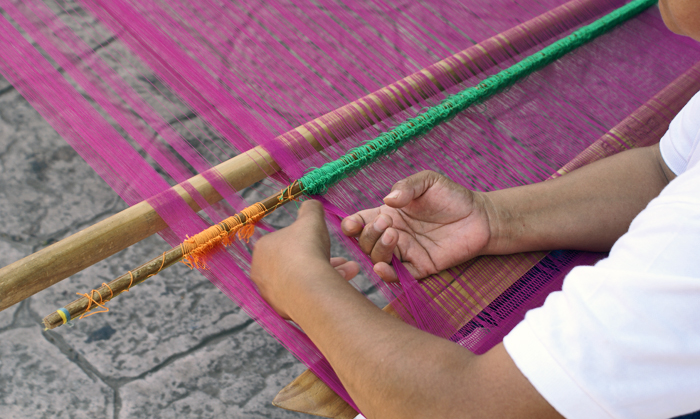
    Counting threads while weaving a fine rebozo (shawl) from Aranza, Michoacán.

    As I observed the pace of their daily lives and the way they related to one another, I began to wonder if the crafts, the festivals, and dances are really what define a culture.  Are those the things that really define culture, or are they merely details?  I'm not so sure.  Perhaps the real cultural experience is the way a group of people relates to one another and interacts with each other.  It's a question I still ask myself.

    Cristo Pasta de Caña 17th century
    Seventeenth century Michoacán Cristo (Christ) made of pasta de caña.

    The crafts and artisans and the metamorphic life of Michoacán still have a hold on me.  But I think that Michoacán has taught me a much greater lesson: the value of life and the way people experience that life, and the warmth and friendship people extend toward one another–and even to strangers who come knocking on their doors.  This was truly the greatest of my metamorphic experiences in Michoacán.

    Pichátaro Blusa 1
    Hand cross-stitched guayanga (blouse), Pichátaro, Michoacán.
    ____________________________________________________________

    Pelota en Llamas, Jesús Alejandre
    Juego de Huarukua (ancient Purépecha fireball game), Tzintzuntzan, Michoacán.  Photo courtesy Jesús Alejandre G., Uruapan.

    On June 27, 2013, Travis Whitehead will present Artisans of Michoacán: By Their Hands at Pátzcuaro's Museo Regional de Artes Populares, in conjunction with an important exhibit of new photographs of Michoacán by Uruapan native Jesús Alejandre.  The opening of photographer Alejandre's exhibition and the presentation of Whitehead's book will be June 27, 2013 at 5:00PM.

    Looking for a tailored-to-your-interests specialized tour in Mexico? Click here: Tours.