Category: Food and Drink

  • Jello Shots, Mexican Style

    Mexico Cooks! originally published this article in June 2007, in a slightly different form.

    Fruit_gelatin_3
    Sra. Abundis, a Guadalajara friend, prepared this clear gelatina (gelatin).  It's approximately 15" in diameter and stuffed with fresh red and green grapes, canned pineapple, and duraznos en almíbar (peaches canned in syrup). 

    Whether you're having a midday meal at a traditional Mexican restaurant anywhere in the República or celebrating at a private party at the home of Mexican friends, you can be almost 100% sure that a prominent item on the dessert menu will be gelatin. As you browse the produce at any town's tianguis (street market) or elbow your way through the crowds at a fiesta patronal (patron saint's celebration), you'll see vendors selling plastic cups and glasses of jewel-colored gelatin desserts. Gelatina is a shimmering sweet fact of life in Mexico, popular with young and old alike.

    What is this Mexican obsession with a food that smacks of 1950s Middle America? Delight in gelatin desserts has been prevalent in Mexico for years; marketing experts here report that it's eaten daily in nearly 90% of Mexican homes. Mexicans consume more gelatin desserts than nearly any other country in the world—three times the quantity of gelatin consumed in the United States alone. In restaurants, the dessert tray will almost always include a variety of gelatin desserts. When Señora Fulana (Mrs. So-and-So) is invited to a party at the home of her best friend, it's very traditional for her to take along a gelatin dessert, all fancied-up and ready for the admiration of the rest of the attendees.  At a birthday party, the dessert of preference is rarely cake and ice cream. It's almost always a plate of cake and a jiggling serving of gelatin, which requires no refrigeration to maintain its shape.

    There are far more ways to prepare gelatin desserts in Mexico than your mother's Jell-O mixed with fruit cocktail or shredded celery and carrots. Some of the desserts are prepared with water, some with milk, and some are prepared as a layered combination of both.  Some are major productions involving hours of labor intensive preparation time.  And trust me when I tell you that housewives closely guard their recipes for gelatin desserts, not sharing among themselves unless the recipient of a recipe swears on her life that she will never take that dessert to a party where the other lady is also invited.

    Tiger_gelatina
    Sra. Abundis and her daughter Cristina prepared and painted this marvelous tiger gelatina for a child's birthday party.

    Several months ago it was my task to prepare individual serving cups of gelatin for a two-year-old neighbor's birthday party—it seemed like I made hundreds. I thought it would be a complicated and difficult project, but it turned out to be quite a lot of fun. After asking another neighbor's advice, I learned that it's possible to buy powdered gelatin at any dulcería (candy store) or grocery store. The variety of available flavors is amazing: in addition to the ordinary strawberry, lime, and orange, I also found pistachio, almond, tamarindo, jerez (sherry), and peach.

    While I could have kept my project simple, I decided instead to get fancy. No single-flavor cups of gelatin for this party! I read the directions printed on each bag and learned to prepare this flavor with water, that one with milk. I combined a layer of strawberry (prepared with water) with a layer of pistachio (prepared with milk). Recklessly, I disregarded the instructions to use water to prepare the peach flavor and used milk instead, combining an opaque peach-flavored, pale layer with a clear, bright orange-flavored layer.

    Gelatina_pinar
    Commercially made in Guadalajara for sale in Mexico's supermarkets, this three-layer single-serving gelatina includes a clear-gelatin fruit layer (complete with a prune and its pit), a milk-based layer, and a clear layer.  The gelatina comes with its own tiny yellow plastic spoon.  These 200 gram gelatins are prepared with preservatives and artificial coloring.  Each one costs about 8 pesos, or 70 cents US.

    It's so simple. Of course you can do this at home, even north of the border. Just buy two different flavors of your favorite brand of gelatin dessert powder, some four-ounce plastic glasses, and have at it. Prepare one flavor and fill each glass to the half-way point. Refrigerate and allow that flavor to set. Prepare the second flavor, using either milk or water, pour it on top of the already jelled flavor, and refrigerate until set.  For me, this was fancy–but reader, read on!

    The preparation of gelatin desserts has been raised to a fine art in Mexico. Special classes in gelatin preparation fascinate housewives and give rise to thriving cottage industry here. Recipes metamorphose from the relatively simple preparations like mine to the most elaborate of flavor and design combinations. A few years back, the craze for making individual clear gelatin desserts which contain flowers also made of gelatin has hit Mexico like a bombshell.

    Flower_gelatina
    Flower gelatins like this one, made and copywrited by the Abundis family, are called gelatinas encapsuladas.  The flowers are made by injecting colors of gelatin and flower designs with a syringe into clear or transparent gelatins.  Neither Sra. Abundis nor Cristina took classes in making the flowers, although many handicrafts schools and individuals offer those courses.

    This week I was fortunate to spend some time with Sra. Abundis and her daughter, Cristina, who operate a small home-based business in Guadalajara.  The Abundis family invited me to come watch and take pictures as they prepared special gelatinas for a child's birthday party.   Mother and daughter have worked together for the last two to three years, preparing made-to-order gelatins for birthdays, baptisms, girls' fifteenth birthday parties, baby showers, engagement parties, and weddings.

    The gelatina personality of the day was Spiderman.  Cristina explained that the gelatin for the Spiderman mold and many more are milk-based, while other gelatins are water-based.  Milk gives the gelatina a more nutritious aspect than does plain water and also makes Spiderman's features show up better after they're painted.

    Ingredients
    In the Abundis kitchen, Spiderman is fresh out of the mold.  A selection of milk ingredients is lined up behind him, along with a small plate full of individual-serving Spiderman heads.

    Sra. Abundis showed me the basic ingredients for the dessert; once the basics are assembled, they're flavored with vanilla.  Spiderman is prepared with powdered milk.  Other gelatinas are made with sweetened condensed milk or with evaporated milk.  The Abundis family uses pure cane sugar and unflavored gelatin for its desserts.  No preservatives are added.  These home-prepared gelatinas must be consumed within 48 hours of their preparation.

    Many fancy gelatinas are painted once they're chilled and set.  Spiderman is no exception.  The paints are special vegetable food coloring gel, manufactured in Guadalajara. 

    Cristina_paints
    Sra. Abundis watches closely as Cristina paints Spiderman's red base coat.

    While Cristina painted, Sra. Abundis told me that when her relatives moved from Mexico City to Guadalajara in 1940, there was no powdered, flavored gelatina available in the city.  Finally the relatives found a source–one stall at the Mercado Corona in Guadalajara's Centro Histórico sold it.

    Spidermans_eyes
    Cristina starts the initial work with black gel food coloring, outlining Spiderman's eyes.  She holds a licenciatura (bachelor of arts) in graphic design from the University of Guadalajara.

    "The gelatina has to be very cold in order to paint it," Cristina commented.  "If it's not as cold and firm as possible, the paint will run."  Spiderman stayed briefly in the freezer between coats of food coloring gel.

    Spiderman_with_threads
    Spiderman's intricate thread work is complete.

    I asked Sra. Abundis and Cristina which molds are most popular for parties. "Right now, Spiderman is the one all the kids want.  Of course they also like Buzz Lightyear, Sponge Bob, all the Disney princesses, and Barbie.  The old favorites like Winnie the Pooh, Mickey Mouse, and Tweetie Bird are always popular."

    Josua_3
    Josua Isai Abundis Linares, Cristina's now nearly nine year old nephew, participated eagerly in the time I spent with his family.  He and I both anticipated our dessert: one of the individual Spiderman heads.

    Cristina added, "For adult parties like weddings and baby showers, people want gelatinas encapsuladas, the ones with the flowers, to accompany their special cakes.  And it's funny, the kids gobble down their gelatinas, but the adults want to save theirs.  The flowers are so beautiful."

    Spiderman_finished
    Cristina shows off the finished product: Spiderman in person!  Sra. Abundis painted the blue base.  The cost of this fantastic super hero is 130 pesos, approximately $11.50 USD.

    "The people who ordered this Spiderman for their child's party will pick it up late this afternoon.  The party is tomorrow."  Cristina was happy that she finished the painting with no smears. 

    One traditional recipe is for Mousse de Rompope (eggnog-flavored gelatin dessert). This preparation is appropriate for dessert at any party for adults.  It is so delicious that it bears repeating now.

    Rompope (Eggnog) Mousse with Strawberry Sauce
    Ten to twelve servings

    Ingredients

    Mousse
    2 envelopes of unflavored gelatin
    1/4 cup water
    1 cup heavy cream
    2 cups rompope (Mexican eggnog flavored liqueur)
    1/4 teaspoon vanilla extract
    4 egg whites

    Strawberry Sauce
    1 pound strawberries, stems removed
    2 tablespoons sugar
    1 tablespoon almond extract, anisette or Frangelica (hazelnut flavored liqueur)

    Preparation

    In a small bowl, sprinkle the gelatin onto the water and let stand until absorbed, about five minutes. Meanwhile, heat the cream slightly in a small saucepan. (Do not boil.) Remove from heat and stir in the gelatin, mixing well to dissolve. Strain into a bowl; add the rompope and vanilla and mix well. Set aside.

    In a large bowl, beat the egg whites until they form stiff peaks. Fold in the eggnog mixture, and then pour into a lightly greased 1.5 quart ring-mold, bowl or specialty-shape pan. Refrigerate at least four hours, preferably overnight.

    Place strawberries, sugar and flavoring in a bowl and let stand for two hours. Purée in a blender, strain and set aside.

    Just before serving, remove the mousse from its mold and drizzle with strawberry sauce. Garnish with slightly sweetened whipped cream. If desired, the mousse can be molded with a graham cracker crust.

    Provecho!

    For dessert after your comida (midday main meal), for a snack or for a light supper, sweet wiggly gelatina satisfies every time. Cooling and slithery, a gelatina is just the ticket when you need a little something, but you don't want too much.  They knew what they were talking about, way back then, when they said, "There's always room for…"

     Looking for a tailored-to-your-interests specialized tour in Mexico? Click here: Tours.
  • Dreams, Reality, and the Future (Sueños, Realidades, y el Porvenir): Restaurante San Miguelito, Morelia

    Pastel de Elote
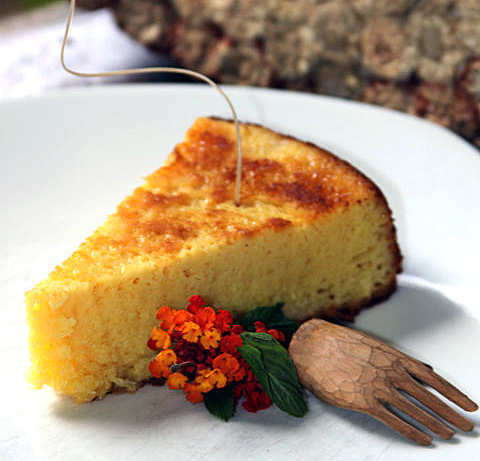
    One of Mexico Cooks!' favorite English-language sayings is, "Life is uncertain.  Eat dessert first."  With that in mind, let's start at the finish.  This traditional pastel de elote (corn cake) is deservedly the most popular sweet end-of-a-meal treat at Restaurante San Miguelito.  Photo courtesy San Miguelito.

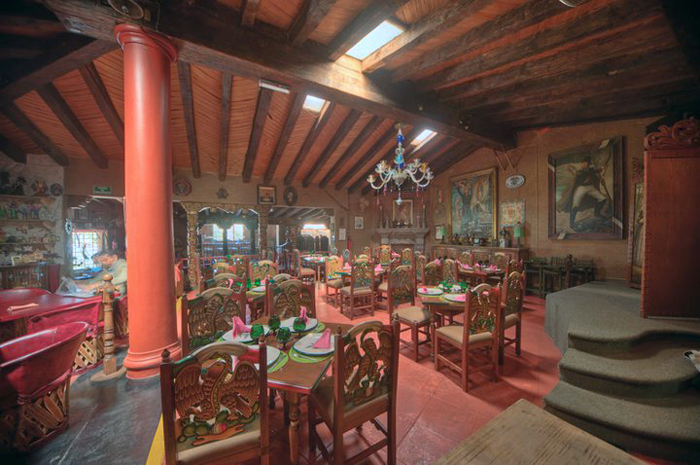
     Restaurante San Miguelito, open in Morelia since May of 1995, started life as a piano bar in San Miguel de Allende, Guanajuato.  Servando and Erik Canela, the father and son team who started the venture, soon decided that offering an all-in-one restaurant, artisans' gallery and museum to Michoacán's capital city residents and visitors would be a wiser use of their time.  They would incorporate Don Servando's forty years' experience as an art and antiques dealer, his son Erik's experience, and his daughter Cynthia Martínez's extraordinary culinary talents and business acumen into a highly unusual endeavor.  Today, Restaurante San Miguelito continues its evolution as one of the most beautiful, most delicious, most spiritual, and most frequented restaurants in central Mexico.

    Cynthia Martínez Sept 2011 1
    The charming and multi-talented Cynthia Martínez of Restaurante San Miguelito.  

    Walk through the door at San Miguelito and your attention is drawn first by the decor, then by the maitre d' who warmly welcomes you, and then by the artesanía (Mexican arts and crafts) that fills every nook and niche.  Even after a score of visits to the restaurant, I still spend as long exclaiming over the latest Noche de Muertos (Night of the Dead) skeletons, the newest finely hand-woven Michoacán rebozos (long rectangular shawls), and the proudly displayed alebrijes (hand-carved and hand-painted wooden fantasy animals) from Oaxaca as I do studying the wine list and the menu.  What beautifully tempting thing to buy!  What delicious tempting thing to eat!  What a wonderful dilemma!

    Salón de las Conspiraciones Memo Martínez
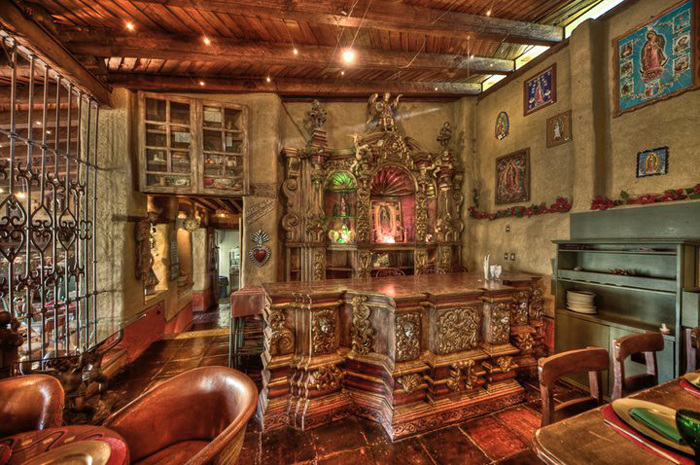
    Salón de las Conspiraciones (the Conspiracies Room), Restaurante San Miguelito.  Photo courtesy Guillermo Martínez Acebo.  Each section of the restaurant has a theme, and almost every item in the restaurant is for sale.  If you like the table and chairs, the glassware, or the plates that you and your guests are using, ask the price: you can treasure them in your own home.  Click on any of the photos for a more detailed look.

    Mexico Cooks! recently spent a leisurely evening talking with Cynthia Martínez about her philosophical relationship with food, especially Mexican food.  Her knowledge of the traditional Mexican kitchen comes honestly: her Oaxacan grandmother taught her recipes and culinary legends while she was a young girl helping out at home.  "Growing up in Oaxaca, I milked cows, caught the grasshoppers we seasoned and ate, and nourished a passion for the kitchen.  My grandmother always said that behind every cultural tradition you find gastronomy, and I still believe that.  The motivation to open San Miguelito was my father's desire to put together a fusion of Mexico's artisan and culinary traditions; my grandfather had the initial dream, and my father kept it alive.  He and my brother Erik and I have brought that dream to fruition in Morelia."

    Rincon de las Solteronas Alejandro Canela
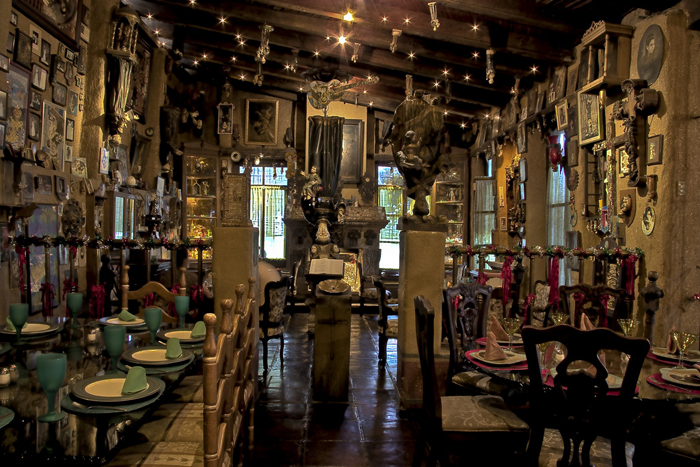
    El Rincón de las Solteronas (the Old Maid's Corner), Restaurante San Miguelito.  Photo courtesy Alejandro Canela

    Arguably the best-known of San Miguelito's several dining rooms is el Rincón de las Solteronas.  Dedicated to St. Anthony of Padua, patron saint of old maids single women, the room contains over 500 images of him–every image hanging by its feet.  From the ceiling, from wall niches, from mantelpieces and window frames, these upside-down St. Anthonys exist only to hear the pleas for a mate from women of all ages.  There's a book to write your prayer (including, if you like, all the characteristics you seek in a mate): the longest petition runs to twenty-five pages!

    San Miguelito Ensalada Azteca
    Ensalada Azteca (Aztec Salad), Restaurante San Miguelito.  The salad is a beautifully presented mixture of lettuces, zucchini-type squash, roasted sweet red peppers, tender corn kernels, queso fresco (fresh Mexican cheese), and cilantro vinaigrette.  Photo courtesy San Miguelito.

    "Until very recently–within the last three to five years–it was unusual in Mexico to find a chef in a restaurant.  A chef has studied at a culinary school or under a great master of the kitchen, and easily 90% of people working in restaurants here have had no opportunity to study their profession.  We Mexicans have usually known to frequent restaurants offering the best food, but until lately, we have not known 'name' chefs.  Our restaurant cooks have traditionally been las mayoras, women whose school-of-life experience and whose individual sazón (unique taste in preparing dishes) made them natural leaders in the kitchen.  We ate at restaurants where we knew we would have a delicious meal, but we didn't know who was responsible for preparing that meal.  Now we have culinary-school graduate chefs whose names are well-recognized and to whose restaurants we flock simply because they are there.  But you can't learn sazón in school.  Techniques, yes, but sazón?  As the saying goes, 'El buen cantante ya tiene voz' (the good singer already has a voice)."

    San Miguelito Altar de las Conversaciones Memo Martínez
    El Altar de las Conversaciones (the Altar of Conversations), Restaurante San Miguelito.  Photo courtesy Guillermo Martínez Acebo.

    "For us at San Miguelito, the challenge today and every day is consistency.  Our clients expect that the meal that they remember eating five days or five years ago, the dish that remains alive on the palate as a fond memory, will look and taste the same now as it did then.  We have guests who dine with us as often as two or three times a week, guests who know immediately if we change the brand of cheese in a dish or if we've changed meat purveyors–because the food tastes just a little different.  Many of our clients know our staff by name, expect to be seated at 'their' table, and know by instinct if anything from table service to the presentation of a dish is slightly different from the last time they dined with us.  Our daily aim is to provide each diner with a delicious meal in beautiful surroundings."

    San Miguelito Pescado en Hoja de Plátano
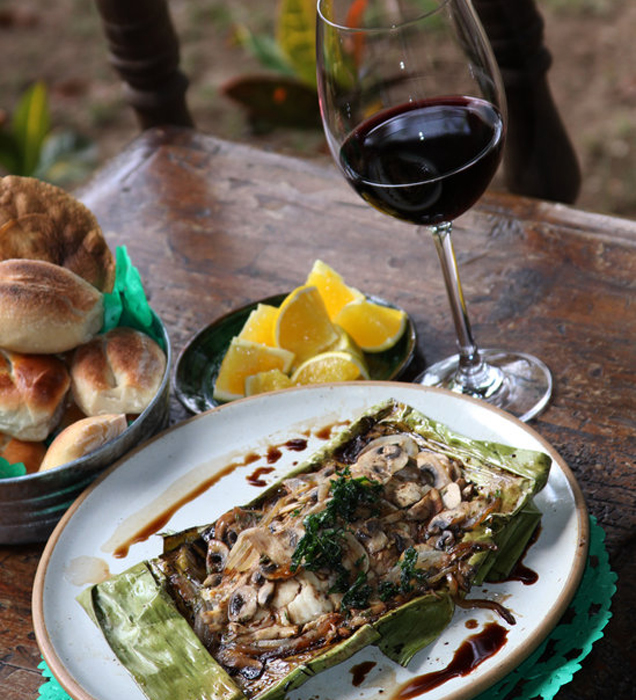
    Pescado en Hoja de Plátano (Fish Cooked in Banana Leaf).  Photo courtesy San Miguelito.  Everything served to you at the restaurant, from the marvelous small bolillos (traditional crusty rolls) to the wine you enjoy with your meal, is chosen with strict attention to quality and consistency.

    "Because traditional culture and traditional gastronomy are so closely linked, San Miguelito plans a number of events every year that offer opportunities to enjoy and learn more about both.  One of our very popular evenings is a marvelous night that includes the history and uses of Mexico's traditional rebozo (long rectangular shawl).  For that event, we showcase weavers and traditional as well as contemporary styles of wearing the rebozo.

    "The next event on our 2011 calendar is an evening with Martha Ortiz Chapa, one of Mexico City's most prominent chefs.  She'll be at San Miguelito on February 19, preparing a seductive and romantic menu in her own inimitable style.  Just in time for el mes de San Valentín (Valentine's month), this evening promises to be extraordinary.  If you haven't made reservations yet, don't wait too long; we expect the house to be filled."

    San Miguelito Salón con Mural de Pátzcuaro Memo Martínez
    Salón con Mural del Lago de Pátzcuaro (room with mural of Lake Pátzcuaro).  Photo courtesy Guillermo Martínez Acebo.  Tiny lights embedded in the mural create a twinkling illusion of an evening overlooking the lake.

    "Aside from the daily challenges of running the restaurant, we also face the challenge of caring for the future of our traditional foods.  The advent in Mexico of genetically altered corn would devastate a milennia-old way of eating; globalization has already brought immense quantities of previously unknown 'convenience' foods to this country, and we're asking ourselves who in the new generations will maintain or rescue the old ways.  Who will take the time to learn and prepare a grandmother's recipes and write them down for the future? 

    "Right now, chefs and restaurant owners are in the vanguard of revitalizing the traditional kitchen.  But unless today's young people commit to keeping traditions alive in their own homes, Mexico's culinary glories will exist only in our memories and as restaurant-produced curiosities.  It's time to put our home kitchens to the test and rescue Mexico's food heritage."

    Restaurante San Miguelito
    Av. Camelinas at Av. Ventura Puente (across from the Convention Center)
    Fracc. La Loma
    Morelia, Michoacán, México
    Tels: 52.443.324.4411 and 52.443.324.2300

    Looking for a tailored-to-your-interests specialized tour in Mexico? Click here: Tours.     


  • Mexico Cooks! Best Flan Ever: Flan de Naranja y Coco (Coconut and Orange Flan)

    Flan Ingredients
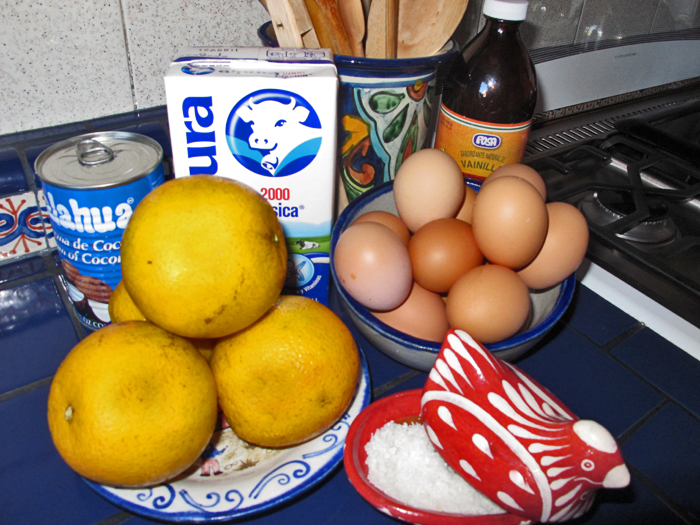
    The major ingredients for Mexico Cooks!' best flan ever–clockwise from the bottom: fresh oranges, cream of coconut, whole milk, real Mexican vanilla, fresh eggs, and sal del mar (sea salt, in the little red hen salt cellar).  You'll also need some sugar.

    Flanera with San Pascual Baylón
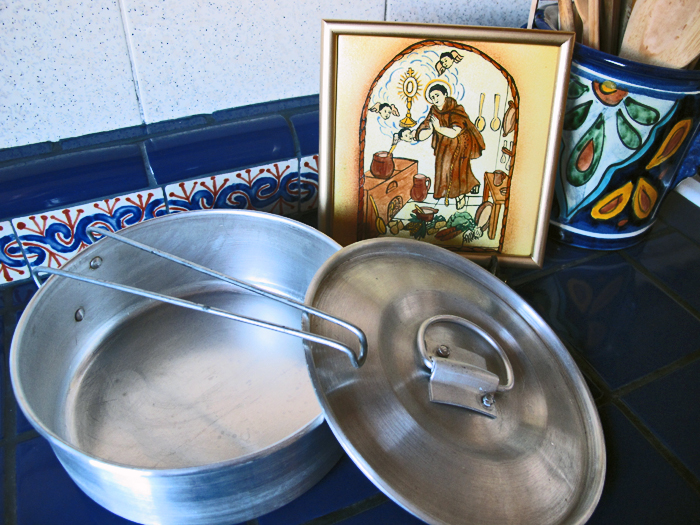
    This is a Mexican flanera (flan pan).  It's made of aluminum; the lid fastens down with a hinged clamp.  If you have one, use it.  If you don't, you can use any kind of oven-proof pan that holds about two liters.  It need not have a lid.  That's San Pascual Baylón, the patron saint of the kitchen, in the background.  He can be especially helpful at the moment you turn the chilled flan onto the serving platter.

    Flan Sugar at Beginning
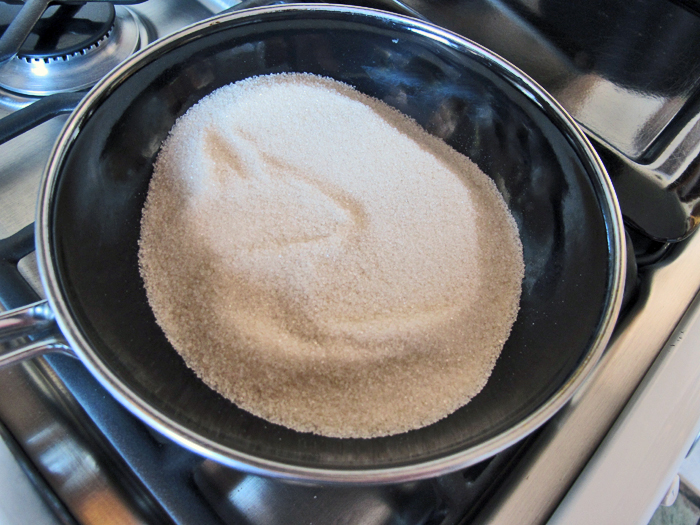
    Start by caramelizing the sugar in a heavy pan.  This is an 8" enameled cast iron omelet pan; it's been in the pantry for nearly 20 years and, for this purpose, works better than any other pan in the kitchen.  Just dump the sugar into your pan over very low heat; when you see that the sugar begins to melt a bit around the edges, move the pan a little to redistribute the sugar so that it caramelizes as evenly as possible. 

    Flan Sugar Caramelized
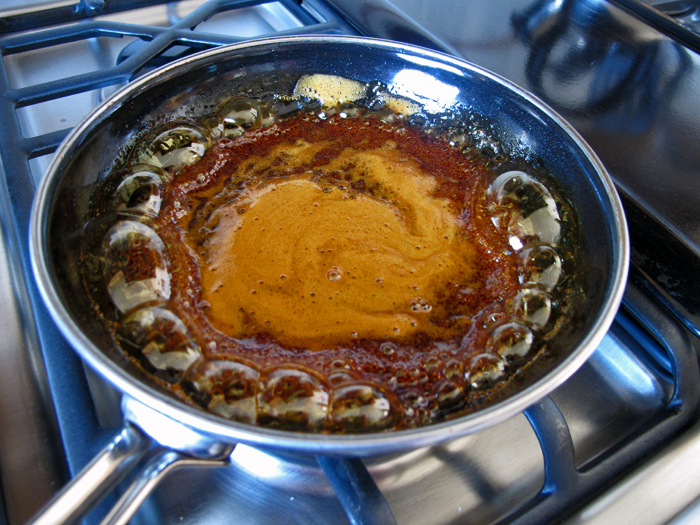
    When the sugar is fully caramelized, it will look like this photo.  Caveat: this process seems to take forever, but you can't hurry it.  And no matter how tempted you are, do not stir the sugar!  Just move the pan little by little, tipping the uncaramelized sugar into the melted mass.

    Flan Sugar in Flanera
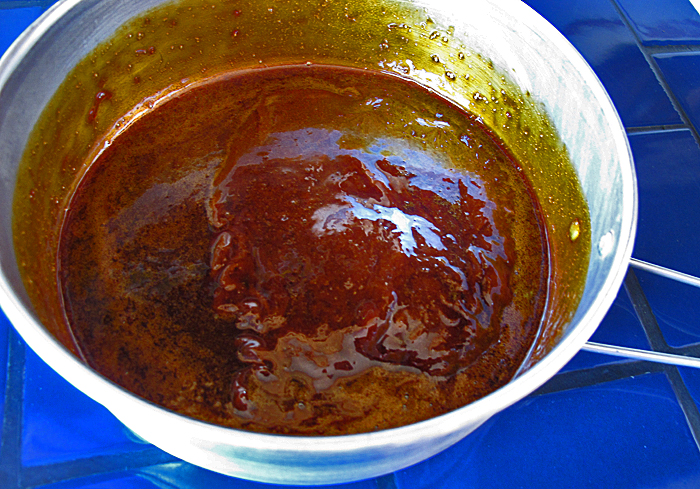
    As soon as all the sugar is caramelized–while it is still boiling hot–pour it into the flanera or whatever pan you are using.  Tip and turn the flanera so that the sugar evenly coats the bottom and sides.  Be very careful not to burn yourself.  Set the flanera aside and complete the recipe.

    Mexico Cooks! Flan de Coco y Naranja a la Antigua (Old-Style Coconut and Orange Flan)
    8 servings

    Make the flan one day ahead of the time you want to serve it.  Once baked, it needs to chill for about 18 hours.

    Move the oven rack to its lowest position.  Pre-heat the oven to 165-170°C or 325°F. 

    Ingredients
    Caramelized Sugar
    1 cup granulated sugar
    4 Tbsp freshly squeezed orange juice

    Flan
    3 cups whole milk
    1 cup cream of coconut
    3/4 cup granulated sugar
    1 Tbsp pure vanilla extract
    1 Tbsp freshly grated orange peel
    4 eggs
    6 additional egg yolks
    pinch sea salt

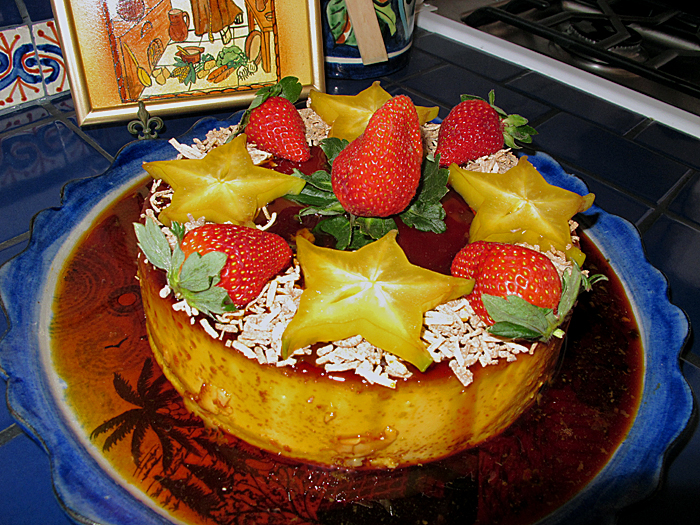
    Garnish as shown in photo
    3 perfect strawberries with their leaves
    4 1/4" slices carambola (star fruit)
    2 to 4 Tbsp grated fresh coconut, toasted

    Preparation

    Caramelized Sugar
    Over a low fire, pour one cup of granulated sugar into a small, heavy skillet.  Do not stir the sugar.  When the sugar begins to melt, move the skillet a little, tipping and turning it so that all of the sugar caramelizes evenly.  Allow the sugar to boil until it is a deep caramel color.  Add the orange juice and tip gently until the juice is fully incorporated into the sugar.  Immediately pour the boiling caramelized sugar/juice mixture into the flanera or other pan, tipping the flanera until the sugar fully coats the bottom and sides.

    Flan
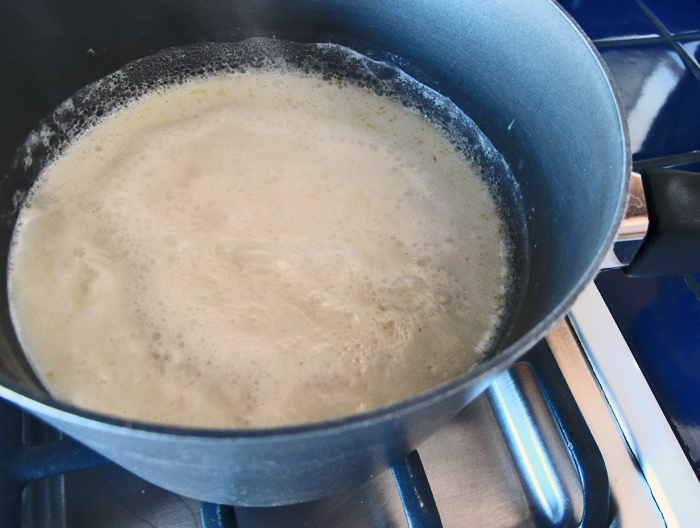
    In a 2-quart pot, combine the milk, 3/4 cup granulated sugar, the cream of coconut, vanilla, grated orange rind, and salt.  With a wooden spoon, stir the ingredients over a medium fire until they are well-heated.  Raise the fire to high and allow the mixture to boil, but don't let it boil over.  Continue to boil the mixture until it has reduced by nearly one cup.  Set aside and allow to cool slightly.

    Flan Leche al Cocerse
    The milk mixture needs to boil until it has reduced by about one cup.  Be sure to set it aside to cool when the reduction is finished. 

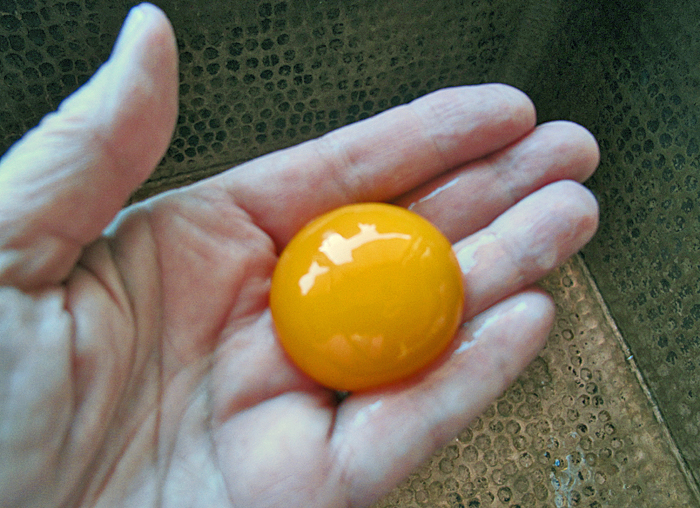
    Flan Separate Egg
    To easily separate six of the eggs so that you can use just their yolks, crack each egg into your open hand and allow the white to run through your fingers into a container.

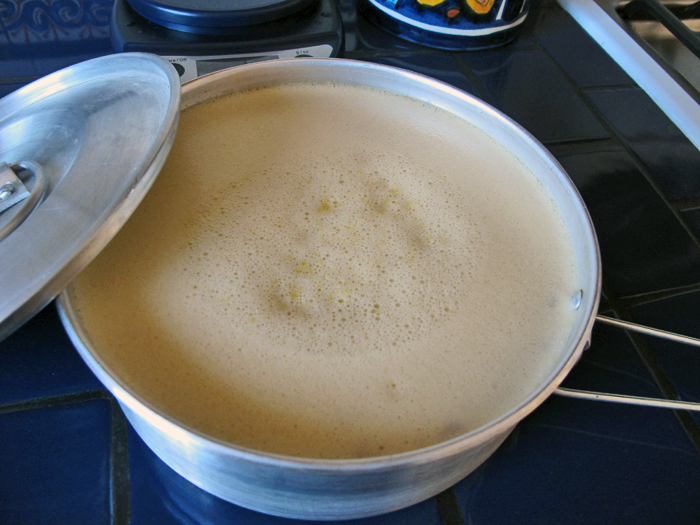
    With an electric hand beater, beat the eggs together with the additional yolks until they are light and foamy.  Add the cooled mixture of milks.  Pour the entire mixture into the flanera or prepared pan.  If it is a flanera, cover it and fasten the latch.  If it is another type pan, do not cover.  Whichever you are using, put the recipient into a baño maría (bainmarie) and then into the pre-heated oven.

    Flan Ready to Bake
    The milk mixture in the flanera; the caramelized sugar is at the bottom.

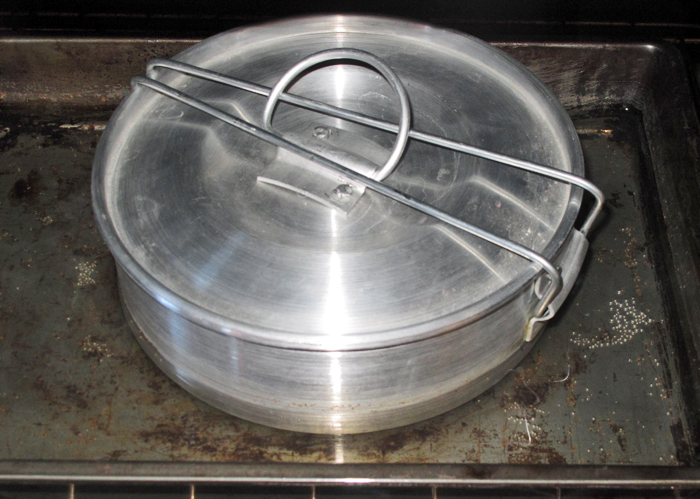
    Flan in Baño María in Oven
    The flanera in the baño maría, just going into the oven.  The baño maría can be any kind of pan; use enough water to come about one and a half to two inches up the side of the flanera or other pan.

    Bake the flan for approximately two hours.  At the end of two hours, take the top off the flanera and test the flan by inserting a thin knife or metal skewer into the middle; if it comes out completely clean, the flan is done.  If some of the egg mixture clings to the knife or skewer, bake the flan about fifteen minutes longer, being careful not to over-cook it.

    Once the flan is cooked, take it AND the baño maría out of the oven.  On a cooling rack, let the flan rest in the baño maría about fifteen minutes more.  Then remove the flanera (still covered) or other pan from the baño maría and allow the flan to cool at room temperature until the pan is cool to the touch.

    Once the flan is cool, put the flanera (still covered) or other pan in the refrigerator and allow to chill until the following day.

    To remove the flan from its mold, uncover and run a thin table knife around the entire outer edge.  To ensure ease of release from the pan, dip the bottom of the flanera or other pan into very hot water so that the caramelized sugar liquifies a little.  VERY CAREFULLY turn the flan out onto a platter.  Mexico Cooks! puts the platter (one with a lip) on top of the open flan mold, calls on San Pascual Baylón, and quickly turns the platter and the mold so that the flan slips out easily.  The caramelized sugar will run onto the top of the flan and make a pool in the bottom of the platter.

    Approximate preparation time: 30 minutes
    Approximate baking time: 2 hours

    Flan Finished Product
    The finished product, ready to be taken to the dinner table.

    Just prior to serving, decorate the flan however you like.  In the photo, you see that I put one large strawberry in the center of the flan.  I carefully made a border of toasted coconut and then cut the two remaining strawberries in half, leaving the leaves attached to each half, and placed one half at north, south, east, and west on top of the coconut.  I then placed four slices of carambola between the strawberry halves.  You could also use fresh red raspberries, thinly sliced twists of orange, and fresh mint leaves for a garnish, or any other seasonal fruit, or use no garnish at all.

    Provecho!

    Looking for a tailored-to-your-interests specialized tour in Mexico? Click here: Tours.


  • Viva la Vida: Mexico Cooks! Looks Back at 2010

    Paracho Fruta con Avejas
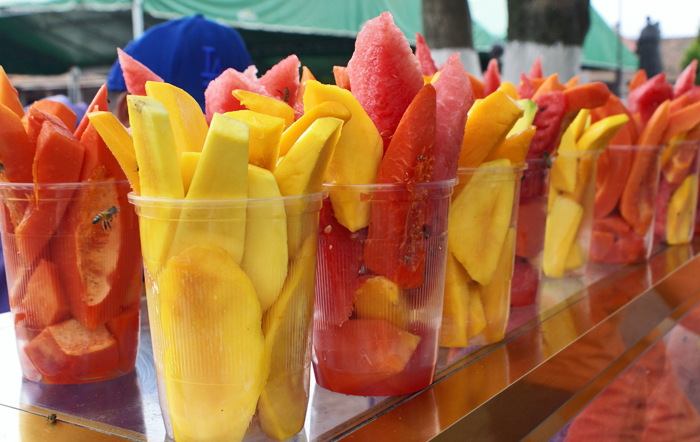
    Fruit stand with mango and papaya, Paracho, Michoacán.  A large cup of fruit, served with fresh-squeezed limón, salt, and chile if you like, costs 10 pesos (about 80 cents US at today's exchange rate).  The bees are always free.

    Papel Picado Detail Turismo
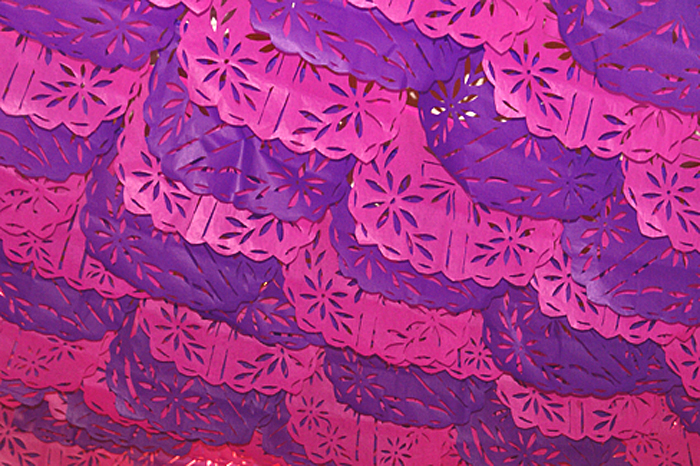
    Artisans from Tzintzuntzan, Michoacán, prepared papel picado (cut paper) banners for a Semana Santa (Holy Week) exhibition of antique religious art in Morelia.

    Colegio Culinario Hierbabuena
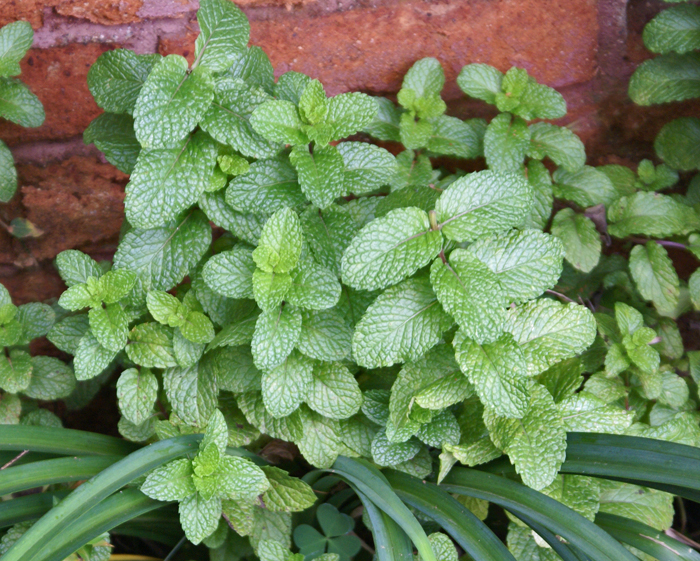
    Menta (in this case, apple mint–menta sauveolens) growing against old bricks at the Colegio Culinario de Morelia.  It was planted several years ago by Guillermo Lara Góngora, the English-language teacher at the CCM.

    FIMM Tapete Diablo 1
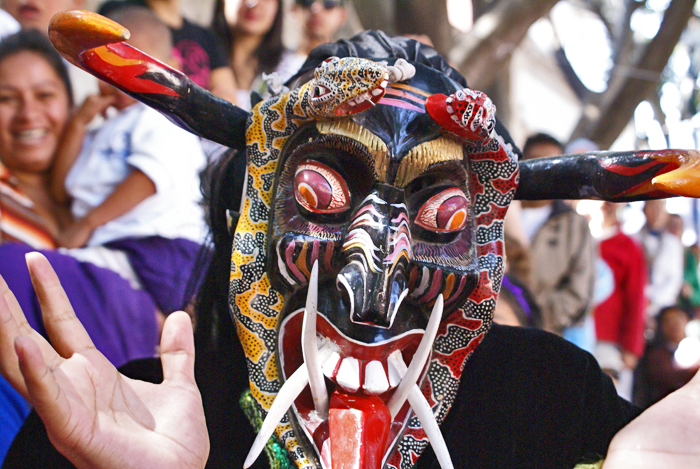
    Devil dance mask, Tocuaro, Michoacán.

    Mercado Patas de Pollo
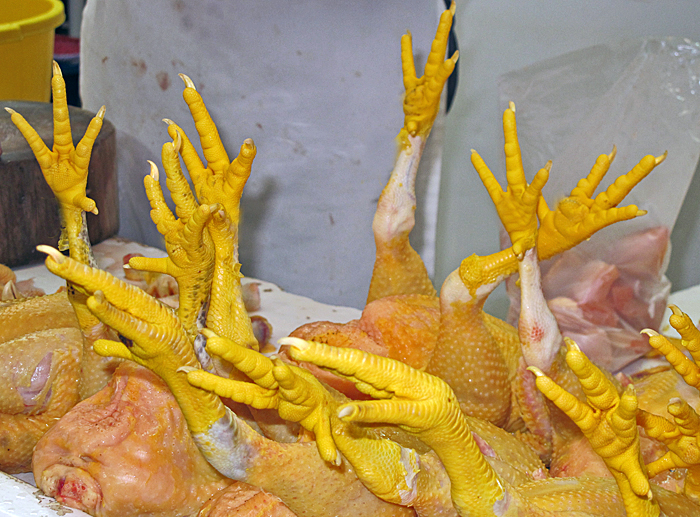
    Caldo de pollo (Mexican-style chicken soup), on the hoof.  The butcher will use his machete to cut off all the claws for you; the well-washed feet add color and flavor to your chicken broth.

    Saturday 2 Fuente con Flores
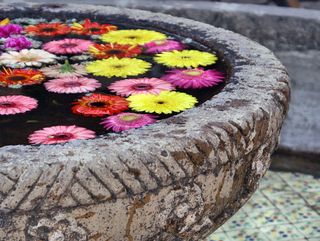
    Flowers float in a Morelia fountain at twilight.

    Rebozo Tzintzuntzan Detalle
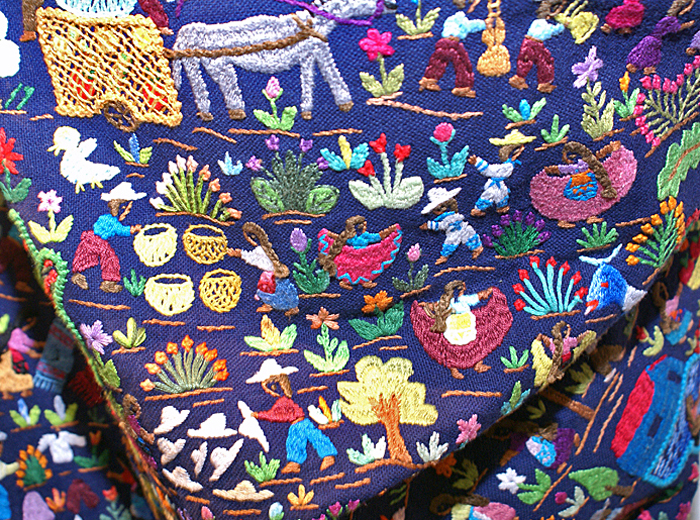
    Detail of hand-embroidered rebozo (long rectangular shawl) from Tzintzuntzan, Michoacán.

    Pine Needle Hot Pad
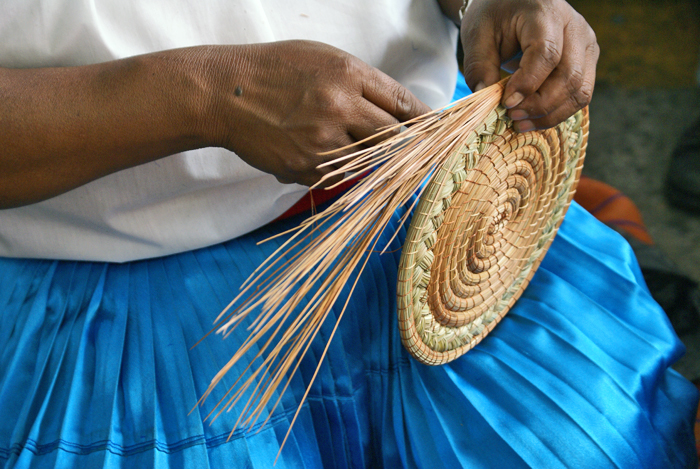
    Creating a basket from huinumo (pine needles), Opopeo, Michoacán.

    Encuentro Masa de Dos Colores 1
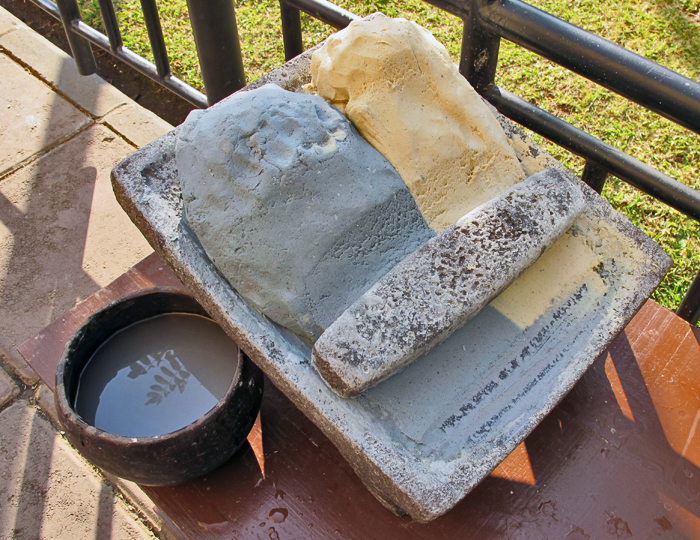
    Two colors of masa (corn dough), one metate (grinding stone).  Uruapan, Michoacán.

    Paracho Huipiles Bordados para Boda  7-15-10
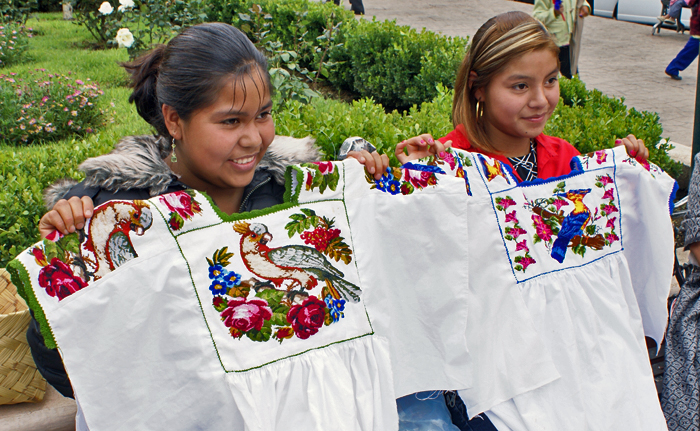
    Two beautiful young women from Paracho, Michoacán show off the hand-cross stitched guanengos (blouses) they  created for a wedding.

    Viernes 4
    Michoacán, for the joy of life.

    Looking for a tailored-to-your-interests specialized tour in Mexico? Click here: Tours.


  • VII Encuentro de Cocina Tradicional de Michoacán: Michoacán’s Seventh Annual Festival of Traditional Cuisine

      Encuentro Papel Picado Uruapan
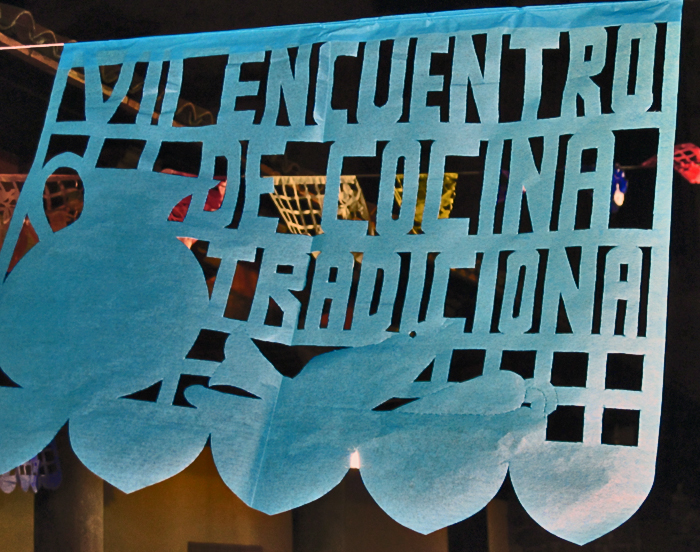
    In Uruapan, Michoacán, on December 3, 2010, multicolored papel picado (cut paper streamers) billowed in the evening breeze to announce our tremendous pride in the VII Encuentro de Cocina Tradicional de Michoacán (Seventh Annual Michoacán Traditional Food Festival).

    Encuentro Mole con Pollo
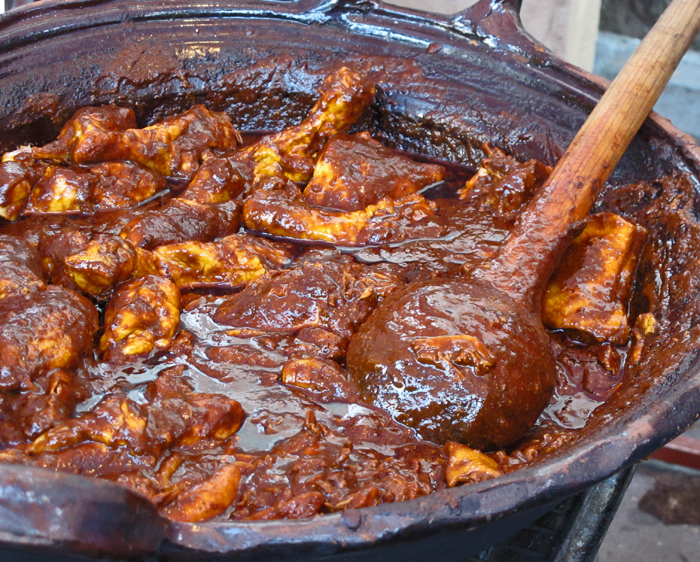
    A sumptuous and traditional mole con pollo (mole with chicken) as prepared by Antonina González Leandro of Tarerio, Michoacán.  Sra. González participated in the concurso de la Zona Lacustre (Lake Pátzcuaro region competition) that took place this year in Pátzcuaro.  In addition to this mole, she prepared pozole de elote con conejo (fresh-corn stew with rabbit), several other savory dishes, and a wonderful sweet dried-corn snack called ponteduro.

    Encuentro Antonina González Leandro con Cynthia Martínez
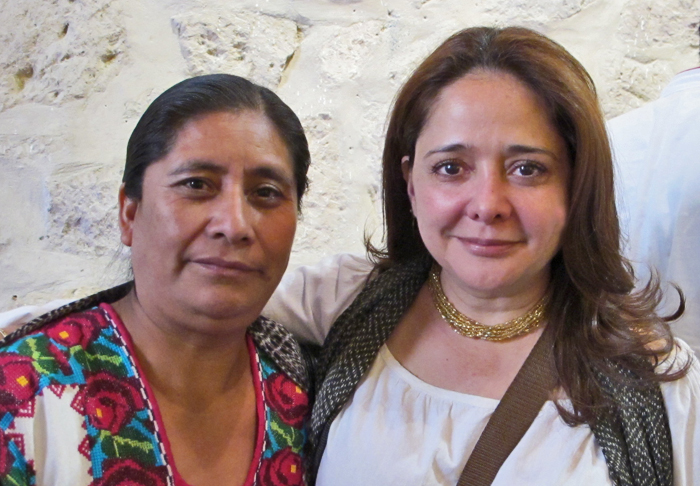
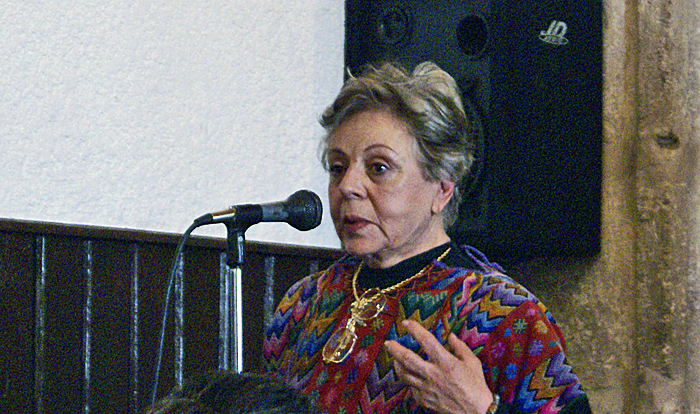
    In Pátzcuaro on December 4, 2010, Sra. Antonina González paused at her booth to pose with Cynthia Martínez, in charge of Morelia's Restaurante San Miguelito.

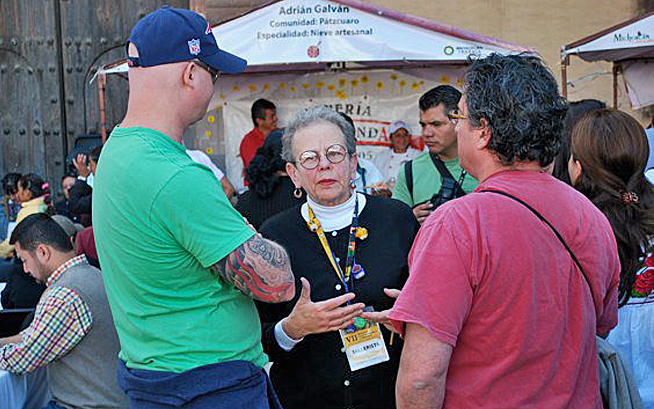
    Each of the last several years, Mexico Cooks! has been privileged to be included on the teams of speakers, judges, and hosts for Michoacán's annual traditional cuisine spectacular.  This year, our joyous cup of participation in the festival was filled to overflowing by the two-week-prior notice that Mexico's cuisine, and especially the cuisine of Michoacán, had been designated as a UNESCO Intangible Heritage of Humanity–the first cuisine in the world to be so honored.  Three cities in central Michoacán (Morelia, Uruapan, and Pátzcuaro) were named to host this year's food festival, and all three went completely overboard in welcoming every participant: host committees, notable chefs and food writers from all parts of Mexico and other countries, hundreds of proud and happy local and regional eaters, and the people without whom there would be no reason to have the party: the stupendous traditional cooks from the Purhépecha communities throughout this part of the state.

    Encuentro Gloria López Morales
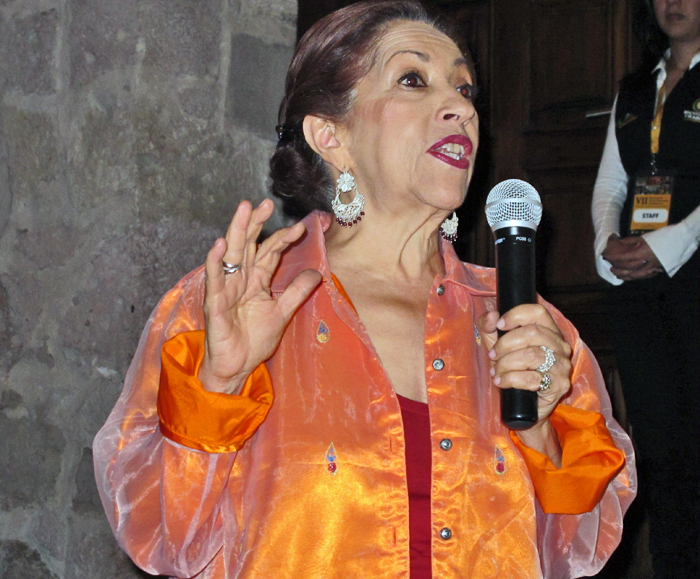
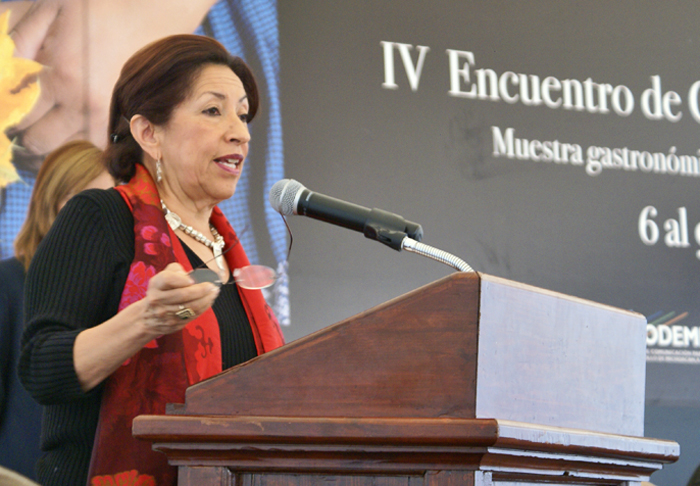
    In Morelia on December 5, 2010, Dra. Gloria López Morales, president of the Conservatorio de la Cultura Gastronómica Mexicana, shares her views on topics related to Mexico's November triumph at UNESCO.

    Encuentro Christian and David conmigo
    In Pátzcuaro, Mexico Cooks! talks about Michoacán cuisine with (left) Christian Plotzcyk and (right) David Suárez of the New York restaurant group Rosa Mexicano.

    A number of internationally known chefs and food writers attended the festival this year.  Among them were Patricia Quintana, Alicia Gironella d'Angeli, Rubén Hernández, Roberto González Guzmán, Sol Rubín de Borbolla, Cristina Palacio, and Gabriel Gutiérrez García, all from Mexico City; Cynthia Martínez, Alma Cervantes, and Joaquín Bonilla of Morelia; and Susana Trilling of Oaxaca.  In addition, David Suárez and Christian Plotzcyk of the Rosa Mexicano restaurant group based in New York City and Iliana de la Vega of the Culinary Institute of America, San Antonio, Texas represented the interest of the United States.  The festival also counted on the participation of internationally renowned Michoacán chefs Rubí Silva Figueroa (Restaurante Los Mirasoles, Morelia), Lucero Soto Arriaga (Restaurante LU, Morelia), and Blanca Estela Vidales (Restaurante La Mesa de Blanca, Ziracuaretiro, Michoacán), who, along with teams of cooks and assistants, prepared several banquets for specially invited festival participants and guests.

    Encuentro Jahuakata 2
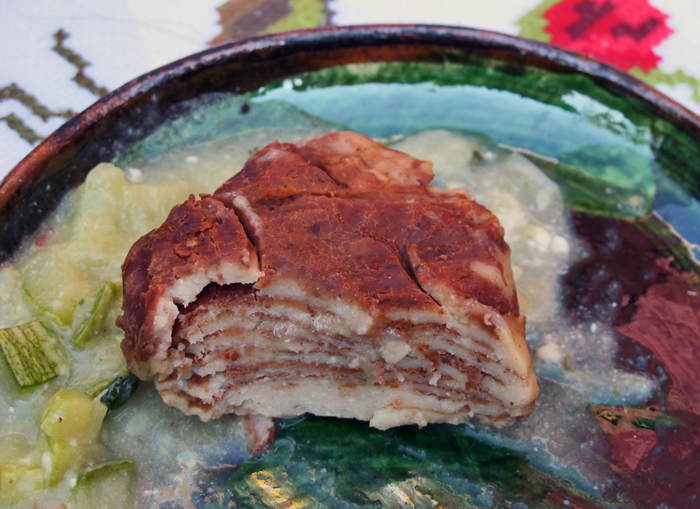
    In Uruapan, we tasted delicious jahuacatas (corundas created using layers of frijoles molidos (beans ground on the traditional metate) and fresh masa (corn dough), as prepared by Sra. Juanita Bravo Lázaro from Angahuan, Michoacán.  Sra. Bravo served these marvelous jahuacatas with an atápakua de calabaza (thick squash sauce).  This preparation won the prize for the best traditional dish.  Click on the photograph to enlarge the picture for a better view of the layers.

    Encuentro Yurucurindas
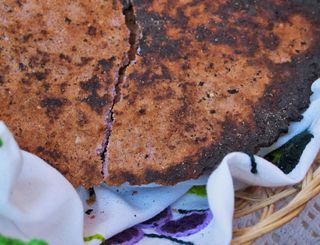
    None of the judges had previously heard of–much less tasted–these incredibly delicious yurucurindas.  Once we tasted them in Uruapan, we couldn't stop recommending them to everyone in earshot.  "Hurry, get one before they're gone!" we mumbled with our mouths full.  Similar in size to but a bit thicker than a standard corn tortilla, the yurucurindas are made from blue corn masa, piloncillo (Mexican raw sugar cones), and canela molida (ground cinnamon), and then baked on a traditional comal de barro (clay griddle).  Even this long after the festival, the photo still makes my mouth water at the memory!

    Benedicta Alejo by Gabriel Gutiérrez
    Señora Benedicta Alejo Vargas of San Lorenzo, Michoacán is one of the greatest traditional cooks in the Uruapan area.  The internationally known Sra. Alejo won the prize for best rescued dish with churipo de carne seca (dried beef soup in the Purhépecha style).  Rescued dishes include traditional preparations that are not usually prepared today and are on the verge of extinction. Photo courtesy Gabriel Gutiérrez García.

    Encuentro Benedicta Servilletas
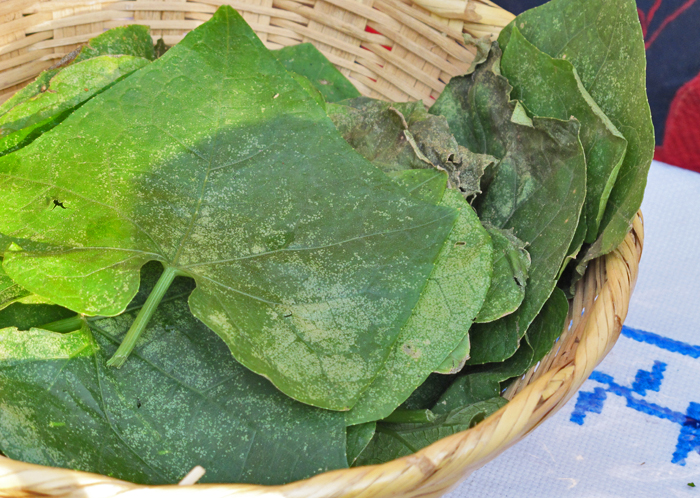
    Mexico Cooks! noticed this basket of fresh green leaves on the table at Sra. Alejo's booth and asked what purpose they served.  Sra. Alejo smiled and said, "When I was a little girl, my grandmother always put a basket of leaves on the table to use as napkins.  It's part of my family's tradition."  In addition to her prize-winning traditional churipo, Sra. Alejo prepared mole de conejo (rabbit mole), mole de queso (cheese mole), and tzirita, a botana (appetizer) made of finely ground chile seeds and other savory ingredients.

    Encuentro Patricia Quintana Uruapan
    For the first time, acclaimed chef (she's the owner of Mexico City's restaurant Izote) and author Patricia Quintana attended the Encuentro de Cocina Tradicional.  She happily served as a judge.

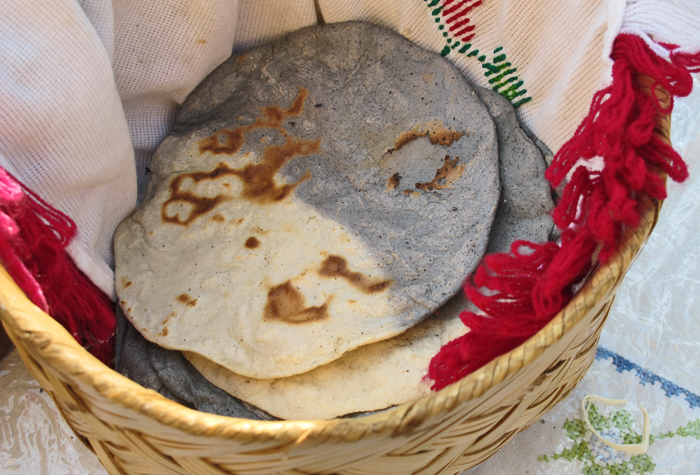
    Encuentro Tortillas Dos Colores en Canasta
    Absolutely gorgeous: hot-off-the-comal tortillas, made with two colors of corn masa.

    Encuentro Atole de Chaketa
    Thick and delicious atole de chaqueta is a corn-based hot drink flavored, in this instance, with the toasted and ground outer shells of the cacao (chocolate) bean.  Nothing is wasted here in Michoacán's kitchens: imagine that such delicious things are made from what you might discard: chile seeds and the hulls of cocoa beans!

    Encuentro Bailable Uruapan 2
    In addition to the wonderful food competition, the festival organization treated the Uruapan public to a marvelous evening of traditional music and dance.

    Encuentro Closure Rubén
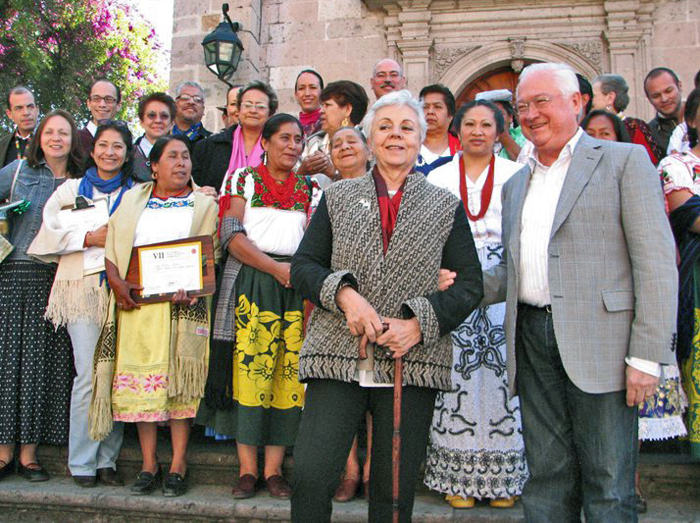
    At the December 5, 2010 Morelia closure of the VII Encuentro de Cocina Tradicional de Michoacán, the prize-winning cocineras (cooks) and other dignitaries posed with (left foreground) Sra. Alicia Gironella d'Angeli, First Lady of Mexico's food world and chef/owner at Restaurante El Tajín in Mexico City and Dr. Genovevo Figueroa, secretary of tourism for the state of Michoacán.  Both Sra. Gironella and Dr. Figueroa are long-time supporters of this annual Michoacán festival.  Photo courtesy Rubén Hernández.

    Looking for a tailored-to-your-interests specialized tour in Mexico? Click here: Tours.

  • Los Reyes Magos to La Candelaria: Three Kings, Rosca de Reyes and Tamales!

    Rosca
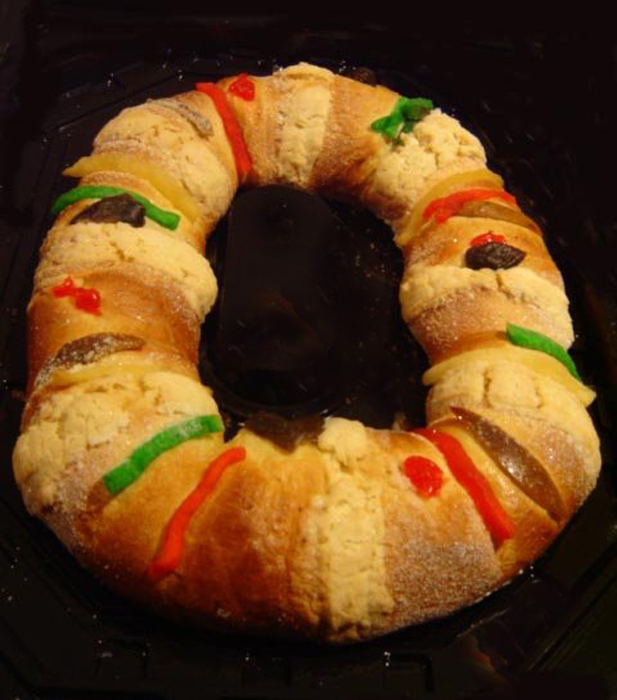
    Most Mexicans eat traditional rosca de reyes (Three Kings' Bread) on January 6.  Its usual accompaniment is chocolate caliente (hot chocolate).

    The Día de los Reyes Magos (the Feast of the Three Kings) falls on January 6 each year.  You might know the Christian feast day as Epiphany or as Little Christmas.  The festivities celebrate the arrival of the Three Kings at Bethlehem to visit the newborn Baby Jesus.  In some cultures, children receive gifts not on Christmas, but on the Feast of the Three Kings–and the Kings are the gift-givers, commemorating the gifts of gold, frankincense, and myrrh that they presented to the Baby Jesus. Many, many children in Mexico still receive special gifts of toys from the Reyes (Kings) on January 6

    Typically, Mexican families celebrate the festival with a rosca de reyes (Three Kings' Bread).  The size of the family's rosca varies according to the size of the family, but everybody gets a slice, from the littlest toddler to great-grandpa.  Accompanied by a cup of chocolate caliente (hot chocolate), it's a great winter treat. 

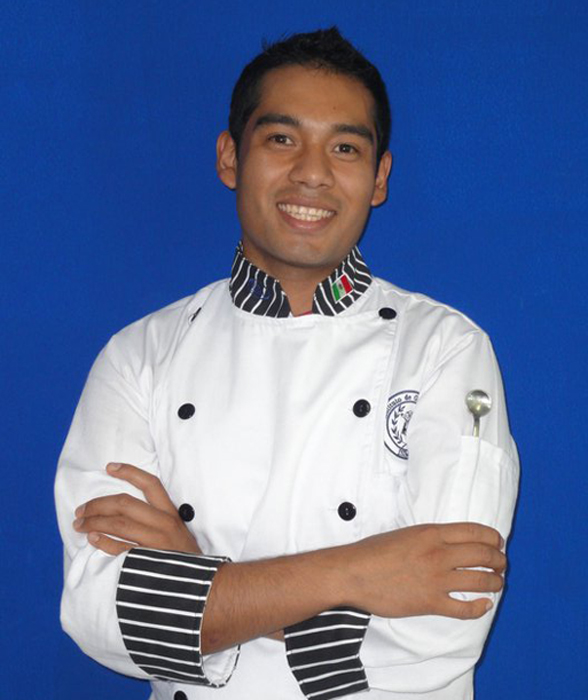
    Chef Arturo Camacho Domínguez
    Chef Arturo Camacho Domínguez of Tampico, Tamaulipas.

    My friend Chef Arturo Camacho Domínguez, who lives and works in Tampico, Tamaulipas, recently wrote a bit about the significance of the rosca.  He wrote, "The rosca de reyes represents a crown; the colorful fruits simulate the jewels which covered the crowns of the Holy Kings.  The Kings themselves signify peace, love, and happiness.  The Niño Dios hidden in the rosca reminds us of the moment when Saint Joseph and the Virgin Mary hid the Baby Jesus in order to save him from King Herod, who wanted to kill him.  The three gifts that the Kings gave to the Niño Dios represent the Kings (gold), God (frankincense), and man (myrrh).

    "In Mexico, we consider that an oval or ring shape represents the movement of the sun and that the Niño Dios represents the Child Jesus in his apparition as the Sun God.  Others mention that the circular or oval form of the Rosca de Reyes, which has no beginning and no end, is a representation of heaven–which of course is the home of the Niño Dios."


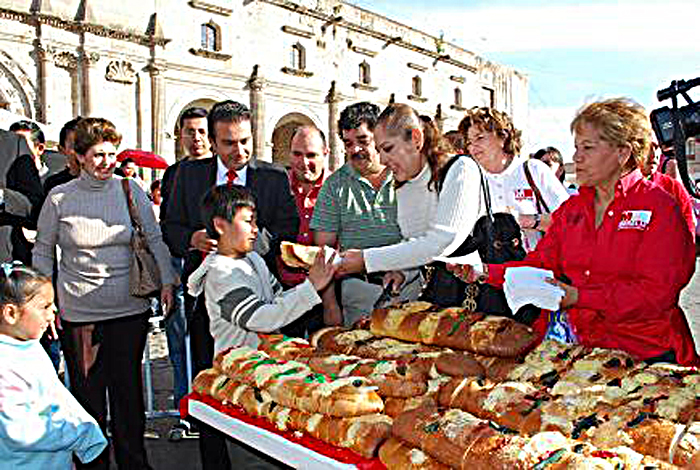
    Rosca morelia
    On January 6, 2009, Paty Mora de Vallejo, wife of Morelia's mayor Fausto Vallejo, served a slice of the enormous rosca de reyes monumental moreliana, prepared jointly by bakeries from everywhere in the city.

    Here in Morelia, Michoacán, bakers prepare an annual monumental rosca for the whole city to share.  The rosca contains nearly 3000 pounds of flour, 1500 pounds of margerine, 10,500 eggs, 150 liters of milk, 35 pounds of yeast, 35 pounds of salt, 225 pounds of butter, 2000 pounds of dried fruits, and 90 pounds of orange peel.  The completed cake, if stretched out straight, measures two kilometers in length!  Baked in sections, the gigantic rosca is the collaborative effort of ten bakeries in the city.  The city government as well as grocery wholesalers join together to see to it that the tradition of the rosca continues to be a vibrant custom.

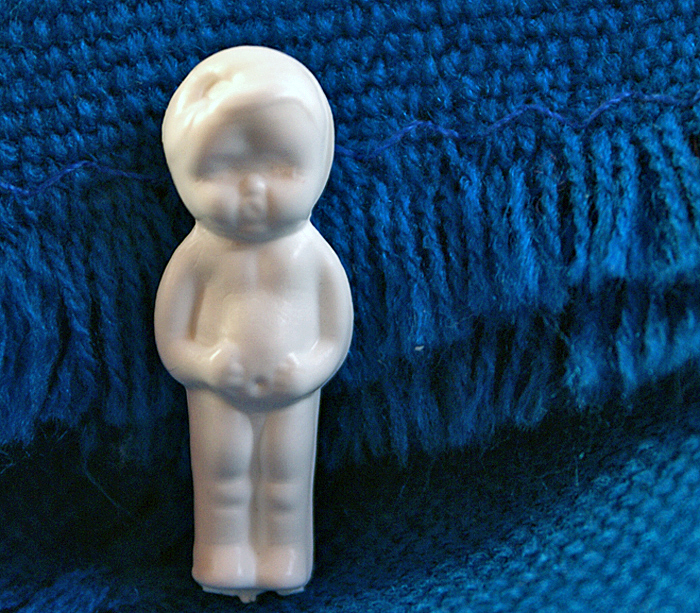
    Niño Dios from Rosca
    The plastic niño (baby) baked into our rosca measured less than 2" tall.  The figures used to be made of porcelain, but now they are generally made of plastic.  See the tooth mark on the head?  Mexico Cooks! is the culprit.  Every rosca de reyes baked in Mexico contains at least one niño; larger roscas can hold two, three, or more.  Morelia's giant rosca normally contains 10,000 of these tiny figures.

    Tradition demands that the person who finds the niño in his or her slice of rosca is required to give a party on February 2, el Día de La Candelaria (Candlemas Day).  The party for La Candelaria calls for tamales, more tamales, and their traditional companion, a rich atole flavored with vanilla, cinnamon, or chocolate.  Several years ago, an old friend, in the throes of a family economic emergency, was a guest at his relatives' Three Kings party.  He bit into the niño buried in his slice of rosca.  Embarrassed that he couldn't shoulder the expense of the following month's Candelaria party, he gulped–literally–and swallowed the niño.

    El Día de La Candelaria celebrates the presentation of Jesus in the Jewish temple, forty days after his birth.  The traditions of La Candelaria encompass religious rituals of ancient Jews, of pre-hispanic rites indigenous to Mexico, of the Christian evangelization brought to Mexico by the Spanish, and of modern-day Catholicism. 

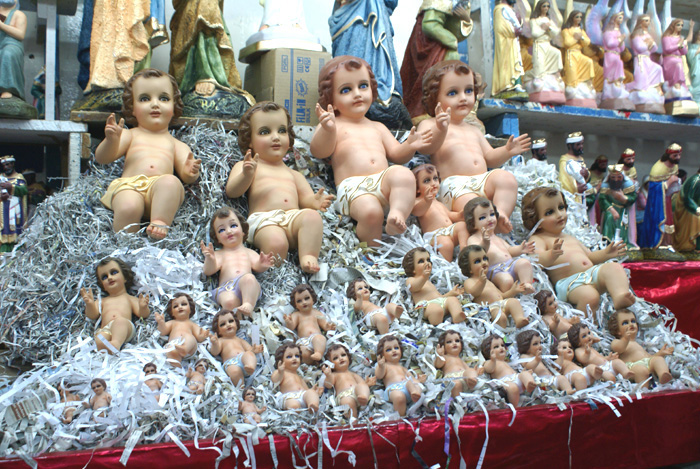
    Baby Jesus Mexico Cooks
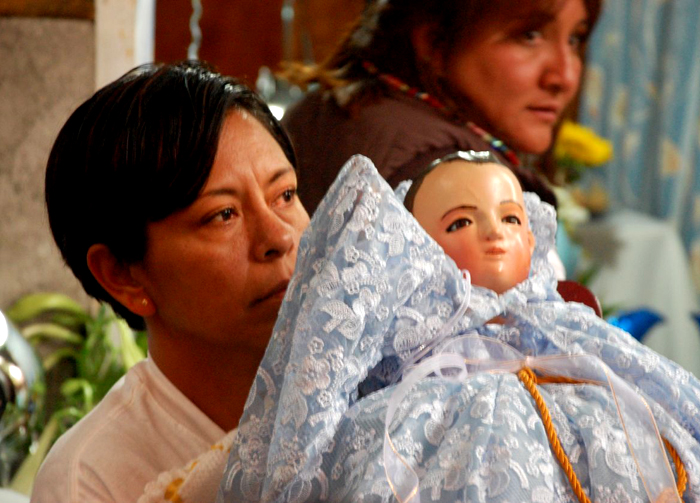
    In Mexico, you'll find a Niño Dios of any size for your home nacimiento (Nativity scene).  Traditionally, the Niño Dios is passed down, along with his wardrobe of special clothing, from generation to generation in a single family.

    The presentation of the child Jesus to the church is enormously important in Mexican Catholic life. February 2 marks the official end of the Christmas season, the day to put away the last of the holiday decorations.  On February 2, the figure of Jesus is gently lifted from the home nacimiento (manger scene, or creche), dressed in new clothing, carried to the church, where he receives blessings and prayers.  He  is then carried home and rocked to sleep with tender lullabies, and carefully put away until the following year. 

    Each family dresses its Niño Dios according to its personal beliefs and traditions.  Some figures are dressed in clothing representing a Catholic saint particularly venerated in a family; others are dressed in the clothing typically worn by the patron saints of different Mexican states.  Some favorites are the Santo Niño de Atocha, venerated especially in Zacatecas; the Niño de Salud (Michoacán), the Santo Niño Doctor (Puebla), and, in Xochimilco (suburban Mexico City), the Niñopa (alternately spelled Niñopan or Niño-Pa).

    Xochimilco Niñopan
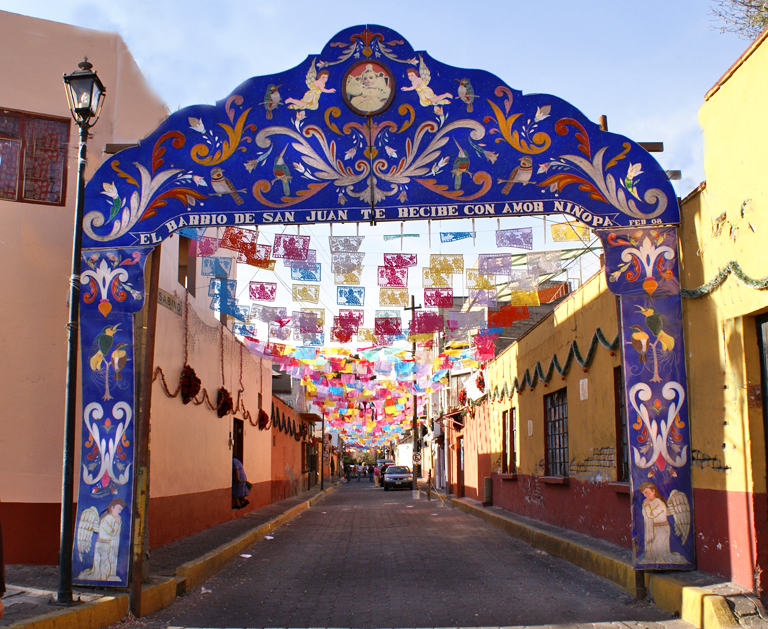
    This Xochimilco arch and the highly decorated street welcome the much-loved Niñopan figure.

    The veneration of Xochimilco's beloved Niñopan follows centuries-old traditions.  The figure has a different mayordomo every year; the mayordomo is the person in whose house the baby sleeps every night.  Although the Niñopan (his name is a contraction of the words Niño Padre or Niño Patrón) travels from house to house, visiting his chosen hosts, he always returns to the mayordomo's house to spend the night.  One resident put it this way: "When the day is beautiful and it's really hot, we take him out on the canals.  In his special chalupita (little boat), he floats around all the chinampas (floating islands), wearing his little straw hat so that the heat won't bother him.  Then we take him back to his mayordomo, who dresses our Niñopan in his little pajamas, sings him a lullaby, and puts him to sleep, saying, 'Get in your little bed, it's sleepy time!"  Even though the Niñopan is always put properly to bed, folks in Xochimilco believe that he sneaks out of bed to play with his toys in the wee hours of the night.  

    Trajineras
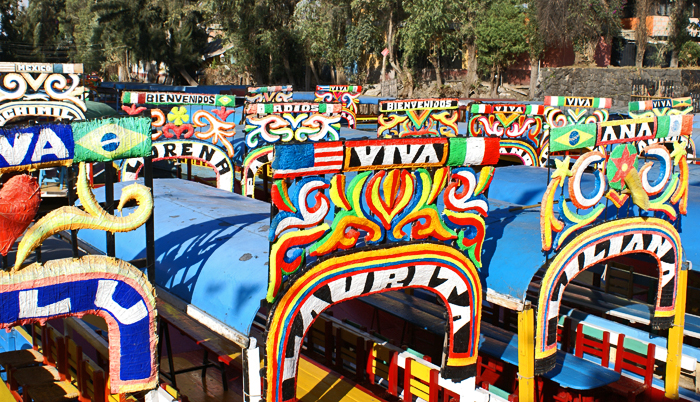
    Trajineras (decorated boats) ready to receive tourists line the canals in Xochimilco.

    Although he is venerated in many Xochimilco houses during the course of every year, the Niñopan's major feast day is January 6.  The annual celebration takes place in Xochimilco's church of St. Bernard of Sienna.  On the feast of the Candelaria, fireworks, music, and dancers accompany the Niñopan as he processes through the streets of Xochimilco on his way to his presentation in the church.

    Niñopa Colibrí
    Gloria in Xochimilco with Niñopa, April 2008.  Photo courtesy Colibrí.

    Xochimilco Papel Picado Niñopa
    Blue papel picado (cut paper decoration) floating in the deep-blue Xochimilco sky wishes the Niñopan welcome and wishes all of us Feliz Navidad.

    Tamales
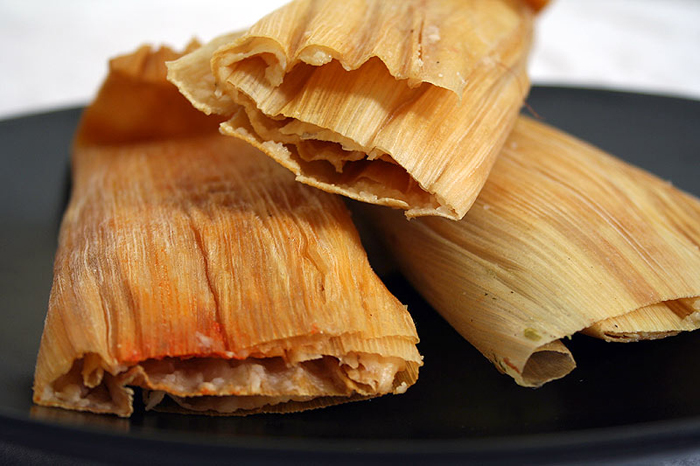
    El Día de La Candelaria means a joyful party with lots of tamales, coupled with devotion to the Niño Dios.  For more about a tamalada (tamales-making party), look at this 2007 Mexico Cooks! article.

    From the rosca de reyes on January 6 to the tamales on February 2, the old traditions continue in Mexico's 21st Century.

    Looking for a tailored-to-your-interests specialized tour in Mexico? Click here: Tours.
  • Feliz Año Nuevo (Happy New Year), Mexican Style

    Chonitos amarillos
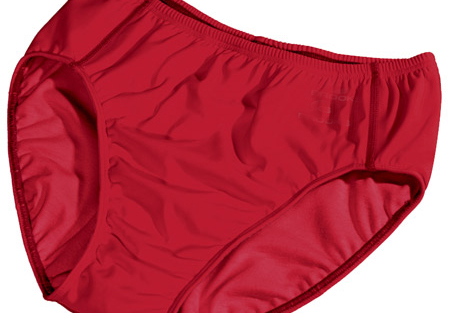
    In Mexico and other Latin American countries, women wear yellow underwear on New Year's Eve to bring good luck and wealth in the year to come.  Red underwear indicates a New Year's wish for an exciting love interest!

    Superstition or not, many here in Mexico have the custom of ritos del Año Nuevo (New Year's rituals).  Some rituals include foods, others prescribe certain clothing, and still others warrant attention for religious interest.

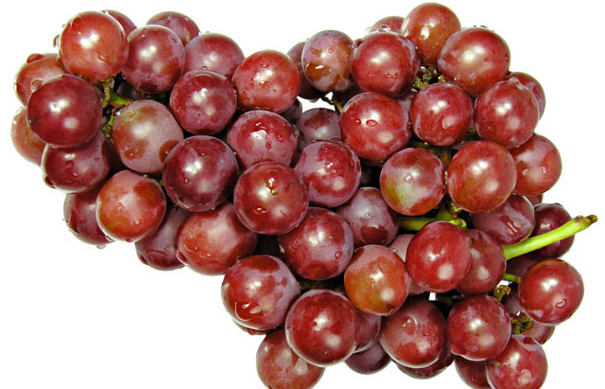
    Grapes
    As the clock strikes midnight, it's common to eat twelve grapes–one at each ding, one at each dong of the bell.  While eating the grapes, you make a personal wish for each grape you consume, welcoming the new year that's beginning.  Mexico Cooks! finds that it's helpful to write down the twelve wishes so as not to forget one or choke in the rush to swallow the grapes before the clock finishes striking the New Year's earliest hour!

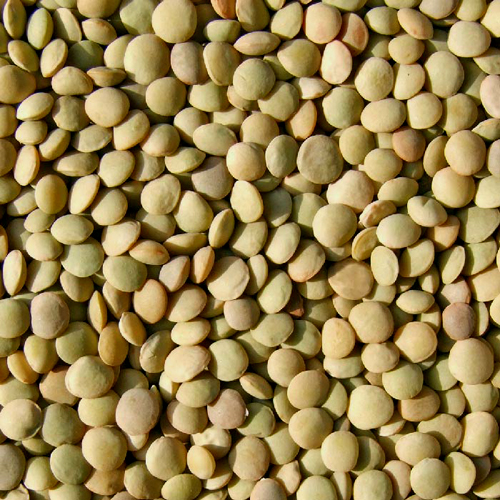
    Lentils
    Eating a tablespoonful of cooked lentils on New Year's Eve is said to bring prosperity and fortune.  You can also give raw lentils–just a handful–to family and friends with the same wish.

    Lit Match
    On a small piece of paper, write down the undesirable habits and customs you'd like to let go of in the New Year that's just starting.  Burn the paper, then follow through with the changes!

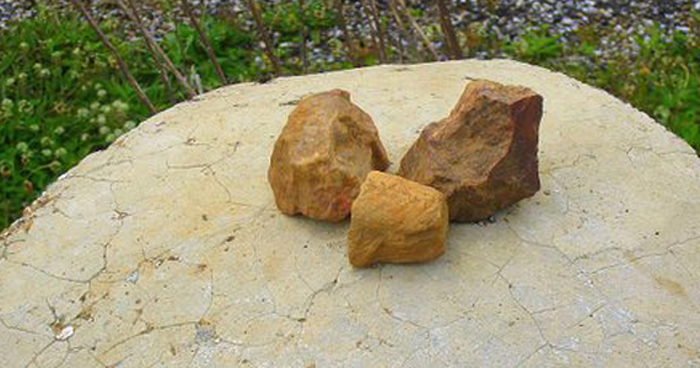
    3 Stones
    Choose three stones that symbolize health, love, and money.  Put them in a place where you will see them every day.

    Candles
    Light candles: blue for peace, yellow for abundance, red for love, green for health, white for spirituality, and orange for intelligence.

    Glass of water
    Spill clean water on the sidewalk in front of your house as the clock rings in the New Year.  Your house will be purified and all tears will be washed away.

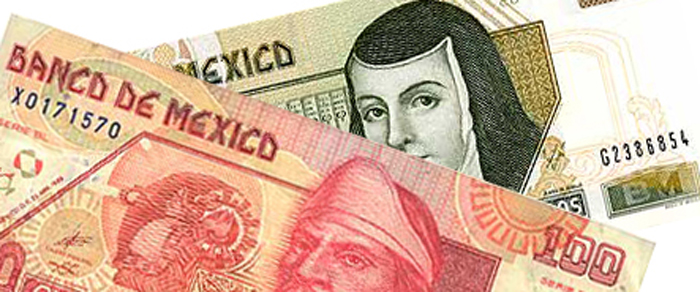
    Pesos layers
    To have money for your needs all year, have some bills in your hand or in your pocket to welcome the arrival of the New Year.  Some people fold up the money and put it in their shoes!

    Suitcase!
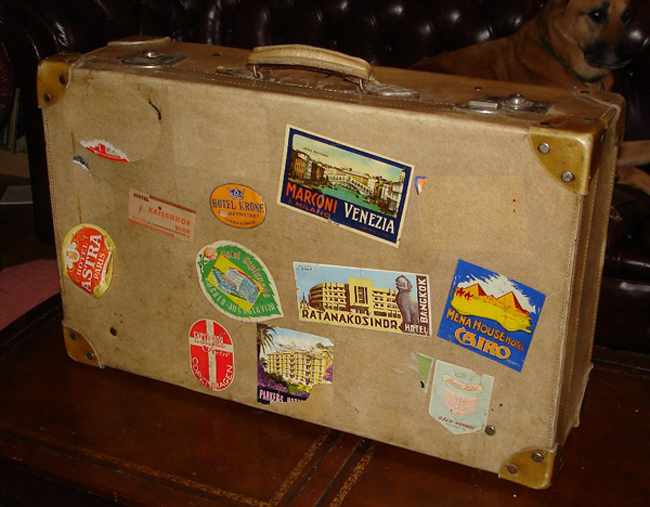
    Take your suitcase for a walk.  Legend is that the farther you walk with your suitcase, the farther you'll travel.  Several New Year's Eves ago, Mexico Cooks! and a few friends celebrated by walking our suitcases around the block, and we all traveled far and wide during the new year that followed.

    Chonitos rojos
    Mexico Cooks! wishes all of you a muy Próspero Año Nuevo–and especially wishes that your red underwear brings you (or keeps you) the love of family, friends, and that special someone.

    We'll see you in 2011!

    Looking for a tailored-to-your-interests specialized tour in Mexico? Click here: Tours.
     

  • Mexico Cooks! Les Desea Feliz Navidad a Todos! :: Merry Christmas to All 2010

    Mercado Piñatas 2
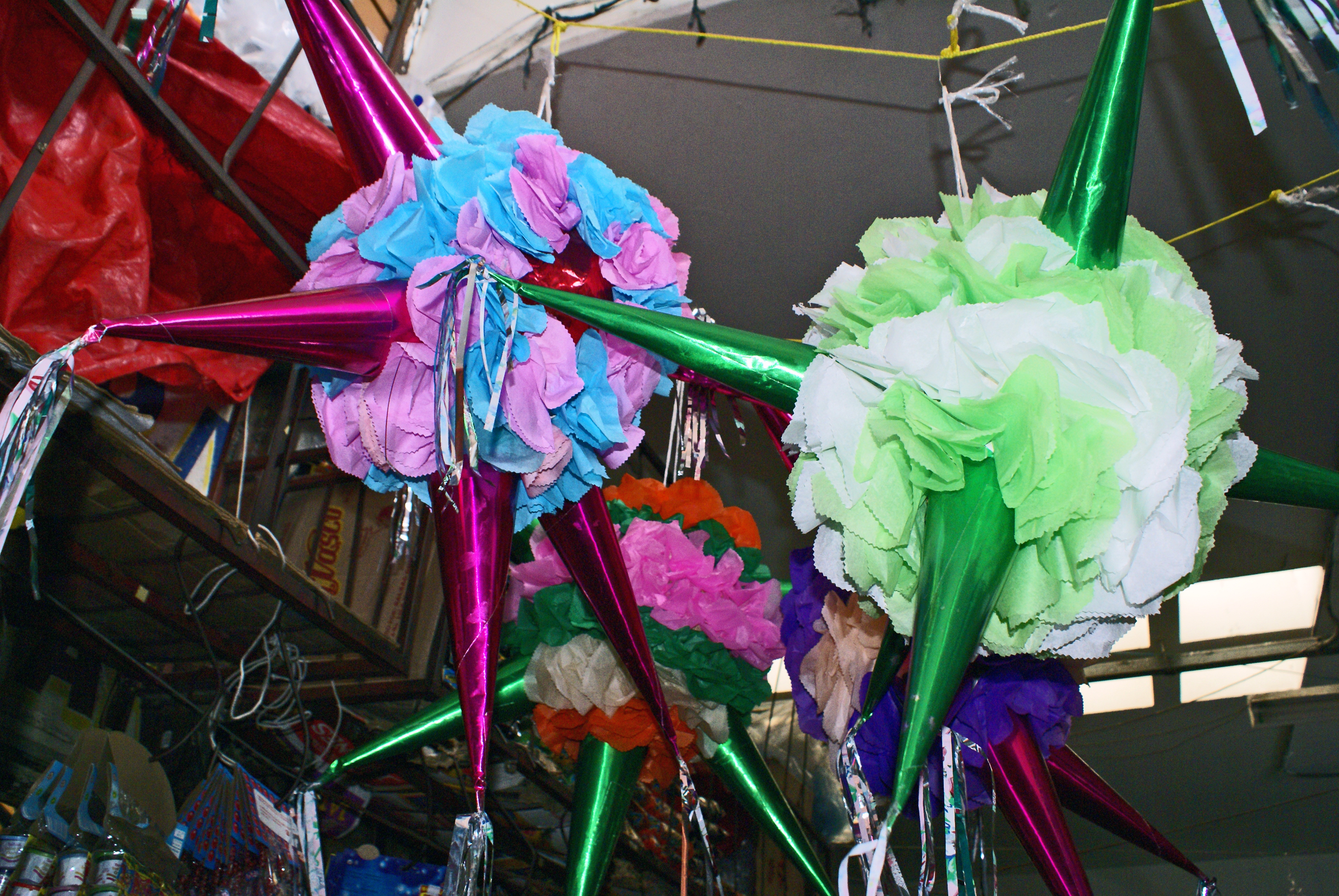
    Few things represent Mexico's Christmas more than the traditional piñata.  Read all about its history right here.

    Christmas in Mexico is absolutely the most special time of the whole year.  Even our daily municipal markets se visten de gala (dress up in their finest) for several weeks before the holidays.  Out come locally-grown arbolitos de Navidad (Christmas trees), out come thousands of nochebuenas (poinsettias).  Nativity sets, toys and more toys, just-for-Christmas candy, special Christmas-season fruit, and special foods of all kinds make their annual appearance on market shelves.  Just a couple of weeks ago, Mexico Cooks! made a special trip to Morelia's Mercado Independencia (the largest retail market in town) to photograph some of the hundreds of goodies and treats available just this month.

    Mercado Adornitos Navideños 2
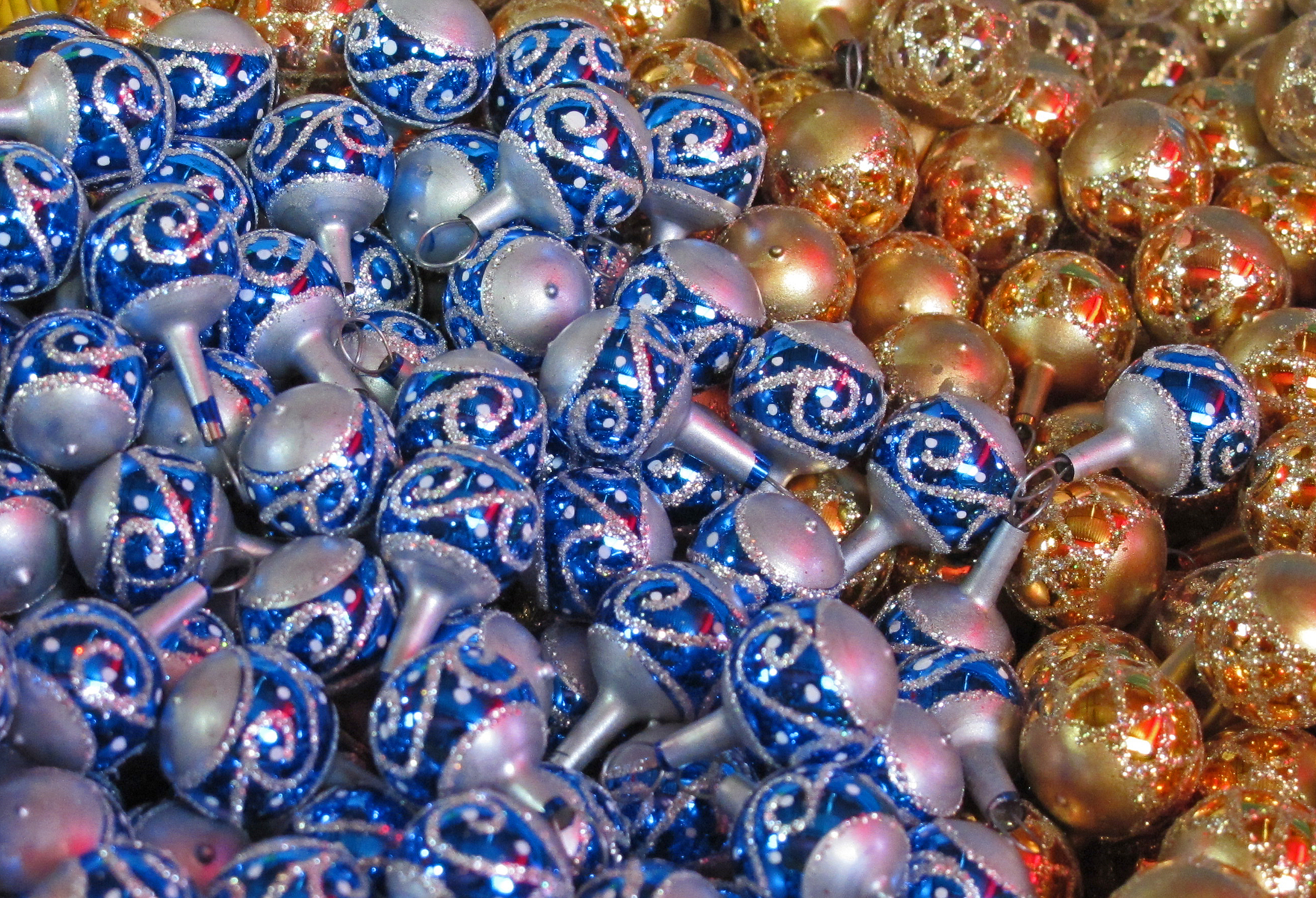
    These tiny, beautiful, glass ornaments, mouth-blown and hand-painted in eastern Michoacán, measure no more than one-half inch in diameter.  Price in 2010?  A dozen for 20 pesos–about $1.50USD.

    Mercado Dulces Peras Anís
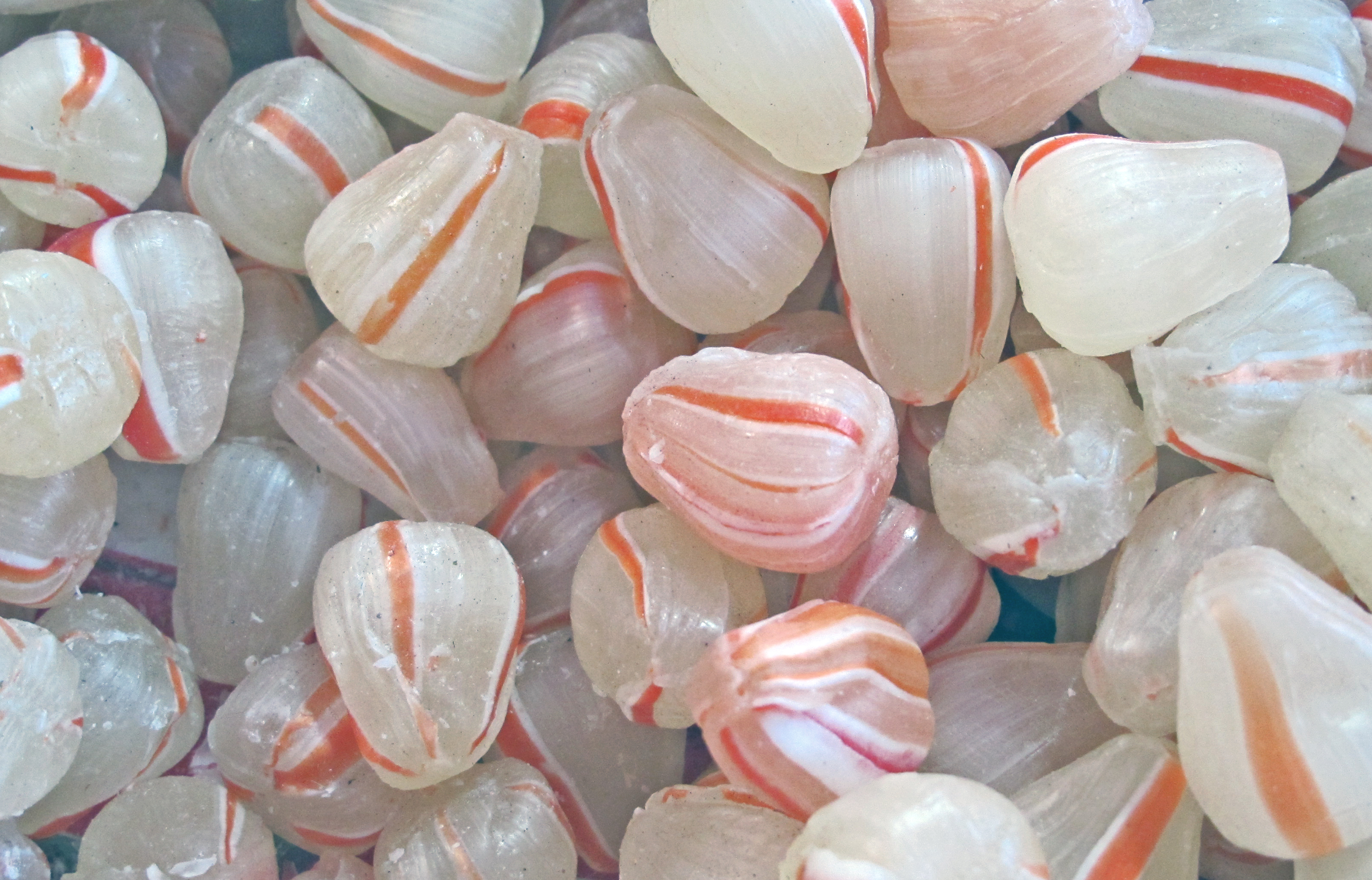
    Peras de anís (anise-flavored pear-shaped candies) are no bigger than the tiny Christmas ornaments in the picture above.

    Mercado Diablos Pastorelas
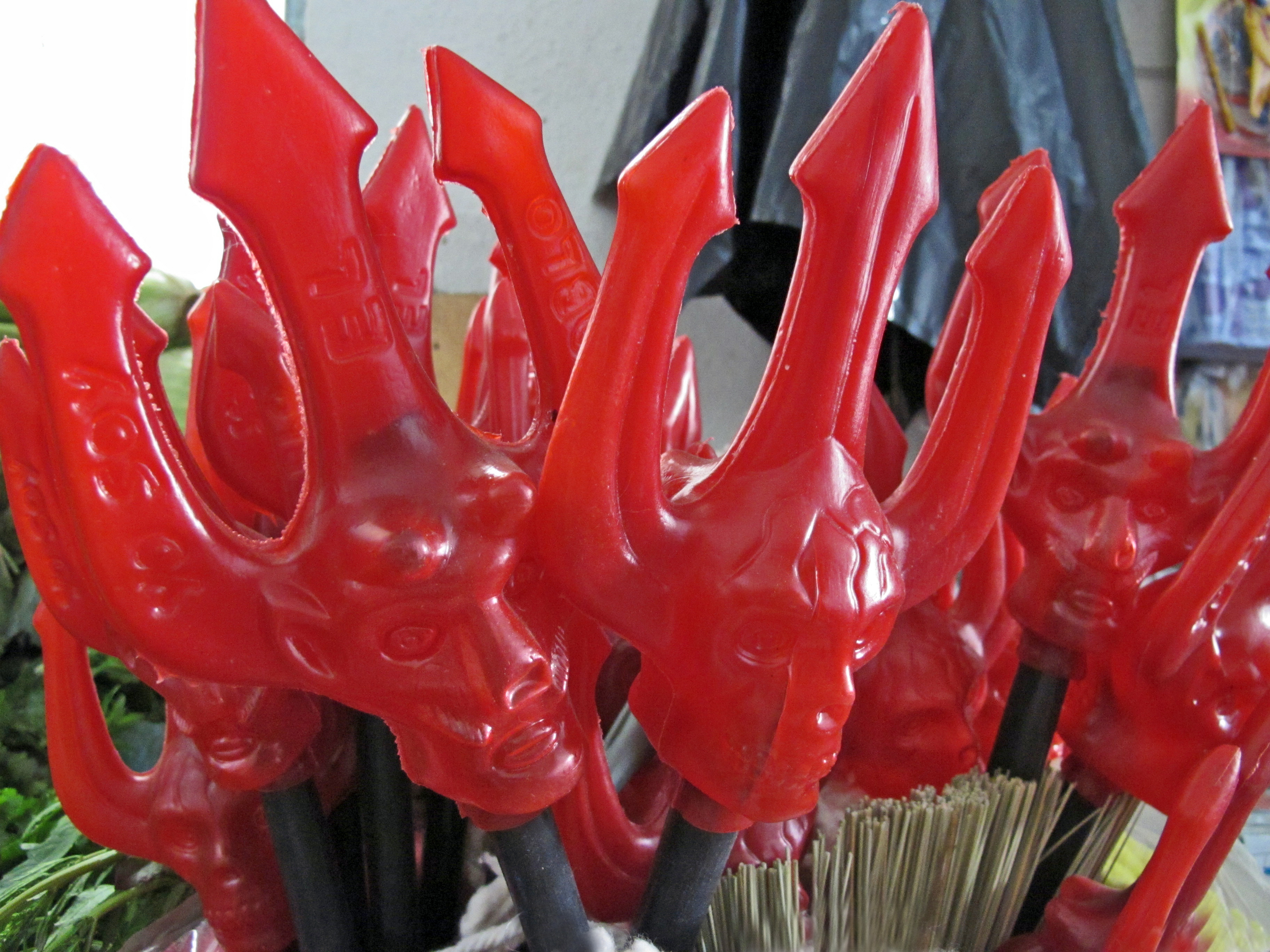
    What in the world do devils' pitchforks have to do with Christmas in Mexico!  Learn all about our tradition of pastorelas (Christmas pageants–but with a twist) from this article on Mexico Cooks!.

    Mercado Mandil Guadalupano
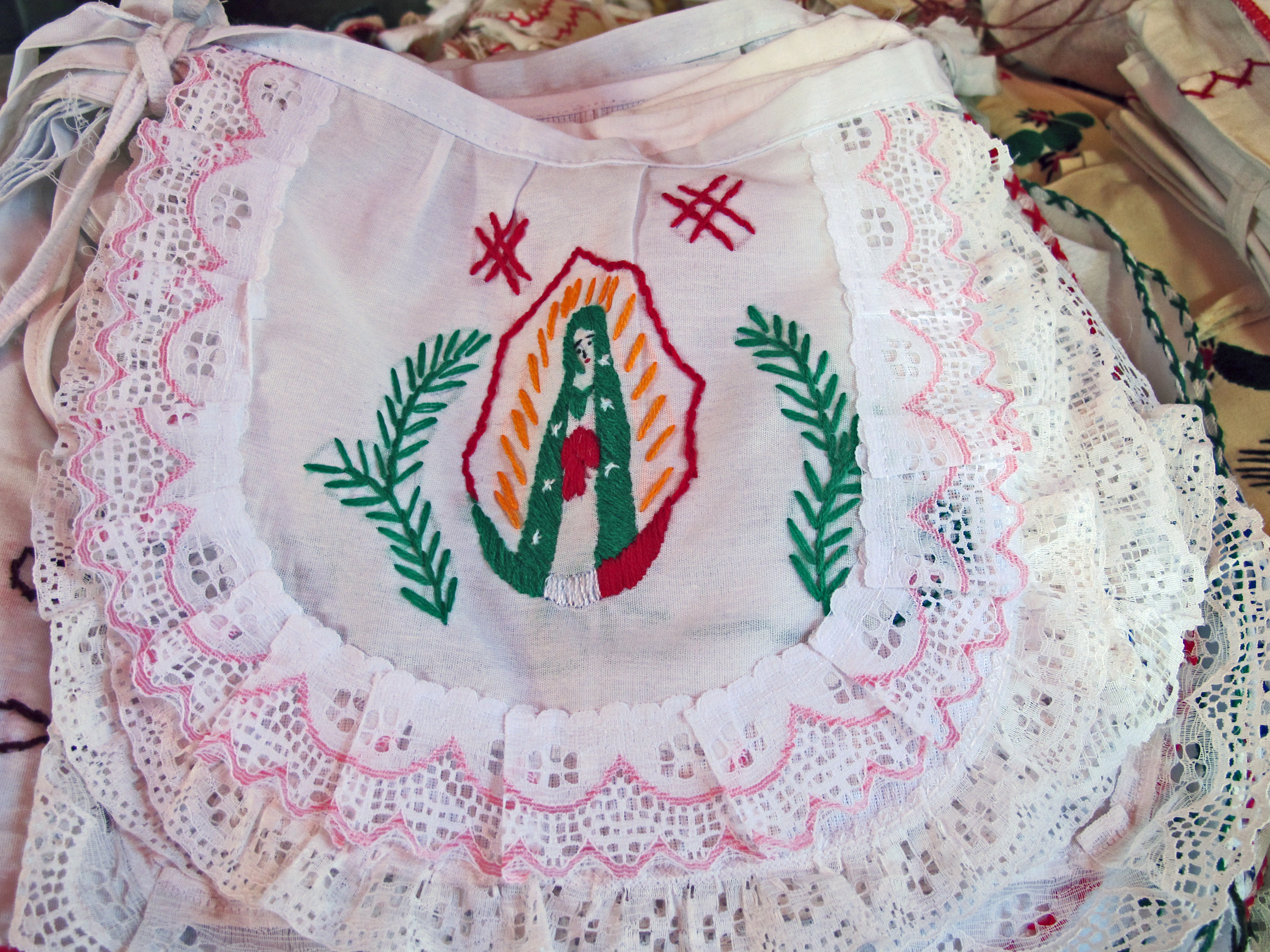
    This frilly apron, hand-embroidered with Nuestra Señora de Guadalupe (Our Lady of Guadalupe) is just the right size for a two- or three-year-old to wear on December 12, Mexico's other important December holiday.  Traditional male and female clothing for the annual pilgrimages is available in every size, from newborn baby to adult.

    Mercado Collares
    Collares (necklaces) of multi-colored glass beads complement a little girl's costume on December 12.

    Mercado Guacales
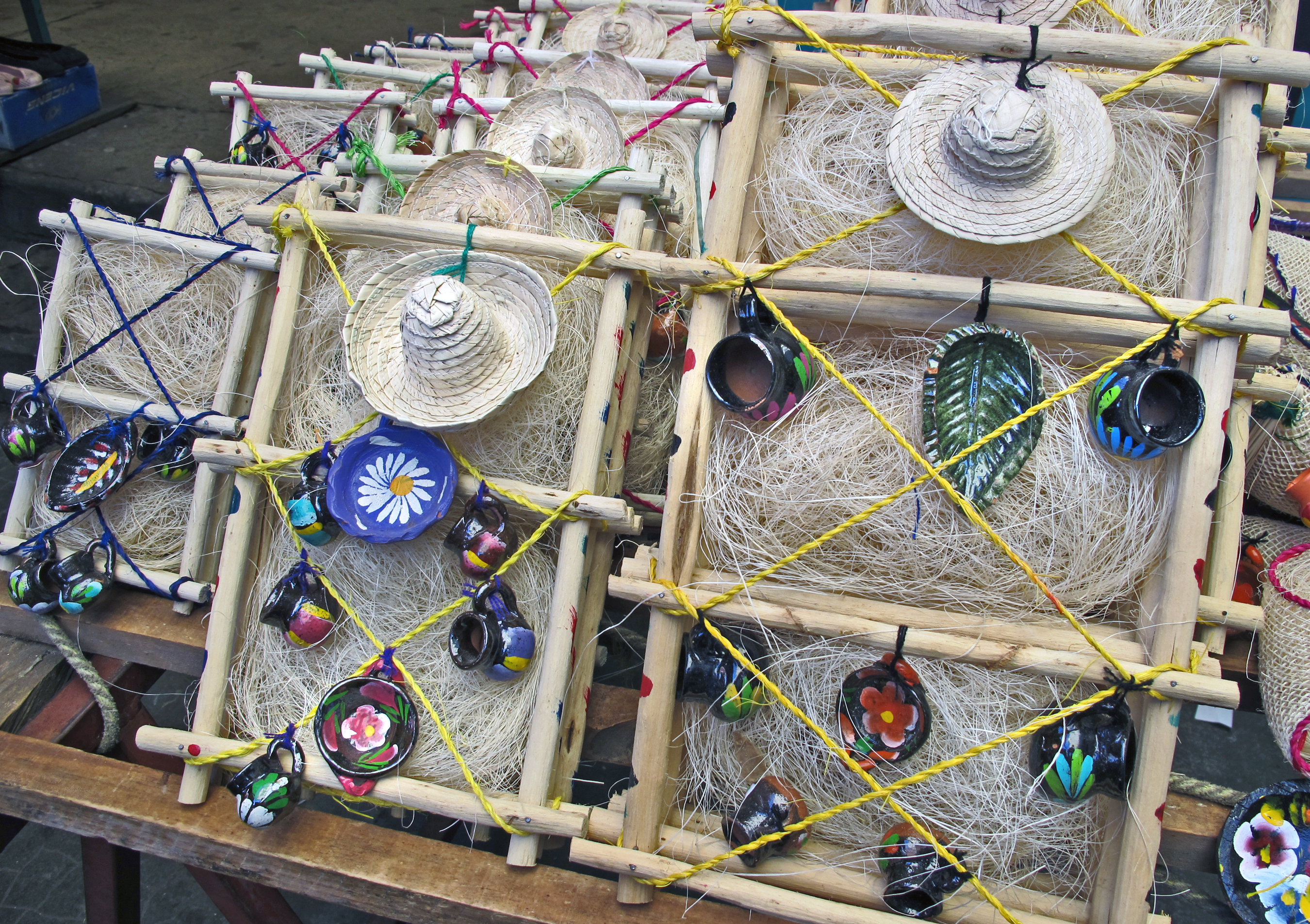
    The guacal (literally, wooden crate), in various sizes for children of various ages.  Little boys dressed in the traditional indigenous shirt and pants of manta (rough unbleached cotton cloth) carry this crate on their backs, with its miniature clay dishes and tiny straw sombrero, on their pilgrimage in honor of Our Lady of Guadalupe.

    Mercado Pollitos de Barro
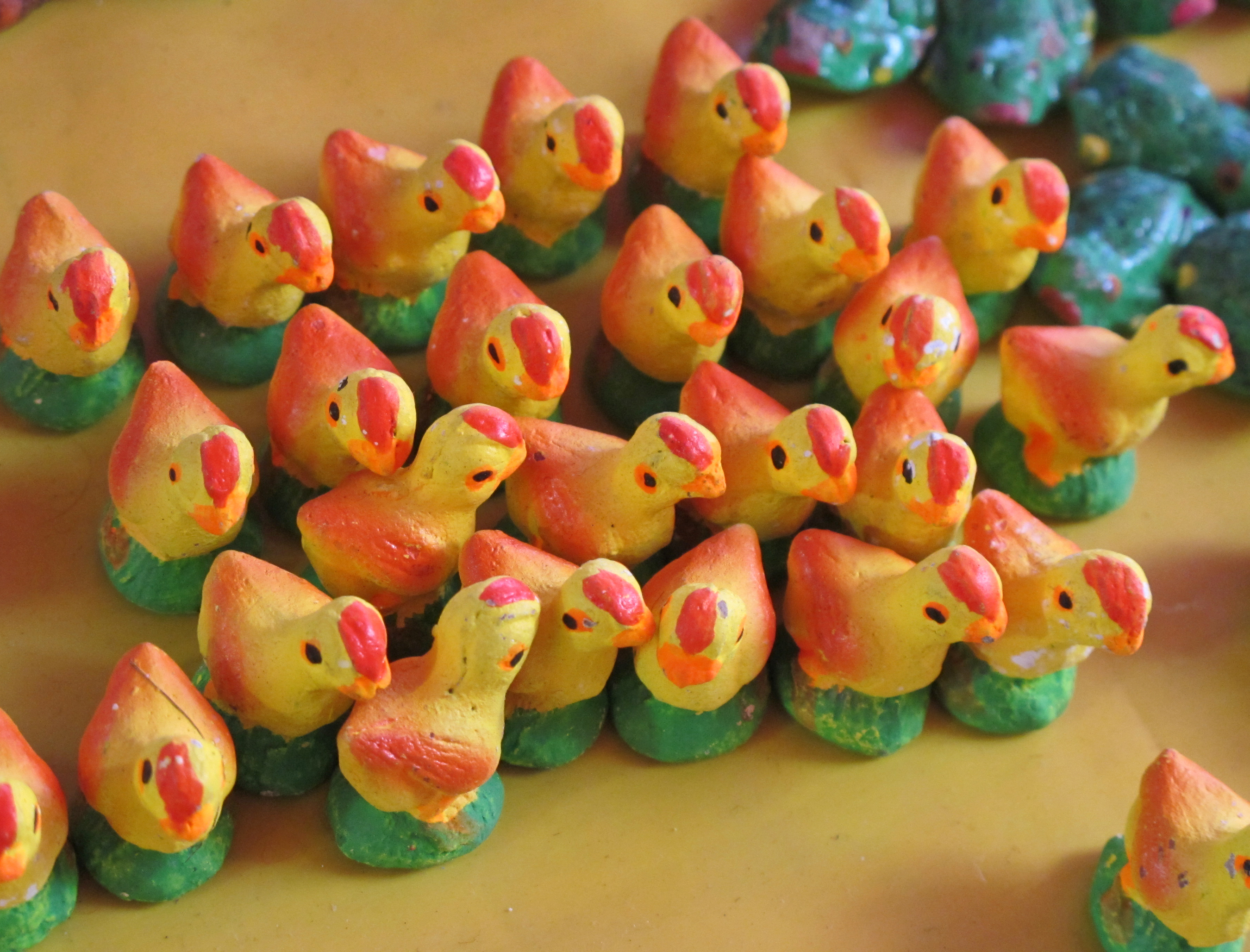
    A flock of tiny chicks, each about half an inch high and made of clay, is ready to add to your nacimiento (manger scene).  Every year, Mexico Cooks! is eager to add figures of one kind or another to ours. 

    Mercado Coronitas Santa Claus
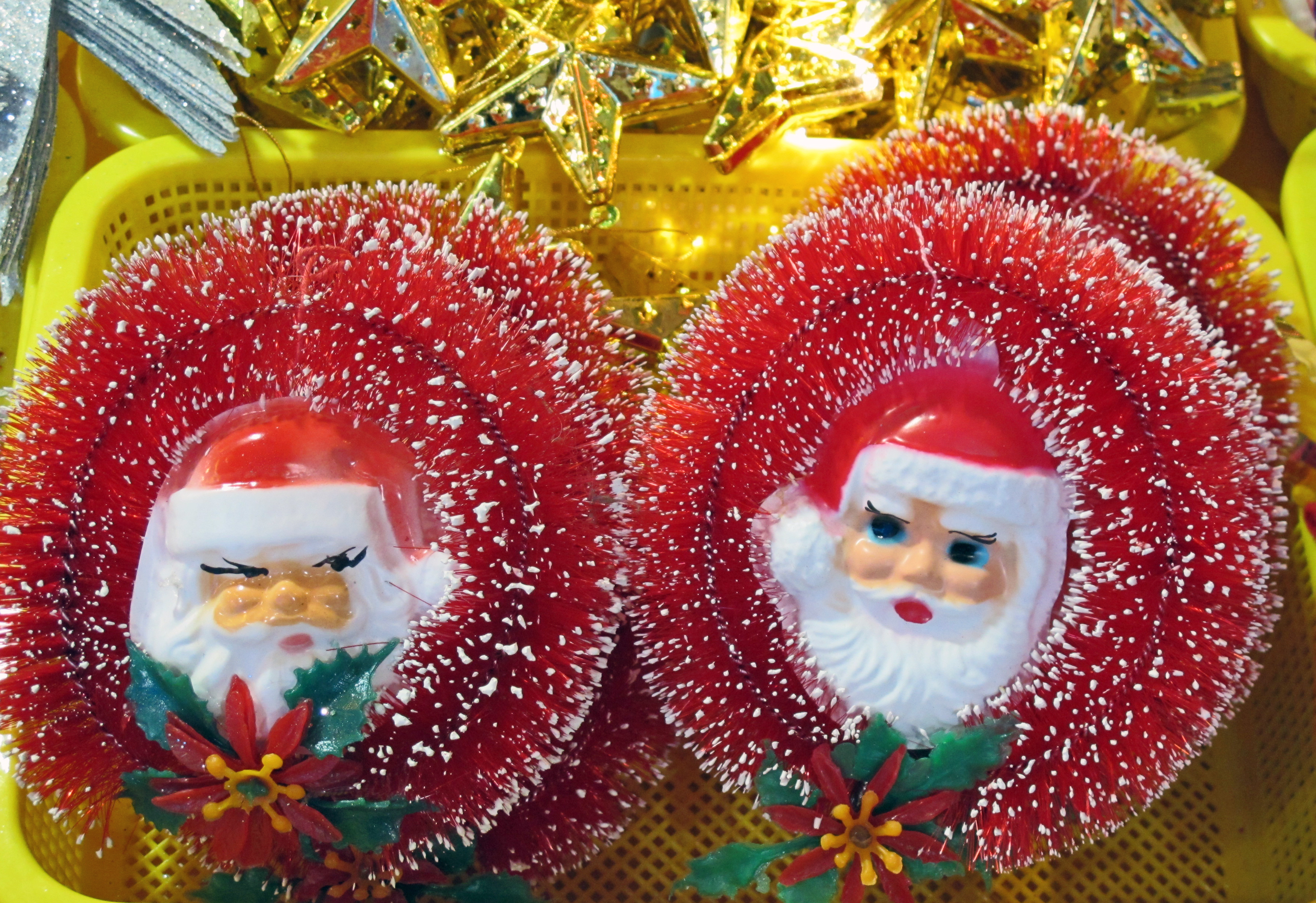
    Santa Claus is a relative newcomer to the Mexican Christmas scene.  Traditionally, Mexican children have received their holiday gifts on January 6–El Día de los Reyes Magos (Three Kings' Day).  The jolly elf is making cultural inroads, though, and some lucky boys and girls get a present from Santa and another one or two from the Three Kings.

    Mercado San Juan Dulces Sandías
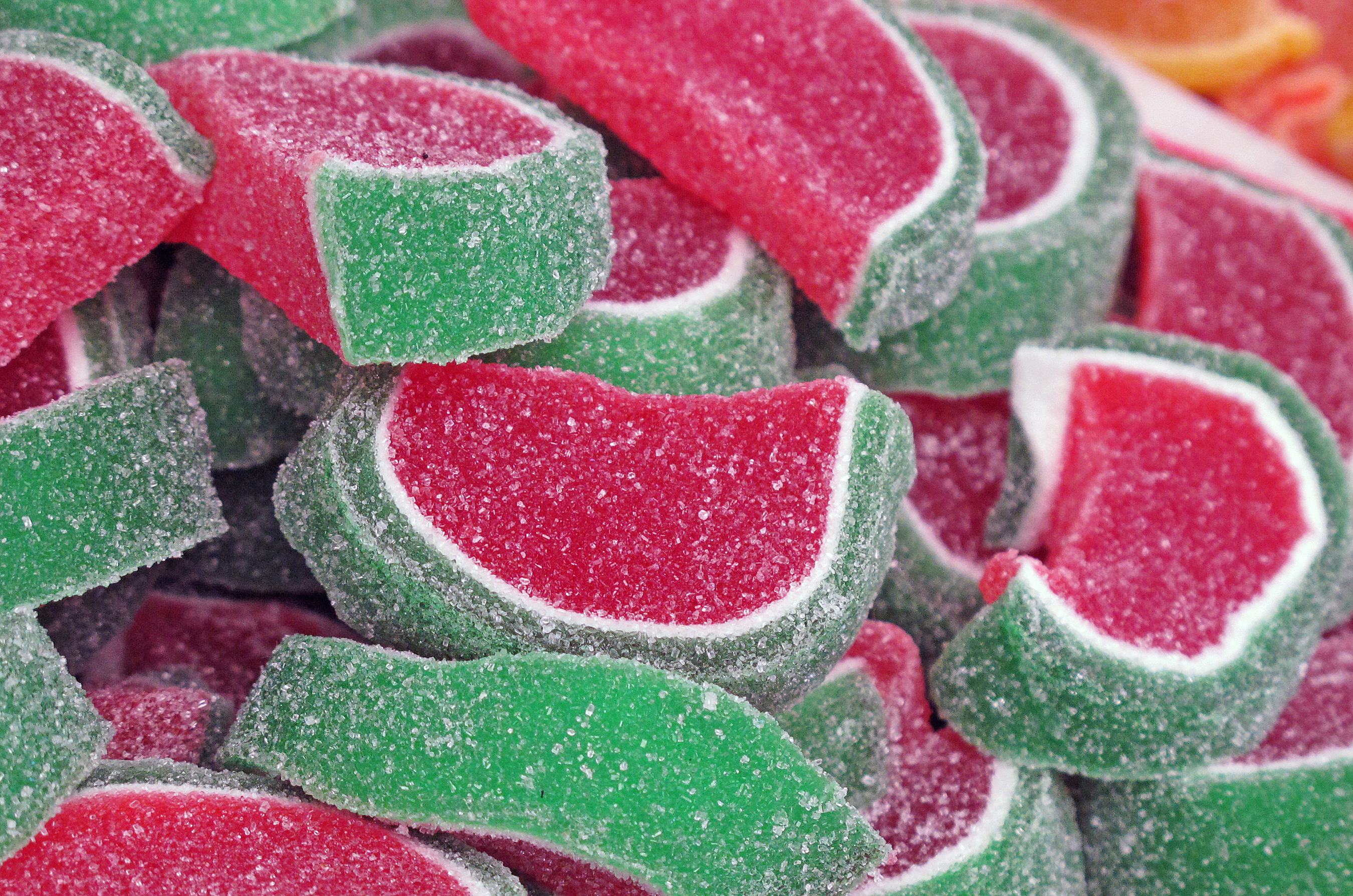
    More candy!  These are similar in texture to gumdrops, but they're shaped like sandía (watermelon).  Click on any Mexico Cooks! photo to enlarge it for more detail.

    Mercado Hule con Nochebuenas
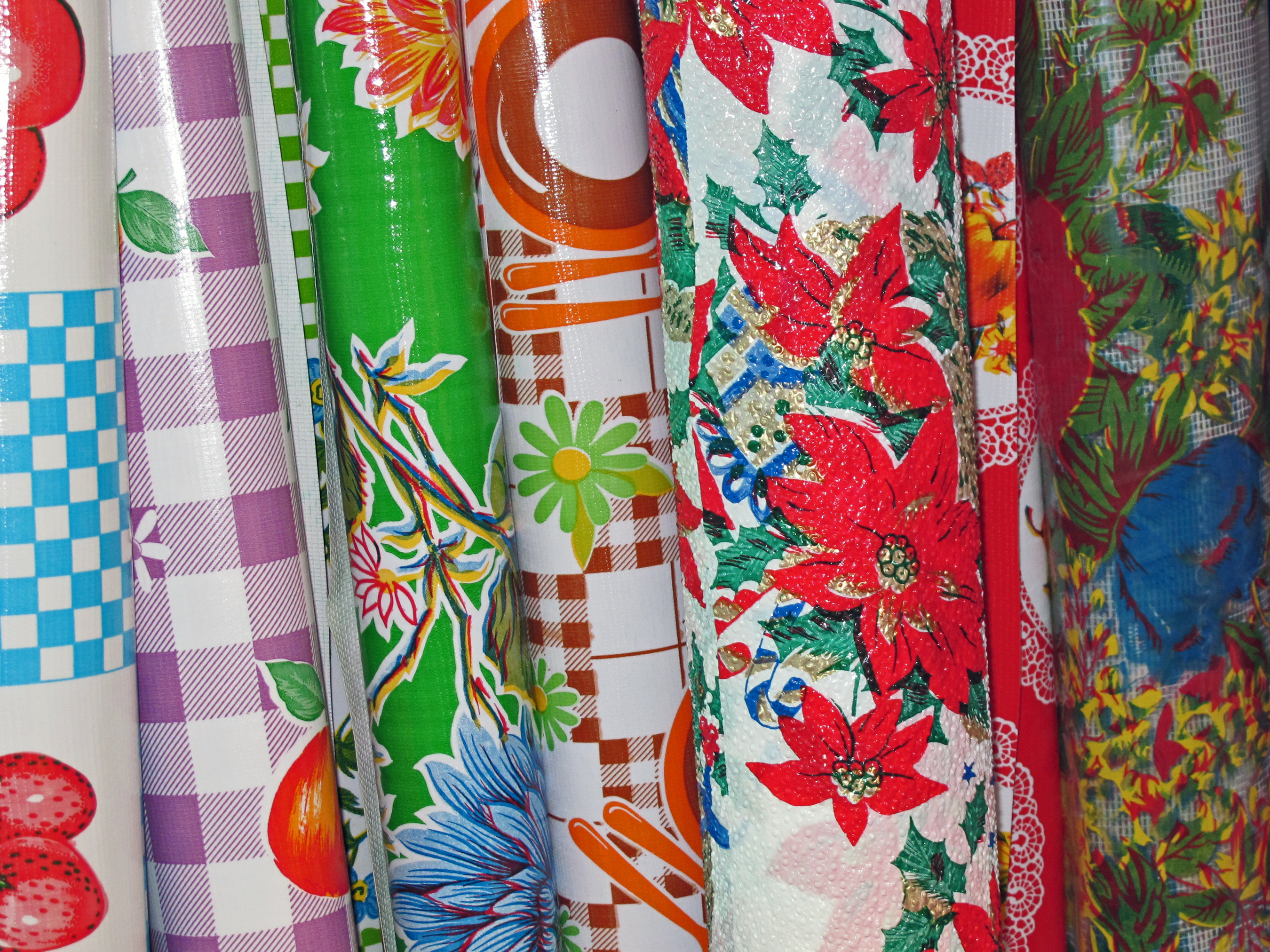
    Even Mexican oilcloth, that terrific table covering, joins in the spirit of Christmas.  The roll that's front and center is decorated with nochebuenas (poinsettias).  Did you know that the poinsettia is a native of Mexico?

    Mercado San Juan Calabazas
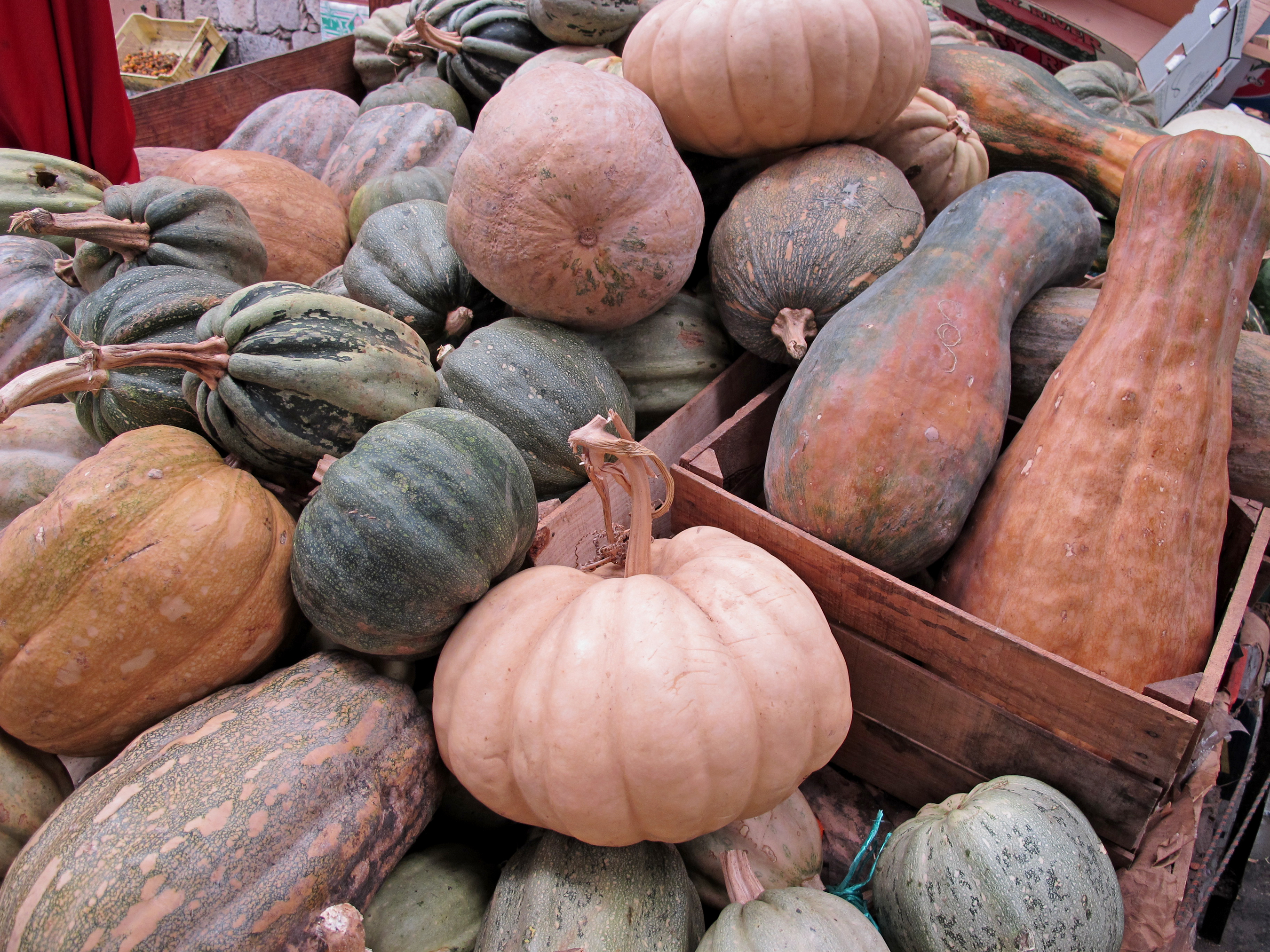
    These big-as-jack-o'lantern-heads calabazas (squash) are a delicious wintertime treat in Mexico.

    Mercado Piñata
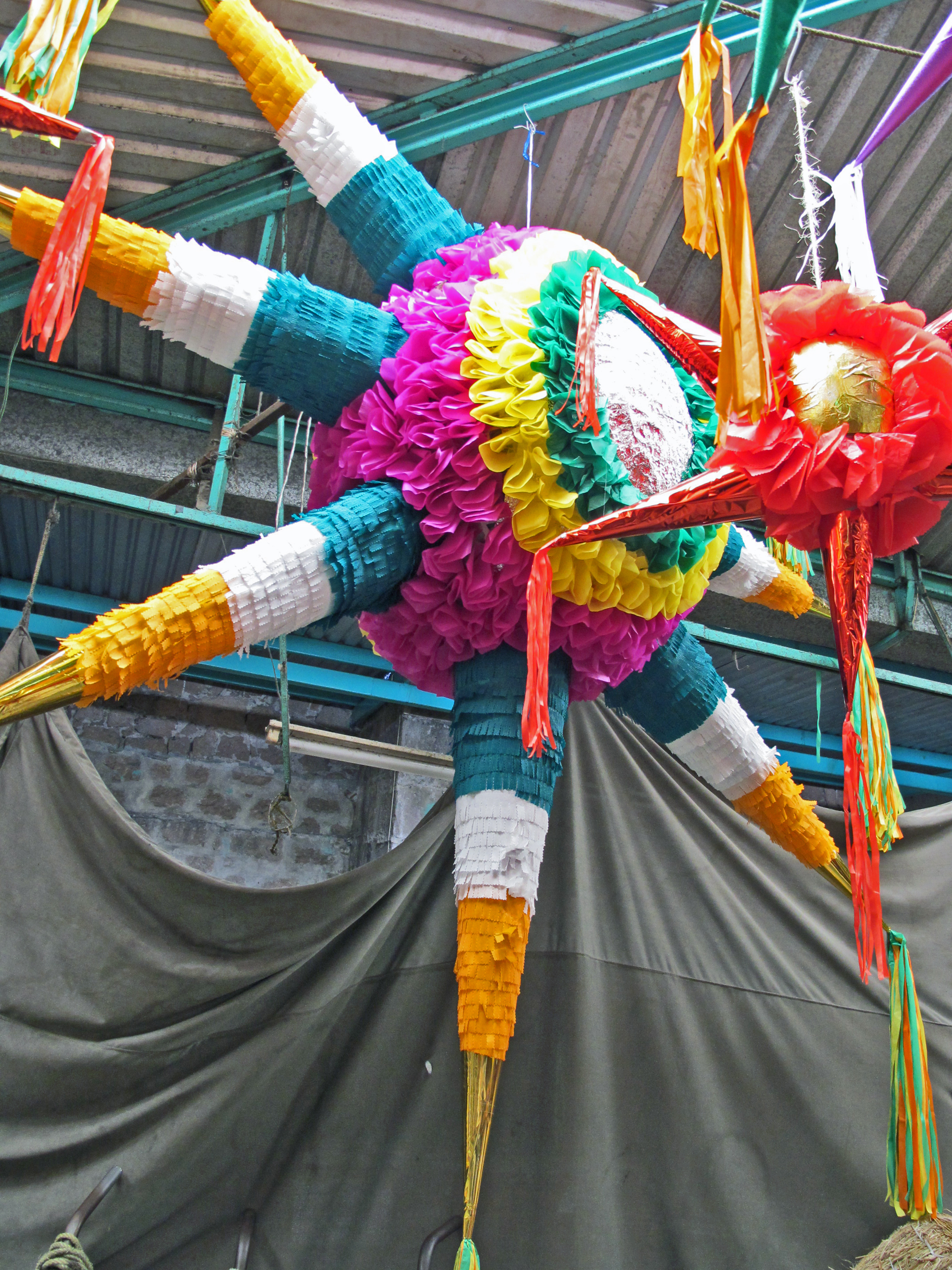
    Yet another piñata, this one about six feet from the top to the tip of the bottom point.  The center container is a large clay pot–just imagine how much it would weigh when it's filled with candy, tangerines, and roasted peanuts! 

    Mercado Listones Navideños
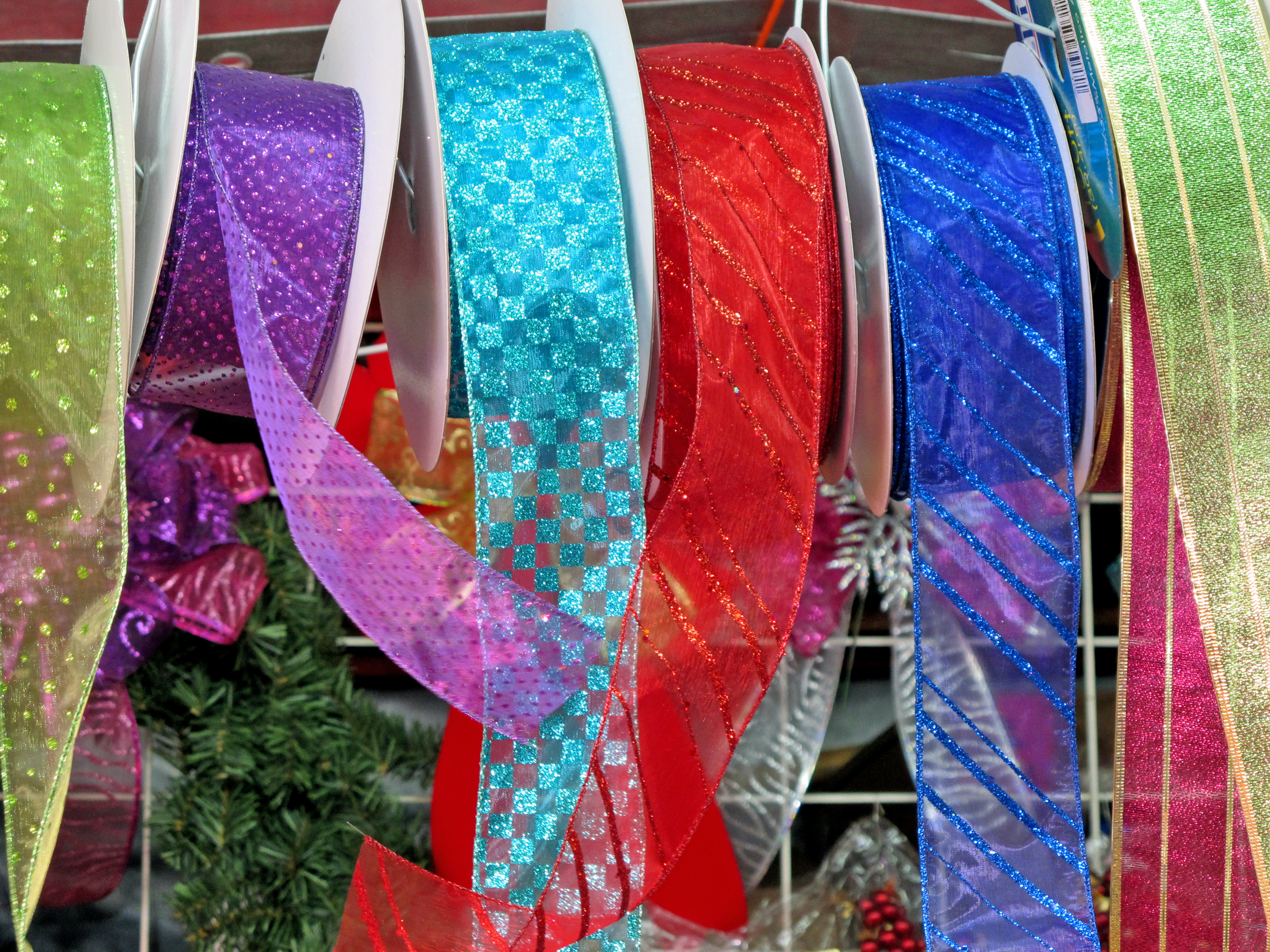
    Ribbons of every kind and color, with or without wire edges, is available by the meter at the Mercado Independencia.  In fact, just about anything you could possibly want–from a pair of pliers to a pair of warm gloves, from a pet parrot to a chicken for your dinner table, is available at the market.

    Niño Dios Navidad 2009
    May your holidays be filled with all you hold dear, and may your New Year bring you all that you desire.

    Feliz Navidad y Próspero Año Nuevo–Merry Christmas and Happy New Year–to you and yours from us at Mexico Cooks!

    Looking for a tailored-to-your-interests specialized tour in Mexico? Click here: Tours.


  • Mexican Edible Oddities: What Is This Fruit and What Do I Do With It?

    Banana Hand and Flower
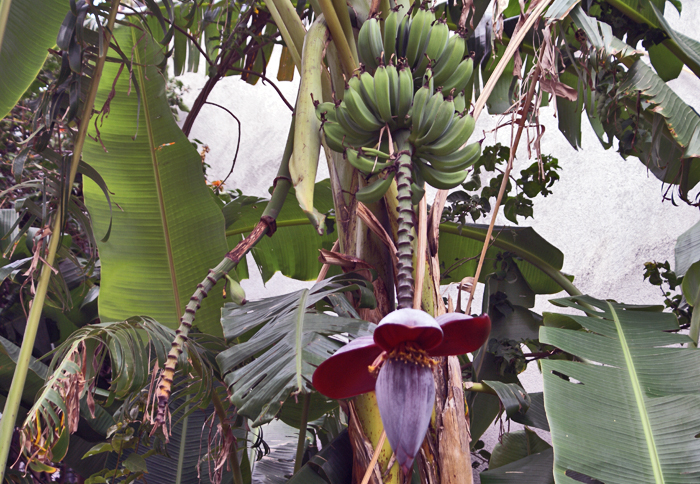
    We'll start off with a gimme: everybody recognizes bananas–the green fruits hang from the long knobby stalk.  The pointed reddish-purple part at the bottom of the photo is the banana flower.  Click on the photo to better see the tiny purple-yellowish florets just under the extended portion of the flower.  That's the part of the flower that matures to form the actual banana fruit.  In India and in Thailand, those tiny flowers are prepared as delicious dishes.  I don't know a Mexican recipe for them–do you?

    Mexico is home to some decidedly unusual fruits (no smart remarks, please). Many of these fruits are unavailable in other parts of the world, but it's certainly worthwhile to learn that they exist and are wonderful to taste.

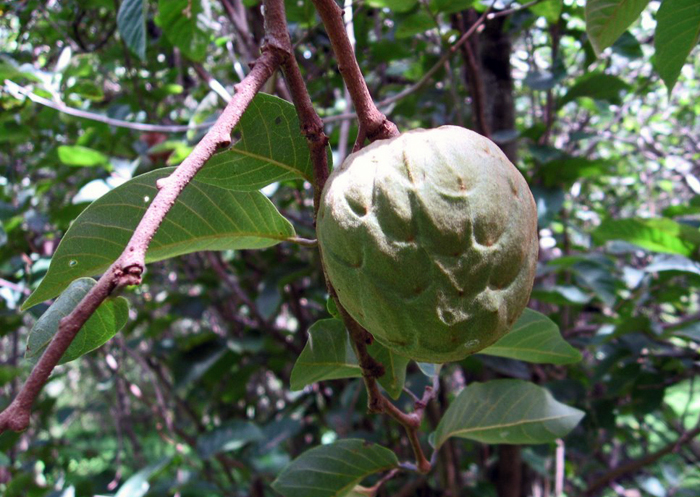
    Chirimoya fruit (not ripe)
    This is a chirimoya (Annona Cherimolia), sometimes known in English as a custard apple.  Its size ranges from that of a baseball to much larger.  I once picked one that was almost the size of my head, carried it by hand from the Michoacán mountains to Mexico City, allowed it to ripen fully, and shared it with my friend Celia Gutiérrez.  

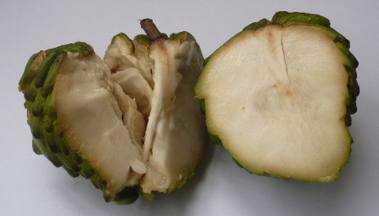
    Chirimoya ripe open
    When ripe, the chirimoya's flesh is soft, yielding easily to a spoon.  The taste is like a combination peach and strawberry: absolute heaven.  The fruit is picked while immature and ripens quickly in a sunny window or on a kitchen counter.  Originally brought to the New World by the Spanish conquistadores, these are available in Mexico primarily during their relatively short summer season.

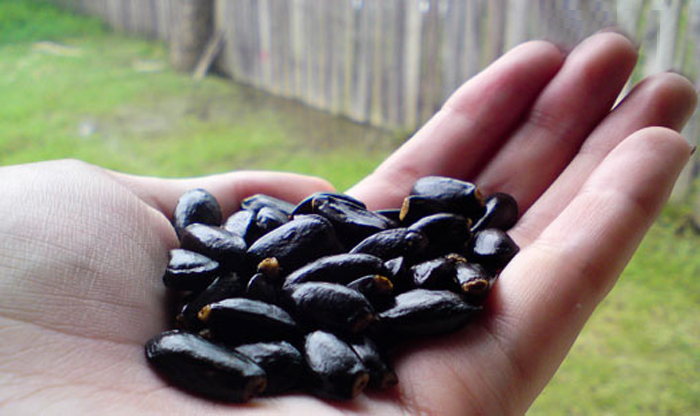
    Chirimoya seeds
    The seeds of the chirimoya are large, black, and shiny.  Occasionally you'll find a sprouted seed inside one of the fruits; I've tried to grow a tree but have had no luck.

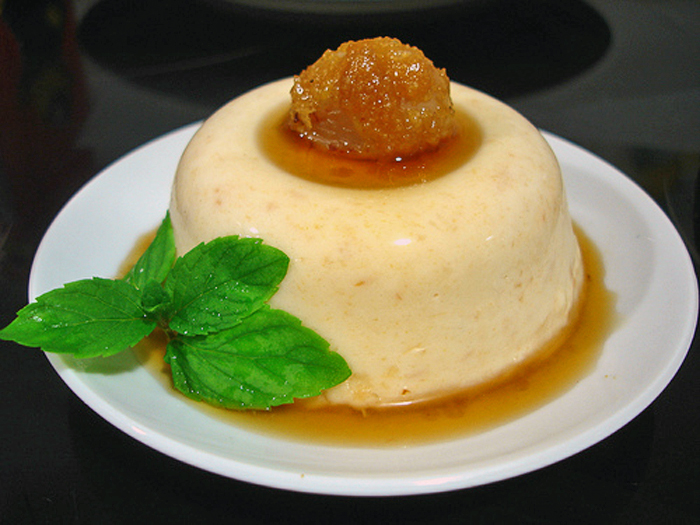
    Mousse de Chirimoya
    Mousse made of chirimoya and cream.  Photo and recipe courtesy this website.

    Mousse de Chirimoya
    Serves six 

    Ingredients
    1 ripe chirimoya (300 or 400 gr.)
    1/4 Cup heavy cream
    2/3 Cup whole milk
    1leaf of unflavored gelatin
    1 Tbsp sugar

    Decoration
    I or 2 white grapes per individual mousse
    2 Tbsp dark brown sugar
    1 Tbsp dark rum
    Sprigs of fresh mint

    Procedure
    Cut the chirimoya in quarters and carefully remove the seeds.  Put the chirimoya flesh into your blender jar.

    In a heavy saucepan, heat the milk, the cream, and the sugar.  Stir constantly to make sure that the mixture does not stick.  Dissolve the gelatin in cold water.

    Once the mixture begins to cook, add the dissolved gelatin.  Allow the mix to cook for a minute more, without moving the saucepan from the burner.  After a minute, take the pan off the fire and allow the mixture to cool.

    Once the mixture is cool, pour it into the blender along with the chirimoya flesh.  Blend until the mixture is smooth and silky.

    Pour the mixture into individual-serving ramekins and chill in the refrigerator for at least four hours before serving.

    To make the grape garnish, roll each grape first in the rum and then in the brown sugar.  Prepare the garnish just before serving.  Unmold each ramekin onto a small dessert plate and top with one or two grapes, a small spoonful of rum, and a sprig of fresh mint.

    Guanabana on tree
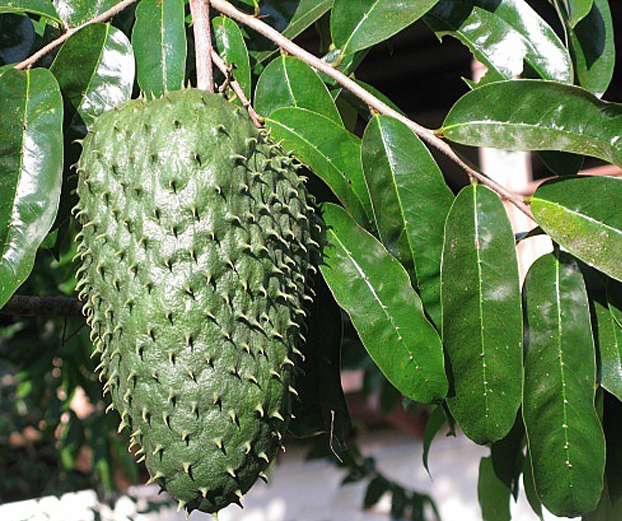
    The guanábana (Annona muricata), known in English as the soursop, is related to the chirimoya.  The flesh is white and the large seeds are black, like those of the chirimoya.  When ripe, the guanábana has a somewhat more acidic flavor than its cousin, although it is still sweet and delicious.  It's easy to tell these two similar fruits apart: the guanábana is the one with the big soft thorns!  In Mexico, guanábana is most often used to make a refreshing agua fresca (fresh fruit drink) or equally refreshing paletas (fresh fruit ice pops). 

    Nanches in Wheelbarrow
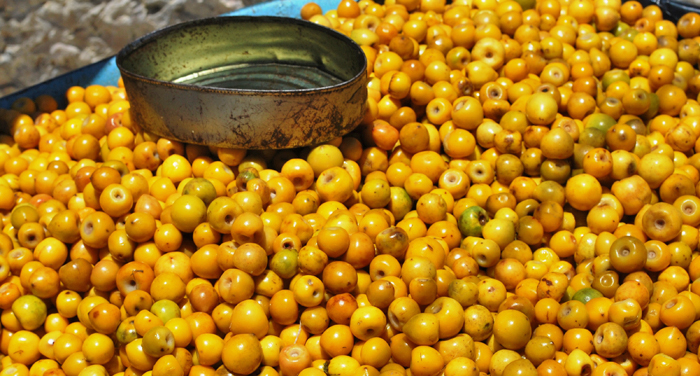
    These olive-size yellow fruits are nanches (Byrsonima crassifolia), also known in Michoacán as changungas.  These fruits grow and are extremely popular in Michoacán.  They're sold by the plastic cupful in markets and at street stands, usually topped with a squeeze of lime, a pinch of salt, and a squirt of bottled salsa.  Sorry, gang, Mexico Cooks! seems to be one of the few people in Michoacán who really, really doesn't like changungas.  More for you!

    Nispero (loquat)
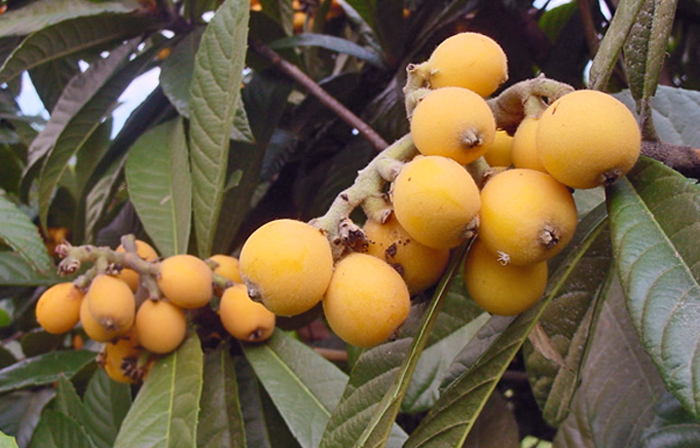
    Similar in size and appearance to nanches, these are nísperos–otherwise known as loquats (Eriobotrya japonica).  Not usually grown commercially, they are nevertheless commonly home-cultivated in Mexico's Central Highlands.  In our neighborhood, it's a race to see who gets to the fruits first: birds or humans.  We humans generally eat them out of hand, but they can be made into jam or conserve.

    Ilama 3 Cristina
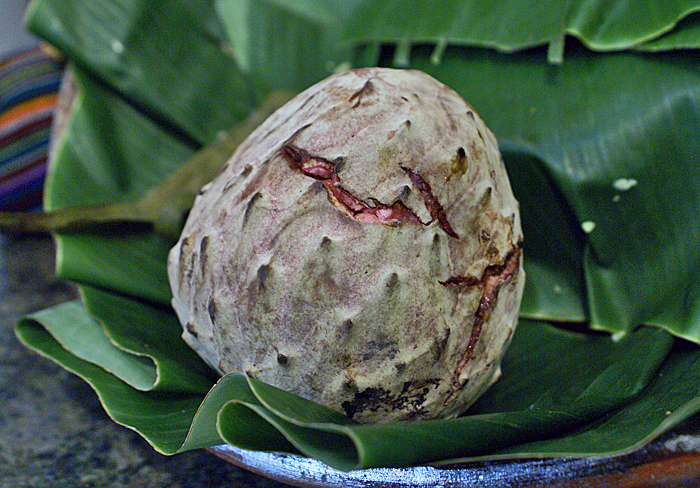
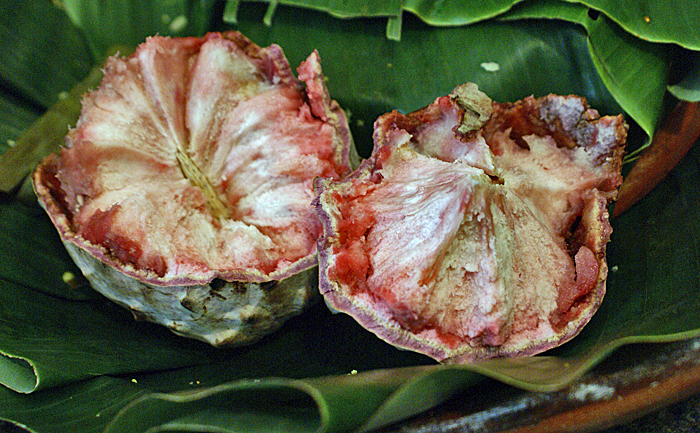
    This, ladies and gentleman, is the illusive ilama (Annona diversifolia).  Yet another relative of the chirimoya, the softball-size ilama grows wild in Michoacán's Tierra Caliente.  Its season is very short, just a few weeks during the summer, and it is normally harvested only when it cracks.  I was privileged to taste and photograph my first ilama this summer.

    Ilama 4 Cristina
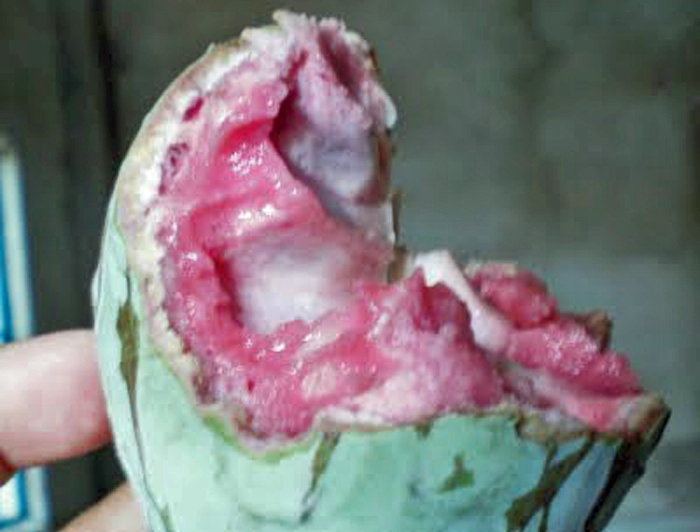
    There are two kinds of ilama, the white and the pink.  This is the pink variety.  The skin is about double the thickness of the chirimoya skin, and the seeds are spherical and brown rather than black.  Some ilama trees bear no fruit during their season; others bear just a handful of the fruits.

    Ilama 2
    Sr. Juan Cortés, the friend who gave me the ilama, said that the ripe fruit is usually just chilled, broken open, and eaten out of hand.  It was delicious, with banana/pineapple flavor notes.  Sr. Cortés also mentioned that the ilama isn't grown commercially in Michoacán; in order to eat one, it's necessary to go to the hills of the Tierra Caliente, find a tree, climb it, and cut the fruit yourself.  Given that summer temperatures in the Tierra Caliente can reach 115°F, it's highly unlikely that I will be clambering about to harvest an ilama.  I was extremely grateful for Sr. Cortés' generous gift.

    Looking for a tailored-to-your-interests specialized tour in Mexico?  Click here:  Tours.


    In fact, every now and again Mexico Cooks! still learns of a new fruit that grows in this part of the country. 

  • UNESCO Intangible Cultural Heritage of Humanity: MEXICO’S CUISINE

    UNESCO Chiles en el Sol
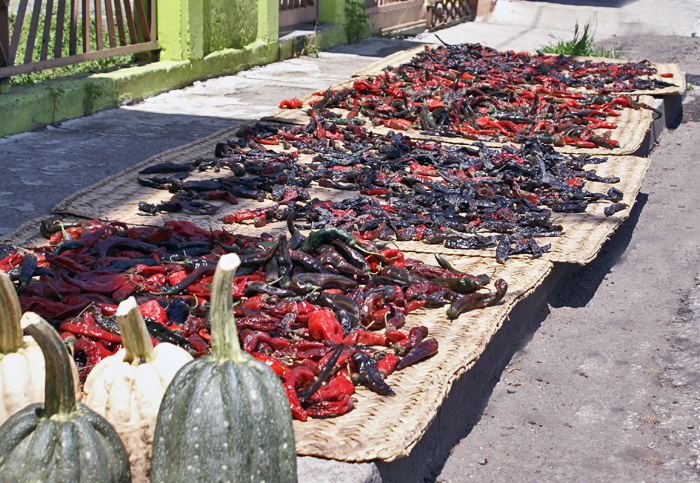
    Chiles chilacas, cultivated in Queréndaro, Michoacán, are spread on traditional petates (woven reed mats)to dry in the late summer sun.  All photos and their captions are copyright Mexico Cooks! unless otherwise noted.

    At its meeting in Nairobi, Kenya on November 16, 2010, UNESCO (the United Nations Educational, Scientific, and Cultural Organization) announced that Mexico, and particularly the state of Michoacán, had been officially inscribed on the Representative List of the Intangible Cultural Heritage of Humanity. 

    According to UNESCO, "The term ‘cultural heritage’ has changed content considerably in recent decades, partially owing to the instruments developed by UNESCO. Cultural heritage does not end at monuments and collections of objects. It also includes traditions or living expressions inherited from our ancestors and passed on to our descendants, such as oral traditions, performing arts, social practices, rituals, festive events, knowledge and practices concerning nature and the universe, or the knowledge and skills to produce traditional crafts.

    UNESCO Gloria López Morales
    Dra. Gloria López Morales, director of the Mexico City-based Conservatorio de la Cultura Gastronómica Mexicana, spearheaded the latest drive for Mexico to achieve the UNESCO award.  Many, many people worked with her to make the dream a reality.

    "While fragile, intangible cultural heritage is an important factor in maintaining cultural diversity in the face of growing globalization. An understanding of the intangible cultural heritage of different communities helps with intercultural dialogue, and encourages mutual respect for other ways of life. 

    "The importance of intangible cultural heritage is not the cultural manifestation itself but rather the wealth of knowledge and skills that is transmitted through it from one generation to the next. The social and economic value of this transmission of knowledge is relevant for minority groups and for mainstream social groups within a State, and is as important for developing States as for developed ones.

    UNESCO Blue Corn Tortillas on Comal
    In Uruapan, Michoacán, blue corn tortillas, tomatoes, and chiles serranos toast on a traditional clay comal (griddle).

    "Intangible cultural heritage is:

    • Traditional, contemporary and living at the same time: intangible cultural heritage does not only represent inherited traditions from the past but also contemporary rural and urban practices in which diverse cultural groups take part;
    • Inclusive: we may share expressions of intangible cultural heritage that are similar to those practised by others. Whether they are from the neighbouring village, from a city on the opposite side of the world, or have been adapted by peoples who have migrated and settled in a different region, they all are intangible cultural heritage: they have been passed from one generation to another, have evolved in response to their environments and they contribute to giving us a sense of identity and continuity, providing a link from our past, through the present, and into our future. Intangible cultural heritage does not give rise to questions of whether or not certain practices are specific to a culture. It contributes to social cohesion, encouraging a sense of identity and responsibility which helps individuals to feel part of one or different communities and to feel part of society at large;
    • Representative: intangible cultural heritage is not merely valued as a cultural good, on a comparative basis, for its exclusivity or its exceptional value. It thrives on its basis in communities and depends on those whose knowledge of traditions, skills and customs are passed on to the rest of the community, from generation to generation, or to other communities;
    • Community-based: intangible cultural heritage can only be heritage when it is recognized as such by the communities, groups or individuals that create, maintain and transmit it – without their recognition, nobody else can decide for them that a given expression or practice is their heritage."

    UNESCO Alicia Gironella
    Sra. Chef Alicia Gironella de'Angeli headed the group of high-level chefs, culinary professionals and food aficionados in Mexico which, in 2000, began to organize the 2005 application for the UNESCO designation.  For the next five years, Sra. Gironella continued to work toward the goal that Mexico finally achieved in 2010.

    UNESCO Cristina Palacio
    Cristina Palacio, Mexico City-based food historian and indefatigable promoter of Mexico's culinary heritage.

    Text from the UNESCO documents as they relate to Mexico:

    "Traditional Mexican cuisine is a comprehensive cultural model comprising farming, ritual practices, age-old skills, culinary techniques and ancestral community customs and manners. It is made possible by collective participation in the entire traditional food chain: from planting and harvesting to cooking and eating.
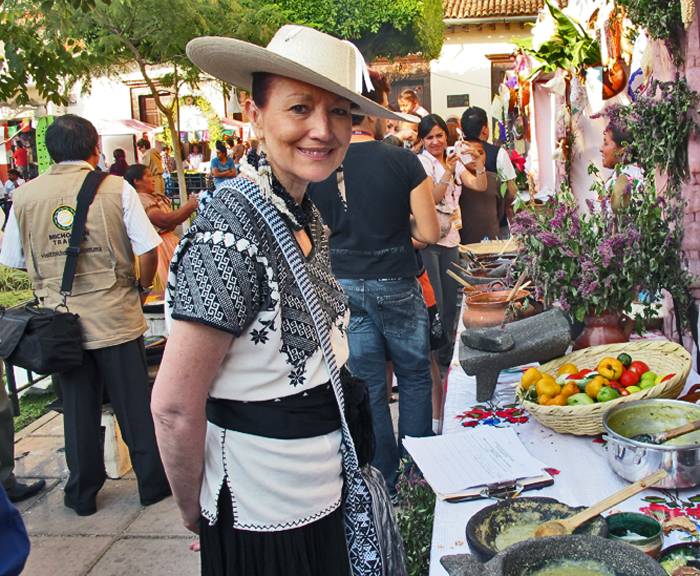
    UNESCO Flor de Calabaza por Roset
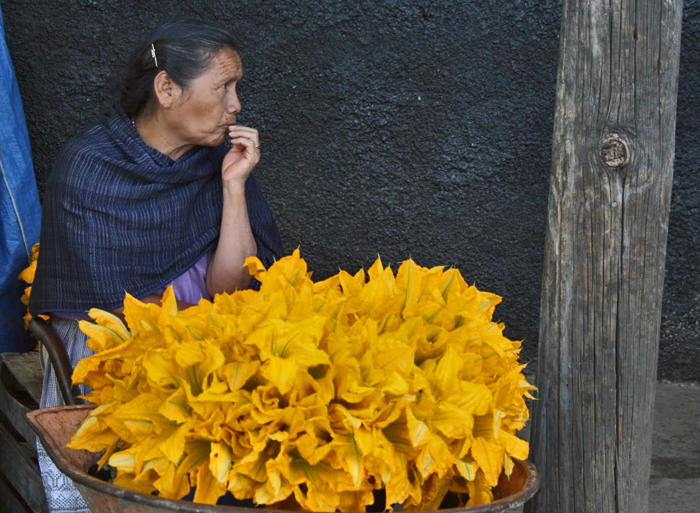
    In Cherán, Michoacán, a Purhépecha woman waits to sell delicious flor de calabaza (squash flowers). Photo courtesy Roset Claes.

    Outdoor Kitchen
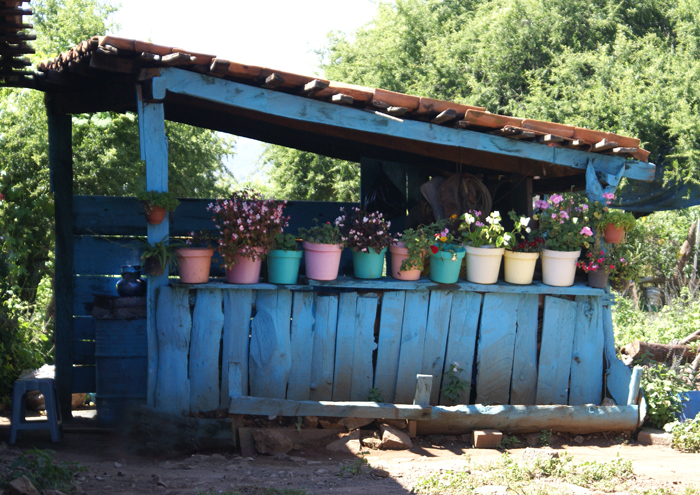
    Outdoor kitchen, San José de la Torre, Michoacán.

    "The basis of the system is founded on corn, beans and chile; unique farming methods such as milpas (rotating swidden fields of corn and other crops) and chinampas (man-made farming islets in lake areas); cooking processes such as nixtamal-ization (lime-hulling maize, which increases its nutritional value); and singular utensils including grinding stones and stone mortars.  Native ingredients such as varieties of tomatoes, squashes, avocados, cocoa and vanilla augment the basic staples.  Mexican cuisine is elaborate and symbol-laden, with everyday tortillas and tamales, both made of corn, forming an integral part of Day of the Dead offerings.
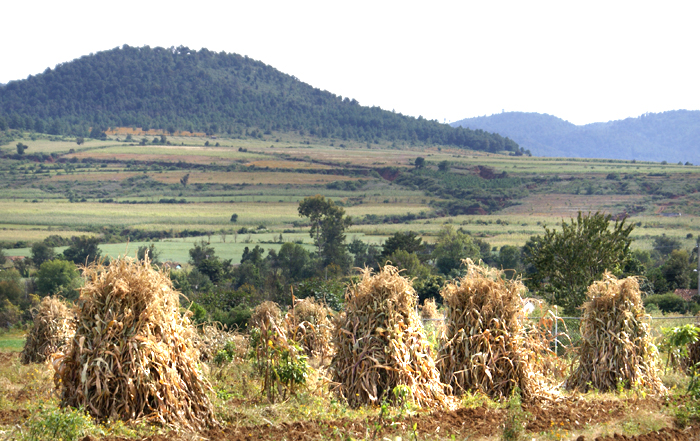
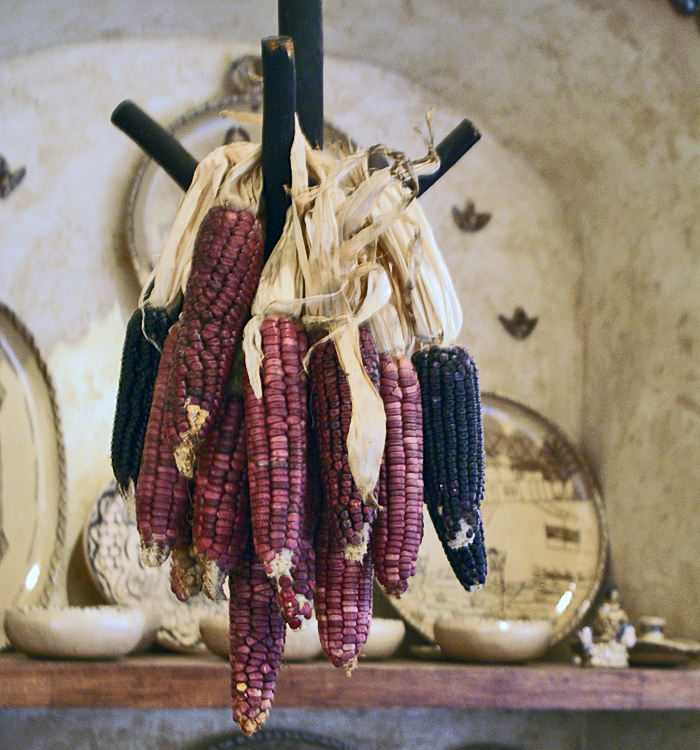
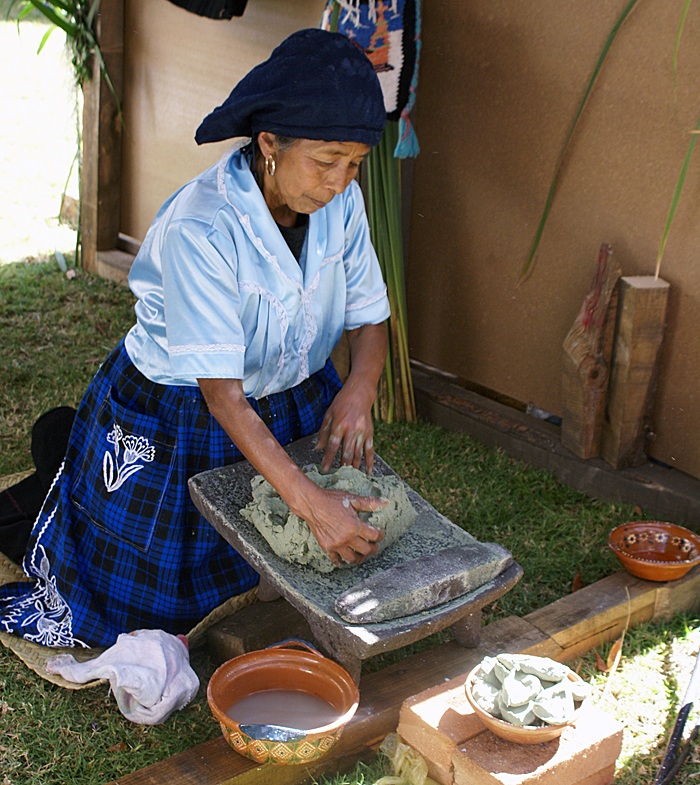
    Paisaje  Otoñal, Cuanajo
    Late-summer corn shocks mark the end of harvest in Cuanajo, Michoacán.

    UNESCO Mazorcas en  Garabato
    Ears of red and blue corn, hung to dry from a wooden garabato (hook) in a traditional Michoacán kitchen.

    UNESCO Al Metate
    Preparing blue corn masa (dough) on a volcanic stone metate (grinding stone).  This masa, used to make tortillas, is made from freshly ground nixtamal-ized blue corn, moistened as needed with water.  It has no other ingredients.

    UNESCO Atole de Grano en Cazo
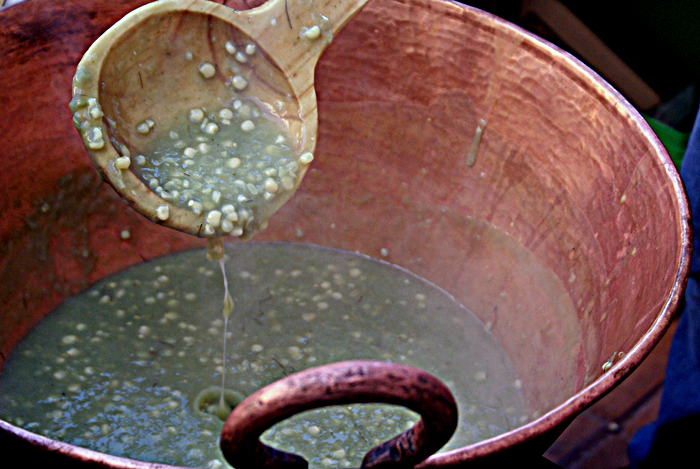
    Atole de grano (corn soup prepared with fresh anise) dates to the milenia before Mexico's Spanish conquest.  All ingredients for this delicious soup are original to the New World, as are the copper that is hand-hammered to make this cazo (cooking pot) and the pine that's hand-carved to form the cuchara (spoon).

    "Collectives of female cooks and other practitioners devoted to raising crops and traditional cuisine are found in the State of Michoacán and across Mexico. Their knowledge and techniques express community identity, reinforce social bonds, and build stronger local, regional and national identities. Those efforts in Michoacán also underline the importance of traditional cuisine as a means of sustainable development."

    UNESCO Charales y Manos de Alicia 2005
    Charales (tiny fish), used in Mexico's cuisine for thousands of years, are still abundant in our lakes.  These fish are eaten whole in many different preparations.  Click on any photo for a larger view.

    UNESCO Kitchen Corner with Window Light
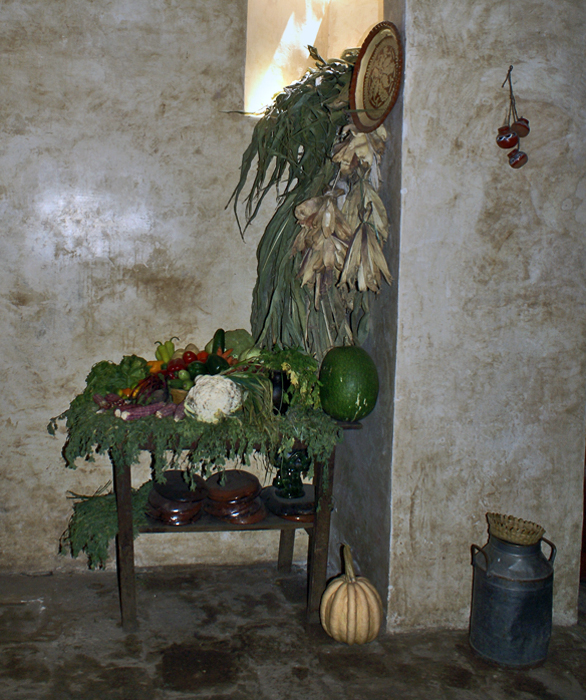
    Pale light filters through the high window of a traditional Michoacán kitchen.  Many 21st Century rural Mexican homes do not have refrigerators.

    The UNESCO decision as it relates to Mexico:

    "The Committee decides that [this element] satisfies the criteria for inscription on the Representative List, as follows:

    • R1: Traditional Mexican cuisine is central to the cultural identity of the communities that practise and transmit it from generation to generation;
    • R2: Its inscription on the Representative List could enhance the visibility of intangible cultural heritage and promote respect for cultural diversity and human creativity;
    • R3: Current and planned safeguarding measures include consultations and research projects as well as practical training, with the support of the State and the communities concerned;
    • R4: Practitioners participated actively in the nomination process and provided their free, prior and informed consent;
    • R5: Traditional Mexican cuisine is included in the Inventory of the Intangible Cultural Heritage of Mexico maintained by the National Council for Culture and Arts."

    UNESCO Figeroa y Godoy
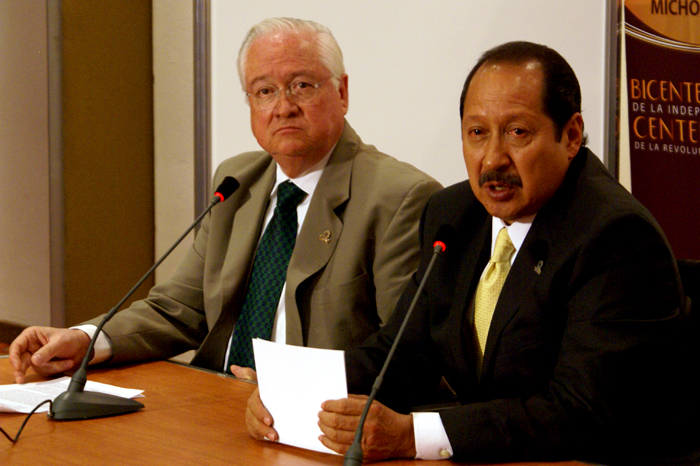
    On November 16, 2010, Michoacán governor Leonel Godoy Rangel (right) and Dr. Genovevo Figueroa (Michoacán Secretary of Tourism, left) made the official announcement of the UNESCO designation.

    All of us who have been involved in this enormous effort, all of the hundreds of traditional cooks who keep the flame of Mexico's ancient culinary excellence alive, all of those who believe in the sanctity of Mexico's trinity of corn, beans, and chile, and all who simply crave a meal of truly Mexican cuisines celebrate UNESCO's recognition of Mexico's cooks, villages, culinary heritage and her tremendous worth.  We who are from Michoacán invite you to get to know what UNESCO calls 'the Michoacán paradigm'.  We simply call it home cooking.

    UNESCO Mirasoles
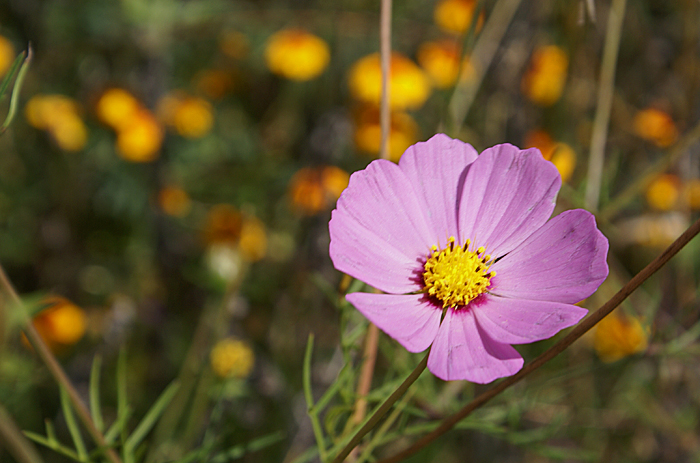
    The wild mirasol, symbol of Michoacán's splendid autumn, invites you to celebrate with us.

    Special thanks to the United Nations Educational, Scientific, and Cultural Organization for the use of excerpts from its public documents.

    Looking for a tailored-to-your-interests specialized tour in Mexico?  Click here:  Tours.