Category: Food and Drink

  • Mexico Cooks!’ Winter Tour to Oaxaca, 2016 Part III: Barro Negro, Alebrijes, and FOOD

    Oaxaca Mercado de la Merced La Florecita MC
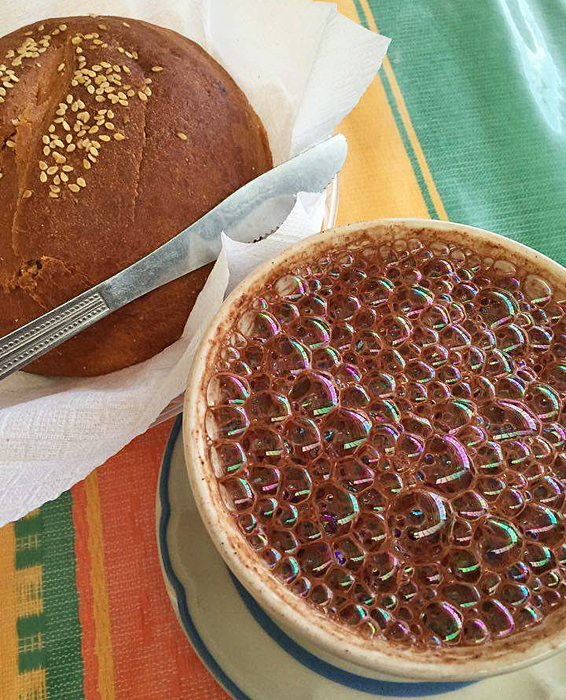
    Day Three of Mexico Cooks!' February 2016 Oaxaca tour started with a superb breakfast at the municipal Mercado de la Merced.  For starters, we ordered hot chocolate, traditionally made with water rather than milk, and frothed to a fare-thee-well.  The bubbles lasted to the last drop in the cup and the flavor and texture were swoon-worthy.  Pan de yema (egg yolk bread), iconic to Oaxaca, came with the hot chocolate.  When you're in Oaxaca, be sure to have at least one breakfast at Fonda Florecita in the market; it's the only place to be on a Oaxaca morning.
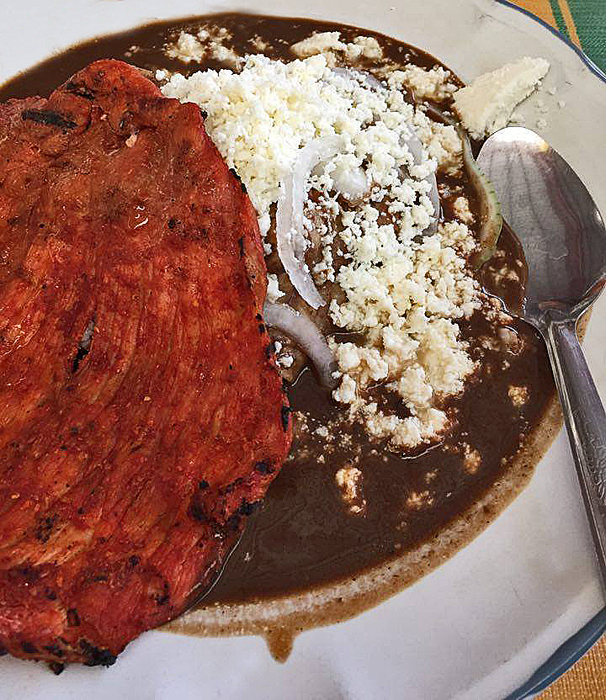
    Mercado de la Merced La Florecita Con Cecina y Enfrijoladas MC
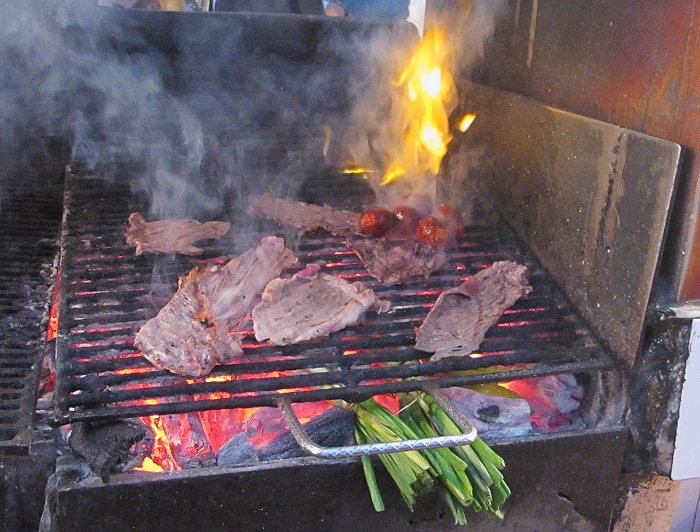
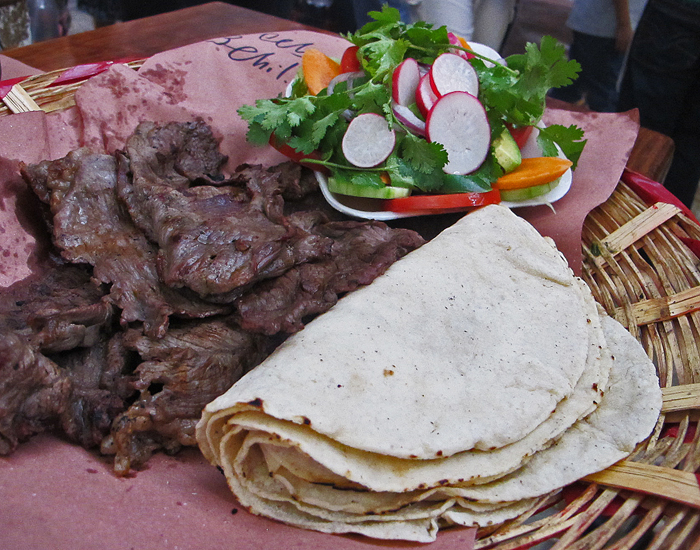
    Breakfast's main course: cecina enchilada (semi-dried beef flavored with spicy red sauce and then grilled), accompanied by enfrijoladas (tortillas dipped in anise-y black bean sauce, then topped with queso fresco and slivered onions).  The anise-y flavor of the black bean sauce comes not from anise, but from the dried, powdered small leaves of the aguacate criollo (native avocado).  All this and a huge glass of freshly squeezed orange juice got our day off to a bang.

    Museo San Bartolo Olla Negra Enorme MC
    After breakfast, our driver took our tour group to San Bartolo Coyotepec, the original home of Oaxaca's unique and famous barro negro (black clay).  We spent most of our time in San Bartolo at the Museo Estatal de Arte Popular de Oaxaca (MEAPO), where many of the museum-quality pieces are actually for sale. Enriqueta López García made this huge cántaro de rosas (water jug decorated with roses); the piece measures more than two feet high. Barro negro is actually light grey prior to firing. After the clay is prepared by grinding and kneading, each piece is formed either on a pre-Hispanic wheel or in a mold and then dried in the sun for several days.  The piece is then polished with a stone to bring out the color and the shine; after polishing, it is again dried for several more days. Once thoroughly dry, the piece is ready to be fired. During firing, it acquires its glossy metallic black finish.  A high-quality piece like the one in the photograph can take a month or more to create.

    Jacobo_Maria Courtesy Chiripi
    Our next stop was San Martín Tilcajete, where I had arranged for the group to visit Maestro Jacobo Ángeles and his wife María, makers of world-renowned hand-carved, hand-painted copal wood alebrijes (realistic and fantasy animals).  Jacobo and María are arguably the most successful alebrije makers in the village, although others have also had considerable success.  They have a large workshop where Jacobo gives fascinating demonstrations of ancient aniline dye-making techniques.  Although other alebrije makers have switched to modern acrylic paints, Jacobo Ángeles remains faithful to original aniline dyes.  Due to the success of Oaxaca's alebrijes in the world crafts markets, approximately 150 households now make the majority of their annual income in their manufacture.  Photo courtesy Chiripa.
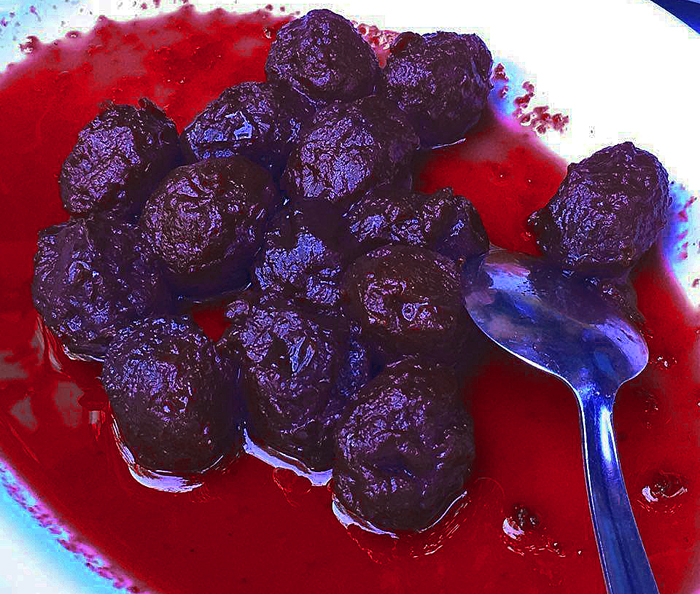
    La Teca Ikakes MC
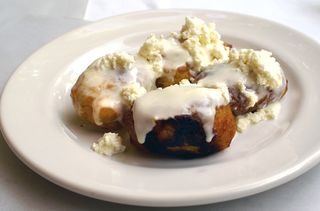
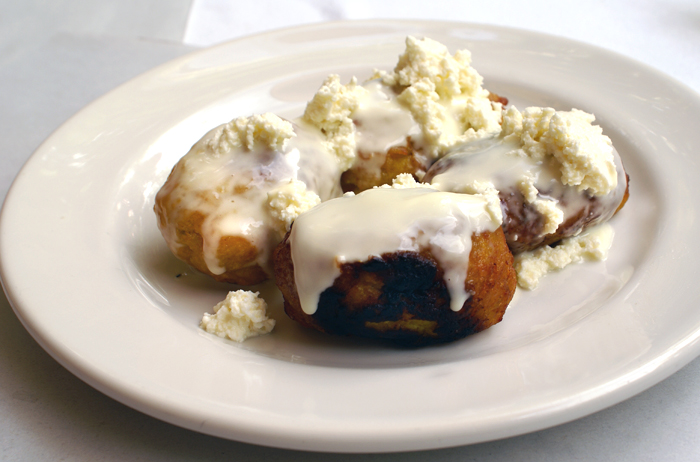
    The road from San Martín Tilcajete took us back to Oaxaca city, where we enjoyed a marvelous comida (main meal of the day) at La Teca.  In the photograph, you see a plate of ikake, a fruit in conserve that was one of our desserts.  The cooked consistency of the fruit is similar to that of a cooked plum, and the stone is nearly as large as the fruit itself.  Mexico Cooks!' spelling may be incorrect; the name of the fruit does not appear to be Spanish, but is most likely a transliteration of a Zapotec word.  If you are familiar with this fruit, please email me!  You can read here about all of the delights of La Teca's wonderful food from the Isthmus of Tehuantepec.  It's one of my favorite restaurants in all of Mexico.
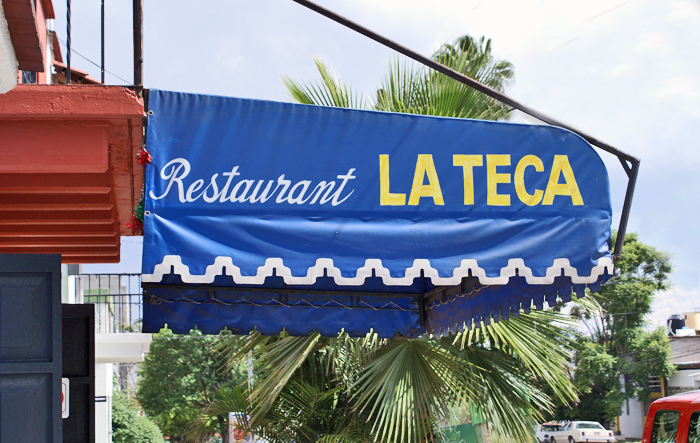
    Oaxaca Restaurante La Teca
    Restaurant La Teca
    Calle Violetas #200-A
    Colonia Reforma
    Oaxaca, Oaxaca
    01.951.515.0563 (from within Mexico)

    Next week: Day Four of Mexico Cooks! 2016 winter tour to Oaxaca, in which we visit the best market in Mexico and are privileged to eat with Abigail Mendoza.

    Looking for a tailored-to-your-interests specialized tour in Mexico? Click here: Tours.
  • Mexico Cooks!’ Winter Tour to Oaxaca, 2016: Part II, Ocotlán de Morelos

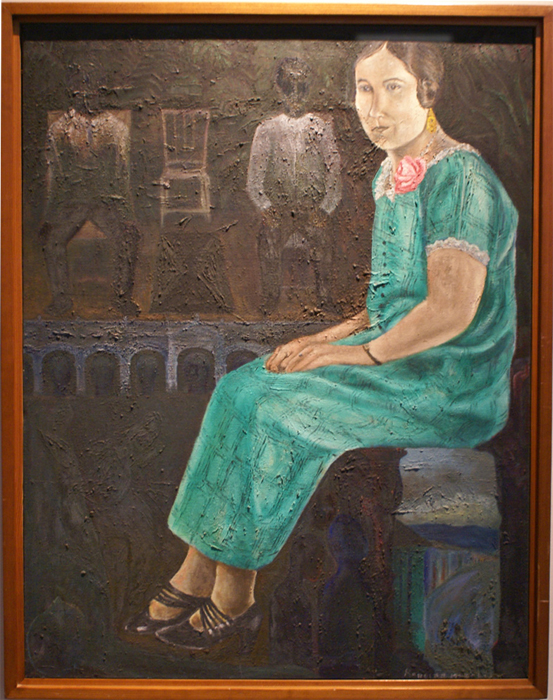
    Rodolfo Morales Mother copy
    The second day of Mexico Cooks!' February 2016 tour to Oaxaca was devoted to visiting Ocotlán de Morelos, less than an hour south of Oaxaca. The small city of Ocotlán is the home of indigenous Zapotec artist Rodolfo Morales (May 8, 1925-January 30, 2001).  In addition to working at his art, Rodolfo Morales devoted much of his later life to restoring historic buildings in Ocotlán and to working with the painters Rufino Tamayo and Francisco Toledo to further artistic achievement in Oaxaca.  For more than ten years before his death in 2001, Morales was considered to be one of the two greatest living artists from the state.  The other, Francisco Toledo, is still living.  The painting (oil on linen) above is a portrait of Morales's mother. 

    Casa Rodolfo Morales Cocina MC
    Family kitchen, Casa Rodolfo Morales.  The Morales home is still open as a museum, and tourists are welcome to visit.

    Ocotla?n Mercado Tejate MC
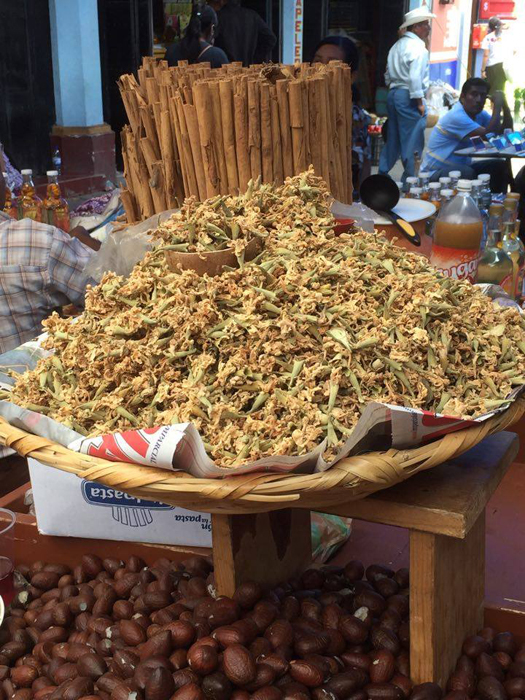
    At the Ocotlán Friday outdoor market, our group first tasted tejate, a cold and refreshing chocolate drink iconic to Oaxaca.  It's made with several ingredients (cacao, rosita (aka flor de cacao), and the ground seed of the mamey fruit, among others, and mixed with the bare hand until thick foam rises to the top of the liquid.  This vendor has covered the top of her huge vessel of tejate with plastic.

    Ocotla?n Mercado Venta de Rosita y Semilla de Mamey MC
    Some of the ingredients for tejate: on the flat basket, a goodly amount of rosita.  Below the rosita, mamey fruit seeds.

    Oaxaca Tlacolula Mamey
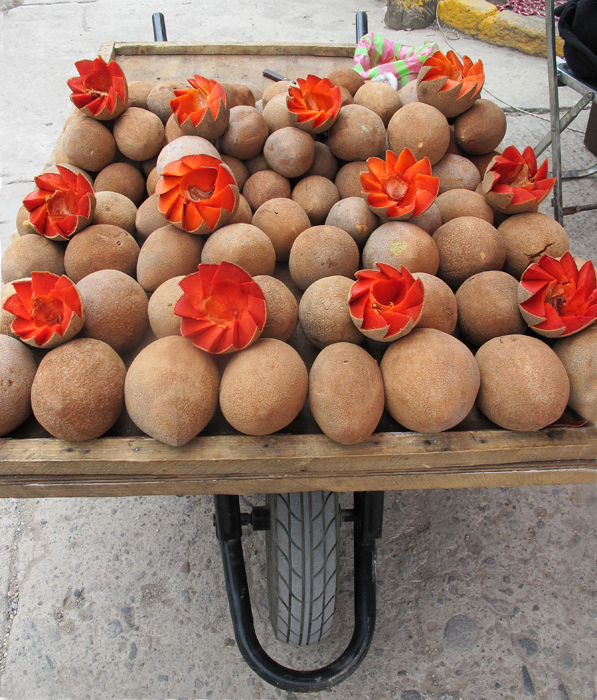
    Mamey fruit with the seed already removed, displayed for sale.  This creamy, sweet fruit looks like a little brown football and tastes like a baked sweet potato.  Delicious!

    Ocotla?n Cocina de Frida Puesto MC
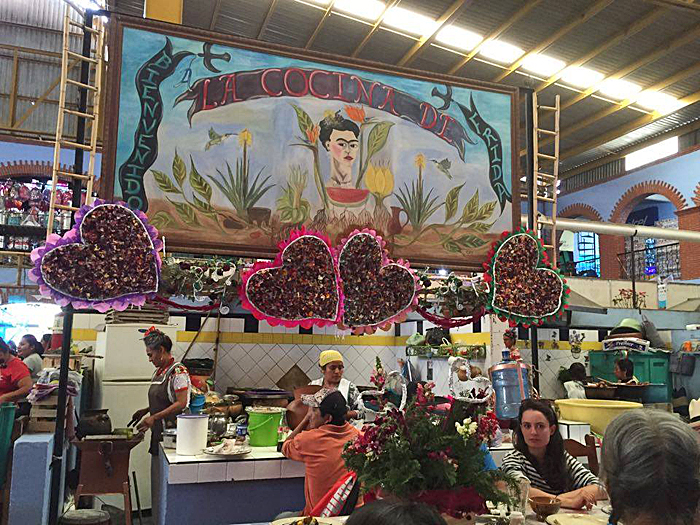
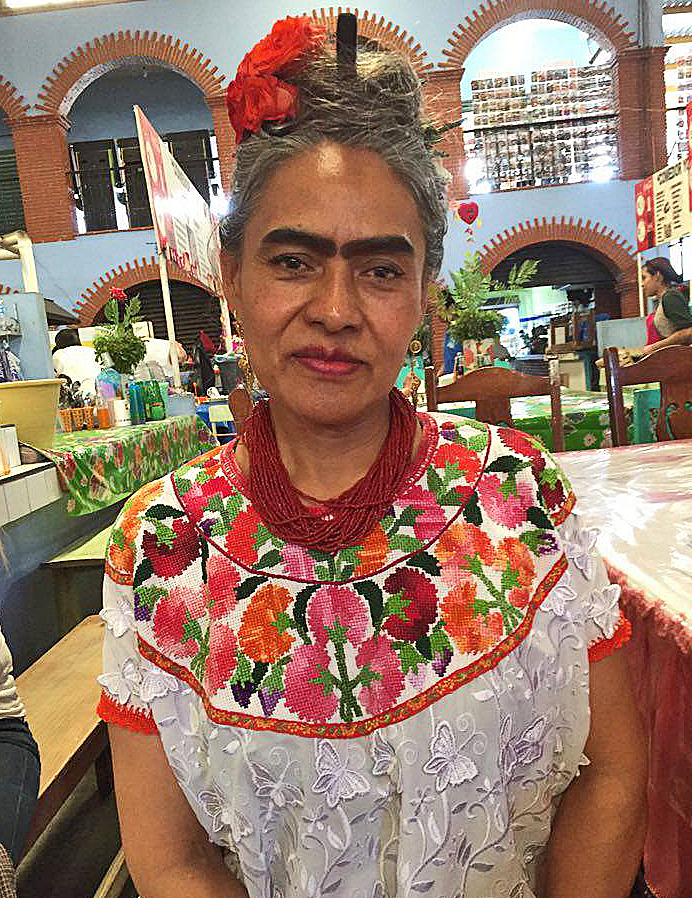
    Our group had heard about the Ocotlán indoor market food stand called "La Cocina de Frida" (Frida's Kitchen). The owner's stock in trade is her strong resemblance to painter Frida Kahlo!  Click on the photo to enlarge it; you can see the owner, on the left, standing at the stove. We were intrigued and decided to eat there.

    Ocotla?n Cocina de Frida Frida MC
    Her resemblance to Frida Kahlo is extraordinary.  The food didn't live up to our hopes, but we did have a good time.

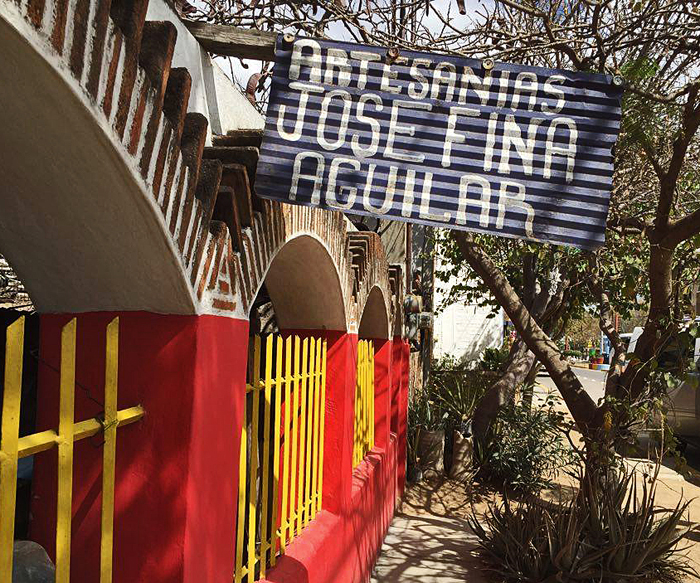
    Casa Josefina Aguilar Sign MC
    Our other main goal in visiting Ocotlán was to meet the Hermanas Águilar: we spent time with gifted sister potters Josefina and Irene and visited Guillermina's home as well.  Their talleres (workshops) are in three consecutive houses near the entrance to the town.  Our first stop was with Sra. Josefina Águilar, whose work has been collected since the 1975, when Nelson Rockefeller bought some of her pieces for his own notable collection of Latin American folk art.

    Casa Josefina Aguilar Ella Amasando MC
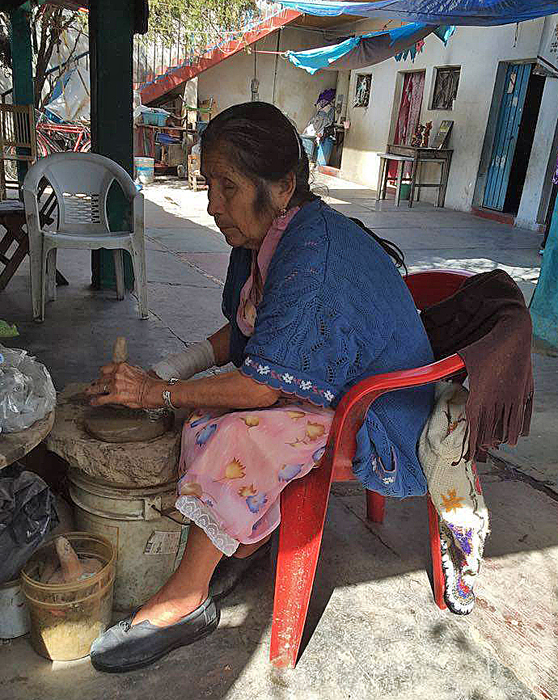
    Sra. Josefina Águilar continues to work clay, here forming the masa (clay 'dough') that will become the charming and original figures that she calls muñecas (dolls).  Diabetes has made her blind, but she still makes her muñecas by feel.  Doña Josefina is one of four daughters of potters Isaura Alcantara and Jesús Águilar; Guillermina, Josefina, Irene, and Concepción are all master potters.

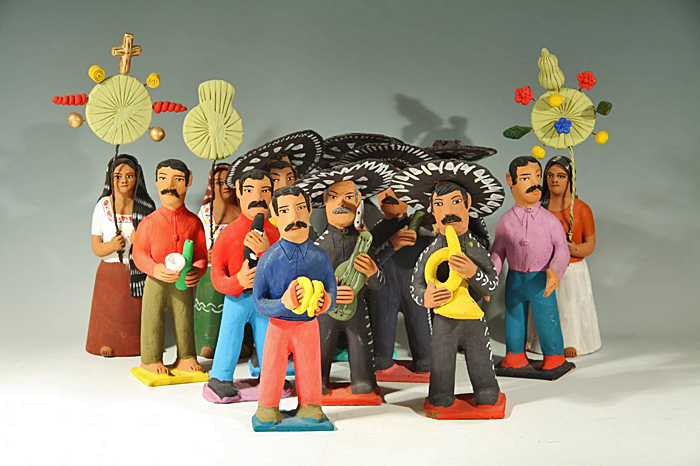
    Oaxaca Josefina Aguilar Figuras
    Typical clay village figures by doña Josefina Águilar.  The tallest of these measures approximately 10" high.  Photo courtesy Liveauctioneers, 2013.

    Casa Josefina Aguilar 2
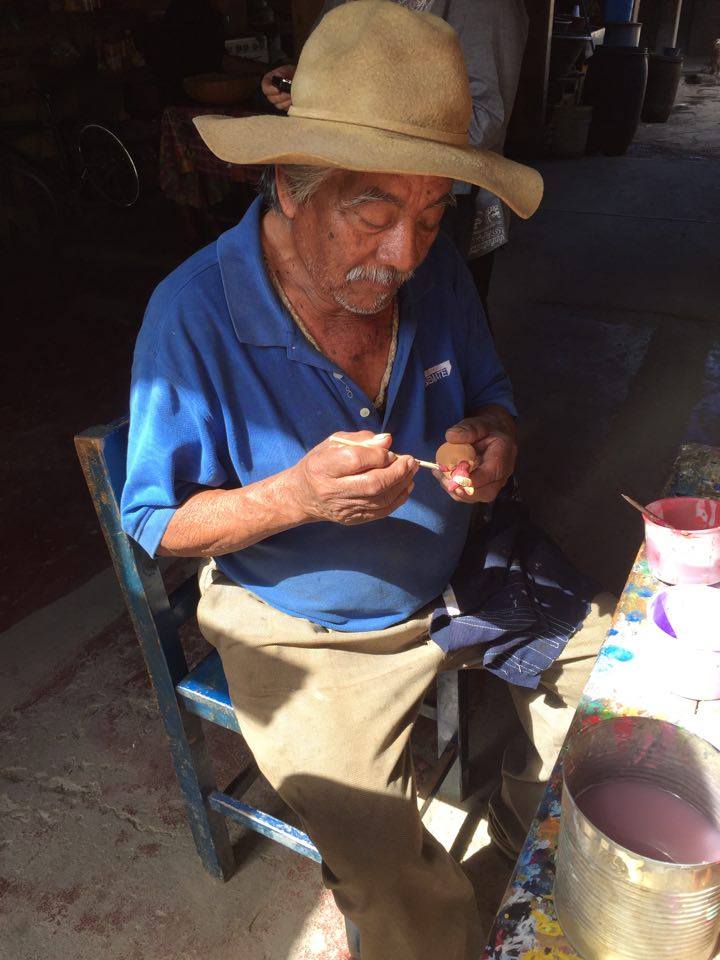
    A relative paints careful detail on a small clay figure in doña Josefina's sunlit patio.
     

    Jose? Juan Garci?a A?guilar Figura Best 2
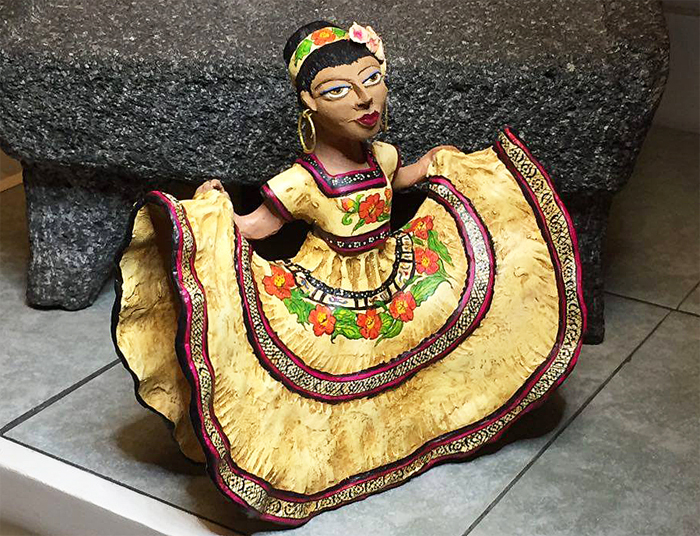
    Juan Jesús García Águilar, doña Josefina's grandson, made this 6" high dancer with the fabulous sloe-eyes.  The brilliantly talented  young man is the fourth generation of potters in the Águilar family.  Please click on the photo to enlarge it for a better look at the detail.  Mexico Cooks! collection.

    Casa Irene Aguilar Mojigangas MC
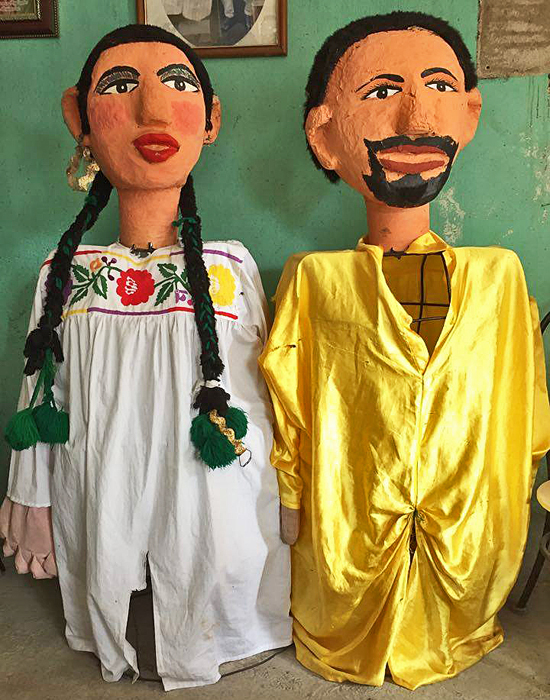
    A pair of paper maché and bamboo mojigangas (giant dance puppets) created by doña Irene Águilar Alcantara. These are meant to be worn on the shoulders of adult dancers; they stand about fifteen feet high once attached to the dancer!  The soft, loose fabric arms twist around and around as the dancer gyrates.  Doña Irene also makes clay figures and other artistic work, but she creates these mojigangas by special request. 

    [youtube=https://www.youtube.com/watch?v=Fy53Hr9S8F4&w=560&h=315] 
    This video will take you right to the heart of Oaxaca City–and make you want to dance along with the mojigangas! We wended our way down the street in Oaxaca along with a wedding calenda (street dance/celebration) and had a marvelous time.  Mexico Cooks! can make it happen for your group, too–just ask!

    By the end of our long day in Ocotlán de Morelos, we were ready for some down-time at our hotel.  After a good night's sleep, we were ready to hit the road again.  Next week: Day Three, with more adventures and some delicious food.

    Looking for a tailored-to-your-interests specialized tour in Mexico? Click here: Tours.
  • Mexico Cooks!’ Winter Tour to Oaxaca, 2016, Part I: Spring Comes Early to the Central Valley

    Oaxaca Primavera Tree 2
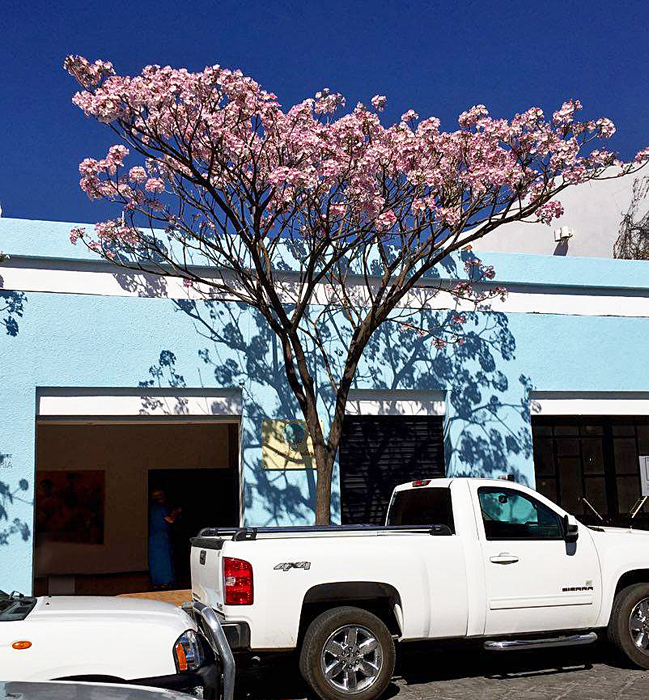
    Mid-February 2016 in Oaxaca.  The sky really is that blue, the sun really is that strong, and the flowers really are that pink.  Winter in Oaxaca? The daytime temperatures during our week there were as high as 90ºF.  The pink-flowering tree is the amapa (Tabebuia impetiginosa), one of the first blooming signs of spring in Mexico.

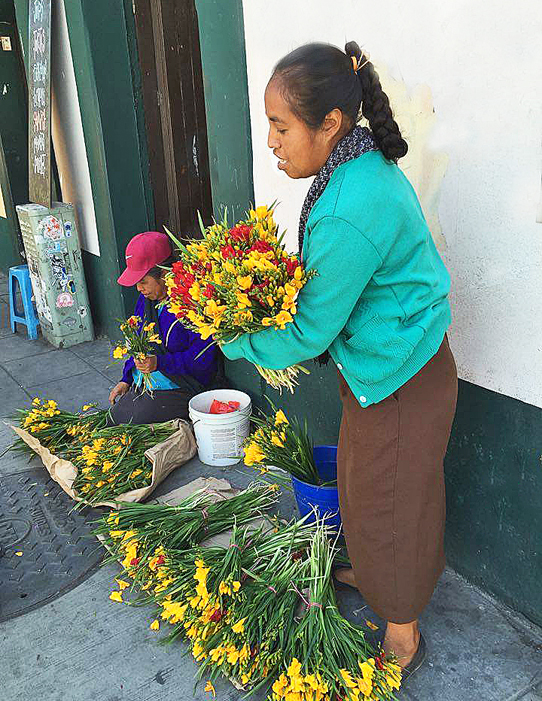
    Oaxaca Vendedora de Freesias 2
    These street-corner vendors were selling freshly cut freesias.  The sweet, distinctive fragrance of the flowers and their colorful beauty stopped all of us for a few minutes' enjoyment.

    Oaxaca Primavera Papalotes 2
    One of the surest signs of a Oaxaca spring: kites for sale along our way!  Papalotes (kites) take flight when the early spring winds kick up in February and continue into March.  Street vendors were hawking them all over the Central Valley.

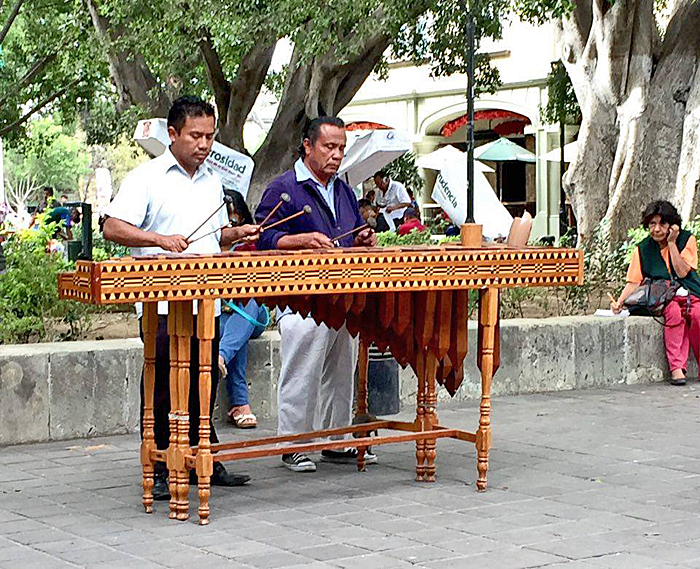
    Oaxaca Zo?calo Marimba 2
    After a couple of hours walking around the city, looking into shops, and enjoying the sights, we stopped at a sidewalk restaurant on the Zócalo for a cold drink.  Pretty soon these marimba players set up shop and serenaded us.  The tropical sound of the marimba is always a crowd-pleaser.

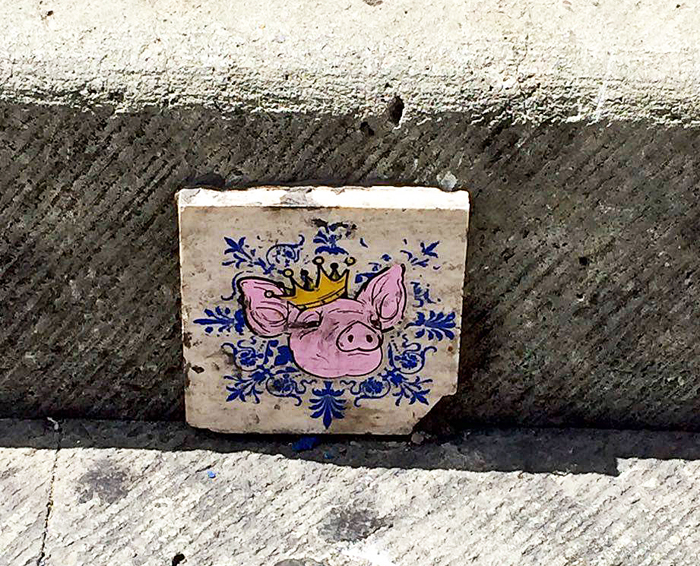
    Oaxaca Puerco Anarquista 2
    It's always fun to see a detail for the first time and then see it in many different guises.  I initially noticed this tile with its crowned-pig design near a church, slapped onto the riser of a short staircase; later, I saw similar designs in many places in the city.  After asking a lot of people, I found out that it is one symbol of an anarchist political movement in Oaxaca.

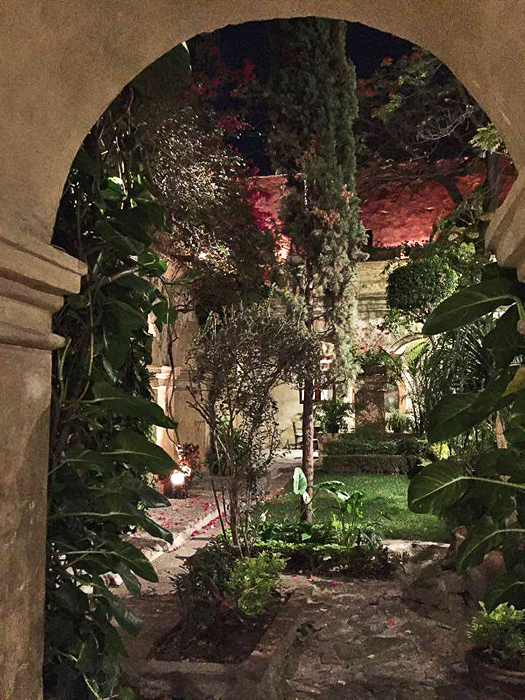
    Oaxaca Moonlit Jardi?n Camino Real
    After mid-February's hot Oaxaca days, the evenings were warm enough to sip a drink under the moonlight in a beautiful garden.  For me, these were the most relaxing moments of our trip.  

    Next week, visits to several artisans–and what we ate along the way!  Join us here.

    Looking for a tailored-to-your-interests specialized tour in Mexico? Click here: Tours. 
  • A New Look at an Old Favorite: Restaurante La Tecla in Mexico City

    La Tecla Exterior
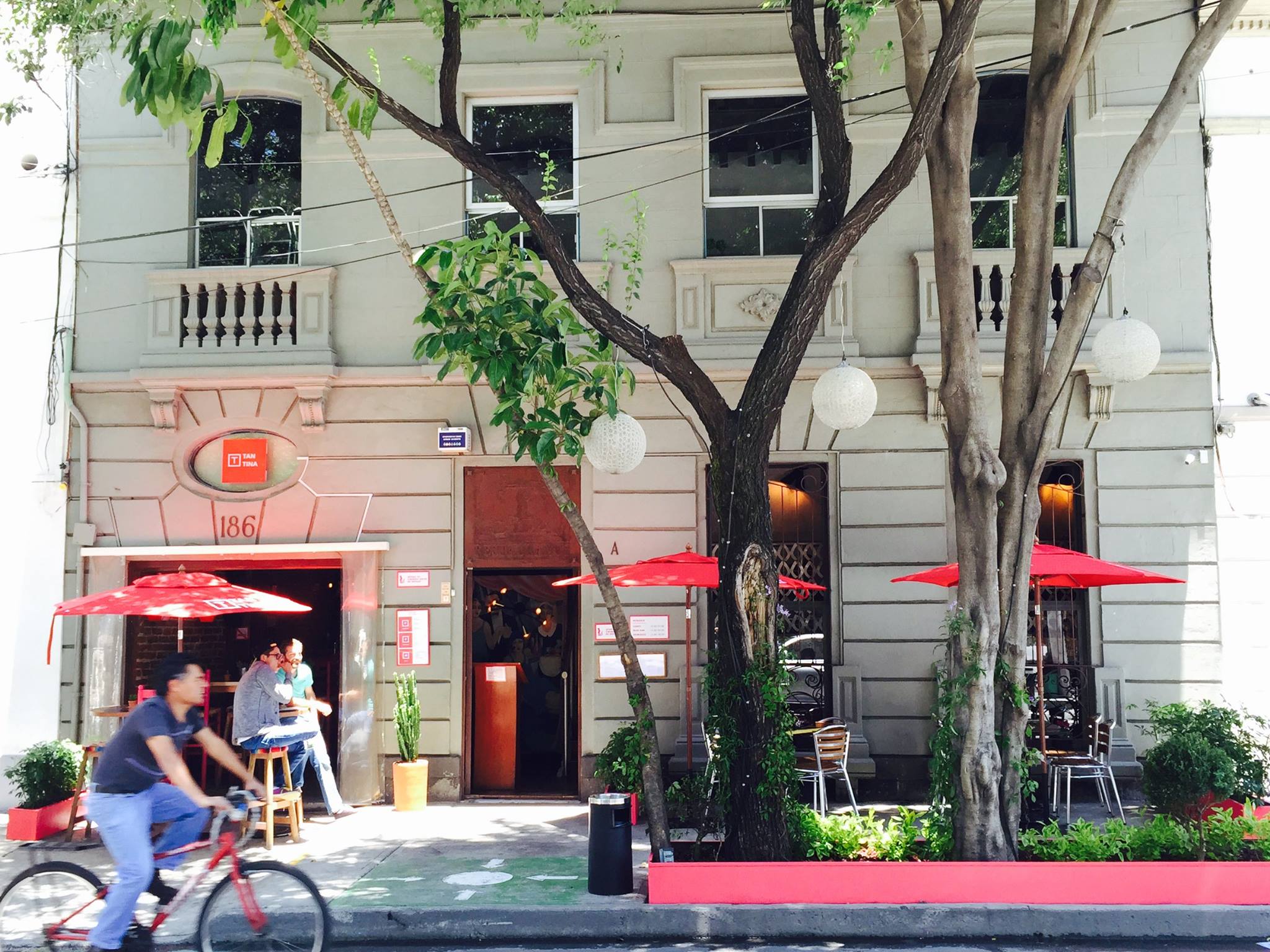
    Restaurante La Tecla at Calle Durango 186-A, Colonia Roma Norte, Mexico City.

    Several months ago, Mexico Cooks! arrived by pure happenstance at the door of Restaurante La Tecla–not to dine, but to retrieve a package that a friend left for me with Eduardo Holcombe, the charming and professional restaurant manager.  After a brief chat, Sr. Holcombe graciously invited me to call him anytime to go back to the restaurant for a meal.  "You really should give La Tecla a try.  We've been right here since 1995."

    As life will, life intervened, Mexico Cooks!' tour business took over, and I neglected Sr. Holcombe's kind invitation to dine.  Weeks passed, until one day a gentle reminder email from him appeared in my inbox.  "Will you be able to come to La Tecla sometime soon?"  Several more emails and a phone call later, we had set a date and time for me to meet him at the restaurant.

    La Tecla Exterior Cristina
    The delightful view from my upstairs table at La Tecla.  I might as well have been in Paris as in this pleasant part of Mexico City.  Barely out of view to the left of the window is lovely Plaza Villa Madrid and the Cibeles fountain, an icon of this section of Colonia Roma.

    La Tecla Bolita 3 Chiles 2
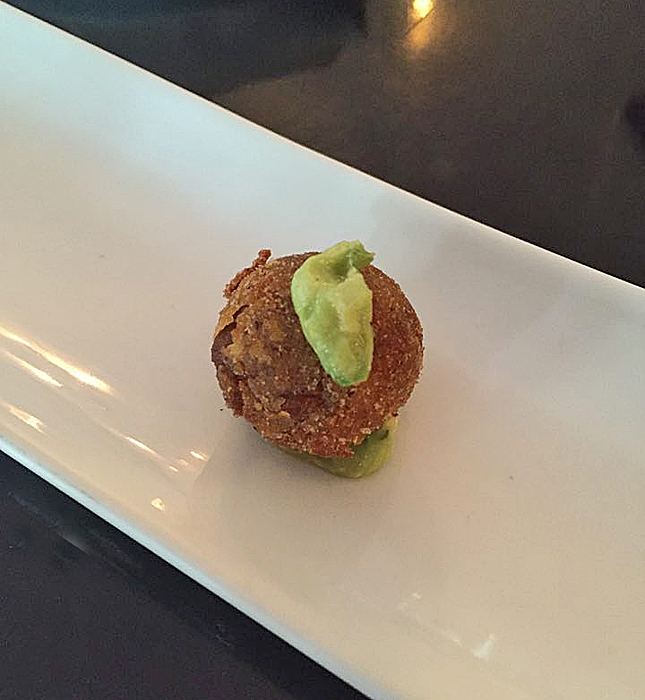
    I was smart enough to ask Sr. Holcombe to order a meal for me, believing that he would surely choose the dishes most representative of the long trajectory of La Tecla. We sat and chatted cheerfully over our drinks until the courtesy-of-the-house 'amuse' came to the table.  This bite-size delight is a croqueta de tres chiles (little croquette made of three chiles), served with a bit of guacamole on a long thin plate.  The number of croquetas on the plate depends on the number of diners at table! 

    La Tecla Perejil Frito Cristina 2
    This is La Tecla's version of one of Mexico Cooks!' favorite appetizers: perejil frito con doble crema (fried parsley with cream cheese).  Fried parsley is a deceptive dish, an old standby made new again with the use of a tostada base and a cream cheese accompaniment.  The parsley, fried until crisp, is entirely different from parsley fresh out of the refrigerator.  Its melt-in-your-mouth texture and sweetly toasty-green flavor wake up one's palate for the meal to come. 

    La Tecla Crema de Elote 2
    Crema de elote (cream of fresh corn soup) with a square of pan de elote (sweet corn bread) and fresh corn kernels. This slightly sweet cream soup, served over an individual square of Mexican-style corn bread, perfectly complemented the fried parsley appetizer.  Behind the soup you have a glimpse of the house-baked breads that accompanied the soup.  Don't miss the crescent-shaped bread filled with house-made La Tecla mole–it's a standout!

    La Tecla Caldo de Habas 2
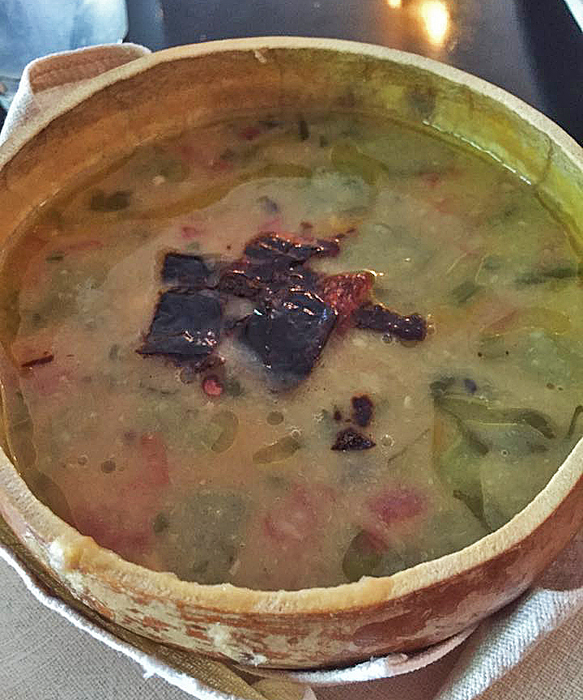
    Another of La Tecla's savory soups is this caldo de habas con nopales y chile pasilla (fresh fava bean and prickly pear cactus paddle soup, garnished with flavorful but gently spiced chile pasilla) and beautifully served in a traditional jícara.  I'd be hard-put to say which of these two soups was my favorite.  Each is very different from the other and each is a delicate treat.

    La Tecla Ensalada Higo Gorgonzola 2
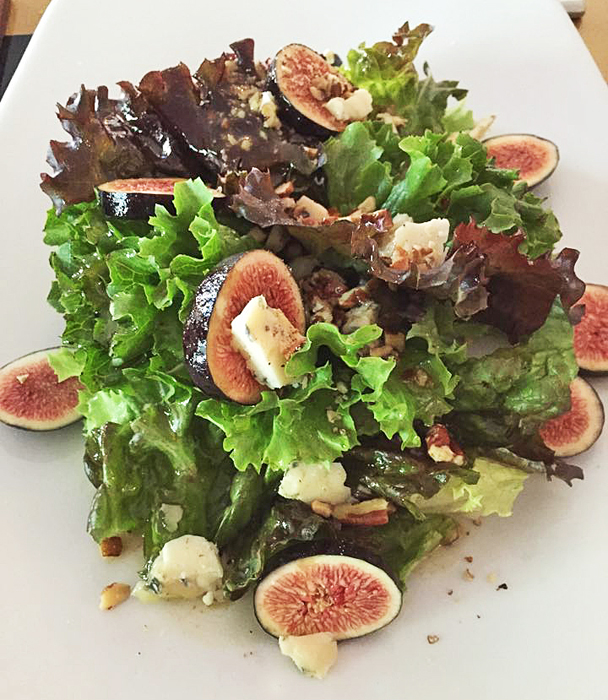
    Ensalada de higos y lechuga con nuez caramelizada y queso gorgonzola (lettuce and fig salad with caramelized nuts and gorgonzola cheese). You might think that this is a 'staged' salad, with more of each ingredient than usual.  Nope, what you see is what you get.  It's a huge portion, perfect for sharing with a companion, and absolutely marvelous.  The figs are sweetly ripe, the cheese is a savory foil, the nuts add an extra touch of texture and flavor, and the lettuces crunch wonderfully.  

    Pechuga de Pollo con Flor de Calabaza 2
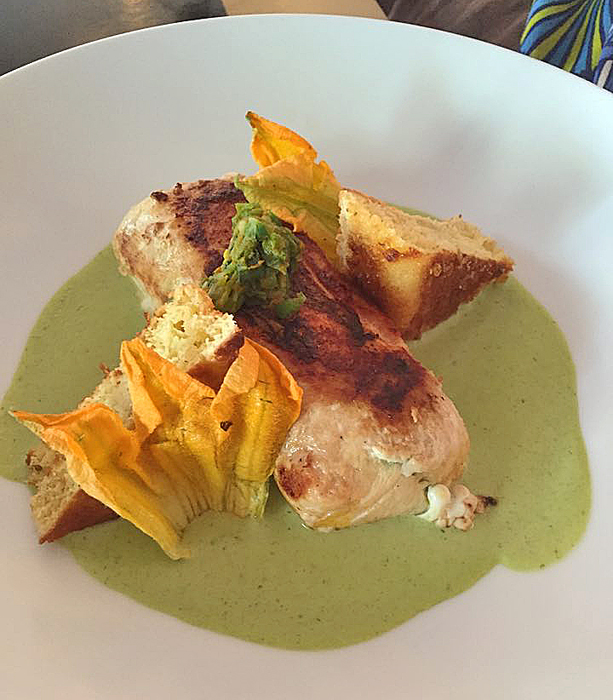
    Mexico Cooks!'s main course: pechuga de pollo rellena de flor de calabaza con torta de elote y salsa de poblano (chicken breast stuffed with squash flowers, with corn cake and a sauce of poblano chile).  The chicken breast was tender and juicy, the squash flowers and chile poblano combined to give the dish fresh-from-the-milpa flavors.  This modern dish is a deep reflection of Mexico's agricultural history.

    La Tecla's goal when it opened its doors in 1995 was to present dishes with unique style and flavor in a contemporary Mexican style.  After 21 years in the same spot, that successful goal remains the same.  The restaurant is committed to caring for every detail, flavor, and quality of ingredients in each of its dishes.  The atmosphere at La Tecla is cozy and comfortable, giving the diner the sensation that he or she is a welcome guest at the table of someone who cares deeply about offering a pleasing experience.  Some of the dishes are homey favorites presented in a modern fashion; others are up-to-the-minute Mexican haute cuisine that bring freshness, flavor, and beauty to the table. 

    After my first visit to La Tecla, I started asking Mexico City food-world friends if they had ever eaten there.  To a person, each answered, "Of course, La Tecla!  With so many new restaurants on the scene, we haven't been there for years."  My response: "It's time to go back.  Surprise yourself with what's on the menu!"

    A huge thank you to the gracious Dr. Carmen Oceja, to Eduardo Holcombe, and to the entire team at La Tecla for this introduction to its wonderful menu.  

    Whether you are visiting Mexico City or are a long-time resident, you&#
    39;ll be excited to find that La Tecla, at 21, has definitely come of age. 

    Restaurante La Tecla
    Durango 186-A
    Colonia Roma Norte
    Del. Cuauhtémoc
    Tel: 5525-4920  Do make a reservation.

    Looking for a tailored-to-your-interests specialized tour in Mexico? Click here: Tours. 
  • Calabaza en Tacha: Winter Squash Cooked in Piloncillo (Brown Sugar) Syrup

    Calabaza
    Calabaza de Castilla
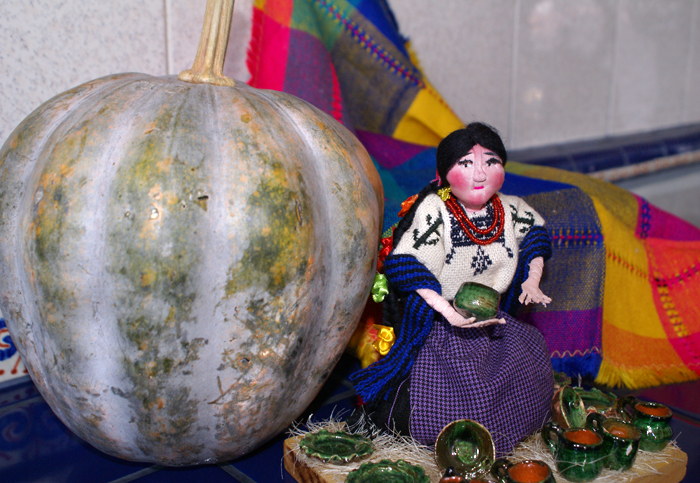
    , the squash Mari brought me, seen here with a charming artisan-made cloth figure of a Purépecha woman with her miniature pottery.  The squash was about 8" high and weighed about three pounds.

    Mari, the woman who at one time spoiled Mexico Cooks! by doing all of my housework, gave me a squash.  She brought two home from her rancho (the family farm) out in the country, one for her and one for me.  The squash wasn't very big, as winter squash go, but it was plenty for us.  Mari's first question, after I had happily accepted her gift, was whether or not I knew how to cook it.  "Con piloncillo y canela, sí?" (With cones of brown sugar and cinnamon, right?) 

    Even though I knew how to spice the squash and knew how to cut it apart, knowing and doing these things turned out to be worlds apart.  Faced with the project, I waffled and hesitated, intimidated by a large vegetable.  The squash sat on the counter for several days, daring me to cook it before it molded.  Then one of the cats toppled it over and rolled it around the counter, so I moved the squash outside onto the terrace table and gathered my nerve. 

    On Sunday, I finally decided it was Cook the Squash day.  Mari was due to arrive early on Monday morning and it had to be done before she scolded me for letting it sit for so long.  I chose pots, knives, and gathered the rest of the simple ingredients for a mise en place.

    Calabaza Partida
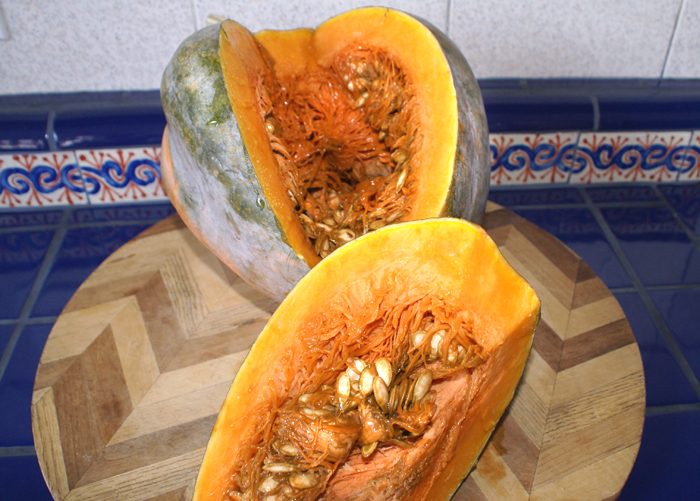
    The squash with the first section cut out.

    Cutting the squash in sections was the only difficult part of preparing it.  The shell of the squash is hard.  Hard.  HARD.  I was careful to keep the knife pointed toward the wall, not toward my body.  With the force I needed to cut the squash open, one slip of the knife could have meant instant and deep penetration of my innards.  Later that night, our friend Araceli told us that her mother usually breaks a squash apart by throwing it onto the concrete patio!  The next morning, Mari told us that her husband had cut their squash apart with a machete.  I felt really tough, knowing that I'd been able to cut it open with just a big knife and a few pointed words.

    Calabaza en Trozos
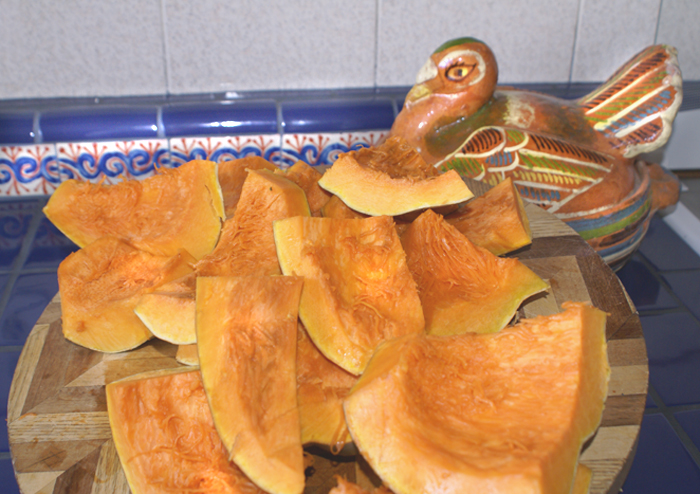
    The squash, cut into sections and ready for the pot.  On the counter behind the squash is a 1930's Mexican covered cazuela (casserole), the top in the form of a turkey.

    Once I had the (few pointed words) squash cut open, I scooped out the seeds and goop and cut it into sections more or less 4" long by 3" wide.  I did not remove the hard shell, nor should you.

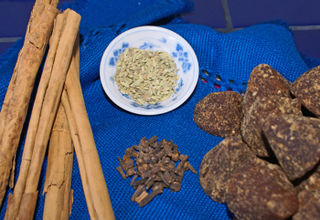
    Meantime, I had prepared the ingredients for the almíbar (thick syrup) that the squash would cook in.  Mexican stick cinnamon, granulated sugar, and piloncillo (cones of brown sugar) went into a pot of water.  I added a big pinch of salt, tied anise seed and cloves into a square of cheesecloth and tossed the little bundle into the water.  The pot needed to simmer for at least three hours, until the syrup was thick and well-flavored.

    Calabaza Especias
    Clockwise from left: Mexican stick cinnamon, anise seed, piloncillo, and cloves.

    Calabaza en Almíbar
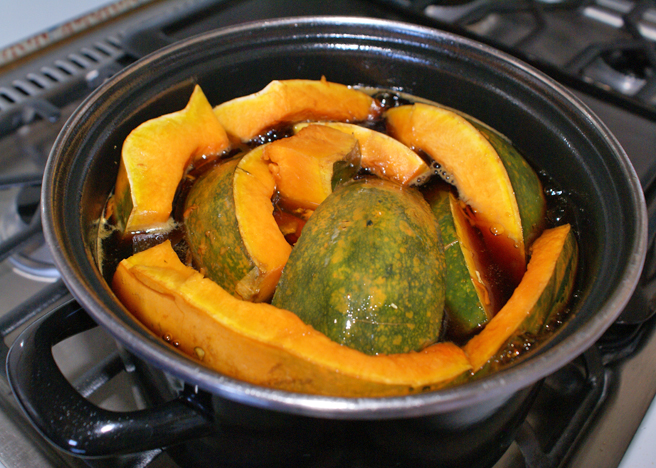
    Several hours later (after the syrup thickened well), I added the pieces of squash to the pot.  Cooking time for this very hard squash was approximately an hour and a half over a low-medium flame. 

    As the squash cooks in the syrup, it softens and takes on a very appetizing dark brown color.  Calabaza en tacha is one of the most typically homey Mexican dishes for desayuno (breakfast) or cena (supper).  Well heated and served in a bowl with hot milk and a little of its own syrup, the squash is both nutritious and filling.

    Calabaza Lista Pa'Comer
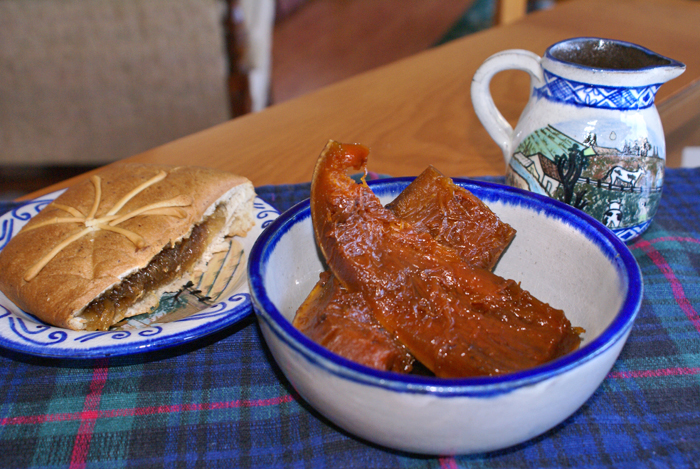
    Squash for breakfast!  On Monday morning, Mexico Cooks! served up a bowl of squash with hot milk, along with a slice of pan relleno con chilacayote (bread filled with sweetened chilacayote squash paste).  Mari thought it was almost–almost–as good as hers.

    Calabaza en Tacha estilo Mexico Cooks!

    Ingredients
    One medium-size hard shell winter squash (about 8" high)
    6 cups water
    14 cones of dark piloncillo (coarse brown sugar)
    2 cups granulated sugar
    4 Mexican cinnamon sticks about 2.5" long
    1 Tbsp anise seed
    1 tsp cloves

    Preparation
    Heat the water in a large pot.  Add the piloncillo, the granulated sugar, and the cinnamon sticks.  Tie the anise seed and the cloves into a cheesecloth square and add it to the pot.  Cook over a slow flame until the liquid is thick and syrupy, approximately three hours.

    While the syrup is cooking, prepare the squash.  Cut it into serving-size pieces as described above.  If the squash shell is very hard, take adequate precautions so that you do not hurt yourself as you cut it in sections.  You can always throw it from your second-floor window onto the patio!

    Add the squash pieces to the thickened syrup and simmer until the squash is soft and takes on a deep brown color.  Cool for 15 minutes or so before serving.  Re-heat for desayuno (breakfast) or cena (supper).  Serve with hot milk poured over it.

    Makes about 16 servings.

    ¡Provecho!

    Looking for a tailored-to-your-interests specialized tour in Mexico? Click here: Tours.
  • Adobo de Cerdo Huasteco, from Verde Blanco y Rojo by Ricardo Muñoz Zurita

    Originally published in October 2011, this illustrated recipe for Adobo de Cerdo Huasteco is a perfect meal for February's chilly weather.  Mexico Cooks! celebrates its ninth anniversary of publishing with this delicious meal to warm body and soul.  Enjoy!

    Adobo Asando Cebolla y Jitomate
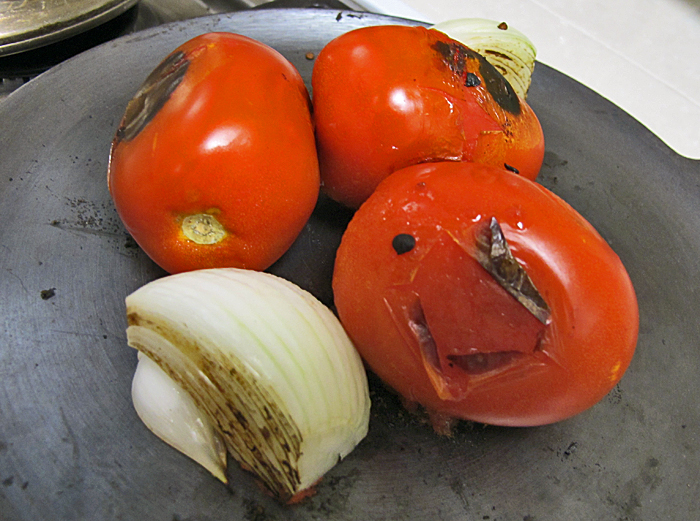
    Roma tomatoes and onion quarters toasting on a comal (in this case, a cast iron griddle).  That little tomato on the right looks downright happy to be toasting.

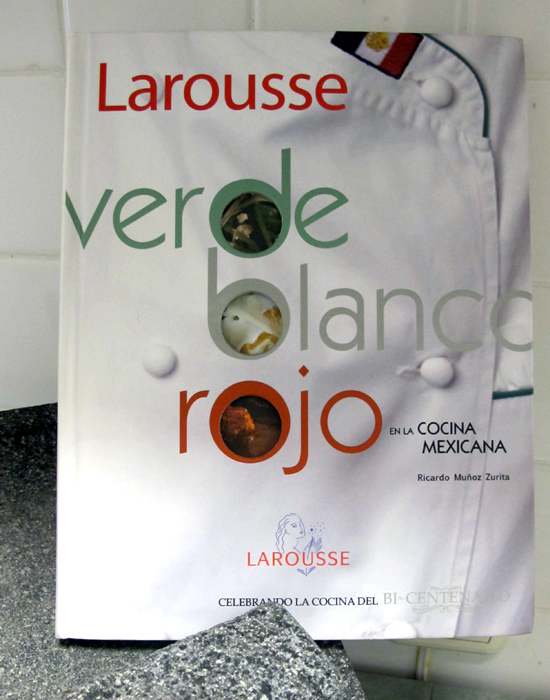
    Several months ago, Mexico Cooks! was thrilled to receive a copy of Chef Ricardo Muñoz Zurita's newest recetario (cookbook), titled Verde, Blanco, y Rojo en la Cocina Mexicana.  Due to the pressures of moving and settling into a new and somewhat more frenetic life in Mexico City, the very attractive book sat patiently in the kitchen bookshelf with its 150 or so brother and sister cookbooks, waiting to be chosen.  'Choose me, choose me!' it whispered each time I passed by the shelf.  And finally I listened.

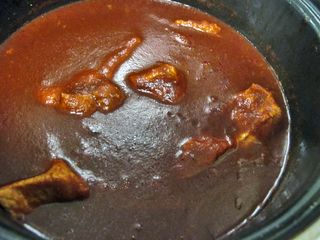
    Adobo Carne de Puerco a Hervir
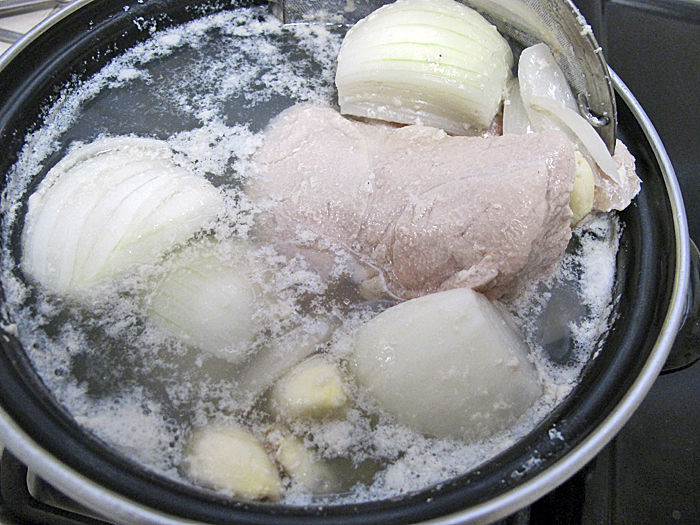
    Serving-size pieces of maciza de cerdo (lean, fresh pork leg) simmering with onion and garlic.

    My friends and I are very fond of traditional Mexican cuisine.  Like most people, we have our favorite dishes.  And like most people, I have a hard time breaking habits and wading into a new cookbook: it means learning a new format, a new organization of ingredients, and a new dish that I had never prepared. 

    The first task was reading the recipe all the way through to the end to make sure that I had all of the ingredients and utensils on hand prior to starting to cook and that I understood the order of cooking.  It's really no fun at all to start the preparations and discover at the time of need that oops, there is no garlic and ouch, that one bowl I really wanted to use is full of last night's stew.  You'll want to organize yourself and prepare your mise en place (all ingredients in place, ready to cook) well before you turn on the stove.

    Adobo Chile Ancho Contraluz
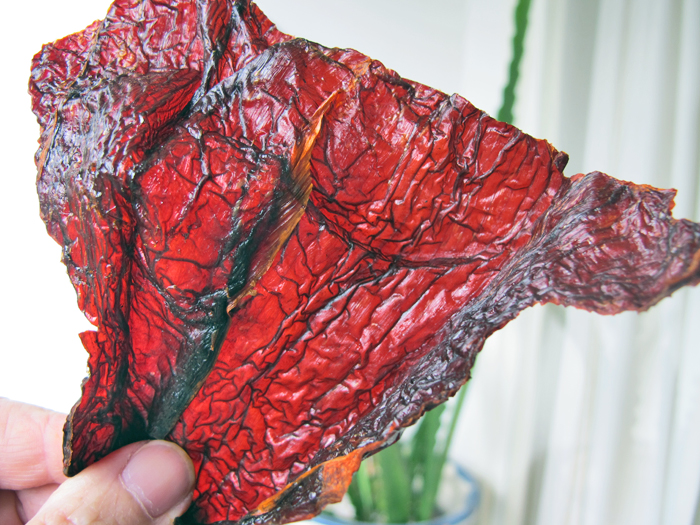
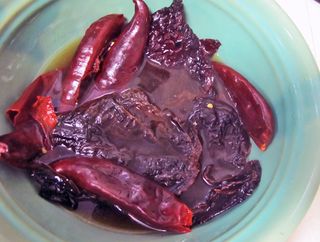
    Differentiating between dried chiles ancho and chiles mulato can be confusing.  If you open a chile ancho and hold it up to the light, it looks from the inside like red stained glass.  The mulato, on the other hand, looks brown when held to the light.  It's immediately apparent which this is.  Always try to buy chiles that are leathery and flexible, not brittle.

    Ingredients
    2 kg (approximately 4.5 pounds) lean pork meat, cut into serving-size pieces
    1 white onion, cut into quarters
    1 head of garlic, split in half
    4 liters water
    6 tsp salt
    8 chiles guajillo
    5 large chiles ancho
    3 large tomatos, roasted
    1/2 white onion, quartered and roasted
    5 garlic cloves
    2 tsp ground cumin
    1 tsp dry Mexican oregano, crumbled
    1/2 tsp freshly ground black pepper
    4 cloves
    3 Tbsp pork lard (you can substitute oil if you can't get real, freshly rendered lard)
    1/2 cup white vinegar

    Utensils 
    Comal or griddle
    Mesh strainer
    Several small or medium-size mixing bowls
    Mixing spoons
    Heavy-bottom pot with lid
    Blender

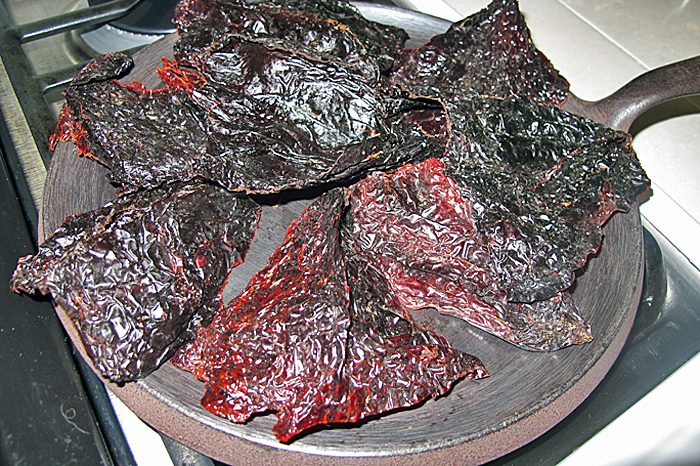
    Adobo Asando Chiles Anchos
    Toasting the chiles ancho on the comal.

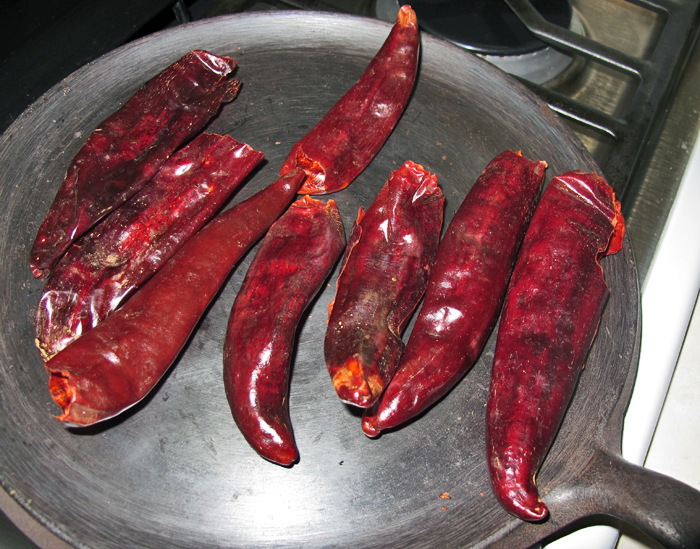
     Adobo Asando Chiles Guajillos
    Toasting the chiles guajillo on the comal.

    Procedure
    Put the pork, onion, and head of garlic in a large pot.  Cover with water, add 4 tsp salt and bring to a boil.  Lower the heat until the water is down to a simmer and cook until the pork is tender, about an hour.  Remove the pork from the water, drain the liquid into a bowl, and reserve both the meat and the cooking liquid for later use.

    Remove the stems, seeds, and veins from all of the chiles and discard them.  Lightly toast the chiles on the comal, being careful not to burn them.  If they turn black, they will be bitter.  Soak the toasted chiles in four cups of the reserved cooking liquid from the pork.

    Adobo Chiles Remojándose
    Both types of toasted chiles are then soaked for a few minutes in some of the freshly cooked hot pork broth.

    Blend the soaked chiles with enough of the cooking liquid to make a smooth, somewhat liquid paste. 

    Roast the tomatoes, onions, and garlic on the comal, then blend them until they make a very smooth sauce.  If necessary for blending, add just a little of the reserved meat cooking liquid.  Using the wire mesh strainer, strain into a bowl and reserve. 

    Adobo Chiles Molidos Caldo y Especias
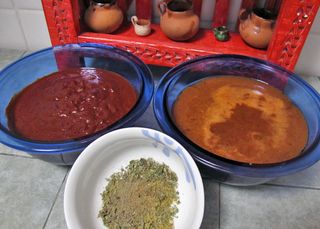
    The mix of various seasonings (foreground), the blended and strained chiles (left rear) and the blended tomato/onion/garlic mixture (right rear).  

    Grind the cumin, the oregano, the pepper, and the cloves together until they are powdered.  Set aside for later use.

    Over a high flame, heat the lard or oil in a heavy-bottomed pot until it smokes slightly.  Add the ground chiles (splatter alert!) and fry for about 15 minutes or until the mixture is reduced by about one-fourth.  Add the blended tomato mixture, the spices, and two tablespoons of salt.  When the mixture comes to a boil, lower the fire and allow to simmer until the sauce has reduced a little.

    Adobo en la Olla
    The pork now needs to simmer in the adobo for an hour or more, either in the oven or over a very low fire.  The fragrance will drive you crazy, it is so tantalizing.  Mexico Cooks! prepared this recipe on top of the stove using the cast iron comal as a heat diffuser.

    Add the meat, the vinegar, and three cups of the reserved meat cooking liquid.  Correct the seasonings and cook with the lid ajar over low heat (or bake covered in a 350° oven) for about an hour.  The finished sauce should be thick enough to cover the meat without sliding off the pieces.  

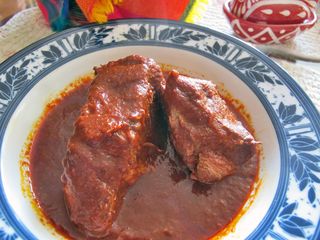
    Adobo en el Plato
    Adobo de cerdo huasteco, ready to eat!  Serve the dish with steamed white rice and plenty of hot-off-the-comal corn tortillas.

    The finished recipe also freezes very well.  Mexico Cooks! served half the recipe as comida for six and froze the rest for a later meal. 

    Serves 12. 

    Adobo Verde Blanco Rojo Larousse
    The wonderful Spanish-language Verde, Blanco, Rojo en La Cocina Mexicana, written by my friend Chef Ricardo Muñoz Zurita of Restaurante Azul/Condesa.

    Looking for a tailored-to-your-interests specialized tour in Mexico? Click here: Tours. 
  • Restaurante La Teca–Cuisine from Oaxaca’s Isthmus of Tehuantepec: Cocina Istmeña Oaxaqueña

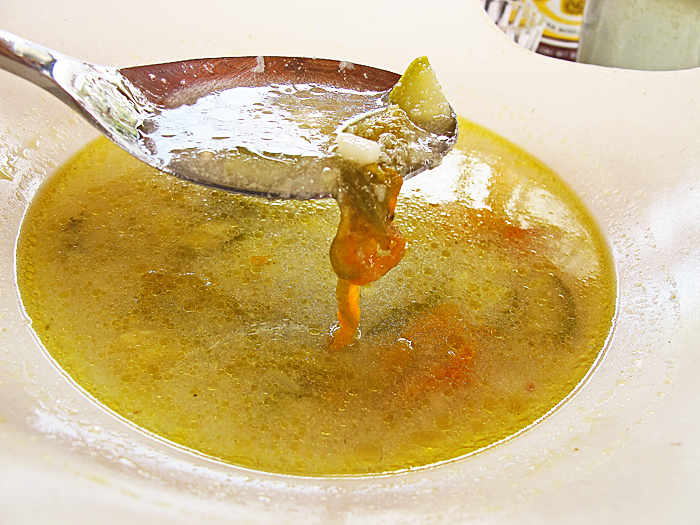
    Ada?n Sopa de Gui?a
    A delicious Oaxaca specialty: sopa de guía, a clear soup made with chicken broth, tendrils of squash plant, and squash flowers.

    While in Oaxaca with a writers' group, I took a little time away from that group to visit another group: several culinary-world friends who live and work in this southern Mexico city.   I played hooky to eat on Friday with Pilar Cabrera at her wonderful restaurant La Olla, and on Saturday with chef Rodolfo Castellanos and his family at La Teca, a restaurant specializing in cooking from the Isthmus of Tehuantepec.

    The Isthmus of Tehuantepec is the skinniest part of mainland Mexico, lying between the Pacific Ocean and the Gulf of Mexico.  Prior to the opening of the Panama Canal, it was the most important route for goods working their slow way across the relatively flat lands between the two bodies of water.  Partly in Oaxaca, partly in Chiapas, partly in Tabasco and partly in Veracruz, the territory has its own legends, its own history, and its own cuisines. 

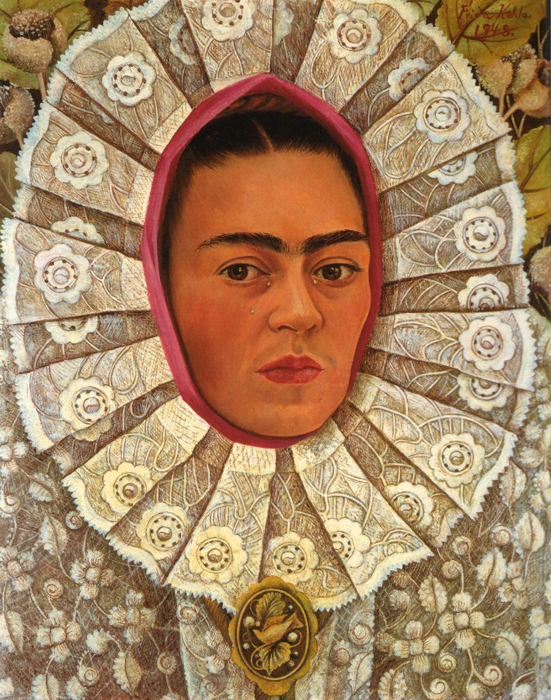
    Oaxaca 1948 Frida Tehuana
    You may not be aware that you are already familiar with the native dress of the Tehuanas, as the women of the isthmus are known.  Above, a Frida Kahlo 1948 self portrait, dressed as a Tehuana. Image courtesy of: http://www.earlywomenmasters.net

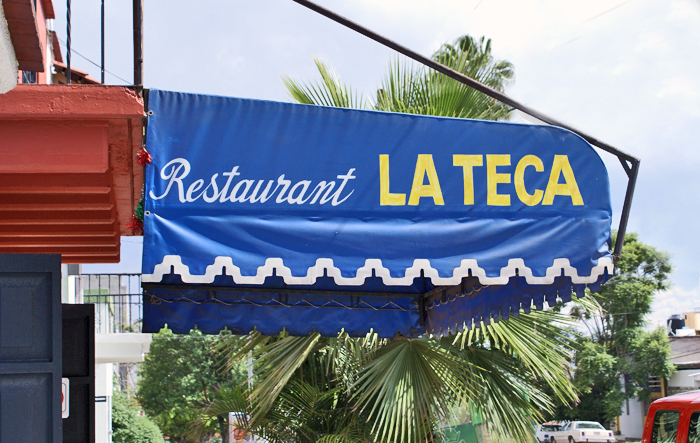
    Oaxaca Restaurante La Teca
    Just off the beaten tourist track in Oaxaca, Restaurant La Teca serves outstanding food from the Isthmus of Tehuantepec.  The welcoming owner and cook, Señora Deyanira Aquino, will make sure that you eat your fill of her marvelous regional cuisine.

    The cooking of the Isthmus is traditionally corn-based and idiosyncratic.  Most ingredients are indigenous to its hot lowlands (for example, armadillo and iguana) and its proximity to the sea: fresh and dried shrimp, fresh fish, and other creatures from the ocean depths.

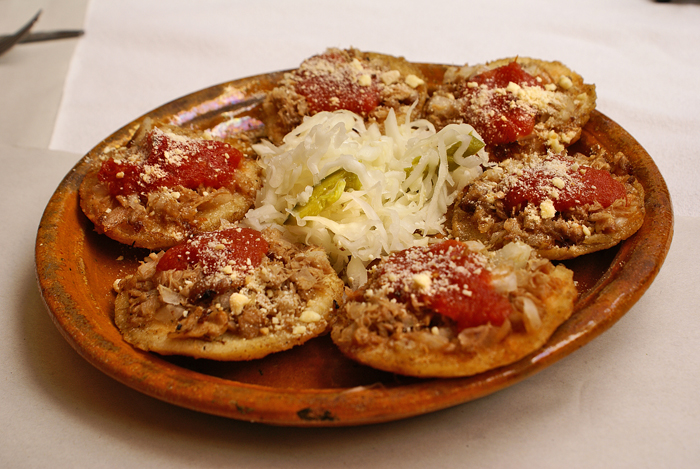
    Oaxaca La Teca Garnachas Oaxaqueñas
    At La Teca we shared a platter of garnachas, a traditional entrada or botana (appetizer or snack) based on a fried disk of corn dough and topped with a mixture of meat, vegetables, and salsa.

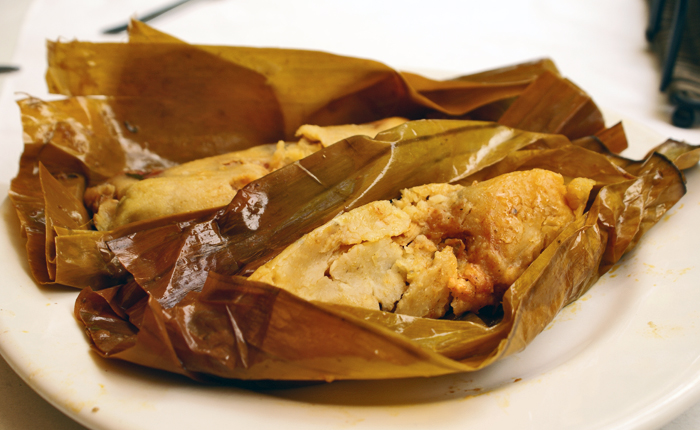
    Oaxaca La Teca Tamales de Cambray
    Tamalitos de cambray from Tehuantepec, savory-sweet tamales made of chicken, raisins, olives, almonds, and capers.

    Oaxaca La Teca Molotes de Plátano Macho
    These are molotes de plátano macho (small, sweetly ripe plantain croquettes) topped with crema de mesa (table cream) and queso fresco (fresh cheese).  The three of us shared an order of four molotes.  We kept dividing the last one into smaller and smaller pieces so that one of us did not hog the whole thing–although each of us would have!

    Oaxaca La Teca Taco de Chile Relleno Pasilla Oaxaqueño
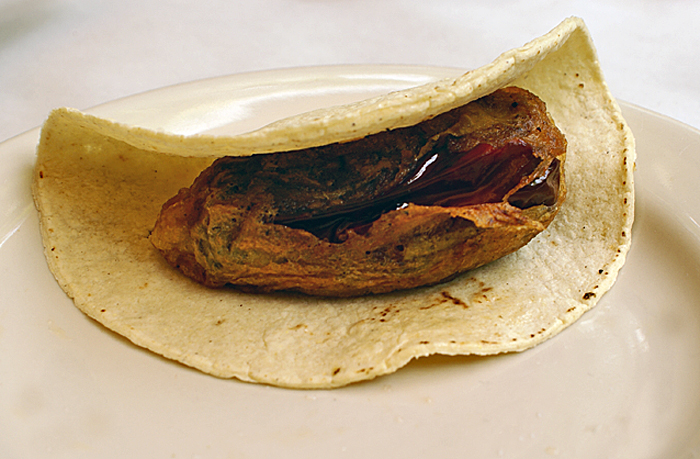
    Next course at La Teca: a taco filled with a small chile pasilla oaxaqueño relleno (a regional dried chile, reconstituted, stuffed, and fried).  It doesn't look like anything special, does it?  If you could just enjoy the fragrance, I assure you that you would want to lick your monitor.

    Oaxaca La Teca Tamales de Elote 2
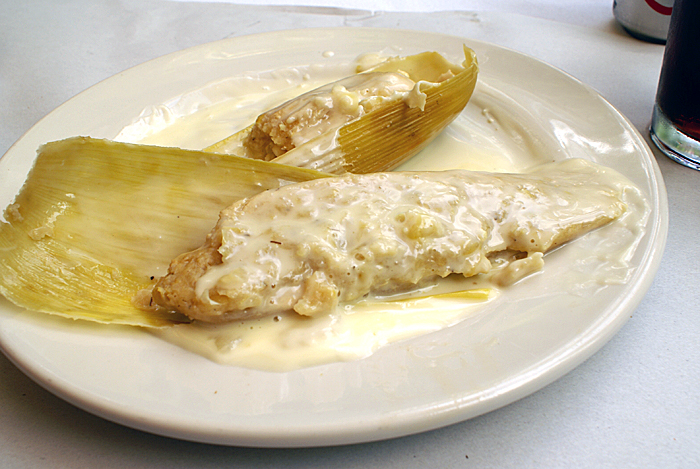
    Tamales de elote (fresh corn tamales) followed, served with crema de mesa.  These reminded me very much of Michoacán uchepos, another kind of fresh corn tamales.

    Oaxaca La Teca Estofado de Bodas
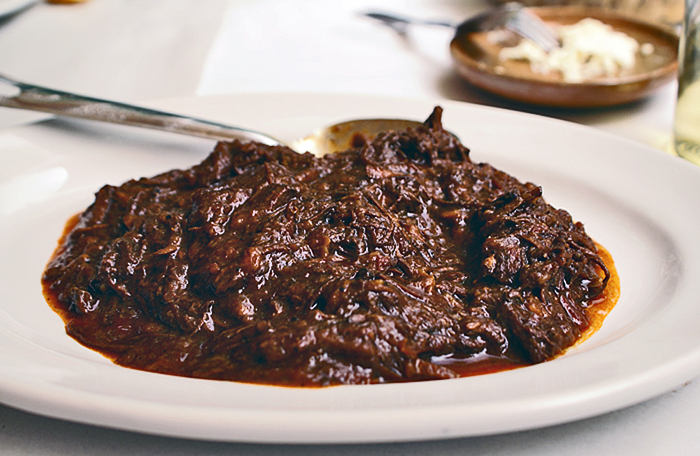
    Another traditional dish from the Isthmus, estofado de bodas (wedding stew).  It's a delicious long-cooked combination of beef, fruits, chiles, and other spices, typically served at weddings.

    Oaxaca La Teca Purée de Papa
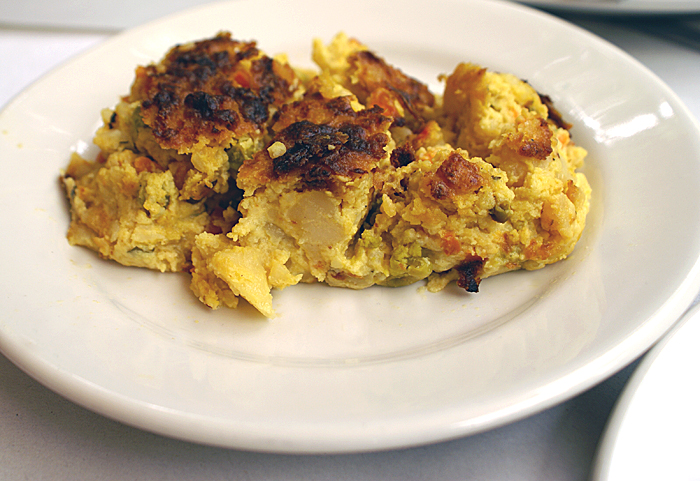
    Purée de papa, estilo Istmeño (potatoes, coarsely mashed and then baked, Isthmus style). 

    Oaxaca La Teca Carne de Cerdo
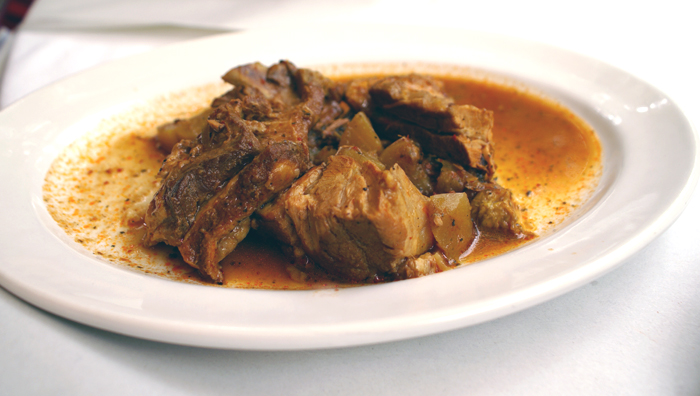
    Asado de puerco con mole (pork roasted with mole, from Tehuantepec).

    Oaxaca La Teca en Persona
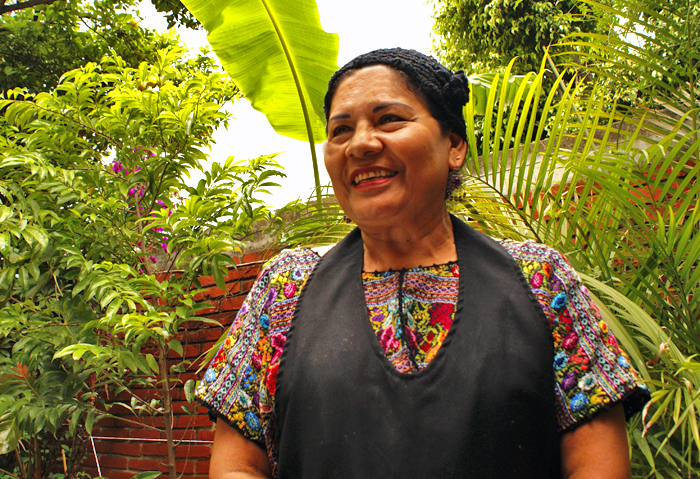
    The owner and chief cook at La Teca is Sra. Deyanira Aquino, born and raised in the Isthmus.  Women of the region are called 'tecas'–from Tehuantepec–hence the name of the restaurant.

    You are probably well aware of the mythical seven moles of Oaxaca, and although the state is best known for those, there are many other less-well-known but equally wonderful dishes available to visitors.  By all means go see Sra. Aquino at La Teca; you will be as thrilled by everything you eat as we were.  This is not fancy, high-end designer-plated food.  Your palate will be delighted by traditional Tehuantepec home-style cooking.  And oh my god, you might exclaim, did the three of you really eat all that?  We most assuredly did, every bite, and so will you.

    Restaurant La Teca
    Calle Violetas #200-A
    Colonia Reforma
    Oaxaca, Oaxaca
    01.951.515.0563 (from within Mexico)

    Looking for a tailored-to-your-interests specialized tour in Mexico? Click here: Tours.
  • Abigail Mendoza Ruiz and Restaurante Tlamanalli: Food for the Gods in Teotitlán del Valle, Oaxaca

    This article, originally published in 2014, promised that Mexico Cooks! would be back in Oaxaca and would return to Tlamanalli.  This week, we're there again, this time leading a tour and delighting in all the marvelous culinary and cultural treasures Oaxaca has to offer.  Abigail Mendoza sends her best wishes to all who follow Mexico Cooks!.

    Zaachila Chocolate
    Emblematic of Oaxaca: chocolate caliente (hot and foamy hand-ground hot chocolate) prepared in water and served in a bowl. Zaachila market, Oaxaca.

    There's much more to Oaxaca's magic than simply its capital city, which is of course fantastic in its own right.  Driving in any direction from the city, twisting two-lane roads lead to small towns; each town has a weekly market, and each market has beauties of its own.

    Zaachila Calabaza en Tacha con Hoja
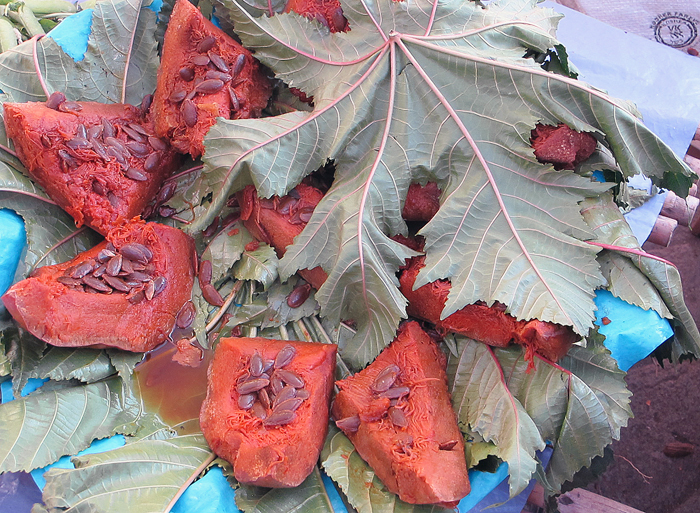
    At the Zaachila Friday market, a vendor sold calabaza en tacha (squash cooked in brown sugar syrup) covered with a leaf to keep insects away and maintain the squash fresh and ready to eat.

    Zaachila Flor de Frijolón
    Another vendor offered flor de frijolón (the red flowers of a large, black, local bean known elsewhere as ayocote negro).

    Zaachila Tejate
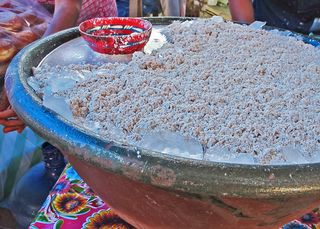
    Tejate, Oaxaca's emblematic cold, foamy, and refreshing chocolate beverage, scooped out of this clay bowl with a red-lacquered jícara into the size cup you prefer: small, medium, or large.  

    When Mexico Cooks! traveled recently to Oaxaca, joyous anticipation and a letter of introduction were stowed among my baggage.  For years I had read about and admired (albeit from afar) Abigail Mendoza Ruiz and her sisters, but we had never met.  This trip would fix that: two days after my scheduled arrival, we had an appointment for comida (Mexico's main meal of the day) at the Mendoza sisters' Restaurante Tlamanalli in Teotitlán del Valle.  The restaurant's name, a Náhuatl word, means several things: it's the name of the Zapotec kitchen god, it means abundance, and it means offering.  For me, newly arrived in Teotitlán del Valle, the word Tlamanalli meant, 'you are about to have the experience of a lifetime'.

    Teotitlán del Valle is best known as the principal Oaxaca rug-weavers' town. Among its five to six thousand inhabitants, the majority weaves wool to make lovely rugs and also combines the weaver's tasks with agricultural work, growing both marketable and personal-use corn and other vegetables plus raising poultry for personal use.

    Rueca Detalle
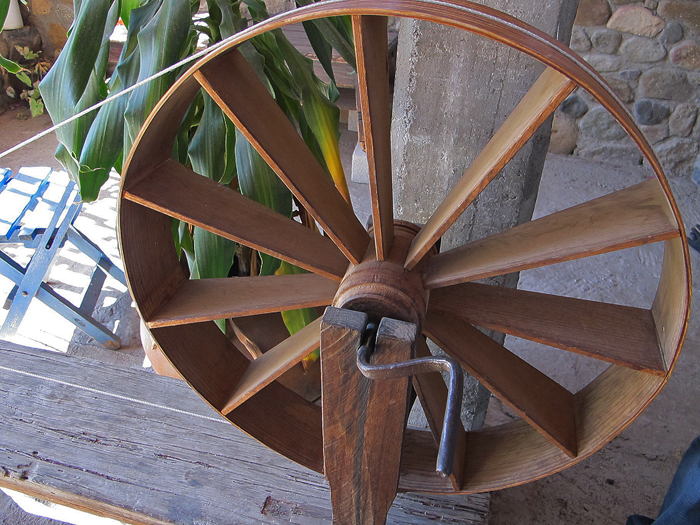
    Detail of the rustic wooden rueca (spinning wheel) used  by the Teotitlán del Valle rugmakers for spinning fine wool yarns.  

    Taller de tejedor
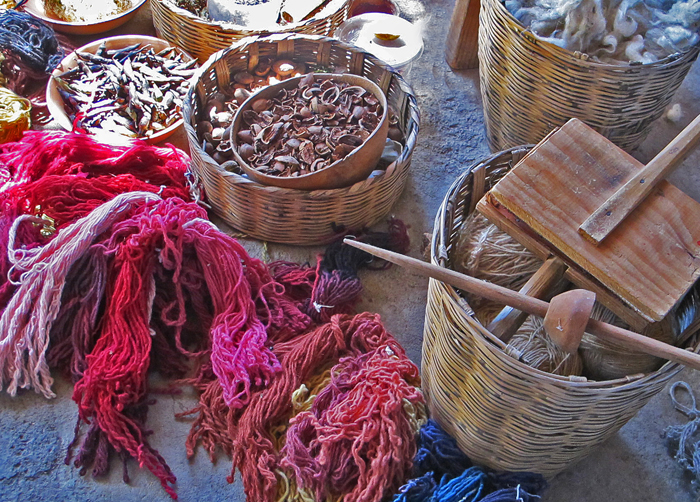
    Shown in this group of Oaxaca-made baskets: a flat double comb for carding wool, a pointed spindle, and various natural coloring agents, along with hanks of wool which demonstrate just a few of the colors used in Oaxacan wool rugs.

    Not only are the Mendoza Ruiz sisters extraordinary regional cooks, they and their siblings are also well-known rug weavers.  Their parents, Sra. Clara Ruiz and don Emilio Mendoza (QEPD), gave this world a group of supremely gifted artisans, all of whom learned the weavers' traditions at their parents' knees.

    Woman and Child Making Tortillas
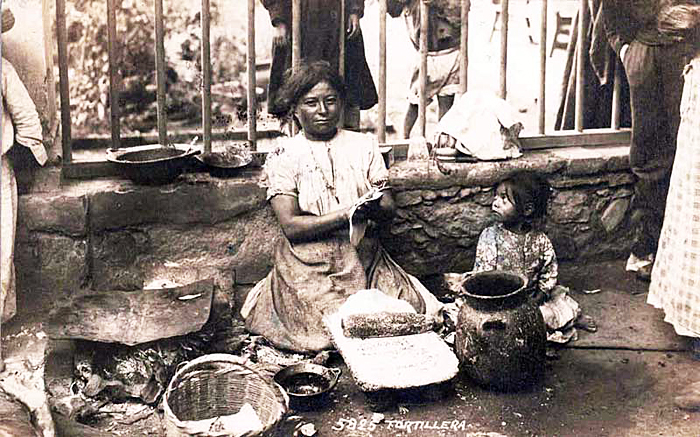
    Abigail Mendoza started learning kitchen traditions as a five-year-old, as the first daughter of the family, watching her mother grind nixtamal (dried native corn soaked and prepared for masa (dough).  In the postcard above, the little girl (who is not Abigail) watches seriously as the woman we imagine to be her mother pats a tortilla into its round shape.  

    By the time she was six years old, Abigail was in charge of sweeping the kitchen's dirt floor, gathering firewood, and making the kitchen fire. At age seven, she told her mother, "I'm ready to grind corn on the metate," (volcanic rock grinding stone, seen in the center of the photograph above), but she wasn't yet strong enough to use her mother's large stone.  She was barely able to lift its metapil (stone rolling pin).  She eagerly awaited the purchase of a metate small enough for her use.  Doña Clara taught her to grind the home-prepared nixtamal, pat-pat-pat the tortilla dough into perfect thin rounds, and bake them on the comal (wood-fired griddle made of clay).

    Las Hermanas Mendoza
    Abigaíl Mendoza Ruiz, the internationally known and much-traveled Zapoteca cook, best loves preparing meals in her home kitchen and her restaurant kitchen in Teotitlán del Valle, Oaxaca.  Here, she's pictured in the beautiful open kitchen of Tlamanalli, the restaurant where she and her sisters Rufina and Marcelina (pictured above) create their culinary alchemy.  

    Abigail Mendoza is at once filled with light and filled with mystery.  Luminous as her joy-filled personality, her smile lights up any room she enters.  She is a woman of deep faith, a subscriber to the mysteries of dreams, a believer in spirit worlds both before and after life, a strong believer both in human relationships along life's horizontal and the vertical relationship of God with humanity.  Formally educated only through primary school, she holds intense wisdom borne of deep meditation on the nature of life, both spiritual and physical.

    In her extraordinary book Dishdaa'w, Abigail reveals her life story, her philosophies, and a good part of her soul.  The Zapotec title of her biography (transcribed and organized by Concepción Silvia Núñez Miranda) means "the word woven into the infinite meal".  And what does that mean?  Food itself has a soul, the soul is transmitted in food's preparation and its ingestion.  We are all part of the whole, and the whole is part of each of us.

    Abigail Mendoza Oaxaca 2014
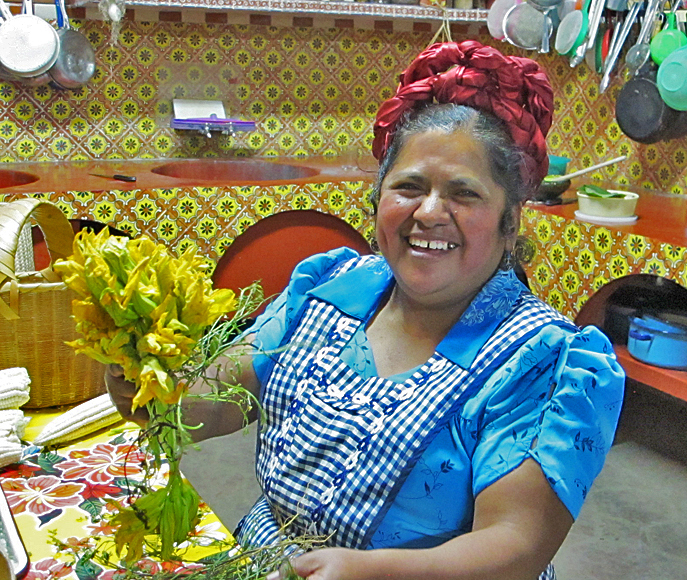
    In her restaurant's large kitchen, Abigail is the sun itself.  Hair braided  with traditional Zapotec ribbons into a royal crown, she's holding a fistful of freshly picked flor de calabaza (squash flowers).

    What did we do, Señorita Abigail and I?  We talked, we laughed, we discovered who our many friends in common are, we swapped kitchen lore and recipes, we gossiped (just a little, and in the best possible way), and we each felt like we had met yet another sister, a sister of the kitchen.  

    And then she asked what we would like to eat.  After stumbling around in a maze of I-don't-know-what-to-request, I suggested that she simply bring us her personal choices from the day's menu.

    Carta Tlamanalli
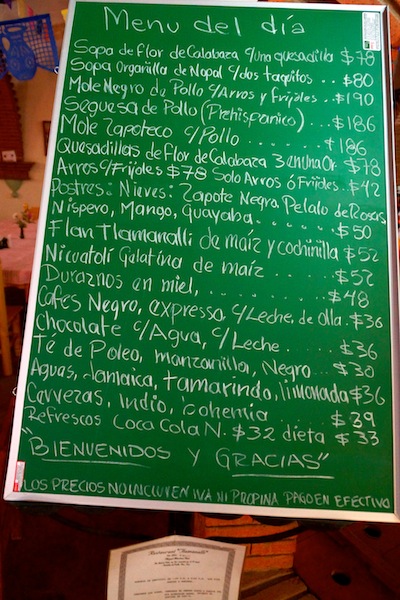
    Menu for the day, Restaurante Tlamanalli.  The dishes are not inexpensive, but ye gods: save up, if you must, and go.  You will never regret it.

    Botanas en Charola
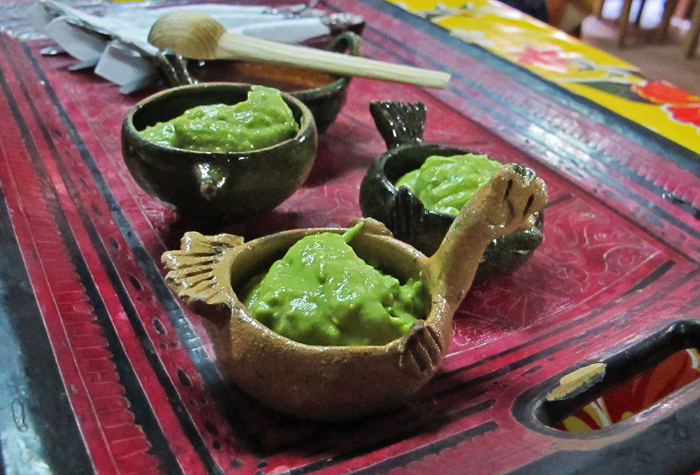
    First came made-on-the-spot creamy guacamole, in tiny turkey-shaped clay dishes and accompanied by a small bottle of local mezcal amd a wee dish of roasted, seasoned pepitas (squash seeds).

    Abigail Mole with Chicken
    Mole zapoteco con pollo (Zapotec-style mole with chicken).  Each of our dishes was accompanied by freshly made tortillas, hot from the comal (griddle).

    Segueza de Pollo con Maíz
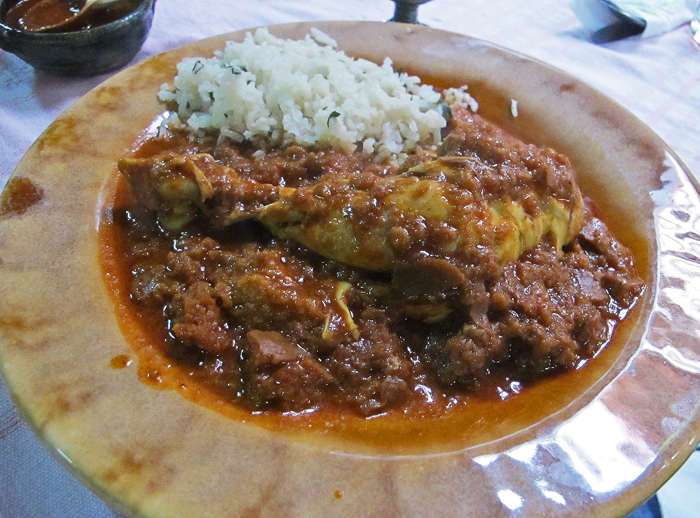
    Pre-hispanic segueza de pollo (breast of chicken in tomato and chile sauce with dried corn and hoja santa).  If I should ever be in Oaxaca and in a position to choose one last meal, this would be it.

    Hoja Santa
    The herb hoja santa is added to the sauce just before serving and gives a delicate anise flavor to the segueza de pollo.

    Zaachila Jitomate Riñón
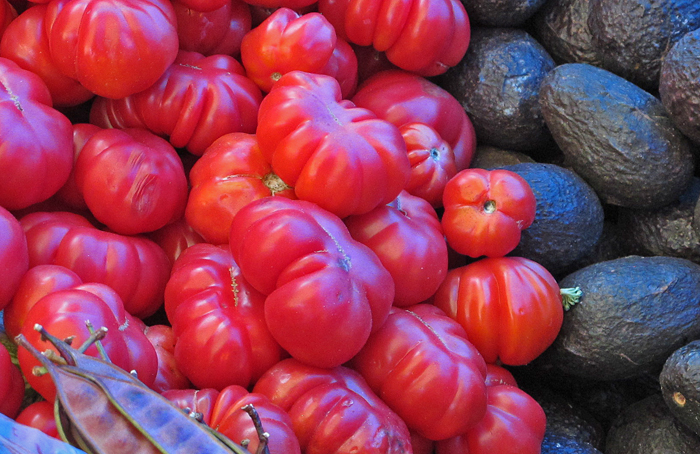
    Oaxaca's heirloom jitomate riñón (kidney-shaped tomatoes) is used for creating the intense and deeply tomato-flavored sauce for the segueza.   

    Altar Casera Preciosa Sangre de Cristo
    When we finished our meal, the Mendoza sisters and doña Clara invited Mexico Cooks! to visit their private kitchen altar, devoted to the Preciosa Sangre de Cristo (Precious Blood of Christ), whose feast day is a major holiday in Teotitlán del Valle and for whom the parish church is named.  The home altar has offerings of seasonal fruits as well as perpetually-burning candles.

    Mexico Cooks! will go back to Oaxaca, back to Teotitlán del Valle, and back to Restaurante Tlamanalli.  After all, I want to visit my new sister–she's a constant inspiration and the best Oaxacan cook I know.

    Looking for a tailored-to-your-interests specialized tour in Mexico? Click here: Tours.
  • Mercado 20 de noviembre, Oaxaca: Shop This Market with Mexico Cooks!

    Mexico Cooks! travels once again to Oaxaca!  A week in this marvelous city is barely enough time to experience some of the wonders it has to offer.  We'll be at the extraordinary Mercado 20 de noviembre this week, just as we were when this article first appeared in 2011. 

    Oaxaca Benito Juárez Mkt 5 Sal de Gusano
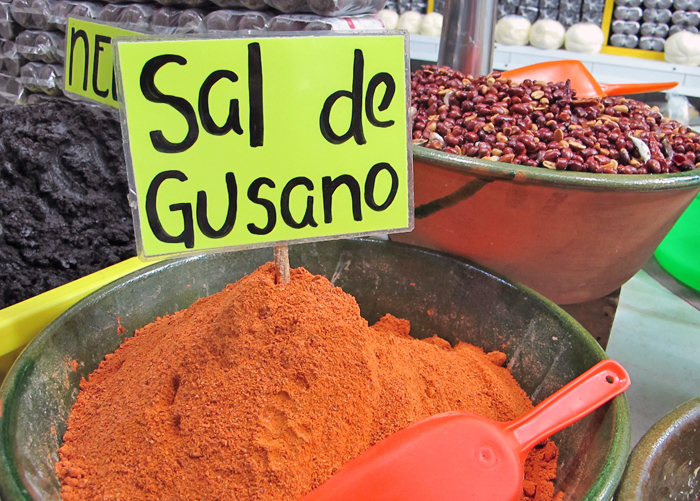
    Emblematic of Oaxaca and its mezcal culture, sal de gusano (worm salt) and a wedge of fresh orange are the truly Oaxacan accompaniments to a shot of what Mexicans call la bebida de los dioses (the drink of the gods).  And yes, sal de gusano is made with sea salt, ground chile, and ground dried maguey worms.  I promise you that it is delicious.

    The last morning of Mexico Cooks!' recent stay in Oaxaca, I grabbed a friend who's working with the initiative and headed off to the city's famous Mercado 20 de noviembre.  The market is in many ways similar to but in many ways different from the traditional markets of Mexico's Central Highlands, those that Mexico Cooks! knows best.  Both my friend and I were fascinated by what we saw and learned while we were poking around among the stalls.

    Oaxaca Benito Juárez Mkt 10 Jícaras y Sonajas
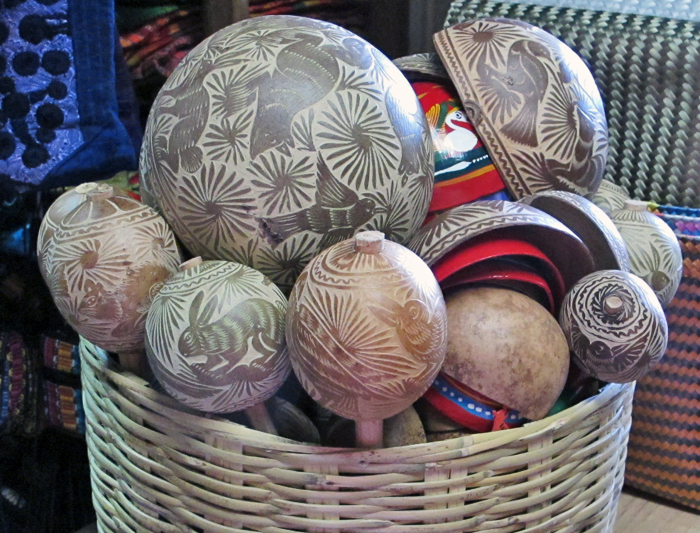
    The large carved bowls at the top of the basket and several of the smaller carved bowls to the lower right–including the laquered red ones–are actually jícaras (dried gourds).  Jícaras are traditionally used for drinking mezcal.  Around the edge of the basket you see sonajas (rattles), in this case whole dried gourds on sticks.  The seeds dry inside the gourds to provide the sound effects when you shake the stick.

    Oaxaca Benito Juárez Mkt 6 Chilhuacle
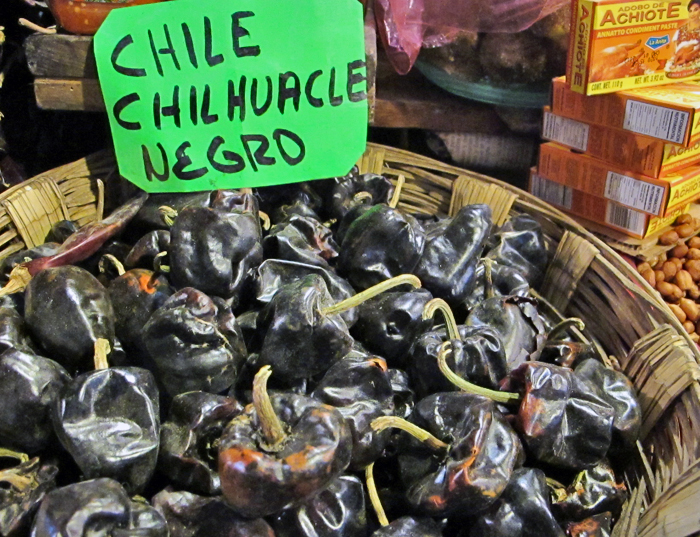
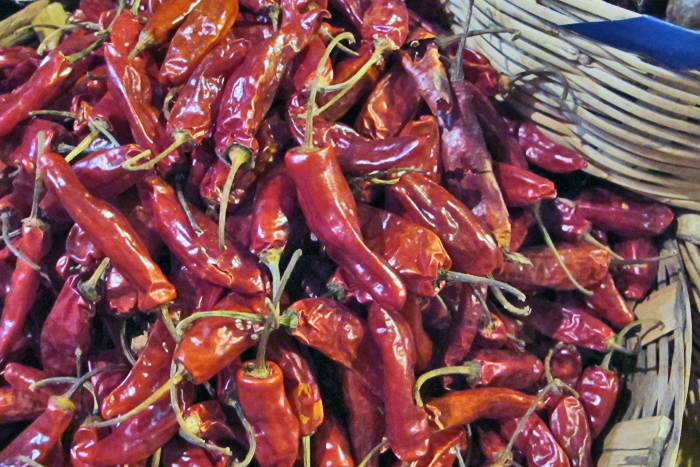
    Rural Oaxaca grows chiles of all kinds, including some that are unique to the state.  These are dried chile chilhuacle negro, arguably the most expensive chile in Mexico.  Retail price?  Eight hundred pesos the kilo–about $75 USD for 2.2 pounds, at today's exchange rate.

    Oaxaca Benito Juárez Mkt 1 Bolsas 1
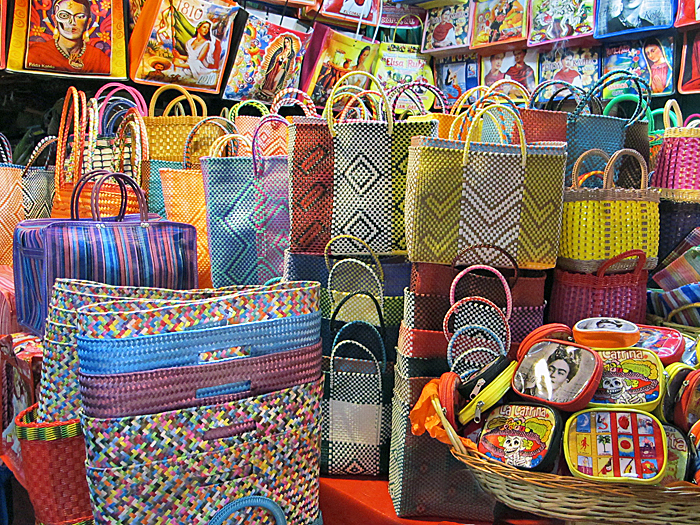
    Bags, bags, and more bags–all plastic–sell at two adjacent market stands.  The bolsas (bags) range from the little zipper change purses in the basket at lower right to the big woven market bags on the left and at the rear.  Mexico Cooks! came home with two of the big ones.

    Oaxaca Benito Juárez Mkt 8 Chiles Pasilla Oaxaca
    Mexican chile terminology is filled with contradictions.  These are chiles pasillas oaxaqueños (Oaxacan pasilla chiles).  Chiles pasillas are different sizes, shapes, colors, and flavors depending on where you are in Mexico, but these are unique to Oaxaca.

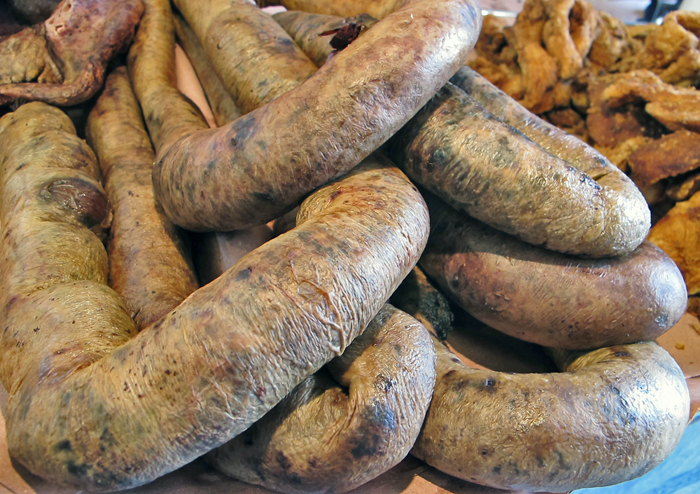
    Oaxaca Benito Juárez Mkt 16 Moronga
    Moronga
    is pork blood sausage.  The blood is heavily seasoned with ruda (rue), oregano, fresh  mint, onions and chile and then stuffed into pigs' intestines and boiled for as much as several hours. 

    Oaxaca Benito Juárez Mkt 11 Chiles de Agua
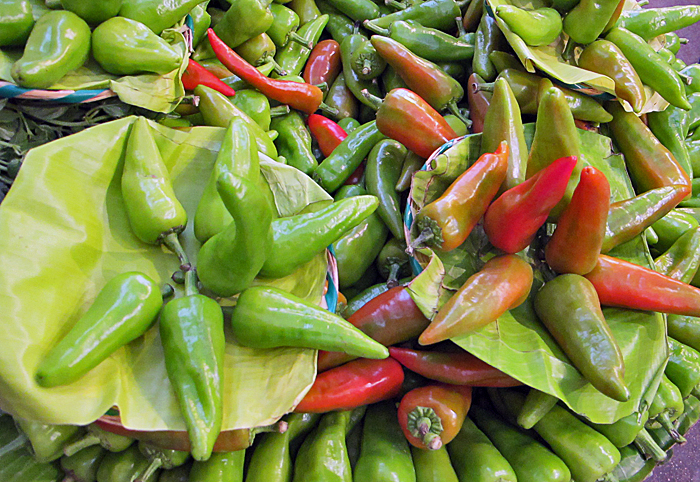
    Chile de agua (literally, water chile) is another specialty pepper from Oaxaca.  Some folks say its heat is medium, some folks swear it's hot as hell, and everyone agrees that it's very difficult to find outside Oaxaca.  Look back a few weeks on Mexico Cooks! to see a wonderful use for these small chiles.  I loved the flavor and the picor (heat factor).

    Oaxaca Benito Juárez Mkt 21 Tres Moles
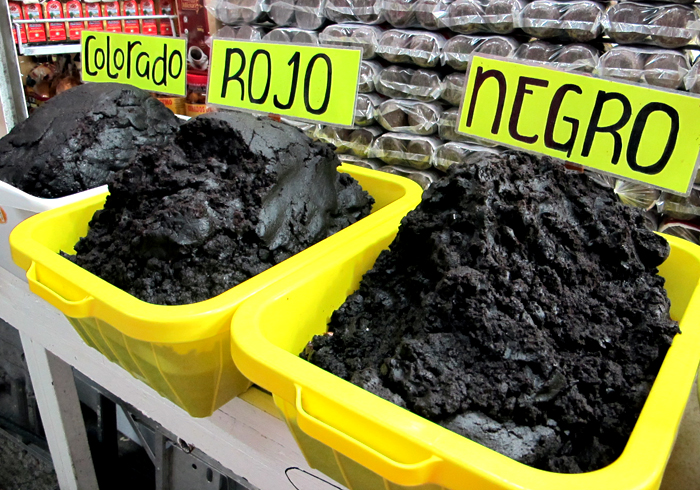
    Three of Oaxaca's famous moles.  These are sold as pastes, by weight.  You simply reconstitute them with chicken broth at home and serve them with the meat of your choice.  Mexico Cooks! is crazy about carne de cerdo con mole negro (pork with black mole).

    We'll come back to Oaxaca, just to give you a sample of marvelous food and drink–next Saturday morning, right here at Mexico Cooks!.  Be ready for more regional Oaxacan specialties.

    Looking for a tailored-to-your-interests specialized tour in Mexico? Click here: Tours.
  • Oaxaca De Mis Amores :: Mexico Cooks! Falls in Love with Oaxaca

    Santo Domingo Through the Window
    La bella Lula'a…beautiful Oaxaca, as said in the indigenous Zapotec language. You are looking through a window toward the Capilla del Rosario (Chapel of the Rosary) dome and bell tower, part of the Templo Santo Domingo.

    Oaxaca Santo Domingo San Pedro Sonríe
    This image of St. Peter (easy to identify because he is almost always depicted holding the keys of the kingdom) in Oaxaca's Templo Santo Domingo wears a tiny but knowing smile: he gets to live in Oaxaca!

    Mexico Cooks! has visited Oaxaca and written several times about the city and its attractions, about the interesting differences of the city's markets from those of long-familiar central Mexico, the palate-tease of regional foods, a dream made real in another Oaxaca town.  I had a good time, several times.  But it didn't hit me, the loving lightning bolt of Oaxaca didn't strike me, until a trip to the city only a few years ago.
    Oaxaca Mercado 20 de noviembre Mandarinas
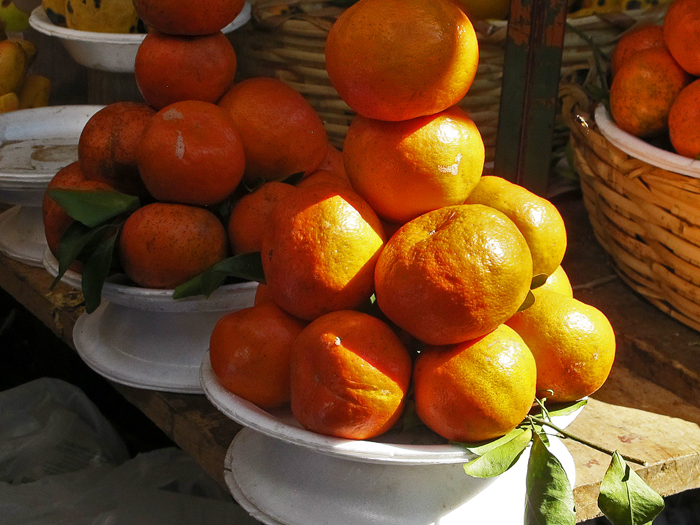
    Winter is mandarina (tangerine) season in Mexico.  These, vendor-stacked in pyramids outside Oaxaca's Mercado 20 de noviembre, caught late January light and presto! they turned into still life magic.

    Those non-descript nouns and pallid adjectives (attractions, interesting) in the first paragraph tell the tale of how I felt about Oaxaca, until now. Where's the punch?  The truth is, I just didn't get the thrill of Oaxaca, no matter how many visits I made.  And then this time: YOWZA!  I got it–or better said, it got me.  Oaxaca, how could I have been so blind? 

    Templo Sta María de Tule
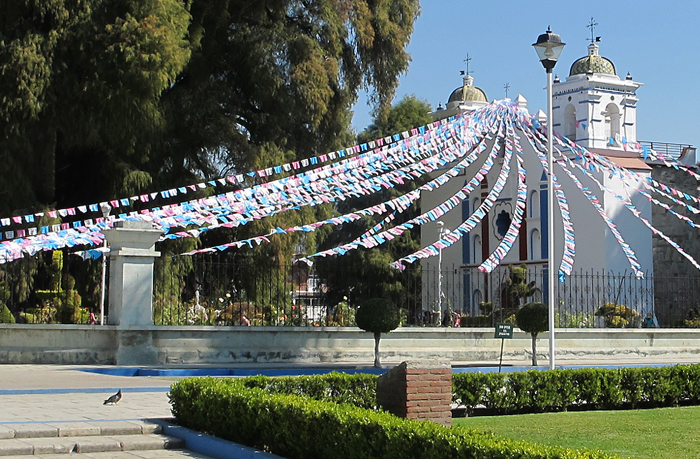
    Templo Santa María de la Asunción (Church of St. Mary of the Assumption), the town parish in Santa María del Tule, just outside the city of Oaxaca. A small part of the famous ahuehuete tree, more than 2,000 years old, is visible on the left side of the photo. 

    Santa María de Tule
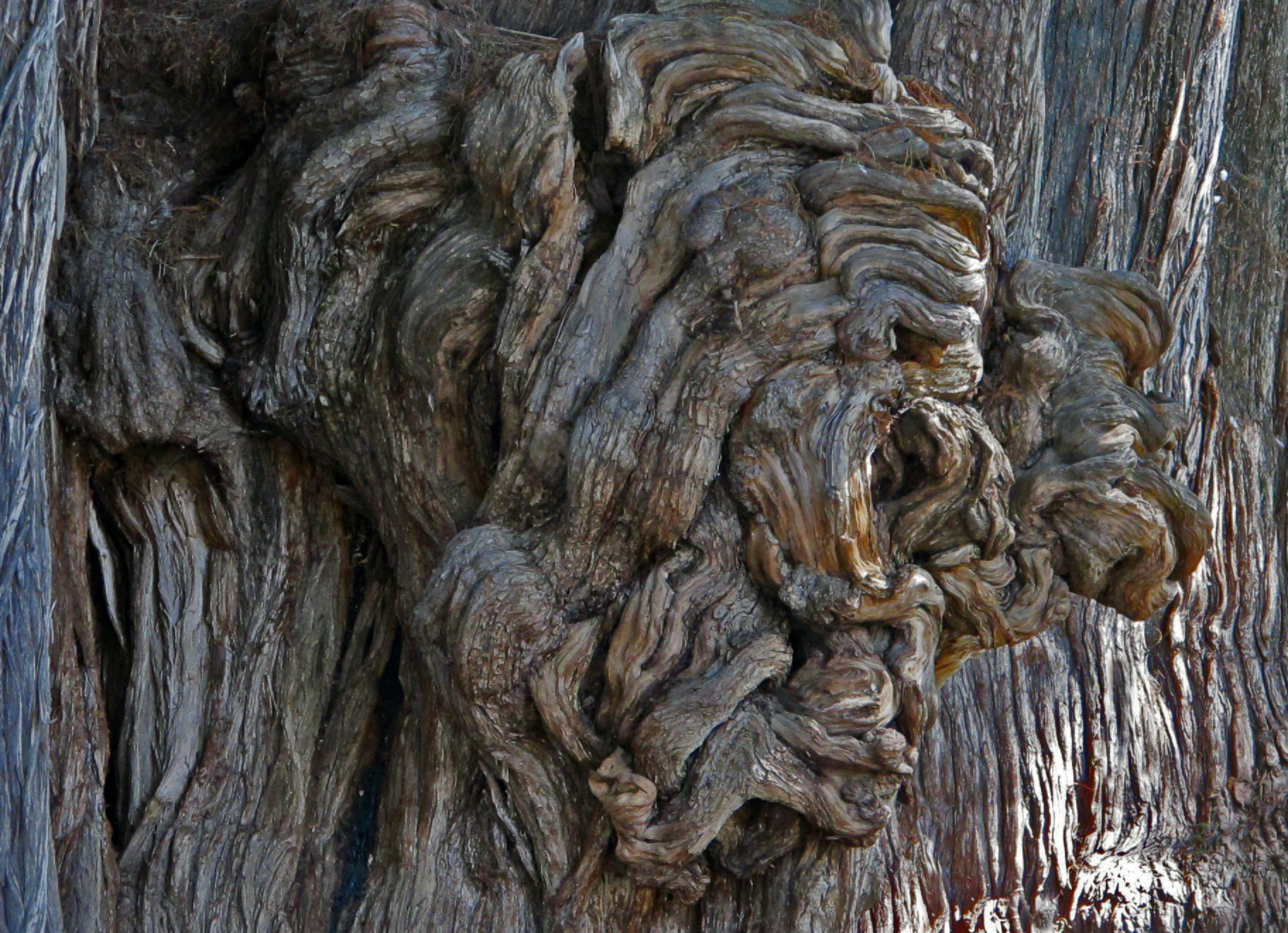
    The photo shows a knot more than five feet in diameter on the trunk of the ancient and enormous ahuehuete tree at the town Santa María de Tule.  The knots have names–they're called everything from 'the elephant' to 'Carlos Salinas's ears'.  At one time people believed that this behemoth was actually several trees, but it has been proven to be only one trunk measuring more than 30 feet in diameter. 

    What I once thought about Oaxaca has always been like at first sight, and second sight, and third, and so on.  It's been similar to going to the movies with a friend and then POW, out of the blue, right between the eyes, it's so long just friends, you're panting for a goodnight kiss.  

    Oaxaca Mercado 20 de noviembre Limpiando Frijol
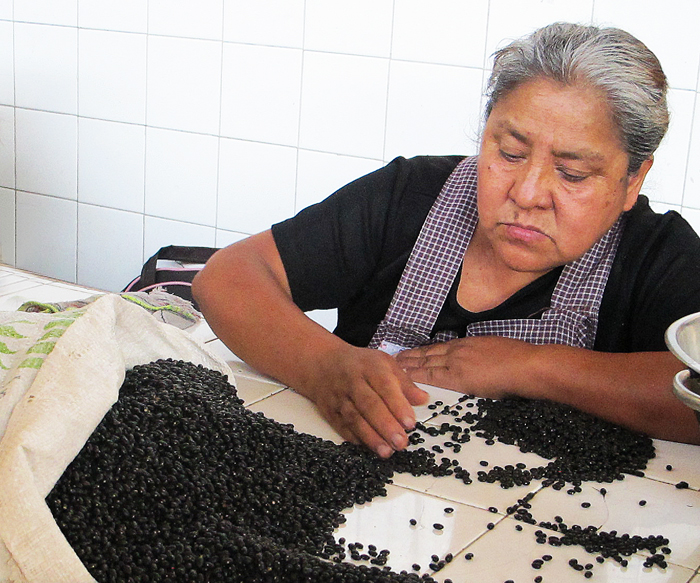
    This woman, who sells dried chiles, beans, and spices at Oaxaca's Mercado 20 de noviembre, is cleaning frijol (dried black beans).  You can see the white costal (large bag) at the left side of the photo.  She picks out as many stones and twigs as she can find, but once you get the beans home, you'll need to sort through them again.  Note: dried beans of any kind for sale in a market are called frijol.  Once you cook them, they are frijoles.

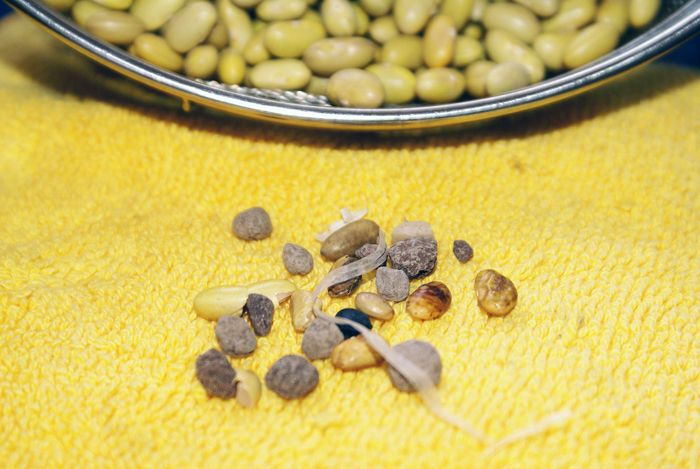
    Oaxaca Piedritas de Frijol
    These stones and pieces of debris are typical of what you might find in any kind of newly purchased beans, whether from a bag you bought at a supermarket or bulk beans from a market.  The beans in the photograph above are peruanos (so-called Peruvian beans).

    Oaxaca Chapulines
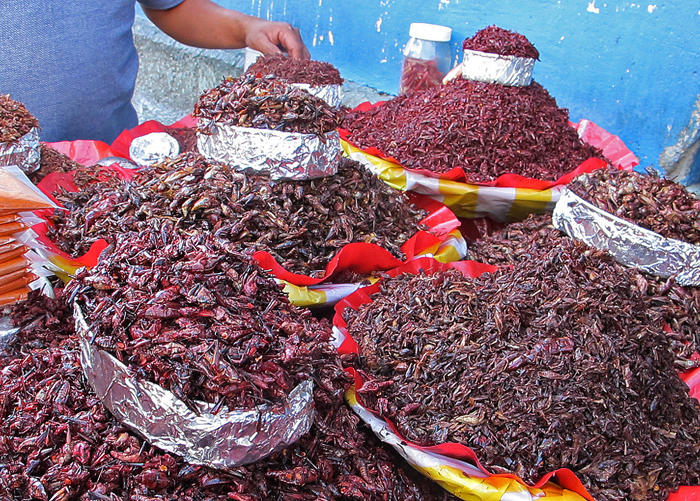
    This market stand is loaded with chapulines (grasshoppers), an iconic snack from Oaxaca.  Seasoned with garlic or chile, these are really delicious.  Mexico Cooks! prefers the tiny ones (at the top of the photo) to the larger sizes.

    What changed?  Not the city, surely.  Oaxaca is a timeless glory.  This trip, for reasons I can't explain, my heart and mind were entirely open to receive the city's gifts.  

    Oaxaca La Olla 3 Verduras
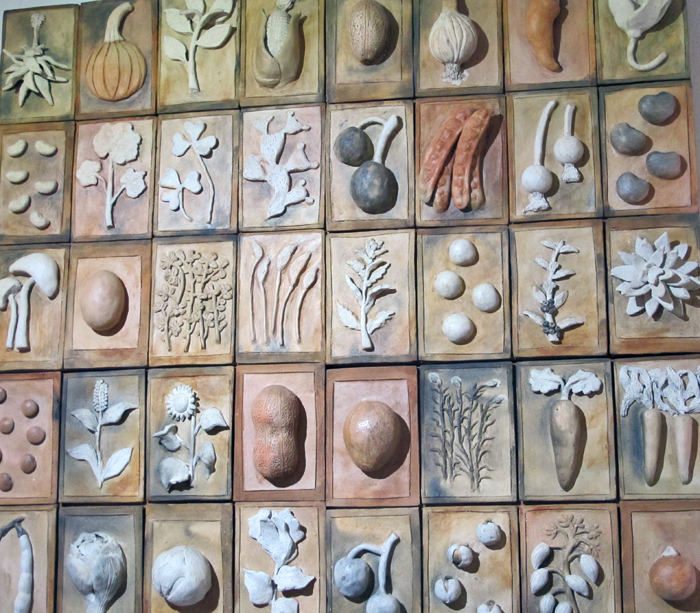
    Wall of bas relief vegetables at my friend Pilar Cabrera's Restaurante La Olla, Calle de la Reforma 402, Col. Centro.  

    Oaxaca Carne Asada Mercado 20 de noviembre 2
    One stand in the famous Pasillo del Humo(Hall of Smoke) of carne asada (grilled meat) at Mercado 20 de noviembre.  From the late afternoon moment that we saw this long hallway, lined as it was on both sides with carne asada stands and tables filled with ravenous carnivores, we knew this would be the spot for comida (Mexico's midday meal) the next afternoon. 

    Oaxaca Carne Asada Mercado 20 de noviembre
    Our basket of tender grilled beef, hot tortillas, and a spritely salad.  The side dishes we ordered–nopales, guacamole, grilled onions, the salad pictured above, and several others–disappeared just as fast as the kilo of carne asada and the pile of tortillas.  Three of us ate and drank our fill for just about $20.00 USD.

    Oaxaca La Teca Molotes de Plátano Macho
    One of my personal favorite Oaxaca restaurants is the Istmo de Tehuantepec's La Teca, owned by the marvelous Sra. Deyanira Aquino.  As part of another day's many-course main meal, friends and I shared these four molotes de plátano macho (small, sweetly ripe plantain croquettes) topped with crema de mesa (table cream) and queso fresco (fresh cheese), dividing the last one into smaller and smaller pieces so that one of us did not hog the whole thing–although each of us would have!

    Paletas en Celofán
    Paletas (in this case, lollipops) stand ready to welcome you to Oaxaca.  For me, just for today, these represent the sweetness, color, variety, and delight that Oaxaca have to offer.

    Come with me next week as we journey just outside the city of Oaxaca to make a new friend, a sister-soul of the cocina mexicana (the Mexican kitchen). I can't wait to introduce you; you'll love her just as much as I do.

    Looking for a tailored-to-your-interests specialized tour in Mexico? Click here: Tours.