Category: Food and Drink

  • What’s the Real Story on Mexico’s Mealtimes? Cena (Supper) at the End of Day.

    DF Camotero 1
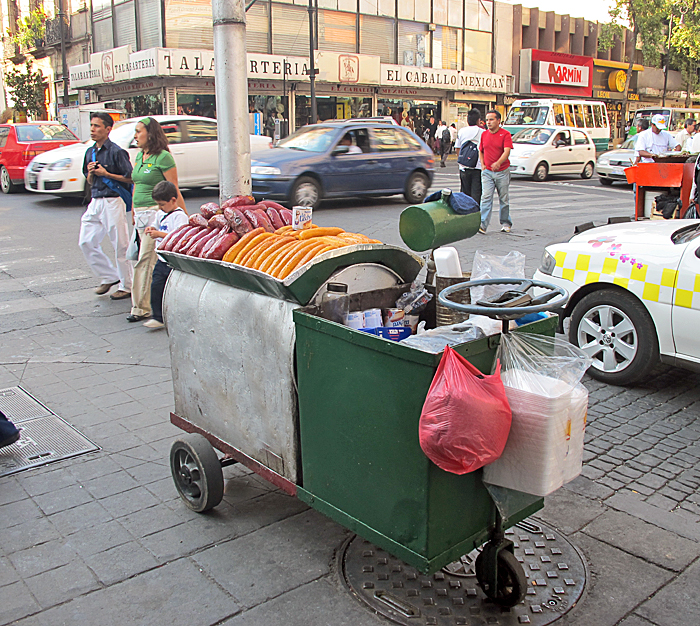
    The man who operates this cart in Mexico City's Centro Histórico (Historic Center) wheels his baked plátanos y camotes (bananas and sweet potatoes) around during the day.  In residential areas, when downtown businesses are closed, you are most likely to hear the steam whistle's raucously loud and high-pitched TWEEEEEEEEEEET during mid-to-late evening hours. Each plateful is either a roasted banana or sweet potato dripping with sweetened condensed milk.  Click to enlarge the photo for a better look at the front of the vehicle, where the bananas and sweet potatoes are kept warm over the cart's firebox.

    Cena (supper) in Mexico is a mixed bag.  For an ordinary cena at home, it's a tiny meal: a cup of hot chocolate or hot milk, a pan dulce (sweet bread), or a quick taco made with what's left over from comida (the main meal of the day).  Comida being the large meal that it usually is, cena is meant only to tide you over from just before bedtime till early the next morning.

    Rose Tacos al Pastor
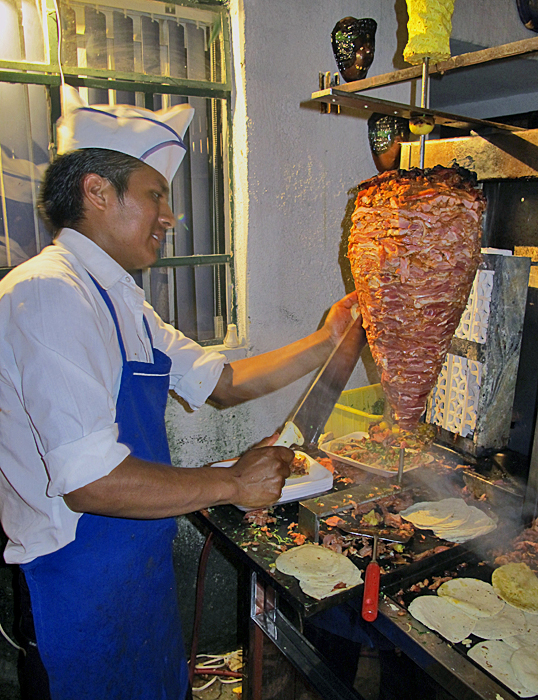
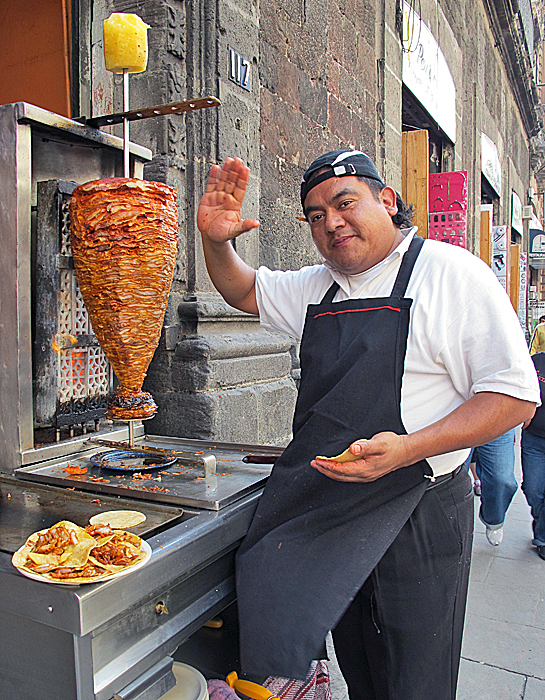
    If you're out partying till the wee hours, a few tacos al pastor (shepherd-style marinated pork tacos) on the street might be just the ticket for your cena.  Note the whole pineapple at the top of the trompo (vertical spit).  The pineapple cooks along with the meat–see the gas grate behind the cone of meat?–and the taquero (taco cook) tosses a few small sweet slices into your grill-warmed tortilla.  Top with red or green salsa, a pinch of sea salt, and a shower of minced onion and cilantro for a taste of heaven.

    Encuentro Buñuelos
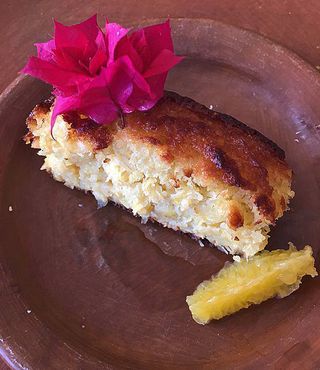
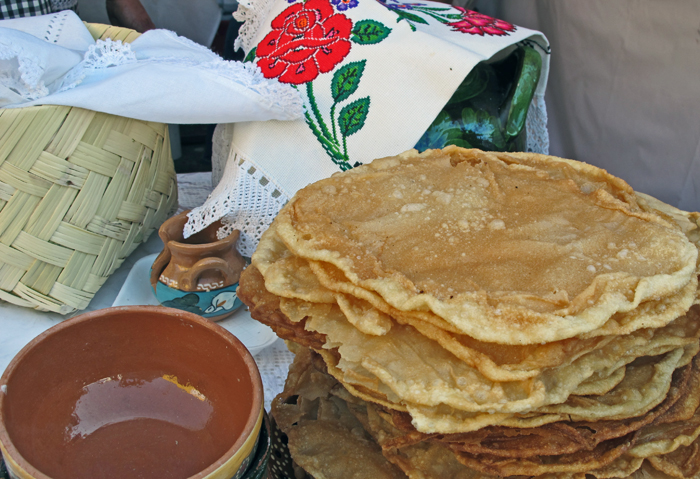
    Buñuelos are another favorite food for cena, either eaten at a cenaduría (supper spot) or purchased from a street vendor.  Some people still make them at home–the dough is very similar to that of a wheat flour tortilla, stretched over the round bottom of a clay pot till thin.  Traditionally, the dough is stretched over the maker's knee to achieve each buñuelo's large size and round shape!  They are usually served either whole and dusted with granulated sugar or broken into pieces in a bowl and drizzled with piloncillo (brown sugar) syrup.

    Conchas
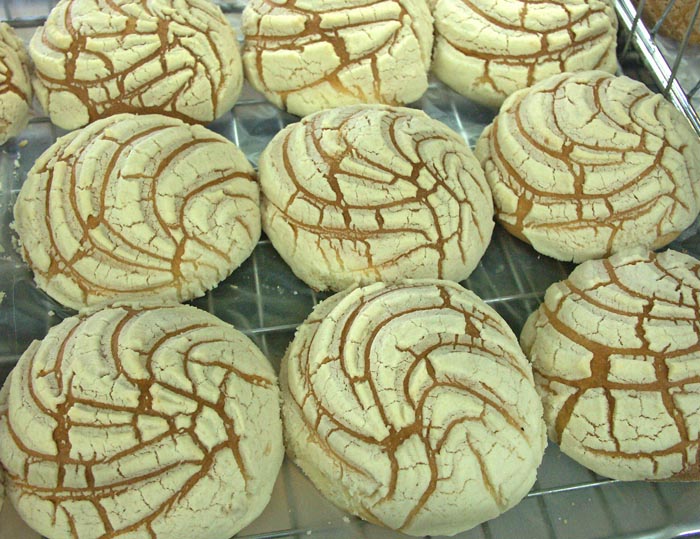
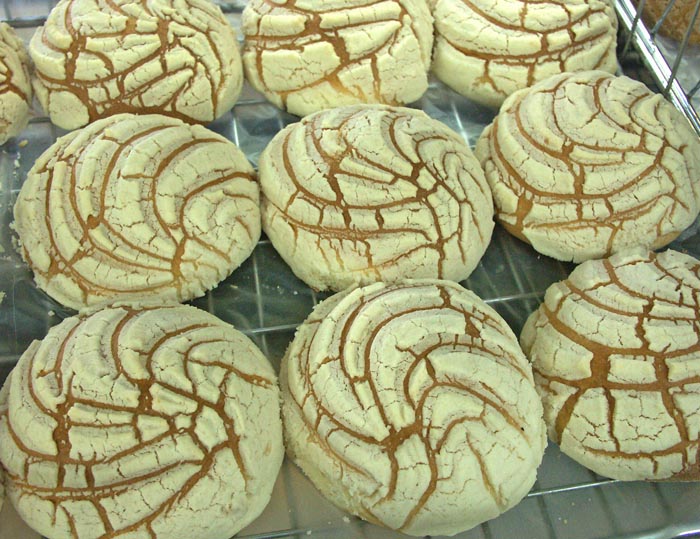
    Conchas (pan dulce), reposted from the breakfast article: food for cena is often the same food we eat for desayuno.

    Just as an aside: in addition to cena, some people in Mexico still partake of merienda, a light snack that can come sometime between comida and cena.  This 'light snack' can be as simple as a couple of cookies and a cup of té de manzanilla (chamomile tea) or it can be a more complex offering similar to an English tea.  Mexico Cooks! will leave the question of how to find stomach room for merienda up to you.

    Atole de Grano en Cazo
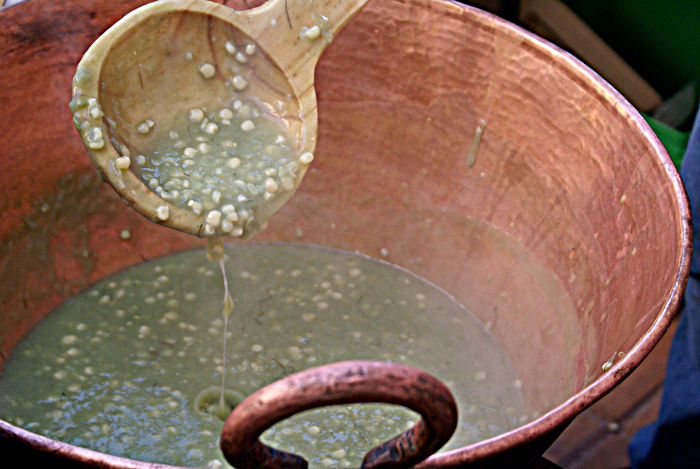
    Not all food eaten for cena is sweet.  Case in point: this Pátzcuaro, Michoacán specialty is atole de grano, a savory corn soup that's colored and flavored with anise.  In the evening, two women sell this heavenly soup on Pátzcuaro's small plaza.  Let's go right now!

    Rosewood Hotel SMA
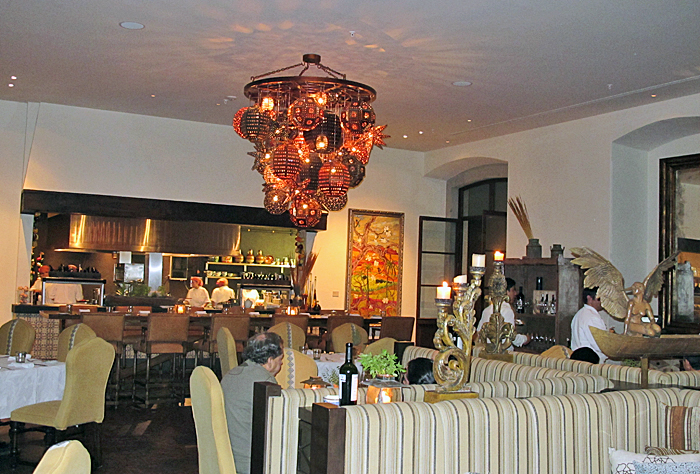
    The 1826 Restaurant at the Rosewood Hotel in San Miguel de Allende, Guanajuato, is an enticing spot for cena whether it's a romantic evening for you and your main squeeze or whether you are supping with a group of friends.

    Cynthia Mesa de Cerca
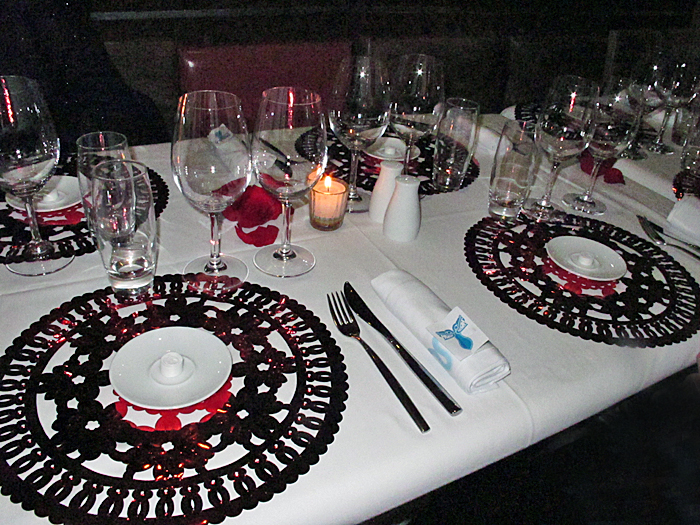
    Several years ago, Mexico Cooks! and a group of friends attended a gala Valentine's Day cena at Restaurante Los Danzantes in Coyoacán, Mexico City.  The dinner was presented by Cynthia Martínez and a team from Restaurante San Miguelito of Morelia, Michoacán.

    If you are invited to a cena baile (dinner dance) or a cena de gala (black tie dinner)at a restaurant, events center, or private home, your hosts will pull out all the stops.  Champagne, beautiful entradas (appetizers), a superb multi-course meal, snazzy dessert, alcoholic beverages and music are de rigeur.

    JASO Mexico Cooks! Research
    Mexico Cooks! researches possibilities for an elegant cena at Restaurante JASO, Colonia Polanco, Mexico City.  It's a tough job, but somebody has to do it.  

    Cristina Cena de Gala Aquiles Cha?vez
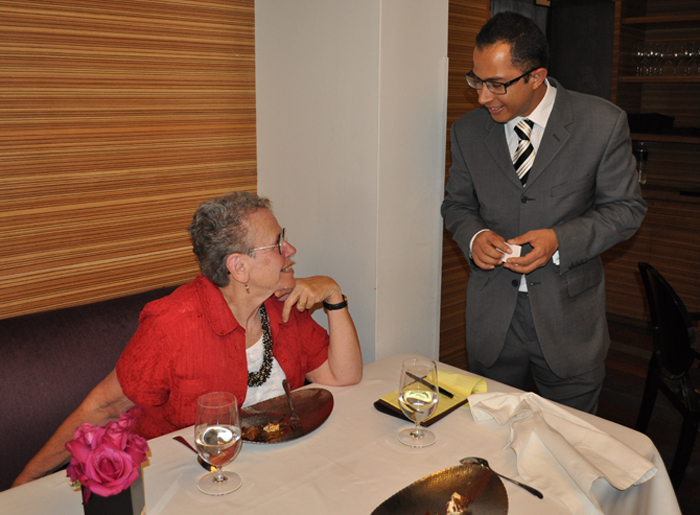
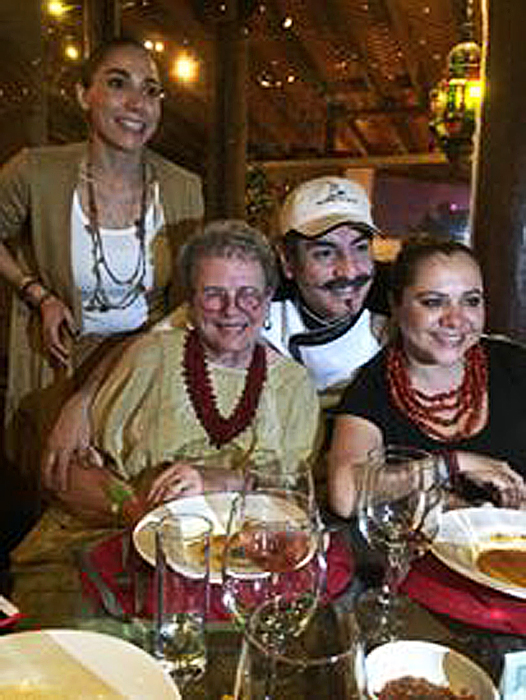
    Expect to gussy up in your elegant best when you are out for a special cena.  From left to right: (standing) Lucero García, (seated) Mexico Cooks!, fabulous and celebrated chef Aquiles Chávez, and Aliz Reyes at a superb and festive cena in Morelia, in honor of Diana Kennedy.

    From street tacos to stilettos and tuxedos, cena in Mexico will keep you going till morning.  Provecho!

    Looking for a tailored-to-your-interests specialized tour in Mexico? Click here: Tours.

  • What’s the Real Story on Mexico’s Mealtimes? It’s Time for Comida, Mexico’s Main Meal of the Day

    Entrada
    A stylized modern entrada (appetizer), served at Restaurante Quintonil in Mexico City.  

    Mexico's main meal of the day is comida, which is eaten sometime between two and five o'clock in the afternoon.  Prime time for comida is three o'clock; in many places all over the República, businesses still respect the old-time rule that closes business doors during mid-afternoon meal time.  In fact, unless the business mentions that it observes horario corrido (continuous work day) you can assume that from two until at least four in the afternoon, its doors are closed to business.  Its workday is from 10:00AM to 2:00PM and from 4:00PM to 8:00PM.

    Azul Histórico 5 Crema de Cilantro
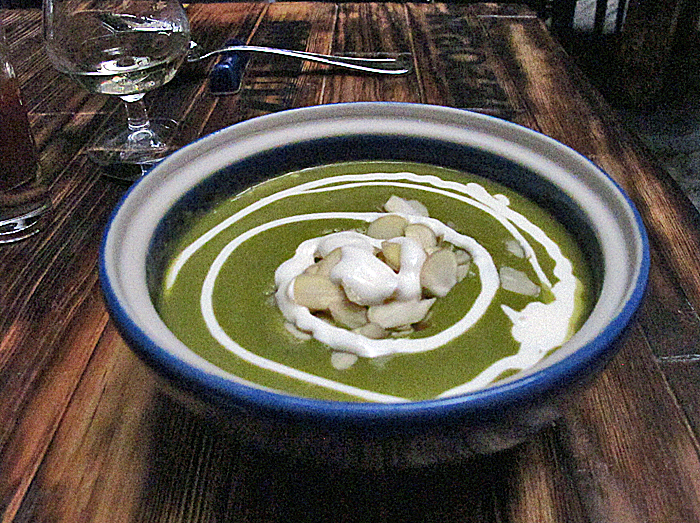
    Crema de cilantro (cream of cilantro soup).  The soup course comes after the entrada. Soups include caldos (broths), consomés (clear soups), cremas (creamed soups), and other styles of sopa aguada–liquid soup.

    In cities and towns all over Mexico, you'll find fondas, comida económica, and comida corrida restaurants.  All of these small, usually family-run restaurants specialize in full meals that stoke your furnace for the rest of your workday and beyond.  In addition, in many cities there are high-end restaurants that specialize in comidas for professional and business lunches, others that are designed for the ladies-who-lunch trade, and still other, family-style restaurants that invite everyone from the oldest great-grandpa to the newest newborn to enjoy time together.

    Amecameca Ensaladas Varias
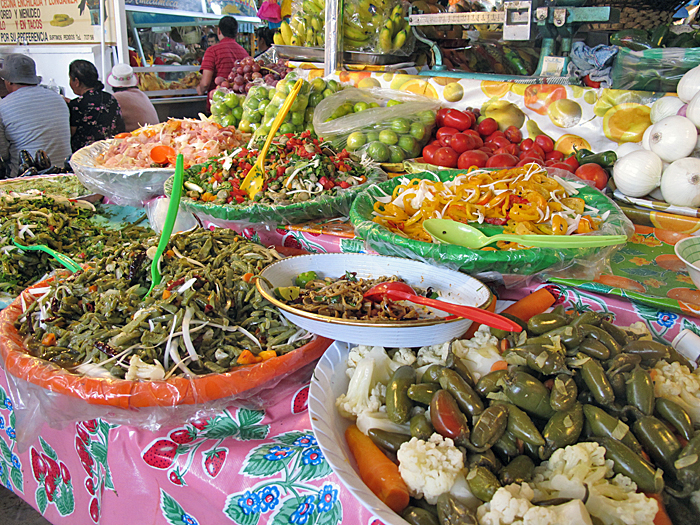
    A variety of prepared salads for sale in a market.  Sold by the kilo or portion of a kilo, these salads are meant to be taken home and eaten along with your comida.

    Encuentro Mole con Pollo
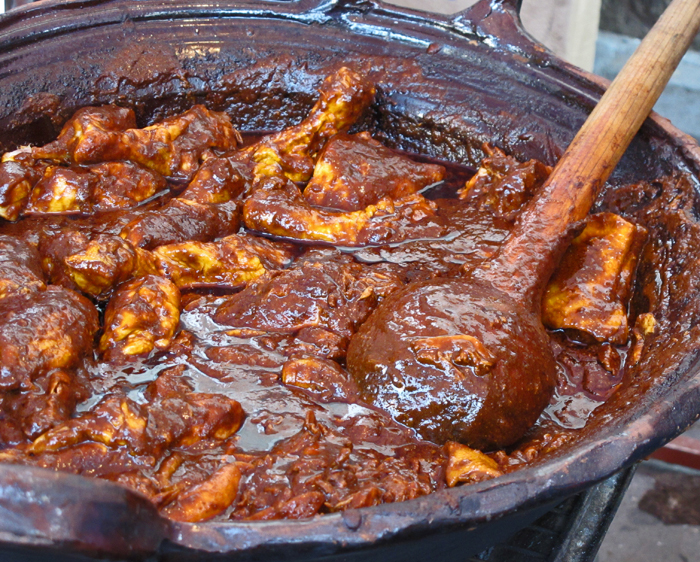
    Mexico's signature mole con pollo (mole with chicken) is popular for the platillo fuerte (main dish) at a comida, whether served at home or in a restaurant.  Many regions of the country have special mole recipes; some, like those found in Puebla or Oaxaca, are very well known.  Others, especially some from the state of Michoacán, are less well known but equally delicious.

    Albóndigas en el Plato
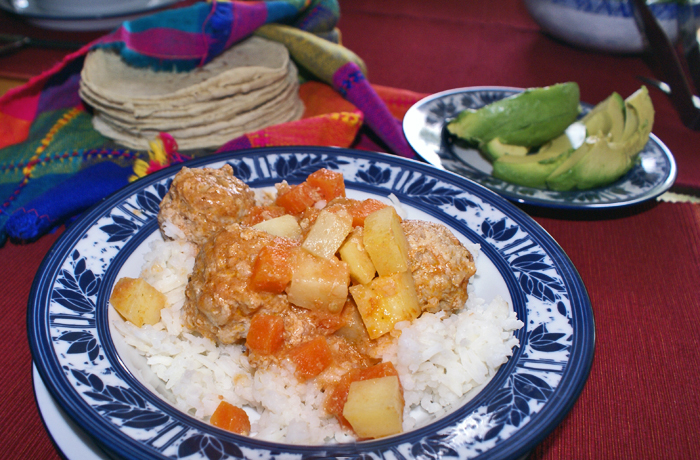
    These Jalisco-style albóndigas (meatballs) are traditional and typically served as a platillo fuerte for comida, along with their delicious sauce, a big helping of steamed white rice, a garnish of avocado, and a tall stack of tortillas.

    Many soon-to-be-visitors to Mexico write to me saying something like this: "I want to plan for breakfast in the hotel and a meal in such-and-such a restaurant at lunchtime.  Then we want to go for dinner at such-and-such restaurant."  Unless you are a professional eater–and I know that some of you are!–it's difficult to fit all of that food into one day, given the times of day that meals are usually eaten here.  If your breakfast is included in the cost of your hotel or B&B, many of the available dishes will look like those featured here last week.  They're very, very filling.  Just a few hours later, it's time for comida, an even more filling meal when eaten in a restaurant.  

    Carne y Salsa Listo para Hornear
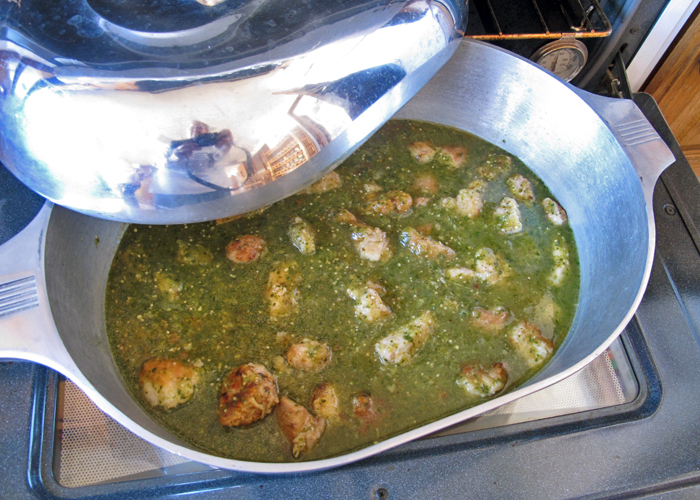
    Carne de cerdo en salsa verde (pork in green sauce) is a typical home-style dish (in this instance, just being put into the Mexico Cooks! oven) often served for comida.  Of course it is preceded by an appetizer, a soup, and perhaps a salad; it's accompanied by red or white rice, refried beans, and a stack of tortillas–and followed by dessert!

    Torta Especial Los Cun?ados Aguascalientes con Chilpancingo 2
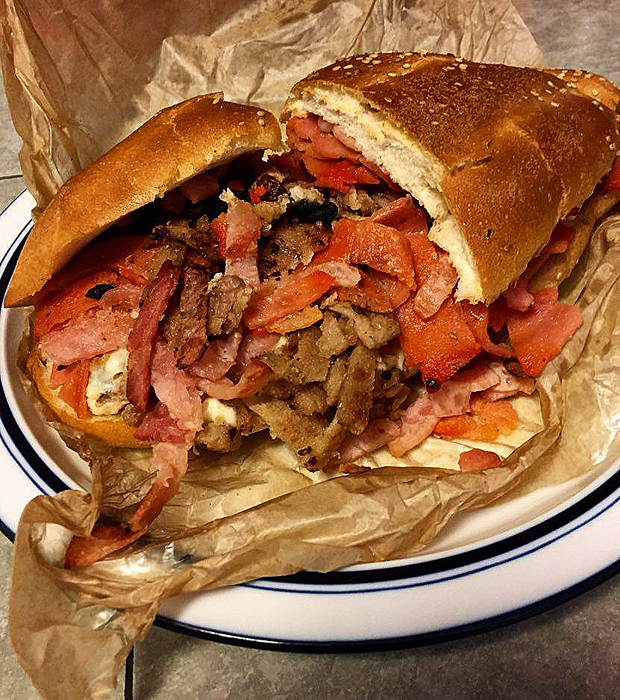
    The famous and enormous torta especial, from Tortas Los Cuñados, across the street from my home.  This torta is a multi-meat sandwich with cheese, garnished with lettuce, tomato, and pickled chiles jalapeños), served on a bread called telera.  The word telera means shuttle, because the bread is shaped like one.  This kind of delicious hot sandwich is neither lunch nor a complete comida

    "Lunch" as it is eaten in the United States or elsewhere does not exist in Mexico.  You might see a restaurant sign reading "LONCHERÍA", but it refers to a kind of cold sandwich, known as a 'lonche', not to a place where you can have lunch.  A lonche can be eaten at any old time–between meals, instead of meals, before or after a movie, and so on.

    Carnitas
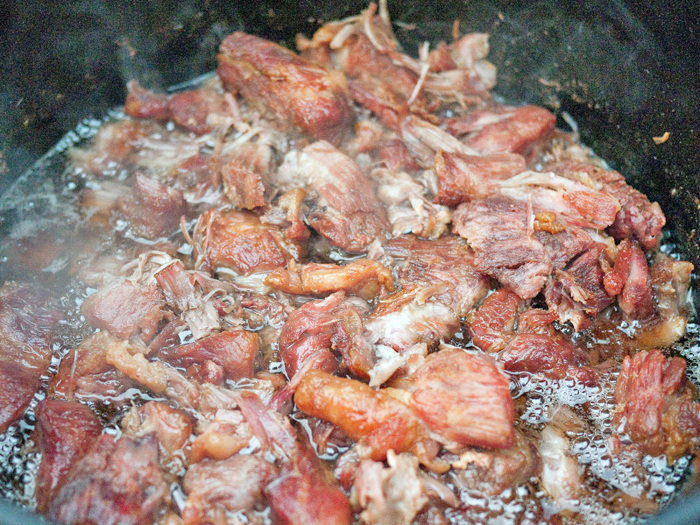
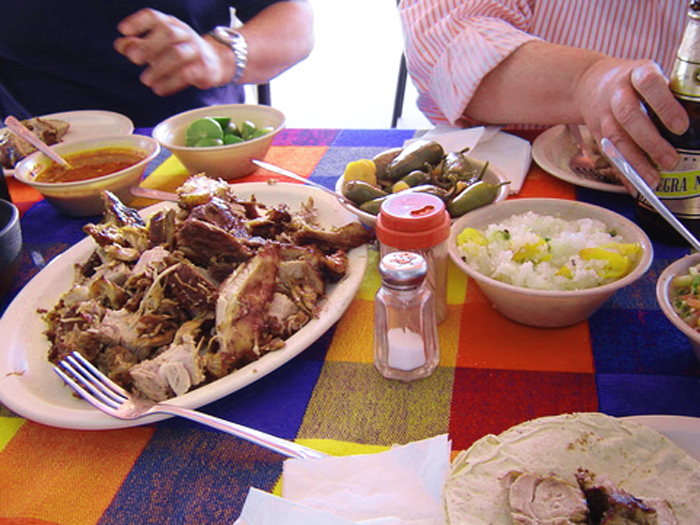
    This is a boiling pot of Michoacán carnitas–huge chunks of lean pork, boiled in freshly rendered lard until the pork is fork-tender with crisp, chewy outsides.  Coarsely chopped and served by the platter, ready to stuff into hot-off-the-fire tortillas and top with minced onions, chopped cilantro, super-spicy salsa, a sprinkle of sea salt and a squeeze of lime, carnitas can be a rustic and delicious comida all on their own.

    Muertos Taco Carnitas
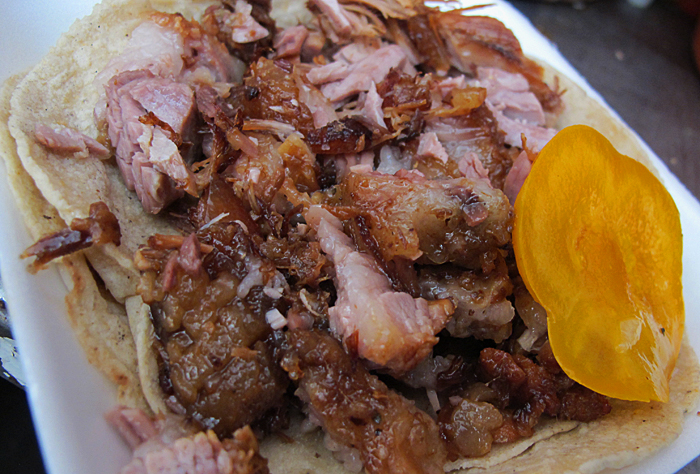
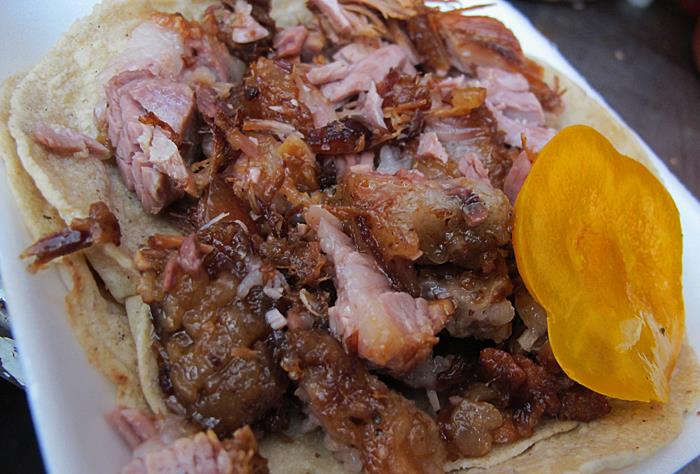
    Here are those same carnitas, in a taco.  On the side is a slice of pickled chile manzano, hot as Hades but much more delicious.

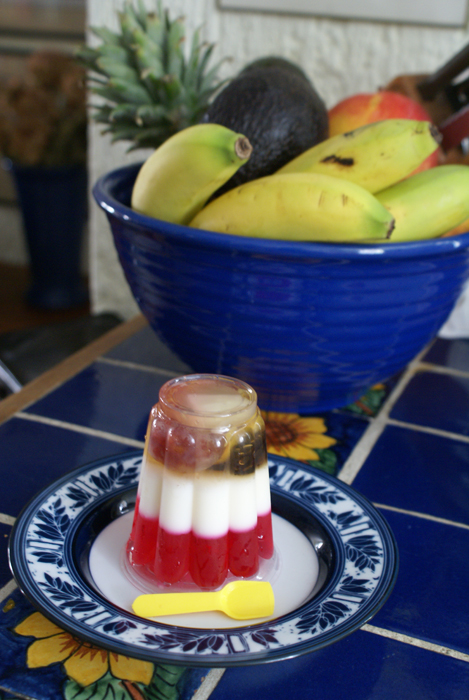
    Gelatina Pinar
    Gelatina is a common light dessert following a heavy comida

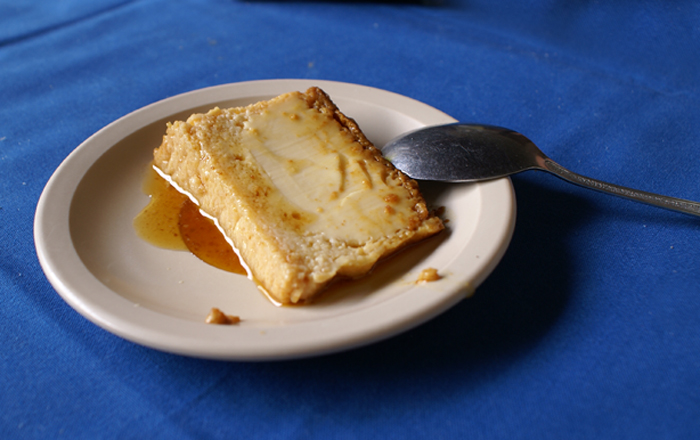
    Flan Napolitano
    On the other hand, you will almost always have room for a slice of old-fashioned creamy flan.

    Next week, we finish our day of Mexico's meals with cena–supper!

    Looking for a tailored-to-your-interests specialized tour in Mexico? Click here: Tours.

  • What’s the Real Story on Mexico’s Mealtimes? First, Let’s Have Desayuno (Breakfast)

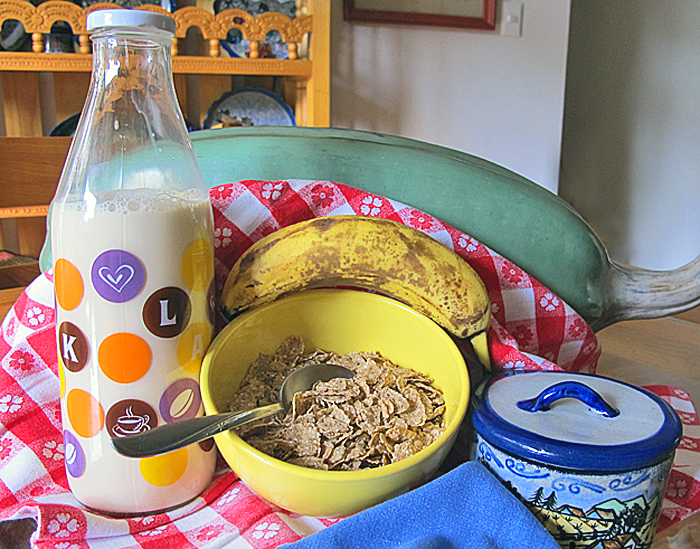
    Classic American Breakfast Cold Cereal
    A classic quick breakfast in the USA, circa 1950s: cold unsweetened cereal with milk and sugar, plus a banana.

    Several times a month, Mexico Cooks! receives vacation-time queries from folks in the United States about mealtimes and what's eaten when in Mexico.  It can be challenging to plan a trip to any country, including Mexico, where mealtimes are different from what you might think of as 'normal'.  This week and for the next two weeks here at Mexico Cooks!, you'll learn more about meals and mealtimes.  

    Conchas
    In Mexico, a huge variety of pan dulce (sweet bread) is available for breakfast.  These are conchas (shells), so-called because of the design impressed into their sugared tops. Have your pan dulce with either hot chocolate, coffee, or a steaming cup of atole (a corn-based hot beverage).

    It can be even more challenging for anyone raised in one frame of reference to understand that breakfast isn't always about what you have always thought of as your first meal of the day.  Many years ago, when I was first living in Mexico, the light bulb came on for me: breakfast food is whatever you happen to eat for breakfast.  You know how leftover pizza straight from the refrigerator is a guilty breakfast for a lot of people in the States?  A slice is really a perfectly adequate breakfast.  Lots of Mexican breakfasts are just like that: whatever food is available at the moment.

    Susana's Corunda, Pátzcuaro
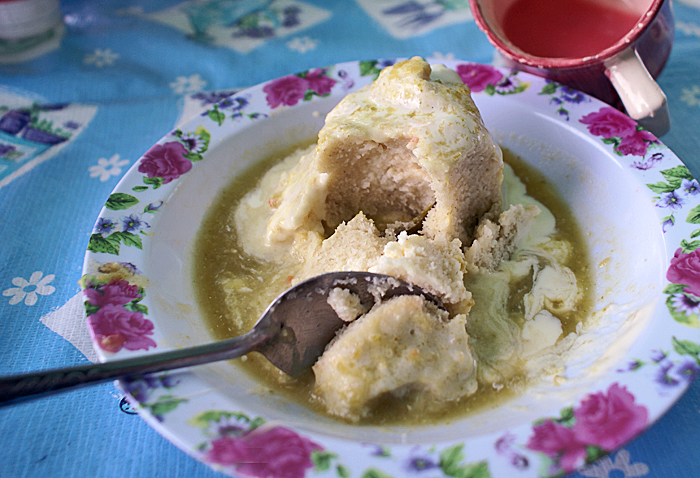
    The corunda is a regional tamal from Michoacán.  This corunda, filled with cream cheese and topped with Mexican table cream and a sauce made of chile perón (a Michoacán-grown chile), makes a great desayuno when accompanied by a cup of hot atole de zarzamora (a corn-based hot drink).

    People in Mexico frequently eat two morning meals. The first is desayuno, which comes from the root word ayunar, to fast.  Desayuno literally means "I un-fast" and is ordinarily eaten first thing in the morning, maybe before work while you are standing in the pre-dawn kitchen thinking about the coming day on the job or gobbled while you are hurrying the kids into their school uniforms.  This breakfast consists of something quick and simple, or a smear of yesterday's frijolitos refritos on a leftover tortilla, washed down with a glass of fresh orange juice; a pan dulce still hot from the corner bakery, accompanied by a cup of Nescafé (Mexico's ubiquitous instant coffee).  It's just enough to help your brain kick into gear.

    Calabaza Lista Pa'Comer
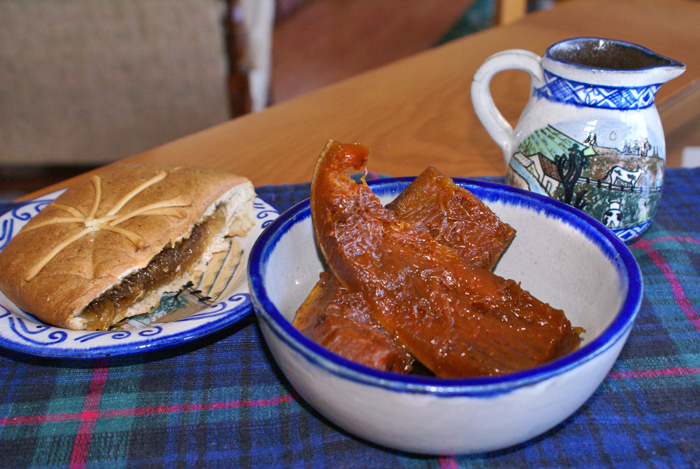
    This Mexico Cooks! desayuno includes home-made calabaza en tacha bathed in hot milk plus a slice of pan relleno con chilacayote (bread filled with sweetened chilacayote squash paste), served with fresh juice or coffee.

    Molletes
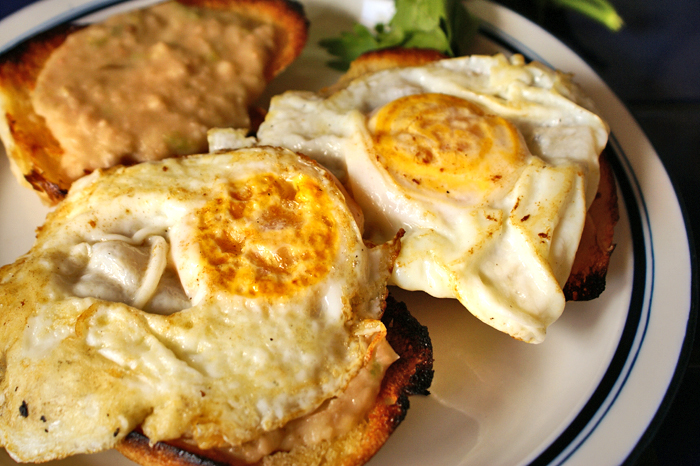
    At home, Mexico Cooks! occasionally prepares molletes, an old-time family favorite.  I grill a bolillo (a dense-textured and crusty white bread roll), add a thick smear of chile-spiced refried beans, and top them with huevos volteados (over-easy eggs).  With some salsa cruda (home-made fresh salsa) a fresh fruit accompaniment, this almuerzo is really stick-to-your-ribs.

    Around 10.30 or eleven o'clock in the morning, when the stomach starts to require something more substantial to keep the body going, many people take a break for almuerzo.  There really is no adequate word in English for this meal.  It's not breakfast and it's not a snack.  Almuerzo is typically a larger meal than desayuno.  Workers on a construction job, for example, often stop work, build a little fire, and heat up yesterday's leftovers that they've brought along in a 'tupper'–the generic word in Mexico for a covered plastic container.  Warmed-up leftovers, a stack of tortillas, and a fresh-made pot of coffee keep the girders going up. 

    El Portalito Enchiladas Verdes Abiertas
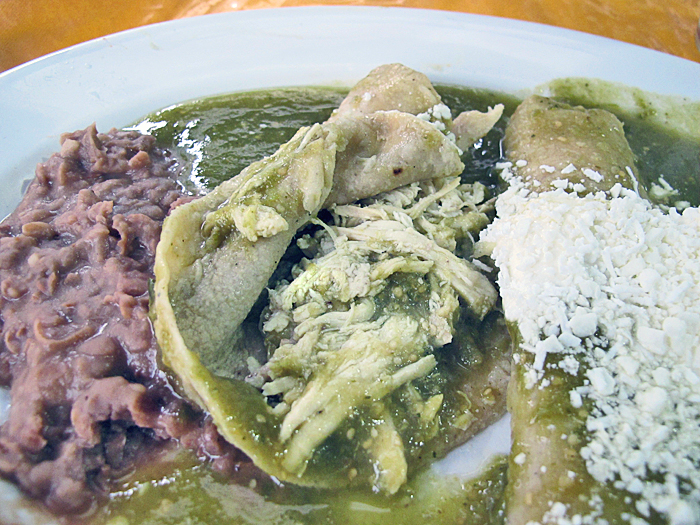
    Another really hearty almuerzo: a plateful of enchiladas verdes con pollo deshebrado (enchiladas with shredded chicken in green sauce) topped with finely grated white cheese and minced onion, accompanied by a guarnición (side) of refried beans.

    Pátzcuaro Breakfast
    Here's another typical almuerzo in Mexico: chilaquiles verdes (fried tortilla strips simmered in green sauce), topped with grated white cheese and thinly sliced white onions, then crowned with huevos a gusto (eggs however you like them).  Add a side of frijolitos refritos, a plate of ripe papaya, a warm-from-the-oven bolillo, either salsa or butter for the bread, and a great cappuchino, all served on a sunny terrace.  Heaven…

    Next week, next meal!  We'll save your place at the table. 

    Looking for a tailored-to-your-interests specialized tour in Mexico? Click here: Tours.

  • Down Memory Lane: Doña Yola’s Albóndigas de Pollo (Chicken Meatballs) en Salsa Verde

    Doña Yola la Chef
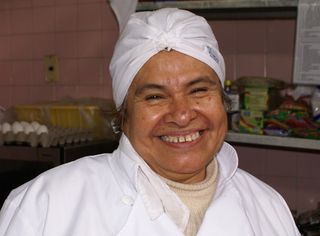
    Several years ago, Mexico Cooks! was thrilled to meet doña Yolanda Rodríguez Orozco.  At the time, she was working at a now-defunct buffet restaurant in Morelia, Michoacán.  In Mexico, 'doña' is an honorific indicating true respect for a woman (it's don for a man).  Affectionately known to one and all as doña Yola, she cooked with tremendous love as the primary seasoning for whatever she put on the table.

    One of the most delicious items on the menu at that restaurant was Albóndigas de Pollo en Salsa Verde (chicken meatballs in green sauce).  Because I promised that I would share the recipe with all of you, Doña Yola graciously shared her amazingly easy recipe with me.  Simple to prepare and marvelous to taste, these meatballs instantly made it to star status on our dining table.

    Pechuga de Pollo Molida
    A chicken vendor grinds fresh chicken breast to order at the weekly tianguis (street market) in our neighborhood.  You can ask the butcher at your supermarket to grind the breasts for you.

    Espinacas
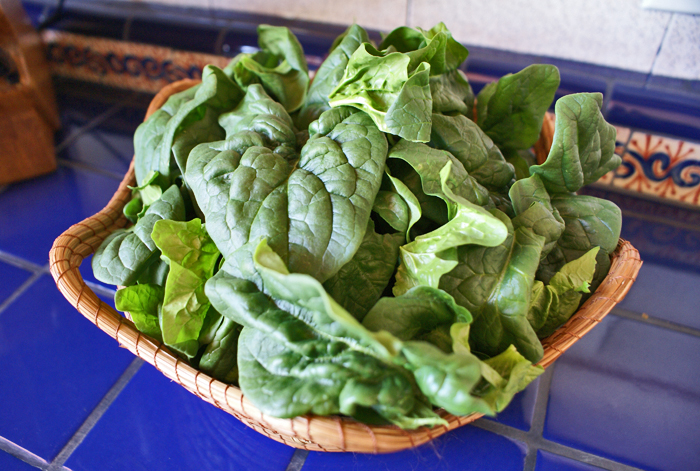
    Gorgeous dark green vitamin-rich spinach, ready to chop for the albóndigas.

    Hierbabuena con Huevos
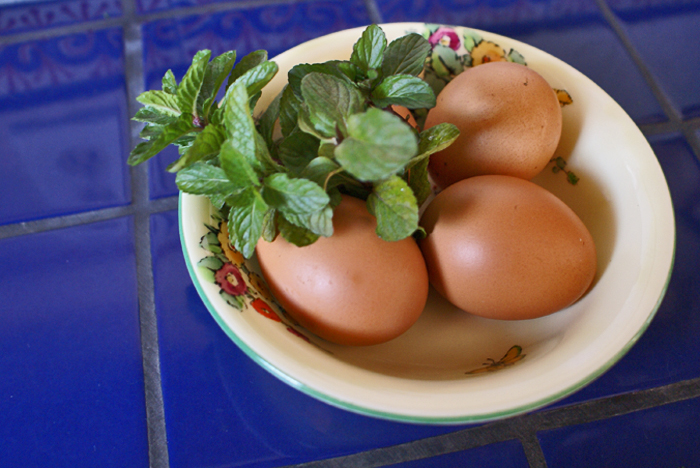
    Fresh mint grown in a pot on our terrace or available at any market, along with beautiful fresh local eggs.

    Albóndigas de Pollo en Salsa Verde Estilo Doña Yola
    Chicken Meatballs in Green Salsa, Doña Yola's Way

    Ingredients for the meatballs
    1 kilo (2.2 lbs) freshly ground chicken breast
    100 grams (1/4 lb) raw fresh spinach (stems removed), finely chopped
    1 small white onion, finely minced
    1 clove garlic, finely minced
    1 Tbsp fresh mint, finely minced
    1 chile serrano, finely minced
    1/2 cup cooked white rice
    3 eggs, lightly beaten
    1 Tbsp Worcestershire sauce
    Sea salt to taste
    Freshly ground pepper to taste
    1 tsp cornstarch or as needed

    Mezcla
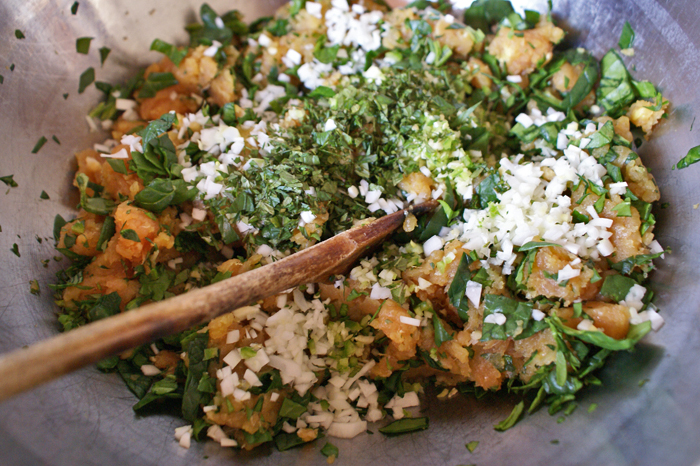
    Ground chicken, spinach, onion, garlic, mint, and chile serrano, ready to mix with cooked rice.

    Procedure
    Lightly mix the first seven ingredients together.  Beat the eggs and Worcestershire sauce together and mix by hand into the mixture.  Add sea salt and ground black pepper to taste.  Add cornstarch until the mixture holds together well when you form a small amount into a ball.  Form the mixture into balls approximately 2" in diameter.  Makes 20 albóndigas.  Plate the meatballs in a single layer (Mexico Cooks! likes to re-use washed Styrofoam meat trays from the supermarket for holding the albóndigas), then cover and refrigerate until ready to cook.

    Tomate y Chile
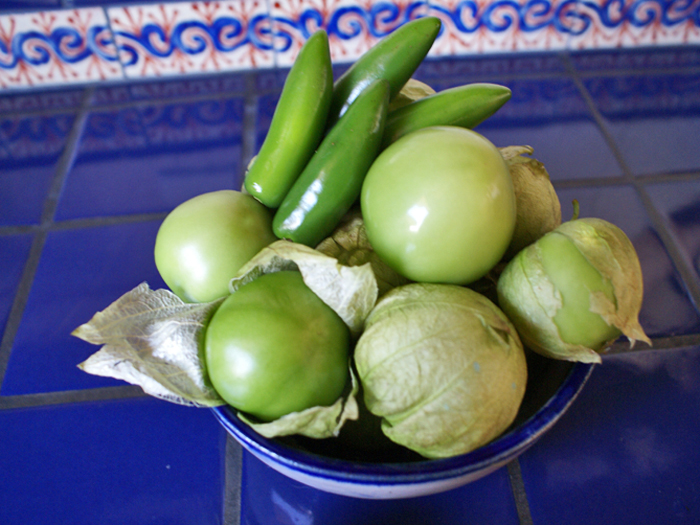
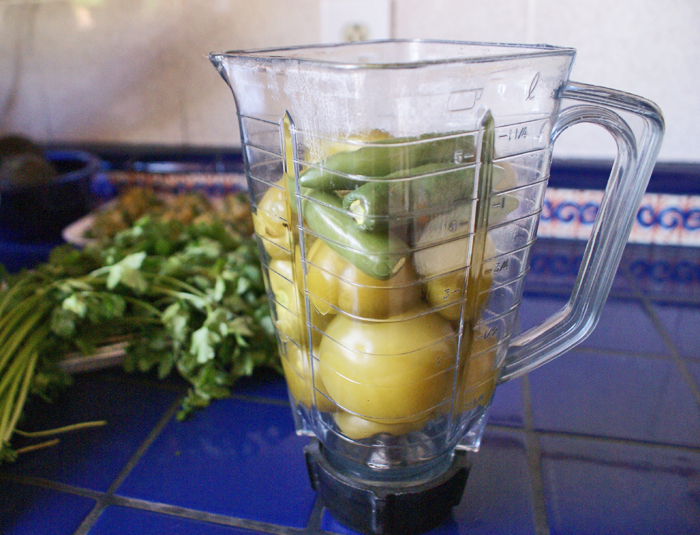
    Tomates verdes (tomatillos) and chiles serranos for preparing salsa verde.  Remove the tomatillos'  papery husks and wash the sticky tomatillos thoroughly.

    Ingredients for Salsa Verde
    10-12 tomatillos (known in Mexico as tomate verde), husks removed
    3 or 4 whole chiles serranos
    1 bunch fresh cilantro, largest stems removed
    Sea salt to taste

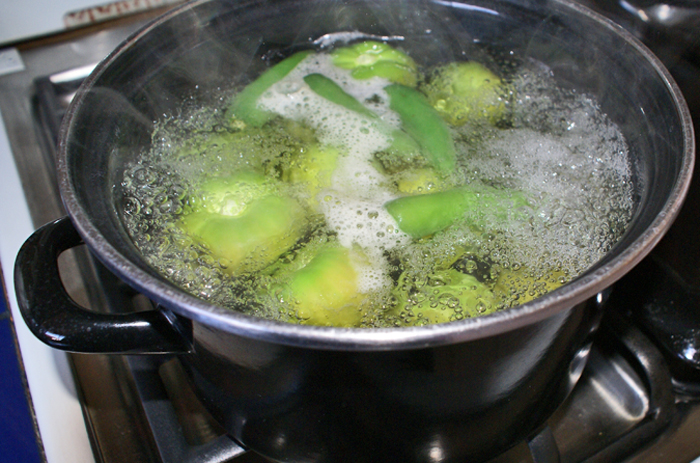
    Hervido

    Procedure
    In a large pot of water, bring the tomatillos and chiles to a full rolling boil.  Boil just until the tomatillos begin to crack; watch them closely or they will disintegrate in the water.

    Listo para Licuar
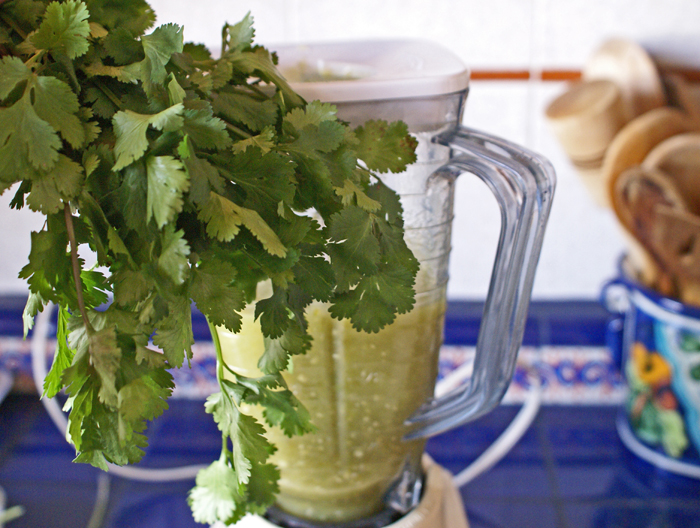
    Using a slotted spoon, scoop the cooked tomatillos and chiles into your blender jar.  There's no need to add liquid.  Cover, hold the blender cap on, and blend until smooth.  Be careful not to burn yourself, this is a hot mixture and tends to react like lava in the blender.

    Listo para Licuar 2
    While the blender is running, remove the center of its cap and, little by little, push the cilantro into the whizzing sauce.  Blend just until smooth; you should still see big flecks of dark green cilantro in the lighter green sauce.  Add sea salt to taste and stir.

    Ya en la Salsa
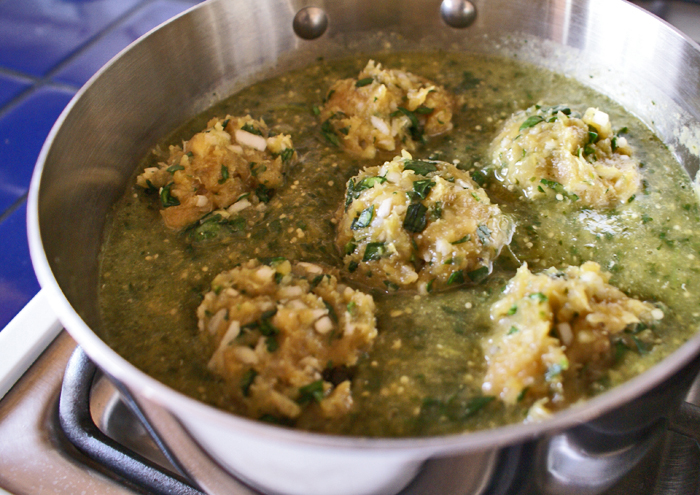
    Pour the salsa into a 2-quart pot.  Add the meatballs and bring to a simmer.  Cover and allow to simmer for about 30 minutes.  Mexico Cooks! prepared six meatballs for our comida (main meal of the day), but two meatballs apiece were plenty for the two of us.  We ate the leftovers (and another two meatballs) the following day.  We froze twelve raw meatballs without salsa for subsequent meals.

    Para dar Hambre
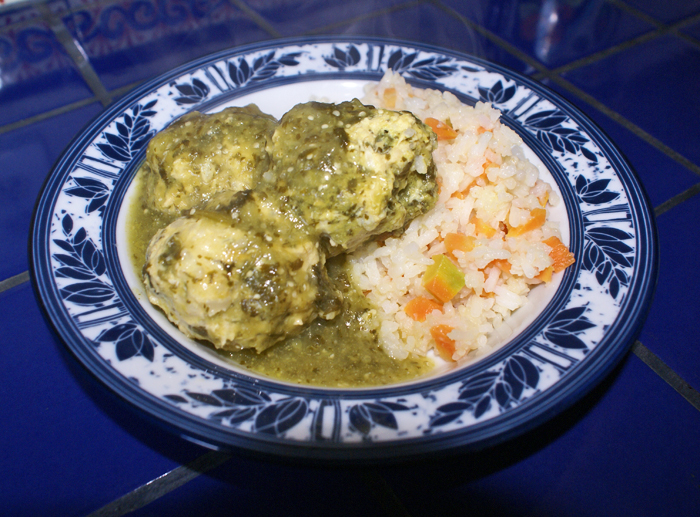
    Albóndigas de pollo en salsa verde, plated with white rice cooked with carrots, Mexican style.

    Mexico Cooks! is so grateful to doña Yola for sharing her recipe with us.  These albóndigas de pollo are not only easy to prepare and very healthy (with high vitamin K and beta carotene content and no added fat), but they are also absolutely delicious.

    Provecho!

    Looking for a tailored-to-your-interests specialized tour in Mexico? Click here: Tours.

  • Hog Heaven: Mexico’s Love Affair with Pork

    Azul Cochinita
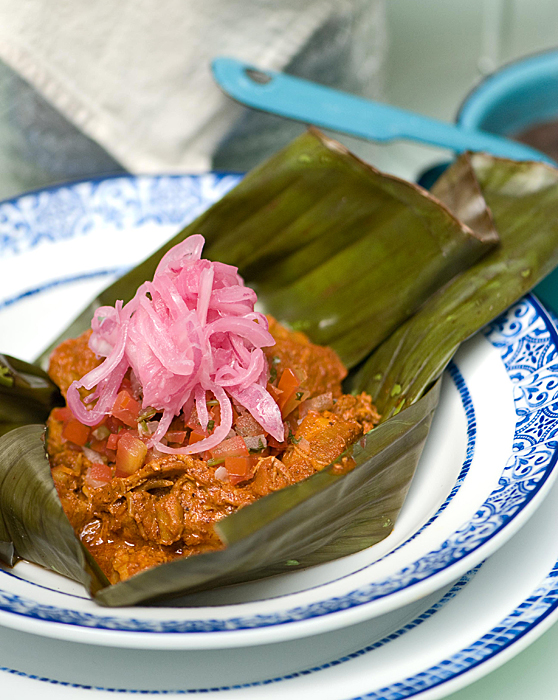
    Cochinita pibil from the Yucatán (seasoned pork, slow-cooked and then shredded), a specialty of Ricardo Muñoz Zurita's Restaurante Azul/Condesa.  Served in a banana leaf with a topping of pickled red onion, it's delicious.

    Mexico is one of the largest producers and consumers of pork in the world, second only to China.  In spite of the 'swine flu' crisis several years ago, Mexico continues to eat pork at a record-breaking pace and, every year, to export millions of tons of pork to other countries.  (FIRA

    Puercos en Camión
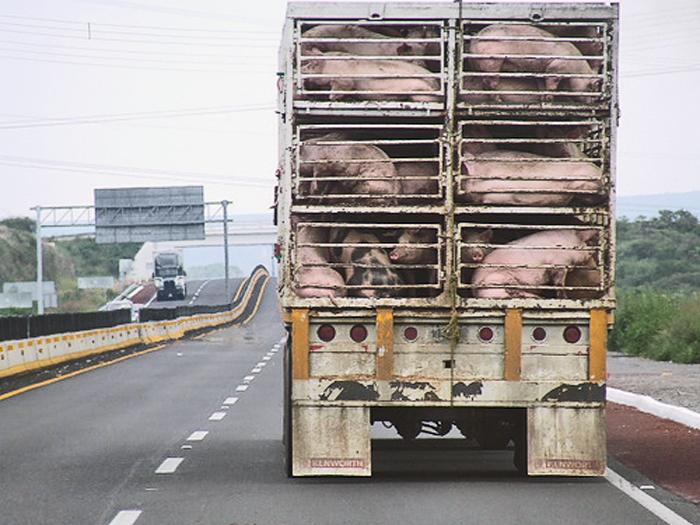
    From the growers' farms to a rastro (slaughterhouse) is a speedy ride along one of Mexico's super-highways.  A truck like this one, loaded with pigs, is an everyday sight throughout Mexico.  Photo courtesy ROTOV.

    Mexico is not nearly as squeamish as the United States in seeing where its carne de cerdo (pork meat) comes from.  In fact, a stroll through just about any city market or tianguis (street market) will give ample evidence that meat–including pork meat–comes from an animal, not from a sterile, platic-wrapped styrofoam meat tray at a supermarket.  

    Pig Head
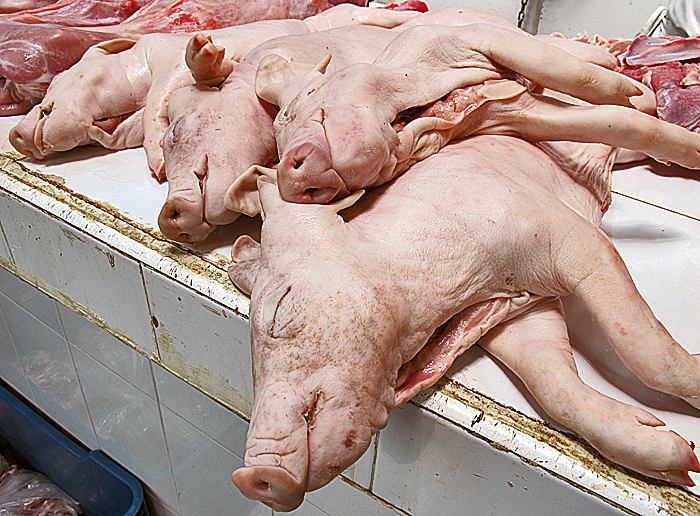
    Every part of the pig is used in Mexico's kitchens.  The head is ordinarily used to make pozole, a rich stew of pork meat, reconstituted dried corn, spices, and condiments.  

    No pork existed in Mexico until after the Spanish conquest; in fact, no domestic animals other than the xoloitzcuintle dog were used for food.  The sources of animal protein were fish, frogs, and other water creatures, wild Muscovy-type ducks, the javalí (wild boar), about 200 varieties of edible insects, doves and the turkey, all native to what is now Mexico.  

    Hog Heaven Pig Tails
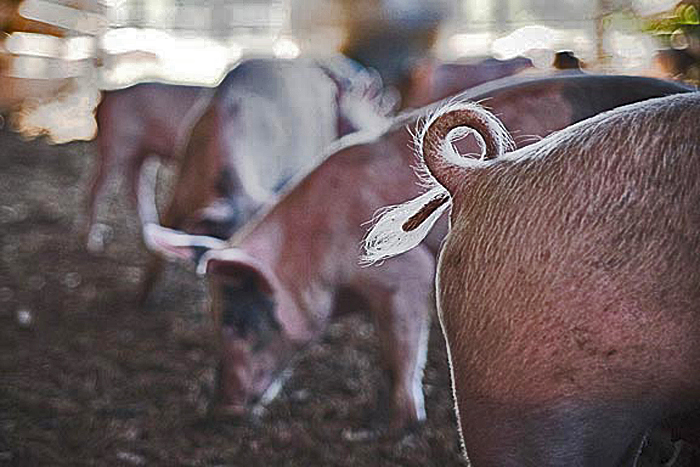
    Mexico has been cooking head-to-tail since long before that notion came into international vogue.  Pig tails are used here for roasting–look for recipes for rabo de cerdo asado (roast pig tail).  In addition, when a butcher is preparing pork carnitas, tails, ears, snouts, tongues, and indeed, everything but the squeal goes into the cazo (enormous cooking cauldron used to boil carnitas in lard).

    Quiroga Taco de Carnitas
    A carnitas taco from Quiroga, Michoacán.  

    Pig Mariachi Mercado de Jamaica August 2013
    No matter that just below these jolly mariachi pigs at Mexico City's Mercado de Jamaica, their once-live counterparts lie ready for the butcher's knife.  These fellows play on!

    Chicharrón 3
    Chicharrón (fried pig skin) is prepared fresh every day by butchers whose specialty is pork.  Nothing goes to waste. In fact, about 75% of the pig skins used to make chicharrón are imported to Mexico from the United States, where the market for pig skin is relatively small.

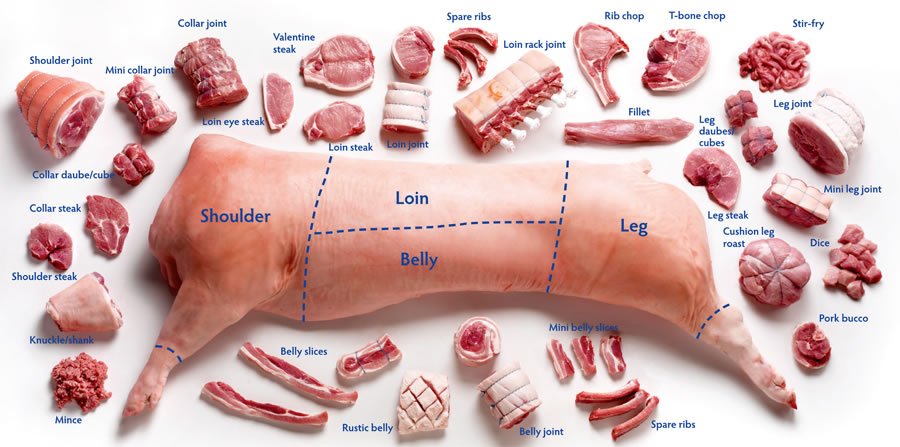
    Just about any Mexican butcher worth his stripes can custom-cut whatever portion of the pig you need for meal preparation.  In case you're not 100% familiar with the names of Mexican cuts, here are two pork cut charts, first in English and then in Spanish for comparison.

    Pork Cuts English
    Pork cuts chart in English.  Click to enlarge the image for better viewing.

    Pork Cuts Chart Spanish
    Pork cuts chart in Spanish.  Even in Spanish, many cuts have different names depending on which country names them.  Again, click to enlarge the image for a better view.

    Mercado SJ Lechón
    These suckling pigs were butchered at 6 weeks to 3 months old.  Known in Mexico as lechón, roast suckling pig is a delicacy by any name.  Many restaurants in Mexico specialize in its preparation.

    Tacos al Pastor Calle Uruguay DF
    One of the most common and popular (and really delicious) kinds of street tacos is tacos al pastor (shepherd style tacos).  This preparation comes from Mexico City.  Marinate thinly sliced pork meat in a sauce made of chiles guajillo, vinegar, and tomato. Next, layer the slices on a vertical spit so that they form the shape of a spinning top.  At the top of the meat, place a pineapple without skin.  Light the fire in the grate behind the spit and allow a portion of the meat to cook until slightly caramelized on the edges and tender within.  Slice into very thin pieces, using them to fill a tortilla warmed on the flattop.  With your sharp knife, flick a small section of the pineapple into the taco.  Add the salsa you prefer, some minced onion and cilantro, and ahhhhh…the taste of Mexico!

    Titita Manitas de Cerdo
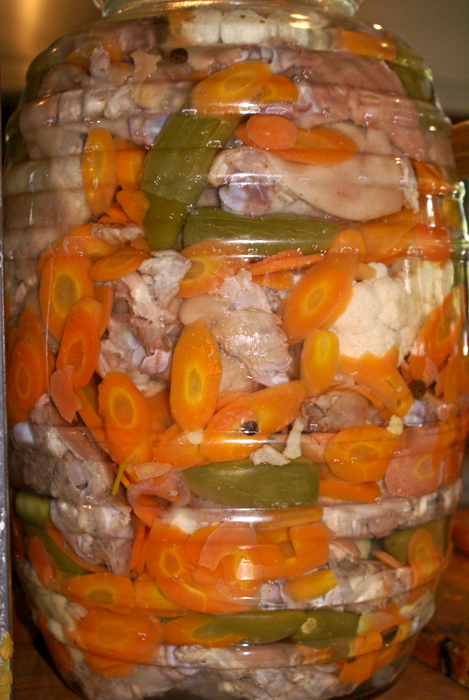
    Manitas de cerdo: pickled pigs' feet.  The well-scrubbed feet are cooked in salted water, then added to vegetables cooked in a pickling solution of vinegar, chile, vegetables, and herbs.  In Mexico, manitas de cerdo can be eaten as either a botana (snack) or a main dish.

    Pátzcuaro Carnitas
    One of my personal favorite pork dishes: carnitas from Michoacán!  These carnitas in particular are the best I've ever eaten: large hunks of pork are boiled in lard until crispy on the outside, succulent and juicy on the inside.  Chopped roughly and served with various salsas, they're the best tacos I know.  Find them at Carnitas Aeropuerto, in Zamora, Michoacán.

    Adobo en el Plato
    Adobo huasteco, another deliciously spicy pork dish.  It's been a while since this last appeared on our table–and it's high time we prepared it again.  Click on the link for the recipe.

    Hog Heaven Bouquet de Cabezas
    Last but not least, here's a rosy bouquet of pig heads for sale at the Mercado de Jamaica in Mexico City.

    Looking for a tailored-to-your-interests specialized tour in Mexico? Click here: Tours.

  • Morelia en Boca en la Boca de Todos :: Everybody’s Talking about Morelia en Boca, Sixth Year!

    Due to an unexpected health issue, Mexico Cooks! is unable to attend the sixth edition of Morelia en Boca, taking place this weekend in Morelia, Michoacán.  Rather than miss the festivities altogether, I invite you this week and next week to a re-run of the very first Morelia en Boca, offered in 2011.

    Morelia en Boca logotipo
    Morelia en Boca 2011
    offered three full days and nights of gastronomic conferences, wine and food tasting, and marvelous dinners (with wine pairings) prepared by internationally-known chefs.  Whispers of the glories of this festival-to-come had circulated for an entire year, and Mexico Cooks! had eagerly awaited the event.

    Everyone's first question was, "Why a rabbit for the festival logo?" The rabbit, long linked with the rich culture of Michoacán, has several meanings.  First, it refers to the former town of San Juan Parangaricutiro, which was relocated to the former hacienda known as Los Conejos (the rabbits) when the erupting volcano Paricutín destroyed the original town in 1943.  Second, the logo refers to the ancient Purhépecha legend of the rabbit in the moon.  According to the legend, the mischievous rabbit devours the ripe produce in a farming family's fields.  The farmer then traps the rabbit to serve as a family dinner.  The smart rabbit tricks a coyote into freeing him from his cage.  The watching moon–considered to be the rabbit's mother–gives her son the gift of zigzagging and hopping in order to escape the angry, hungry, and desperate coyote.  Just as the rabbit is about to be trapped, the moon drops down a silver ladder that she has knit from spiderwebs.  The rabbit hops high and skips up the ladder, disappearing forever into the moon's embrace.  The coyote is left on the earth to howl his pain, his hunger, his fear, and his desperation, while the rabbit is plainly visible on the shining face of his mother, the moon.  Next time the moon is full, take a look and you'll see him for yourself, still cuddled in the moon's embrace.  The rabbit in the moon, ancient emblem of Michoacán and Mexico, is visible to the entire world.

    Mise en Place con Jícaritas
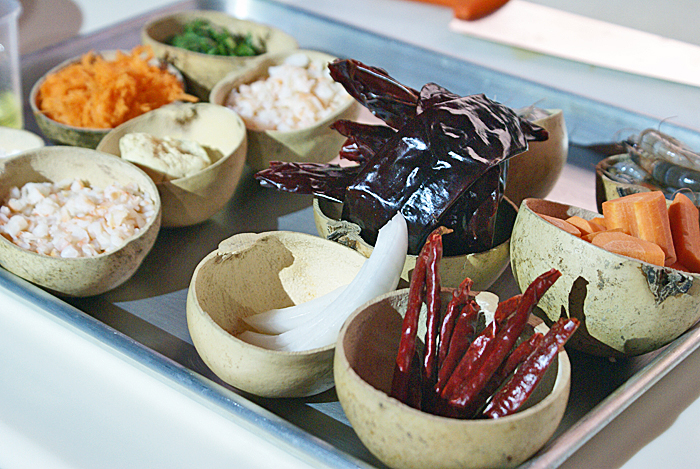
    Mise en place (all previously prepared ingredients in place) for a cooking demonstration, one of many presented at this recent and enormously successful international culinary event .  The pre-measured ingredients that you see here are displayed in tiny dried jícaras (gourds).

    The festival paired renowned chefs from as far south as Oaxaca and Chiapas with others from as far north as New York City.  Food writers and photographers from both Mexico and the United States descended en masse on Morelia for the event.  The most common and excited exclamation among wine and culinary participants at the festival–in both Spanish and English–was, "Oh my god, we're friends on Facebook and finally we get to meet in person!

    Pilar, Lucero, Iliana Presentación
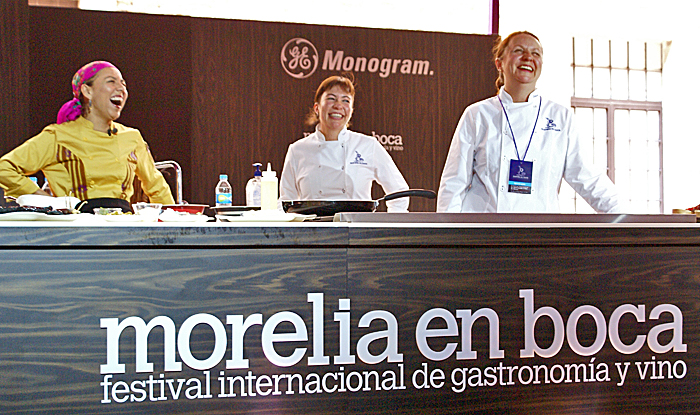
    From left, Oaxaca's chef Pilar Cabrera of Restaurante La Olla, Morelia's favorite daughter chef Lucero Soto Arriaga (Restaurante LU, Morelia), and chef Iliana de la Vega, of the extraordinary Austin, Texas restaurant El Naranjo (formerly based in Oaxaca).  The three laughing chefs were mid-presentation at Morelia en Boca.

    Grupo Cocina al Natural
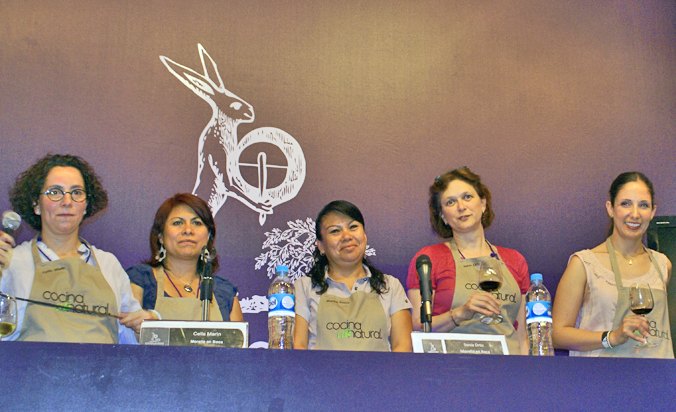
    The group from Cocina al Natural, including Celia Marín, Bertha Herrera, Martha Ponce, Sonia Ortiz, and Ana Luisa Suárez of Vinos Wagner, a sponsor of the website.  Cocina al Natural launched its website with a joy-filled presentation that included video, delightful talk, and chilled white wines from from Vinos Wagner.

    Morelia en Boca offered something for everyone with an interest in either food or wine or both.  Daily conferences included panels speaking on topics ranging from the importance and influence of the Culinary Institute of America (Chefs Iliana de la Vega and Roberto Santíbañez) to the launch of the new and wonderful interactive–and very user-friendly–website Cocina al Natural (Celia Marín and Sonia Ortiz).  Equally diverse demonstrations included presentations by chefs Enrique Olvera (Restaurante Pujol, Mexico City), Pablo San Román (Restaurante DO, Mexico City) and the new generation of chefs represented by Rodolfo Castellaños (Restaurante Huaje, Oaxaca) and Marta Zepeda (Restaurante Tierra y Cielo, San Cristóbal de las Casas), and an enormous chocolate sculpture–of our logo rabbit–by premier Mexican chocolate maker and chef José Ramón Castillo.  More than a dozen separate catas de vino (wine tastings) showed off wineries from Mexico, France, Spain, and the United States.  The Belgian brewer Gouden Carolus beamed over its featured offerings of summery wheat beer and truly delicious fruit flavored beers.

    Riviera Nayarit con Betty Vázquez
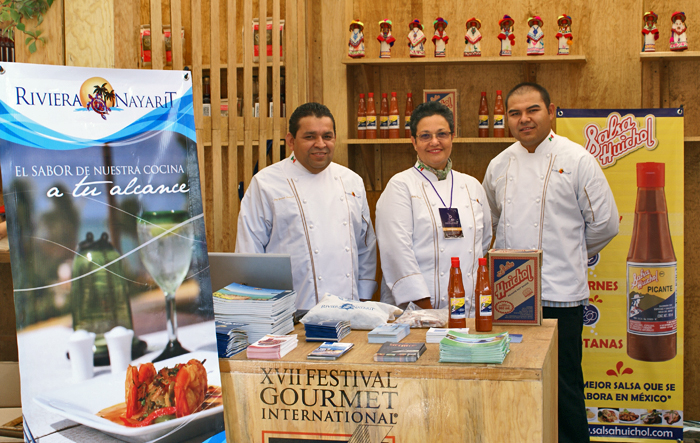
    Part of the team from Riviera Nayarit, including the outstanding west coast chefs (left to right) Gerardo Sandoval Fernández, Betty Vázquez, and Marco Valdivia.  The Riviera Nayarit stand at Villa Gourmet offered portions of aguachile de camarón (raw shrimp marinated in a sometimes-fiery sauce of jugo de limón and chile serrano), along with a delicious Nayarit-style cebiche topped with spicy Salsa Huichol, one of the sponsors of Riviera Nayarit's visit to Morelia en Boca.

    Mexico Cooks! on the Job courtesy Adriana Pérez de Legaspi
    Mexico Cooks! on the job.  Photo courtesy Adriana Pérez de Legaspi.

    Food and wine tastings at Morelia en Boca took place at the Palacio Clavijero, a 17th Century Jesuit school.  In the building's second patio, more than 30 charming wooden providers' booths surrounded a multitude of comfortable tables and chairs.  The cost of festival tickets included good-sized tastes (really, as much as you wanted) of both food and drink, including treats from Oaxaca, Chiapas, Nayarit, and Michoacán, Belgian beer, and wines from several countries.

    Museo del Dulce 1 Zarza con Cotija
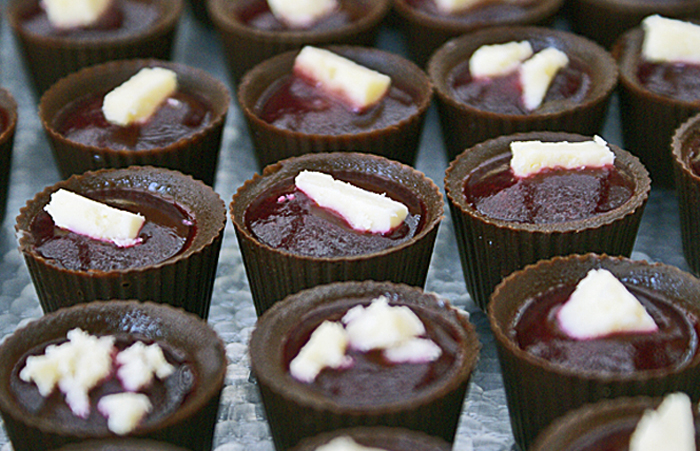
    Drop-dead delicious bite-size dark chocolate cups filled with jam handmade from Michoacán-grown blackberries and topped with artisan-made queso Cotija, also from Michoacán.  These little marvels (and a big selection of others) were available at the Morelia Museo del Dulce stand at Villa Gourmet.

    Next week, come back for Part Two of the festivities at Morelia en Boca.  Mexico Cooks! will feature the Morelia en Boca dinners prepared by chefs Roberto Santibáñez of Fonda in New York City, Lucero Soto Arriaga of Morelia's Restaurante LU, Margarita Carrillo de Salinas of Restaurante Don Emiliano in Cabo San José, Baja California Sur, and Rodolfo Castellanos of Restaurante Huaje, Oaxaca.

    Looking for a tailored-to-your-interests specialized tour in Mexico? Click here: Tours.

  • Fideos, One of Mexico’s Many Sopas–and a Peek at the Mexican Housewife’s Secret Ingredient

    Fideos Forkful 2 MC
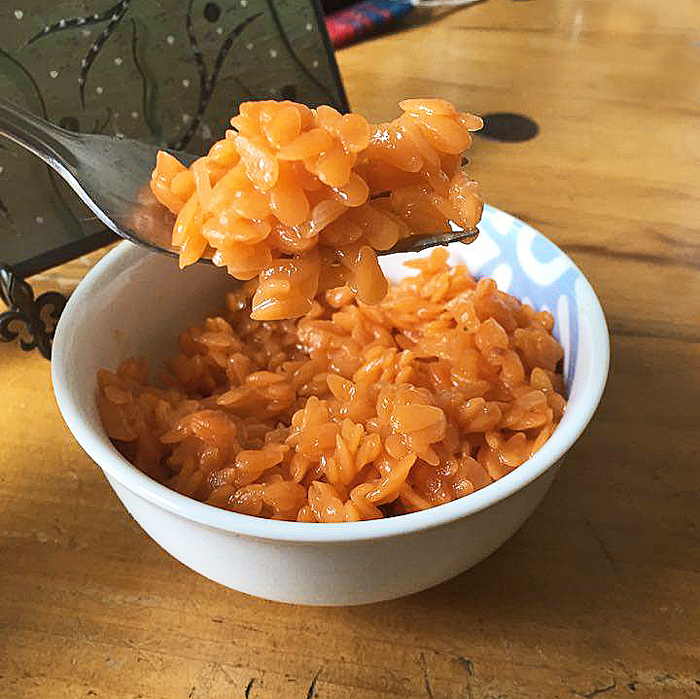
    Meet sopa seca de lenguitas, one of Mexico's many so-called 'dry soups'.  This dry soup of tiny tongue-shaped pasta is one of Mexico Cooks!' favorite accompaniments to a home-style comida (Mexico's main meal of the day).

    Mexico eats a lot of soup, both sopa aguada (liquid soup) and sopa seca (dry soup).  I can hear some of you scratching your heads: dry soup? What?

    Here's the scoop on the soup:

    –Sopa aguada includes consomés, caldos (broths), and cremas (cream soups).  Consomé is clear broth made of chicken, beef, fish, or vegetables.  It's sometimes served plain and sometimes includes a bit of chicken or a few chopped vegetables.  

    Caldos can include caldo de pollo (Mexico's famous chicken soup, loaded with chicken and fresh vegetables), cocido (aka caldo de res, beef soup similar to caldo de pollo), caldo de camarón (shrimp broth), sopa de pasta (usually a tomato broth with plenty of small-size pasta cooked in it), and a long list of other kinds of caldos. Sopa azteca and sopa de tortilla also fall in the caldo category.  

    –Cremas
    , on the other hand, are cream soups.  Everyone is familiar with cream of mushroom, cream of spinach, and cream of broccoli soups, and Mexico has them, too. There are other cream soups that are more common in Mexico than in other parts of the world: crema de flor de calabaza (squash flower), crema de chile poblano, and crema de cilantro are a few of those.  Liquid soups like any of these are served as the first course of a comida corrida–a multi-course comida offered at a single price in fondas or cocinas económicas, small family-run restaurants popular all over Mexico.  Soups of all kinds are also offered on high-end restaurant menus.

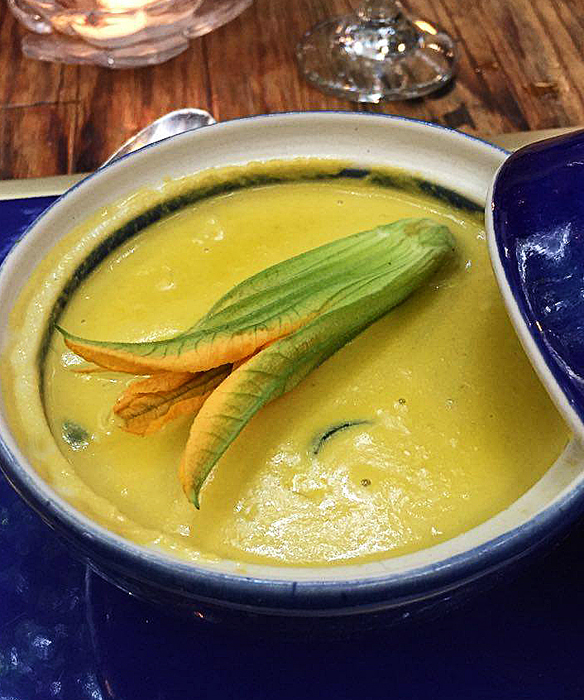
    Crema de Flor de Calabaza Azul Histo?rico 1 Marzo 2016
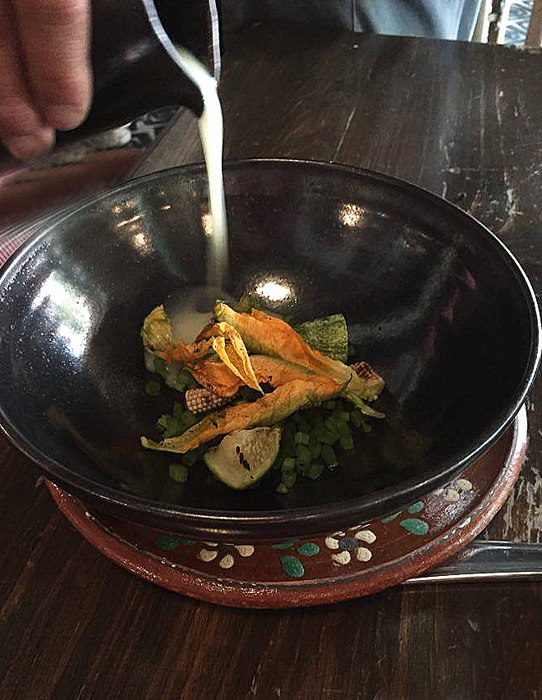
    Crema de flor de calabaza, as served at Restaurante Azul/Histórico, Mexico City.  Each bowl of this soup contains 18 squash flowers!

    Now: what's the deal with these so-called sopas secas (dry soups)?  

    –A sopa seca is usually the second course of a comida corrida; sopa seca includes rice (arroz a la mexicana, arroz blanco, or arroz verde: Mexican red rice, steamed white rice, or rice cooked with various fragrant green herbs).  The dry soup category also includes pastas such as espaguetis con crema (spaghetti with cream sauce), macaronis con jamón y crema (macaroni with ham and cream), and others, which are lumped under the umbrella of fideos.  Fideos are any small-form pasta (angel hair, tiny shells, alphabet letters, gears, wee bow ties, etc.) cooked in broth until all of the broth is absorbed into the pasta.  

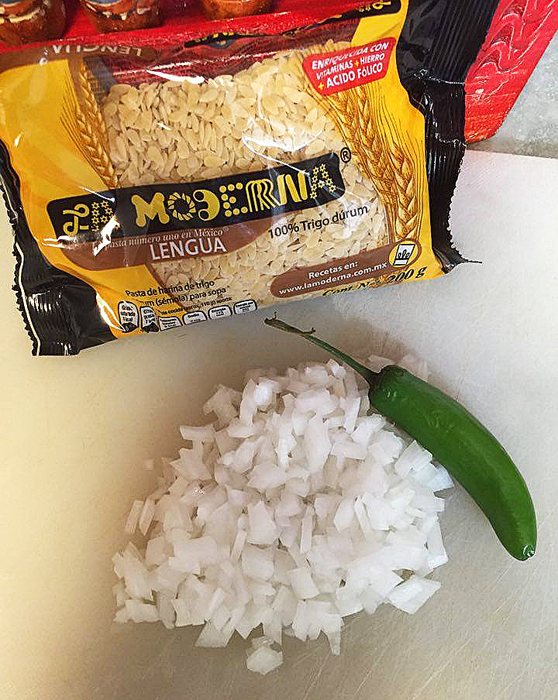
    Fideos Lenguas con Cebolla
    La Moderna has always been my favorite brand of small pasta for making fideos.  You'll probably be able to find this brand at a Latin market near you.  If not, you'll see other brands that you can substitute.

    We're going to learn how to make fideos right now.  This dish ranks up there with the simplest thing in the world and I guarantee you that this 'dry soup' will be a family favorite from the first time you put it on the table.

    Sopa Seca de Fideos

    Ingredients:
    1 200 gram package small pasta, La Moderna or other brand, any shape you like
    2-3 Tbsp lard or vegetable oil
    1/4 white onion, finely diced
    1 chile serrano, split from the tip almost to the stem end (stem removed)
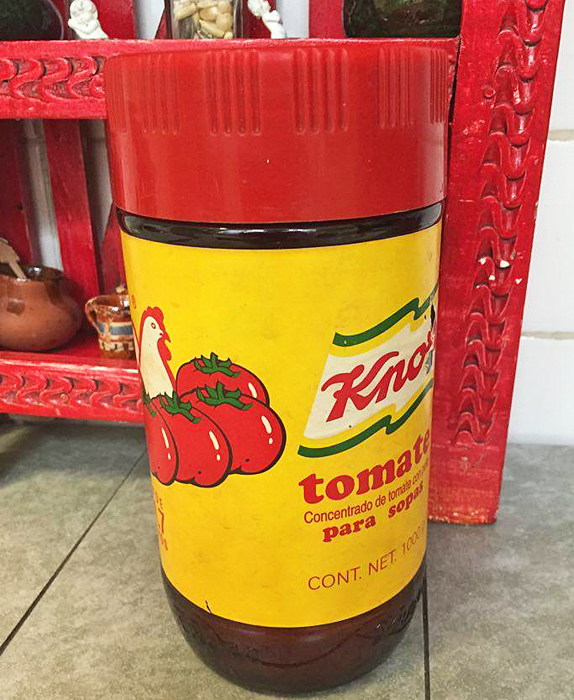
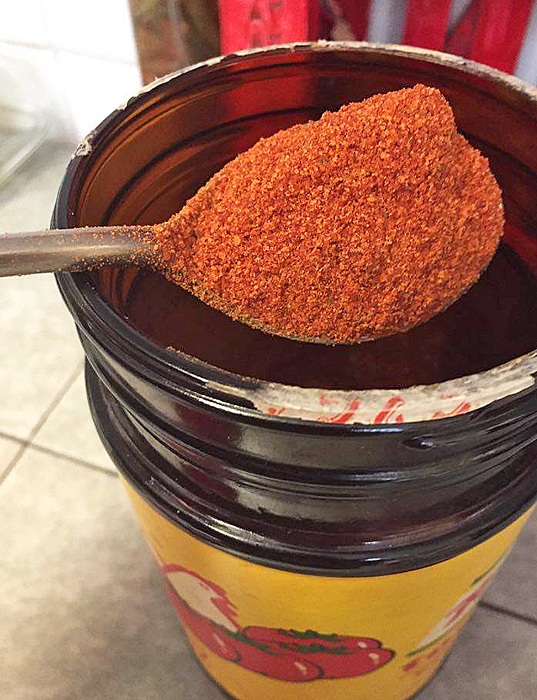
    1 Tbsp Knorr Suiza Tomate bouillon powder, dissolved in 2 cups boiling water  (shhh, don't tell)

    Utensils:
    10" non-stick sauté pan with cover
    Wooden or plastic spoon
    1 Tbsp Measuring spoon
    2-cup heat-resistant measuring cup

    Procedure:
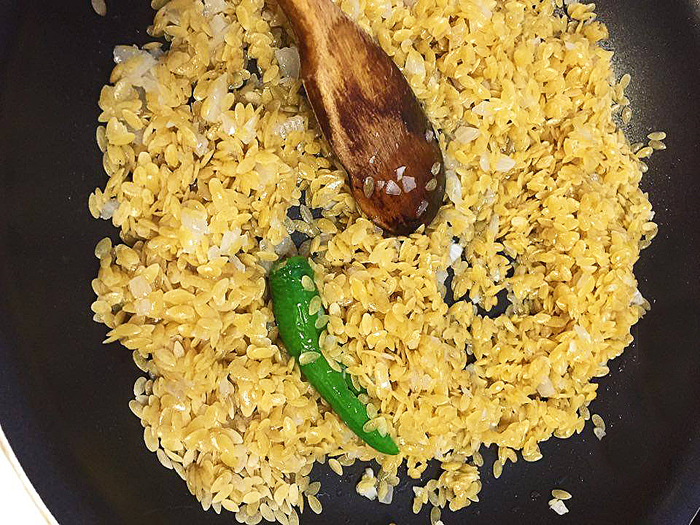
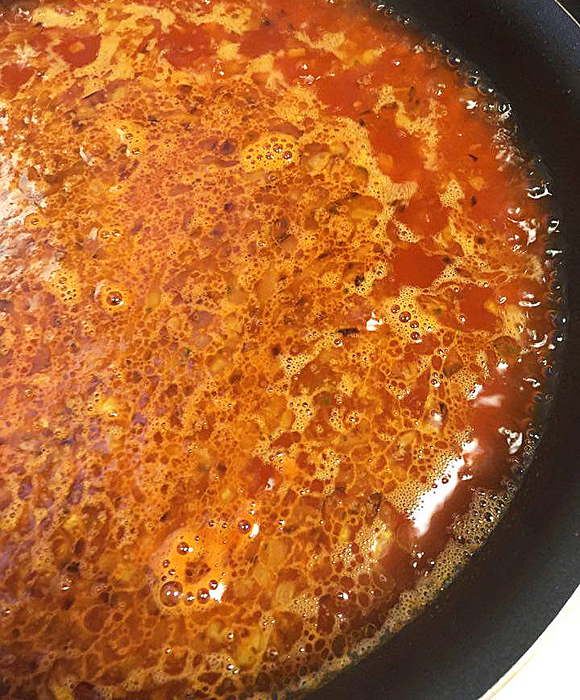
    In the sauté pan, melt the lard or heat the oil until either is just shimmering.  Add the finely diced onion and the split chile and stir over medium heat until the onion is soft and the chile has begun to blister. 

    Fideos a Dorar
    Beginning the sauté step.

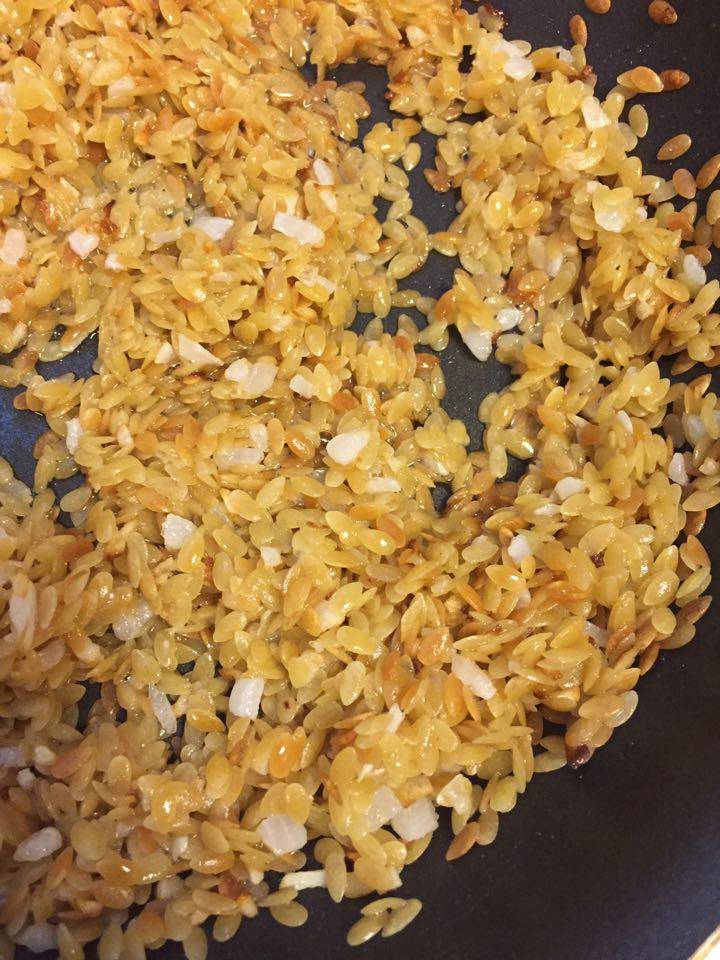
    Add the fideos and continue to stir over low-to-medium fire until the pasta is light golden brown.  Be careful not to burn the onion.  At this point, you can remove the chile if you prefer that your fideos not have much picante (spicy hot) flavor.

    Fideos a Dorar 3
    Your fideos, toasty golden brown.

    Fideos Knorr Suiza Frasco
    The housewife's secret weapon: Knorr Suiza Tomate, a powdered bouillon concentrate for the times when you just don't want (or don't have the ingredients) to make a caldillo de jitomate (thin tomato broth).  You can also buy Knorr Suiza in boullion cubes; it also comes in beef, chicken, and shrimp flavors.  In 'homey' Mexican recipes, this convenient ingredient is often written knorrsuiza. High-end chefs look down their noses at knorrsuiza, so let's not tell any of them that we're using it today.

    Fideos Knorr Suiza Tomate
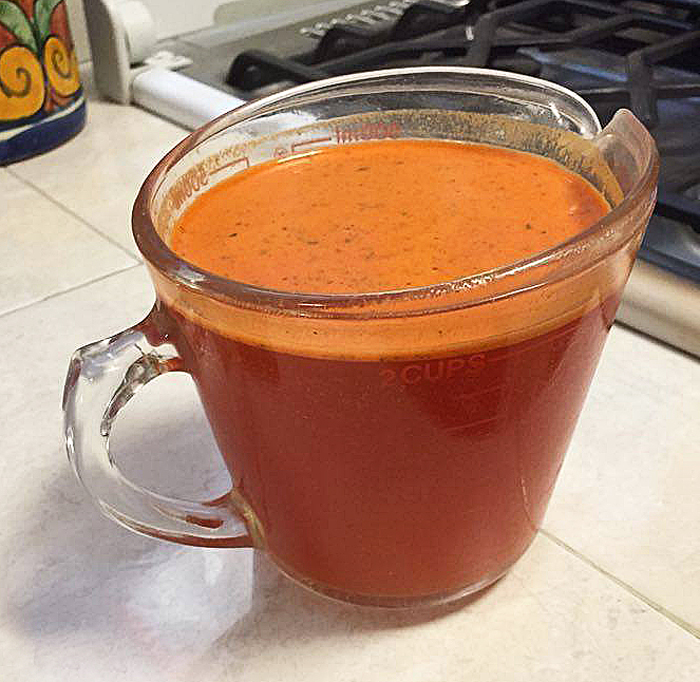
    Add a tablespoon of the knorrsuiza secret ingredient to 2 cups of water that you have brought to a boil.  I usually boil the water in the microwave, in a 2-cup measuring cup.

    Fideos Caldillo
    Stir until the secret ingredient is thoroughly dissolved.  

    Fideos a Hervir
    Bring the secret ingredient and the fideos, onions, and chile to a boil in the sauté pan.

    Fideos Tapados
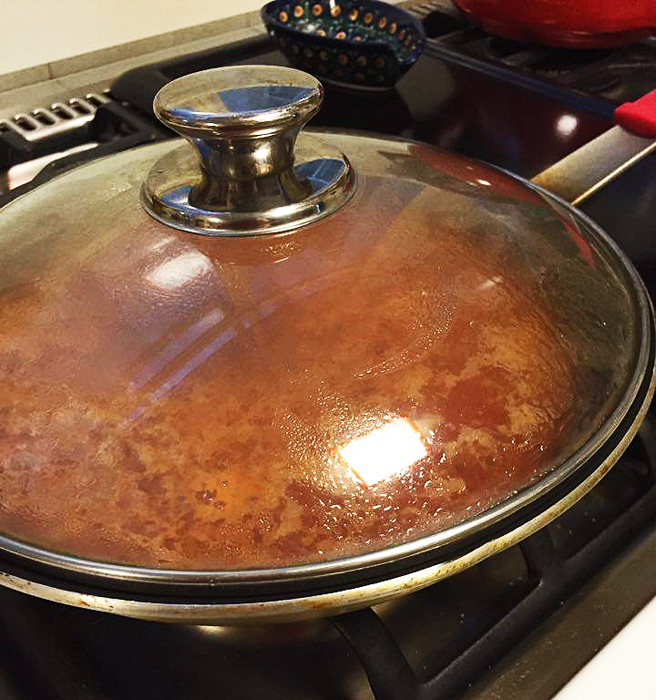
    Lower the heat to very low and cover the sauté pan. Simmer for approximately 12-15 minutes, or until most of the liquid is absorbed and the fideos are tender.  Remove the pan from the heat.

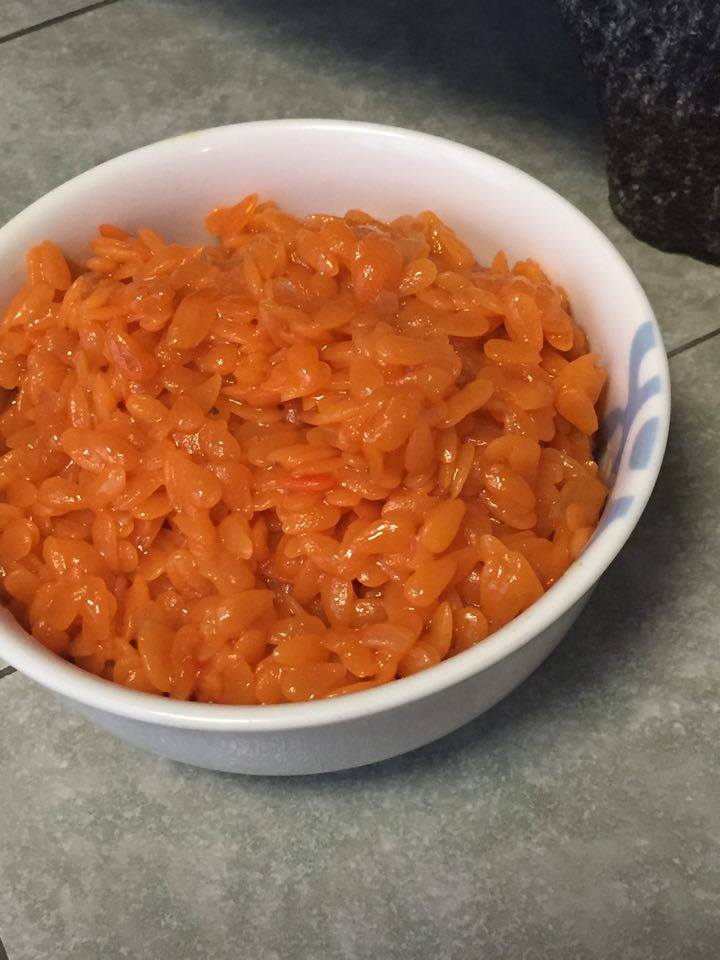
    Fideos in a Bowl
    A little bowlful of the finished product.  You are welcome to eat your fideos plain, sprinkle the fideos with some crumbled queso fresco (fresh, semi-soft cheese) or with some crumbled queso Cotija, a hard, sharper cheese.

    Let me know how you like the fideos–and don't tell a soul that I made them with the housewife's secret ingredient!

    Provecho!  (Mexico's way to say bon appetit!)

    Looking for a tailored-to-your-interests specialized tour in Mexico? Click here: Tours.

  • Mexico Cooks! Returns to Restaurante Yuban, A Special Taste of Oaxaca in Mexico City

    Chef Fernando BandW MC
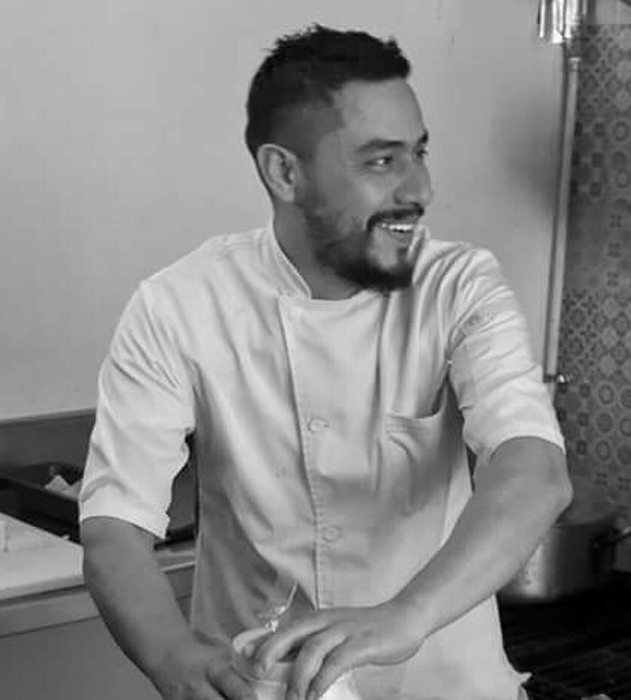
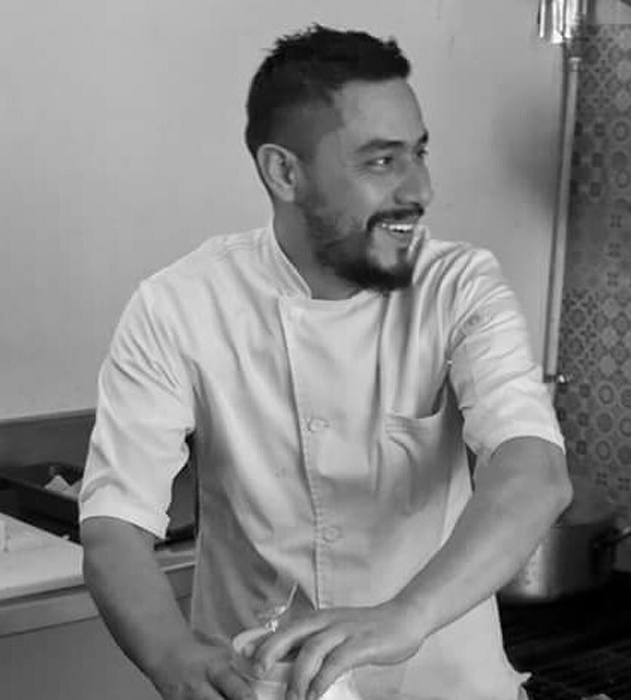
    Chef Fernando Martínez Zavala, in charge at Restaurante Yuban.  Chef Fernando has headed up the kitchen at Yuban for about two years; he's made changes in both the space and the menu that have brought the restaurant to the forefront in Mexico City's mid-to-high-end places to dine.  Photo courtesy Yuban.

    It's part of my job description–self-described, this job–to write about restaurants.  For the first time in nine-plus years, I'm writing a second review of a place I've wanted to love without reserve but needed to revisit several times to be able say, "Yes, absolutely, this is the place to go."  Before you read further today, you might like to take a look at the first article from Mexico Cooks! about Restaurante Yuban, from July of 2015: Restaurante Yuban.  You will see that although I loved much about what I ate there, I still had some questions and suggestions.

    Yuban Front Dining Room MC
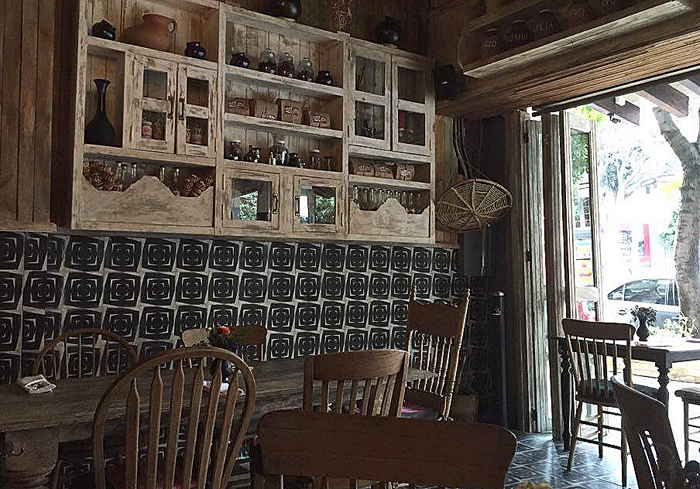
    The first thing I noticed this visit, in April 2016, is Yuban's very recent interior renovation.  The remodel is seamless, opening up both dining and bar space without sacrificing the cozy ambience that everyone has loved about the rooms since Yuban first popped up on Mexico City's restaurant radar. This new section at the front of the restaurant is now open to lovely light and air.  Click on any photo for a larger view.

    Yuban Bar MC
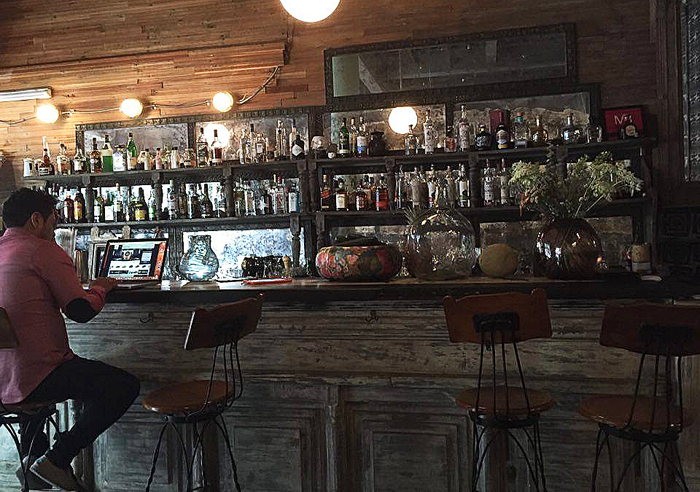
    The bar, with its full complement of spirits, is now integrated into one side of the front dining room, making a wonderfully open space whether you're at Yuban to have a drink with a friend or to share a full meal with your friends, family, or a group.

    Yuban Piso Azulejos MC
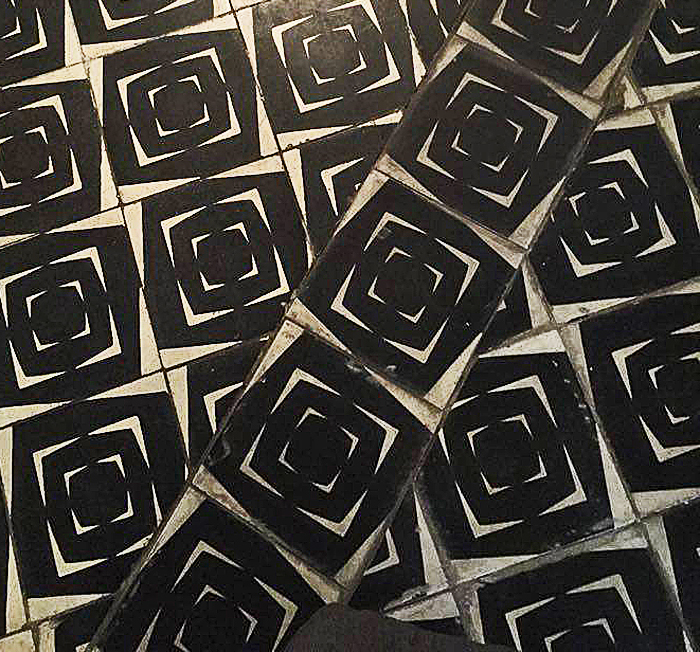
    I've always loved the floor tiles at Yuban and was so delighted to see that they haven't been changed. Remodel and floor tiles aside, the food! The service! What about them?  The menu and the service have been remodeled as well, keeping the best and seriously improving the rest. Restaurante Yuban has graduated to full star status in Mexico City.

    Yuban Chagua con Mezcal MC_edited-1
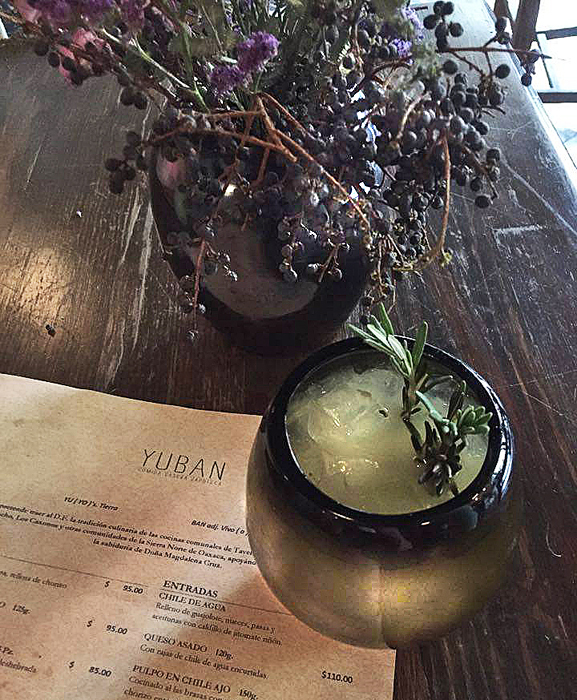
    Of the various cocktails on the Yuban menu, this one–chagua de la reina–caught my attention initially because it is made with mezcal, a drink endemic to Oaxaca and currently the go-to liquor in Mexico City.  Mezcal is also Mexico Cooks!' preferred drink, although I rarely drink alcohol. The chagua (according to chef Fernando, the word refers to someone who produces a lot of super-spicy chile de agua) is made of an infusion of chile de agua, jugo de limón (juice of native limón–you might know the fruit as Key lime), ginger, and mezcal.  The drink's flavors explode in one's mouth and made me, at least, crave a second taste and then a second cocktail.  I can't think when I've gone bonkers for an adult beverage, but yowzah–the chagua de la reina won my heart.  Move over, straight up mezcal.

    Oaxaca Benito Jua?rez Mkt 11 Chiles de Agua
    Oaxaca's chile de agua, the fiery heart and soul of the chagua de la reina

    Yuban Tlayuda con Aguacate, Ceniza, Chile
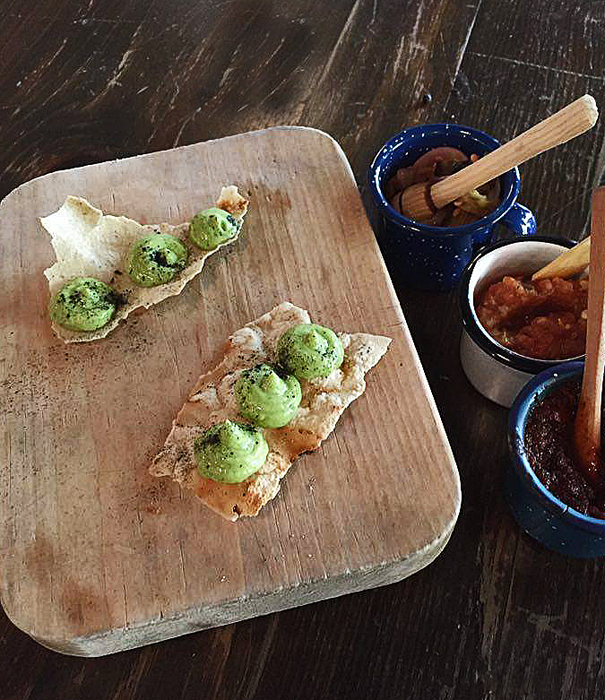
    Lovely bits of tlayuda (a large toasted corn tortilla, an icon of the Oaxaca Central Valley) with avocado and ash accompanied our drinks as a house courtesy.

    Yuban Frijolitos, Hoja Santa, etc MC
    As we chatted and drank, our server also presented us with frijoles de la olla estilo oaxaqueño (Oaxaca-style pot-cooked beans) seasoned with hoja santa (an anise-flavored leaf), radish, pickled onions, queso fresco (tender fresh cheese), chicharrón (fried pork skin), and cilantro sprouts.  Both the tlayuda and the frijoles did what appetizers are meant to do: wake up one's appetite for what's to follow.

    Yuban Sopa de Gui?as MC
    My dining companion and I each ordered Yuban's sopa de guías, she for love and I for comparison with the sopa de guías I learned from Celia Florián in Oaxaca.  This sopa, served using the restaurant's elegant upscale pour, looked and tasted almost identical to the one I helped prepare in Oaxaca. The chochoyotes (tender corn dumplings with a dimple) were delicious!  On a scale of 1 to 10, definitely a ten!

    Yuban Ensalada de Jitomates Criollos MC
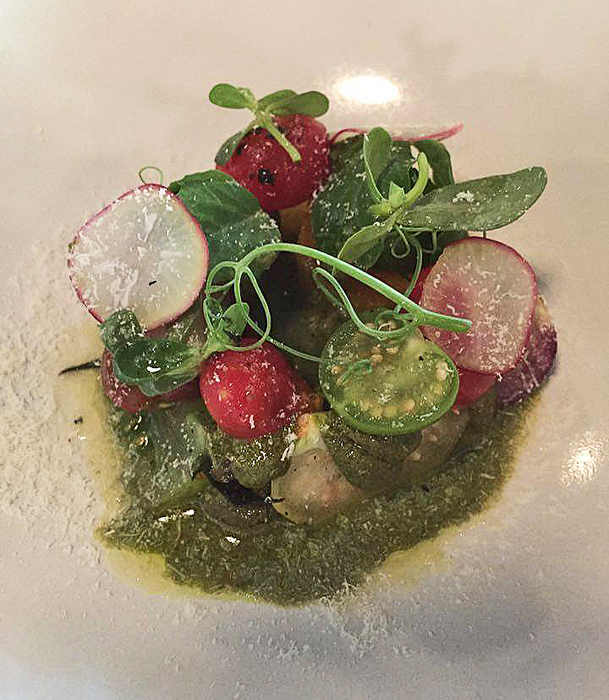
    My companion ordered ensalada de siete jitomates criollos con queso fresco y pesto de hoja santa (salad of seven native tomatoes, transparently thin radish slices, fresh cheese, and hoja santa pesto).  These tiny native tomato halves, dressed with a just-right anise-y pesto, seemed like no big deal on the plate: pretty as a picture, but with a salad-bored shrug.  One taste and I wished I'd ordered my own plateful of pure ripe tomato, wonderful pesto, and all the rest of the flavors that combine to make this small dish a huge hit.  I could cheerfully have licked the plate.

    Yuban Ensalada de Esparragos y Nopales MC
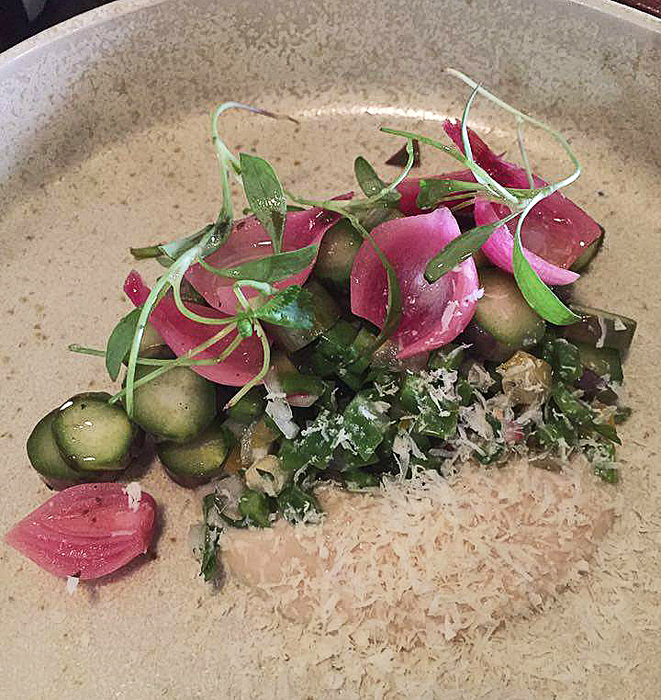
    A second marvelous and beautiful salad, this time of roasted asparagus, roasted nopales (cactus paddles), pickled onions, and a turnip cream. The smokiness of the roasted vegetables was the perfect complement to the mezcal we drank.

    Yuban Mole Verde MC
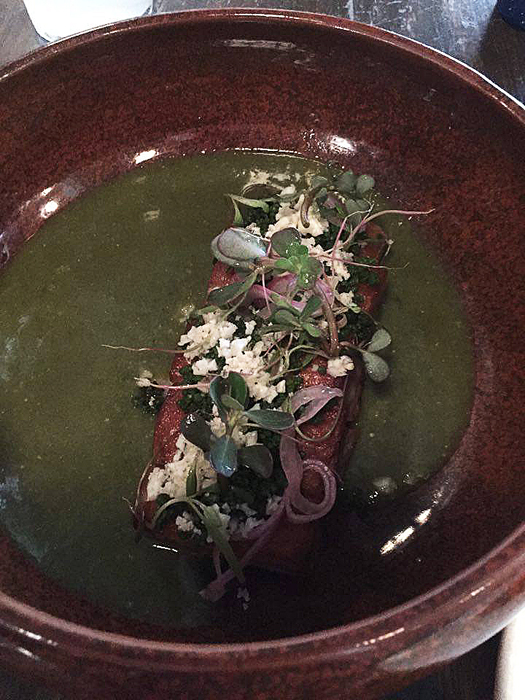
    After listening to me wax ecstatic about the marvelous mole verde (green mole) from February's Oaxaca cooking class, my companion was happy to find the dish listed on Yuban's menu.  She wasn't disappointed; the carne de cerdo (pork meat) was fork-tender and the mole, served with a generous spoonful of alubias (small white beans) was all but identical to the mole verde our cooking class prepared in Oaxaca. 

    Yuban Tasajo Oreado MC
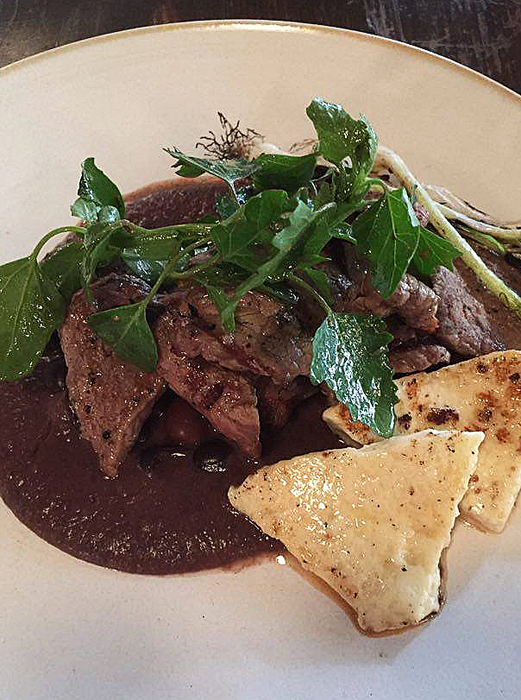
    Tasajo, a Oaxaca-style thinly cut beef topped with quelites cenizo (a kind of greens), tender as served on a pool of black beans, with grilled cebollitas cambray de la sierra (knob onions from the hills) and grilled cheese. House-made tortillas were just right for mopping the plate.

    Yuban Mole Negro con Pavo
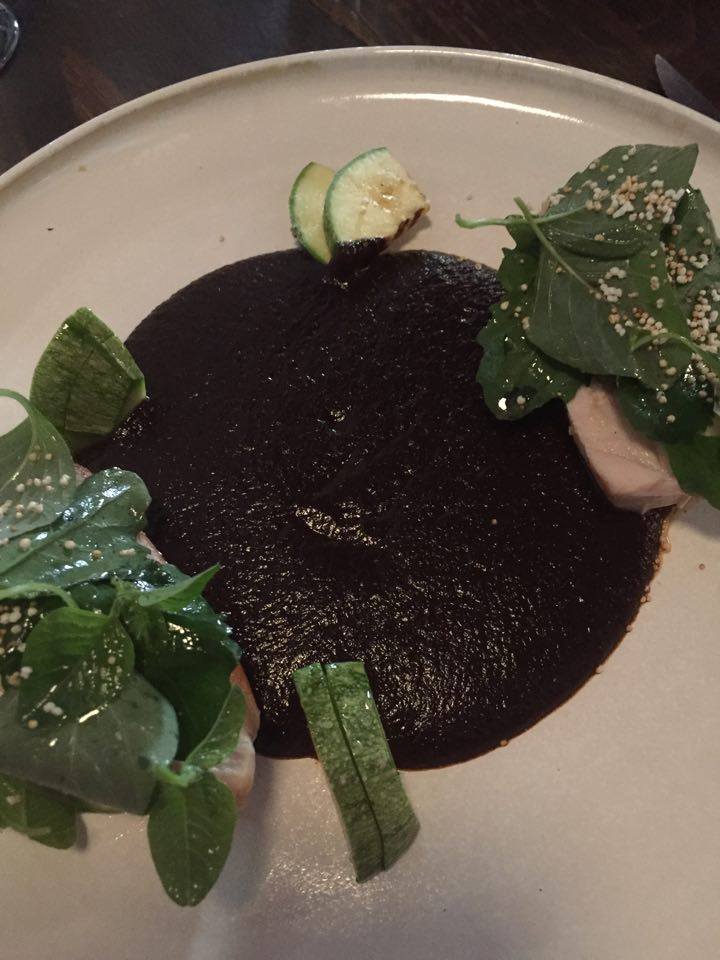
    Mole negro con pechuga de guajolote (black mole with turkey breast), served with a small pot of delicious, perfectly cooked rice.

    Yuban Pastel de Chocolate MC
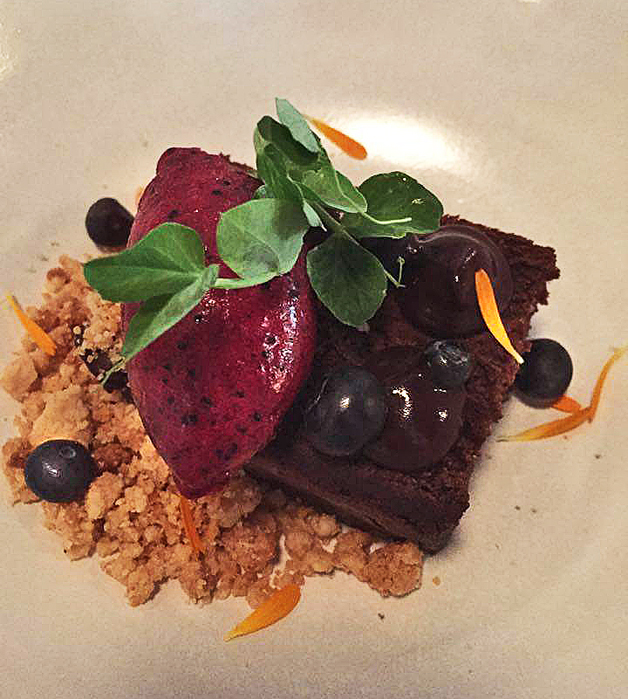
    We tried two of Yuban's three desserts.  This one is pastel de chocolate oaxaqueño (Oaxacan chocolate cake) with house-made sorbet, blueberries, and a streusel crumble. Marvelous.

    Yuban Cremoso de Requeso?n MC
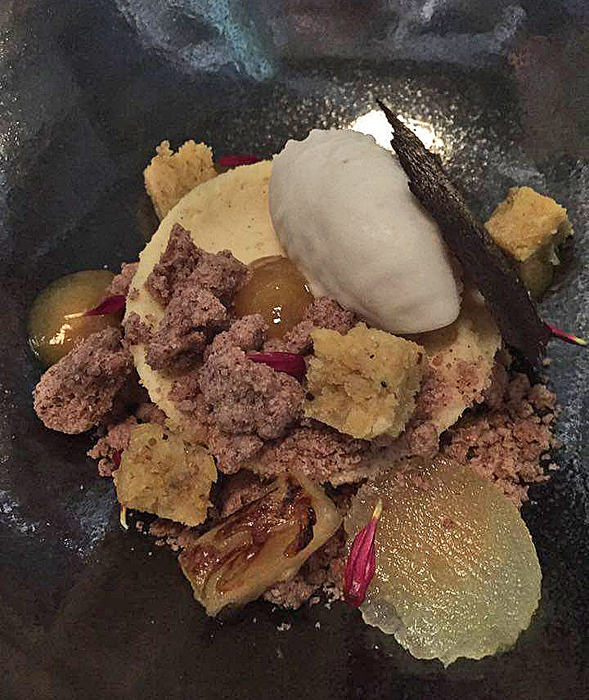
    A companion ordered cremoso de requesón (creamy sweetened cheese similar to ricotta) with streusel de pinole (slightly sweetened toasted, ground corn), piña rostizada (roast pineapple), and coconut ice cream.  I give it two–no, three–thumbs up.  

    When you're in Mexico City but craving the authentic taste of Oaxaca, Restaurante Yuban is definitely your best option.  Don't take my word for it, though: go, and enjoy the best of Oaxaca outside Oaxaca itself.  And by all means order a chagua de la reina and raise a glass to me.

    Provecho! (Say Bon appetit! in Spanish.)

    Restaurante Yuban
    Calle Colima 268
    Near the corner with Insurgentes
    Col. Roma Norte
    Hours:
    Monday through Wednesday 13:30-23:00PM 
    Thursday through Saturday  13:30-1:00AM  
    Sunday                               13:30-18:00PM
    Tel. 6387 0358
    Reservations strongly suggested 

    Looking for a tailored-to-your-interests specialized tour in Mexico? Click here: 
    Tours. 

  • Mexico Cooks! Winter Tour to Oaxaca, Part V: Cooking with Celia Florián

    Celia Florian
    Our magnificent cooking teacher, Maestra Celia Florián, owner at Restaurante Las 15 Letras, Oaxaca.

    Sometime in late 2015, I was chatting with my dear friend Celia Florián, who asked when I would be going again to Oaxaca. "I'll be bringing a group of women in February!" One thing led to another and soon Celia and I had scheduled a cooking class for the group. We planned a menu, an early-morning shopping excursion at the municipal Mercado de la Merced, the group cooking class to follow, and the joy of sharing the finished products as our comida (main meal of the day) later in the afternoon.  I could barely contain my excitement at the thought of introducing this California tour group to one of the most generous and joyous traditional cooks in Mexico.

    The menu that Celia and I planned for the group included:

    –Garnachas del Istmo de Tehuantepec 
    –Sopa de Guías con Chochoyotes
    –Mole Verde con Espinazo y Alubias
    –Pastel de Elote estilo Las 15 Letras

    Las 15 Letras Hoja Santa, Quesillo, Chapuli?n
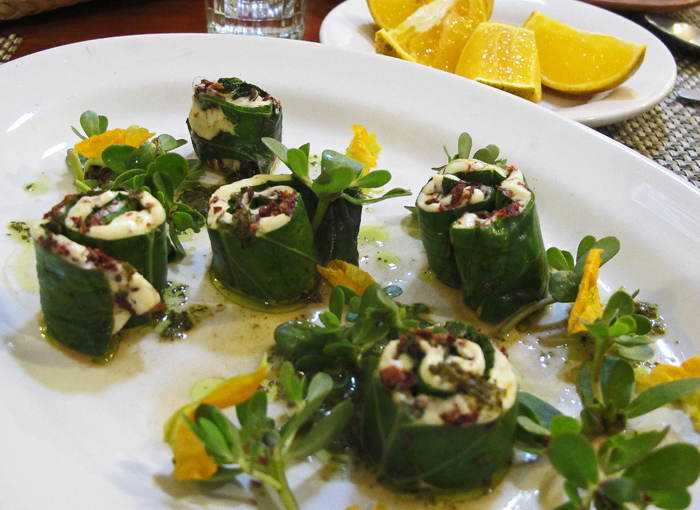
    Maestra Celia and her husband Fidel Méndez Sosa have been the proprietors of Restaurante Las 15 Letras since 1992; today, the restaurant is a favorite among Oaxaca locals and has also become a destination restaurant for in-the-know visitors, both Mexican and foreign.  The photo shows an elegant and delicious dish I ate at Las 15 Letras in February 2015: quesillo (Oaxaca cheese) wrapped in a spiral with chapulines (grasshoppers) and hoja santa (an anise-flavored leaf).
    Celia su Mama? Haciendo Tortillas 2
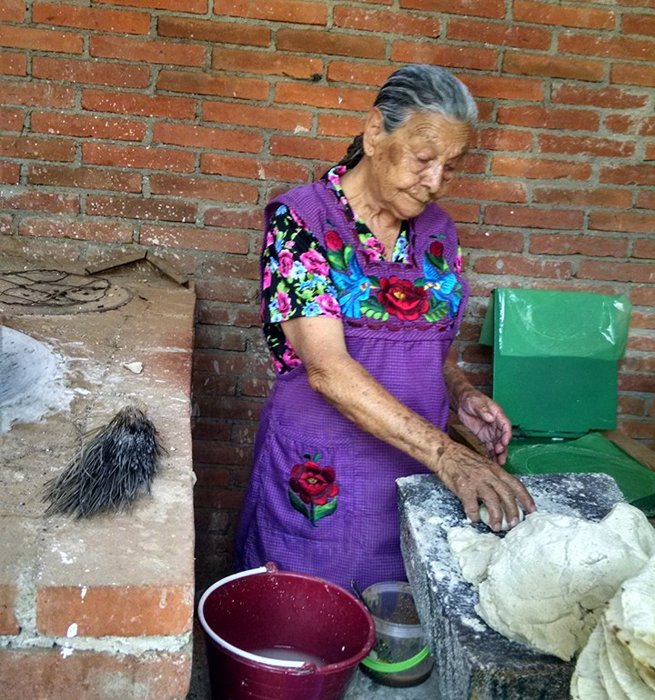
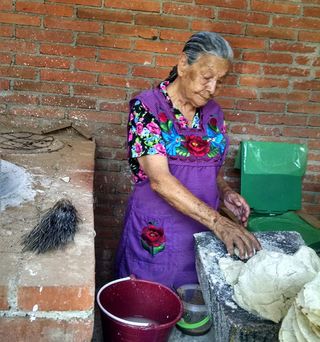
    Doña Carmen Florián, Maestra Celia Florián's now-elderly mother, continues to be able to make hand-made tortillas.  Maestra Celia says, "What one learns well is never forgotten.  My mother has been making tortillas since she was a little girl."
    Mercado de la Merced_edited-1
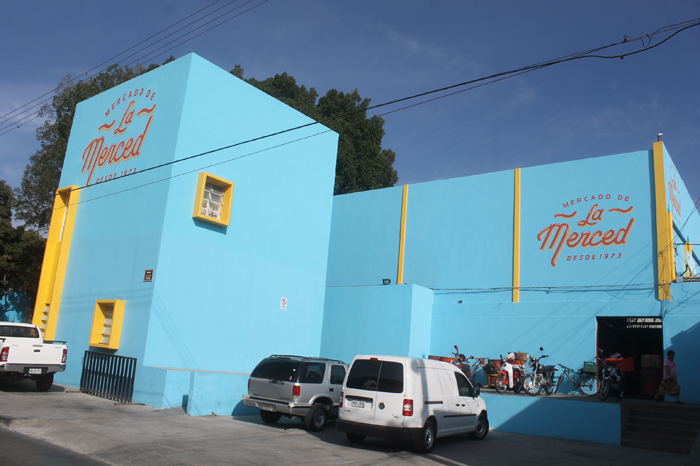
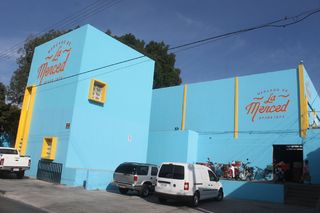
    Oaxaca's Mercado de la Merced is a small, friendly market serving its neighborhood.  It has become a magnet for Oaxaca cooks and food-oriented tourists, as well.  It suited the shopping needs of our group, and Maestra Celia was the perfect guide as we purchased the ingredients for our class and comida

    Celia Mercado de la Merced Jitomate Rin?o?n
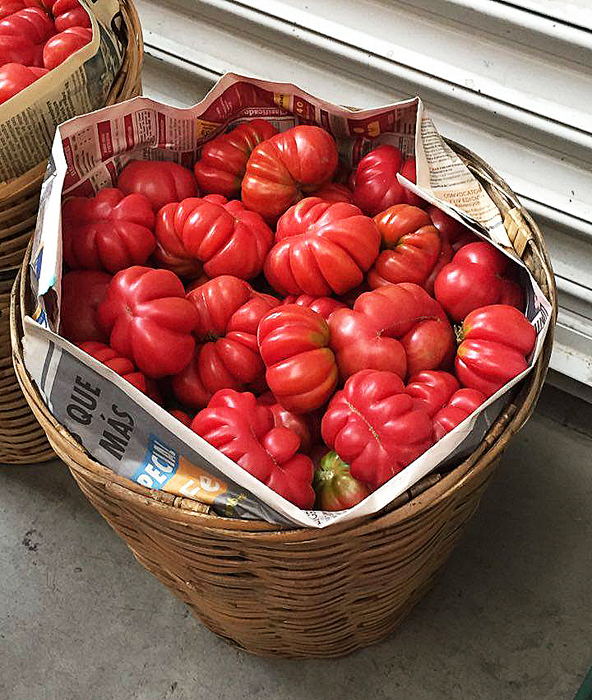
    We purchased a few of Oaxaca's iconic jitomates riñon (kidney-shaped tomatoes) as part of what we needed to prepare the garnachas.
    Clase Charola de Garnachas
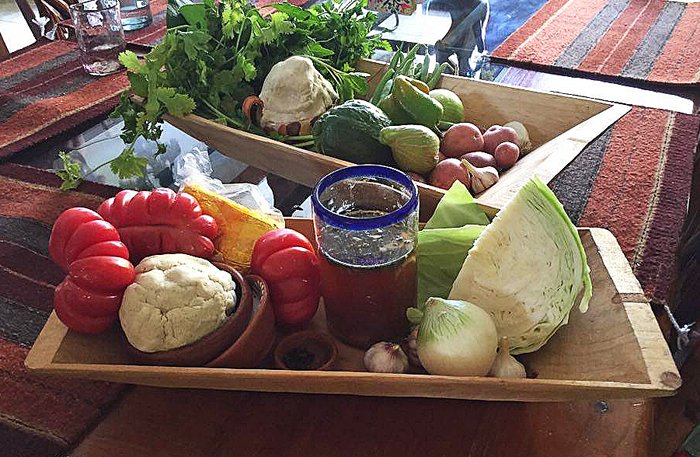
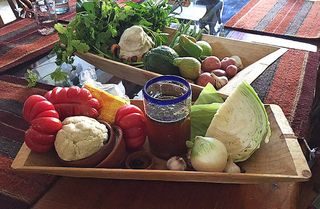
    The tray in the foreground contains the ingredients for the garnachas del Istmo de Tehuantepec.  Clockwise from the left: jitomates riñon (kidney-shaped tomatoes), queso de Chiapas (cheese from Chiapas), vinagre de frutas (Maestra Celia's home-made fruit vinegar), cabbage, onion, garlic, and a bowl of masa de maíz (corn dough).
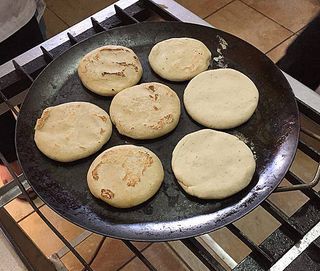
    Clase Gorditas al Comal MC
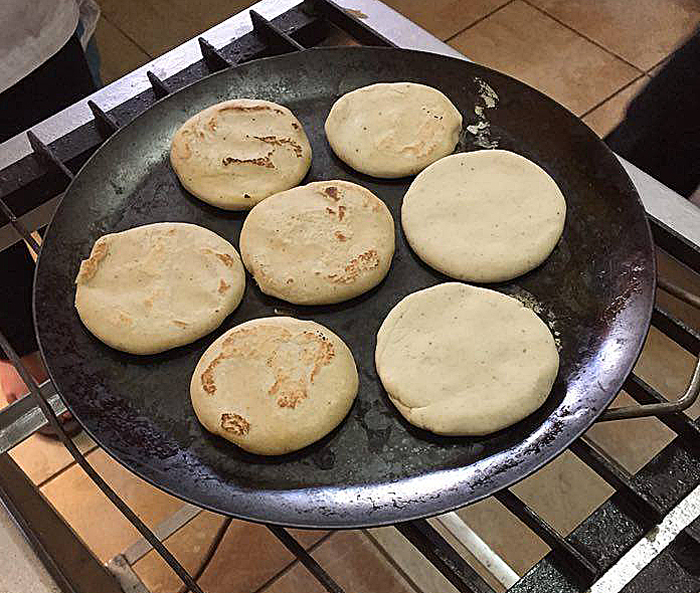
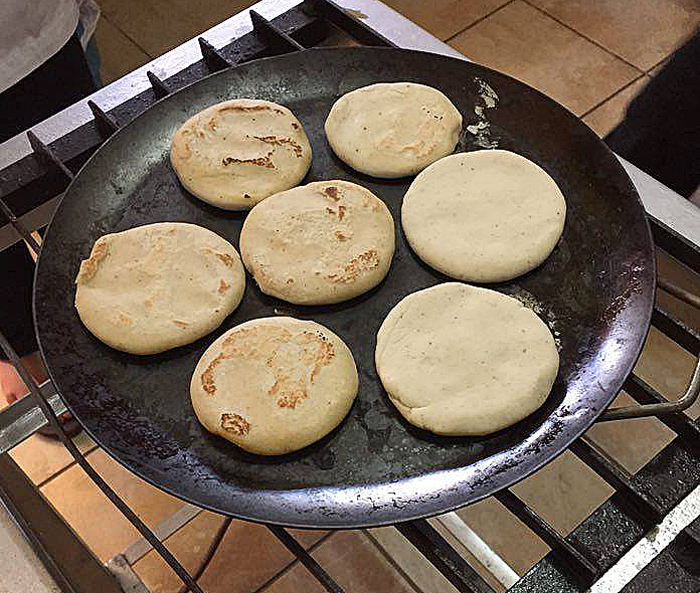
    To make the garnachas, we first patted out gorditas (thick rounds of masa, each approximately three inches in diameter), and baked them on a metal comal (griddle).  
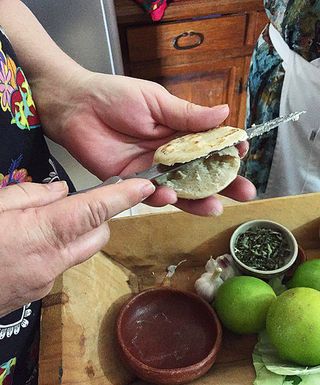
    Clase Judith Abriendo Gordita MC
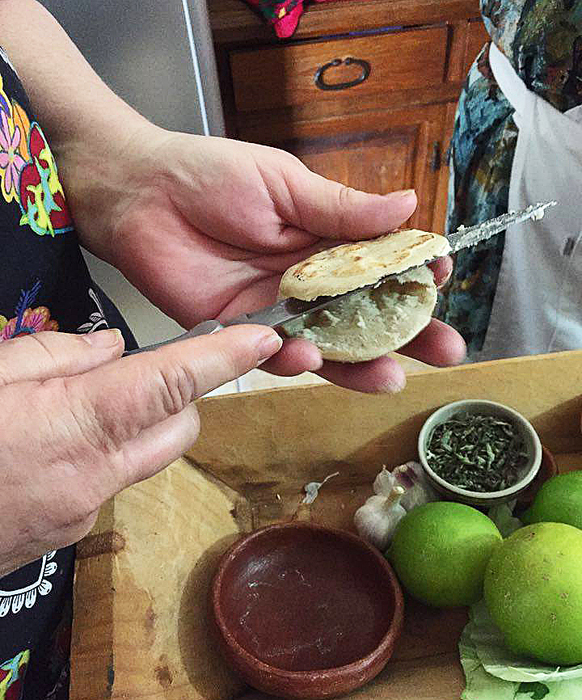
    When the gorditas were completely cooked, we allowed them to cool for a few minutes.  Then we split them in half through the center and set them aside until ready to fill and serve as an entrada (appetizer).
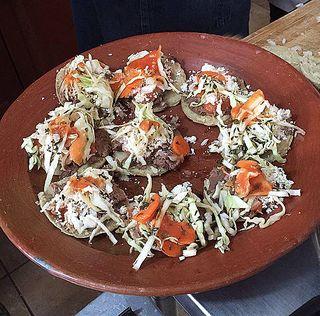
    Clase Garnachas 3a MC
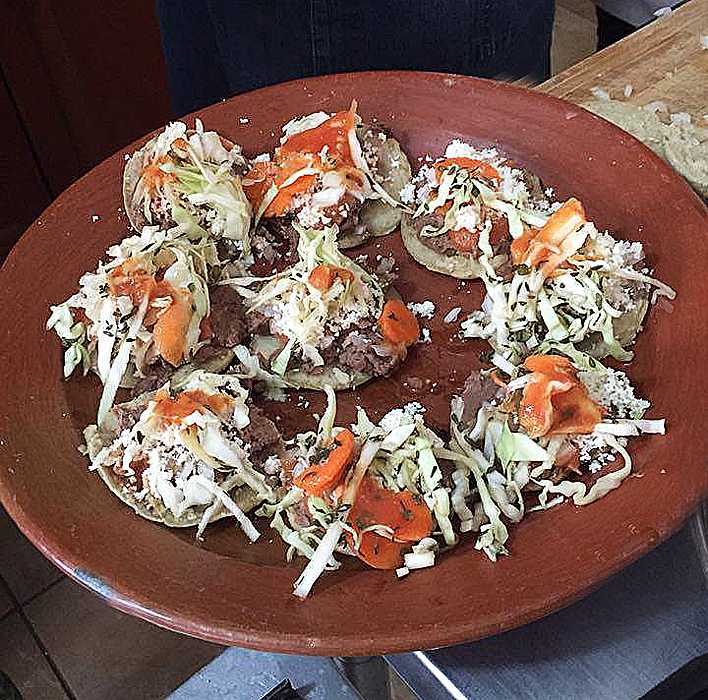
    The garnachas, ready to serve.  Each half of a gordita is topped with shredded beef, along with cabbage and sliced carrots lightly pickled in home-made fruit vinegar. Sprinkle with freshly crumbled cheese.  Add salsa made with jitomates riñon, if you are able to grow them or find them in a market.  Otherwise, use the vine-ripened flavorful in-season tomatoes of your choice.

    While the gorditas baked, we boiled lean beef for shredding as a topping for the garnachas.  Maestra Celia was careful to note that in preparing a multi-course meal, it's important to begin with the steps that take the longest amount of time, finishing with the preparation that takes less time.  That way, all of your menu is ready to serve and eat at approximately the same hour.

    Gui?a de calabaza
    Guías de calabaza
    (squash stems and tendrils) for our sopa de guías.  If you grow zucchini or know someone who does, you can use its tenderest young stems, leaves, and tendrils to make sopa de guías.
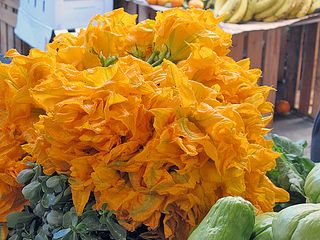
    Celia Mercado de la Merced Flor de Calabaza
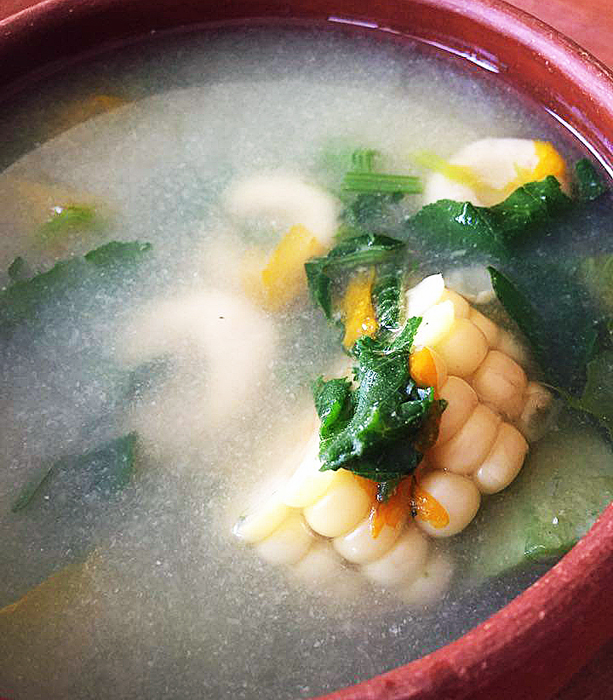
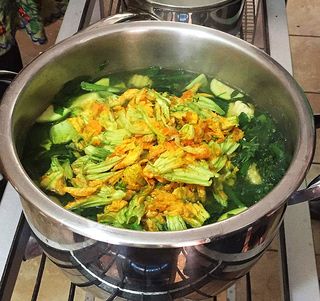
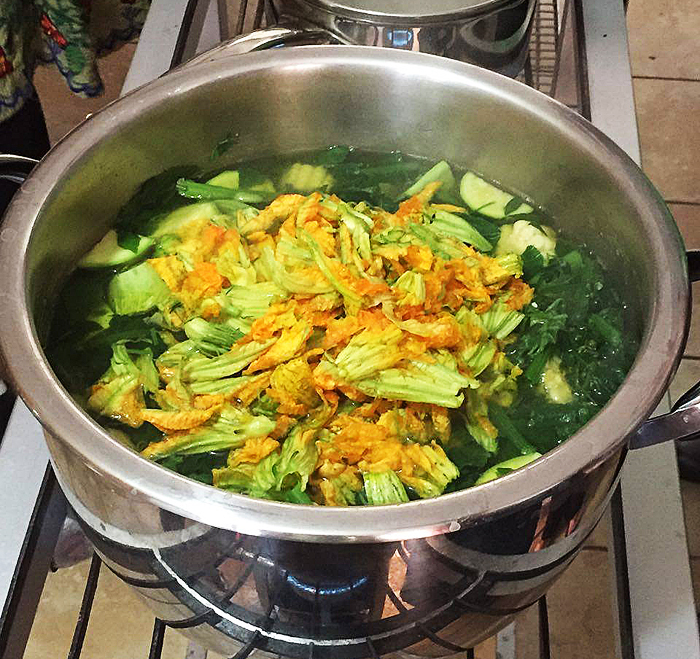
    The recipe for sopa de guías (squash tendril soup) also calls for flor de calabaza (squash flowers).  In addition, we used fresh corn, still on the cob and sliced into rounds, and tender young chayote, cut into round slices.
    Clase Sopa de Gui?as con Flor MC
    We added the vegetables and herbs we prepared to simmering, lightly salted water and allowed them to boil gently just until the vegetables were tender.
    Clase Celia Pone Masa y Agua a la Sopa MC
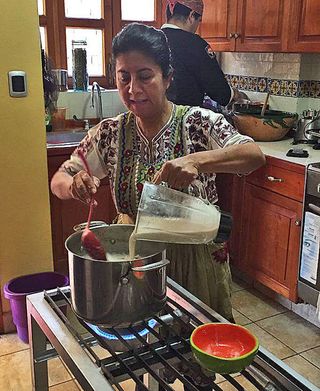
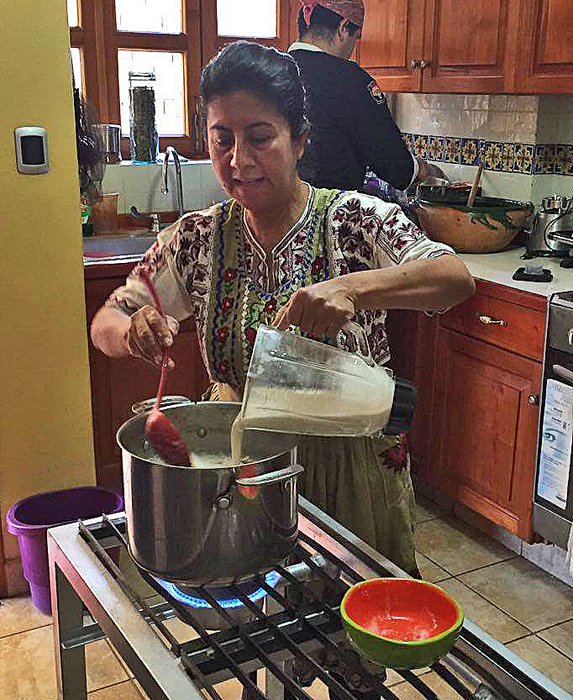
    Maestra Celia adds blended water and masa to the soup to thicken it just a bit.  It should be not too watery, not too thick, but just right. You'll know.  Be sure to stir the mixture constantly until it thickens so that no lumps form.  Our group was profoundly moved by the immense love and respect that Maestra Celia imparted to us: for her country, her city, the market vendors, the ingredients, Oaxaca's traditions, and the act of cooking.  The food we prepared, prepared with this kind of love, had no chance but to turn out to be delicious. 
    Clase Sopa de Gui?as Chochoyotes MC
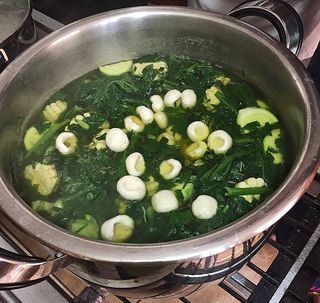
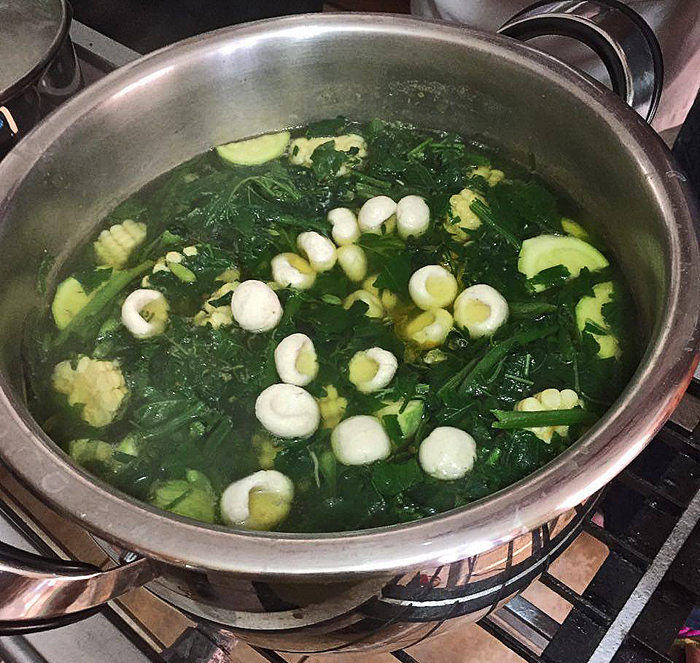
    While the soup continued to cook, we prepared chochoyotes (little masa dumplings) by making one inch spheres of masa, then pressing a fingertip into each one to make the indentation that you see in the photograph.  We then added the chochoyotes to the soup pot and allowed them to cook until tender.  Click on any photo to enlarge it for a better look.
    Clase Sopa de Gui?as MC
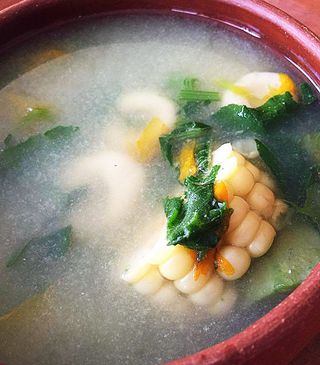
    Sopa de guías, ready for the table.  See the chochoyotes, just under the surface of the broth?
    Clase Charola Sopa de Gui?as MC
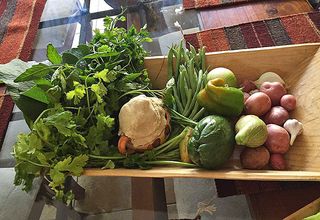
    This tray includes most of the ingredients for mole verde oaxaqueño.  Clockwise from left: herbs including cilantro and several herbs unique to Oaxaca, a bowl of masa, green beans, chile, onions, new potatoes, and chayote.  Rather than include a step-by-step for this simple (and simply extraordinary) recipe, I offer you Maestra Celia's recipe:
     
    Oaxaca-Style Green Mole with Pork 

    Ingredients

    3.5 lbs meaty pork neck bones
    2.2 lbs meaty pork back bones
    1/2 lb small alubias (or white navy beans), cooked until tender
    1/4 lb corn masa
    1 bunch parsley
    1 bunch cilantro
    1 bunch epazote (fresh, not dried)
    4 hoja santa leaves
    Salt to taste
    1/2 white onion, toasted
    1/2 head of garlic, toasted 
    3 cloves raw garlic, separate use
    1 chile serrano
    3 cloves
    1 white onion, sliced in wheels and 'cooked' in Key lime juice and oregano

    Procedure

    Boil the two kinds of pork in water, with garlic, onion, and salt.  When the meats are tender, drain them and reserve the pork stock.

    In the pork stock, blend the masa.  Strain and add it to the consomé, stirring little by little so that lumps do not form.  Blend the herbs together with the clove, the chile serrano*, and the roasted garlic and onion. Strain the liquid into the pot and allow them to boil.  Add the Blend the raw garlic with a little water and add to the pot. Correct the salt and remove the pot from the fire.

    *If you want the mole to be fairly spicy, use the entire chile serrano.  If you prefer less 'heat', add just half the chile. 

    For the garnish

    2 chayotes, cut into pieces
    A good-size handful of green beans, clean and with the stems removed
    Quartered medium-size potatoes, or if you use small potatoes as we did, you may leave them whole

    Boil these vegetables separately until they are tender. Drain and reserve.

    To serve

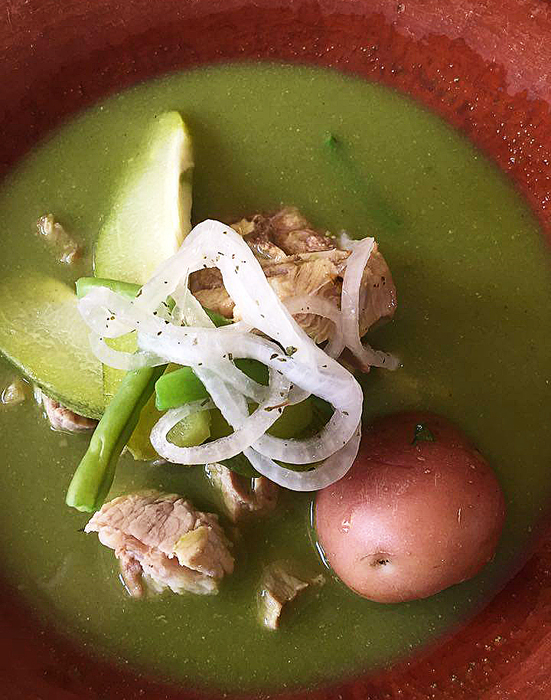
    The mole should be served in a bowl.  First add the pork meats and bones.  Cover with the green mole.  Top with the cooked vegetables.  Add a heaping tablespoonful of the cooked alubias to each bowl.  Add a few rings of white onion.
    Clase Mole Verde MC
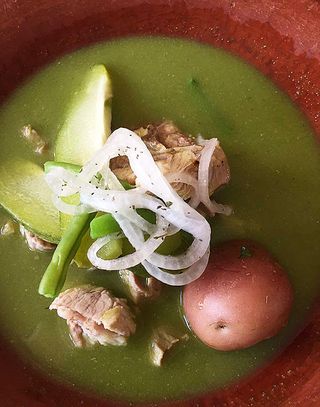
    Mole verde oaxaqueño!

    Clase Pastel de Elote Better MC
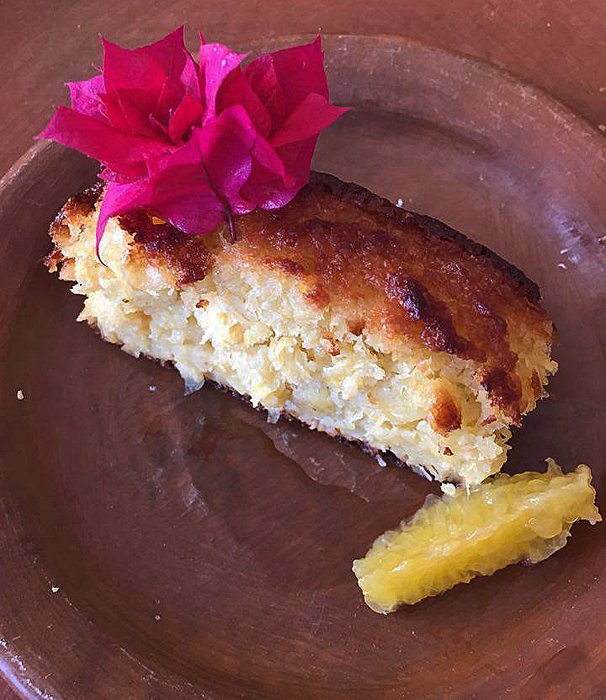
    Because Restaurante Las 15 Letras was in the process of a remodel, our class was held at Maestra Celia's home.  Her staff brought our pastel de elote (corn cake) which had been baked at the restaurant; we did not prepare it ourselves, but we certainly ate it with gusto!  It was the perfect finish to a marvelous meal al estilo oaxaqueño–Oaxaca style!
    Celia Grupo Entero
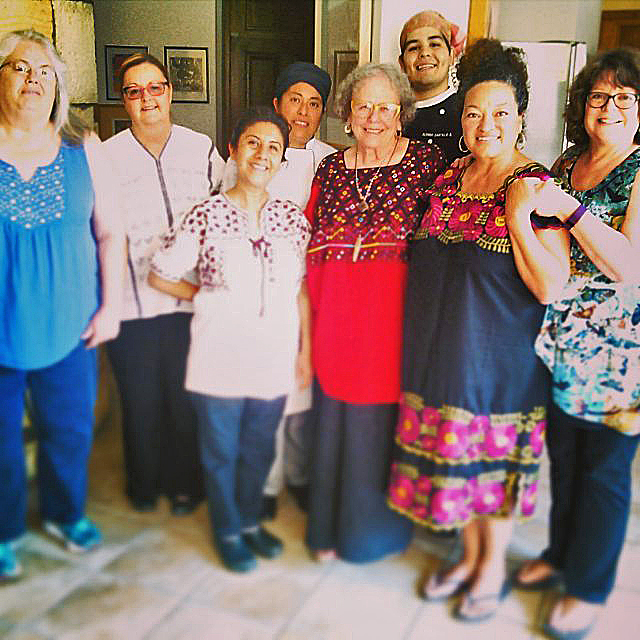
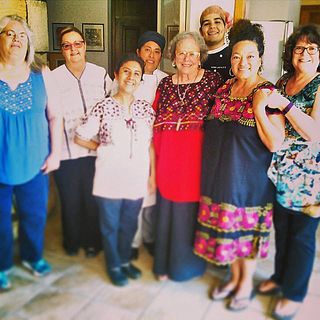
    Our tour group.  Left to right: Judith Eshom, Gayla Pierce, Maestra Celia Florián, Mexico Cooks!, Holli DeLauro, and Robyn Cota Cann.  Back row: culinary school interns Cristina Flores (black cap) and Alonso Castillo, who assisted Maestra Celia and our group in the kitchen. Photo courtesy Alonso Castillo.

    Our class, the connections we made, and our meal were extraordinary.  Each of us felt that we had become very close to Maestra Celia during our time together. There were tears at parting, promises to stay in touch with her, promises to prepare these dishes for our families and friends–and my promise to pass information about this cultural and culinary event along to you.
    Oaxaca Luna Llena Camino Real 2
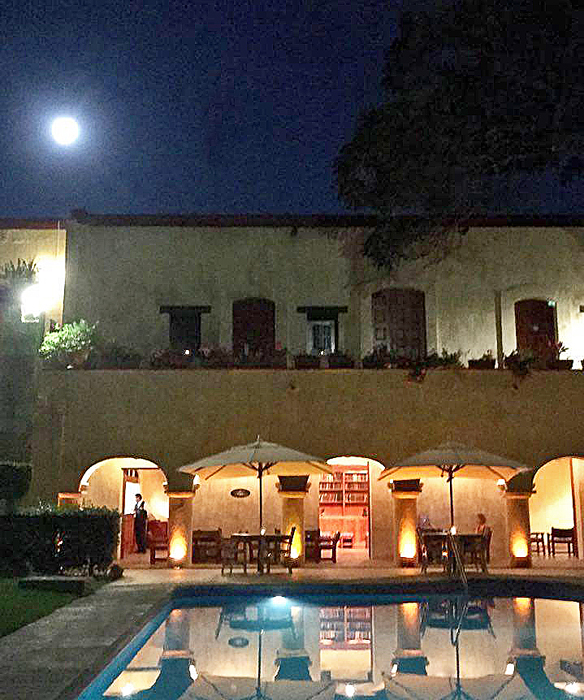
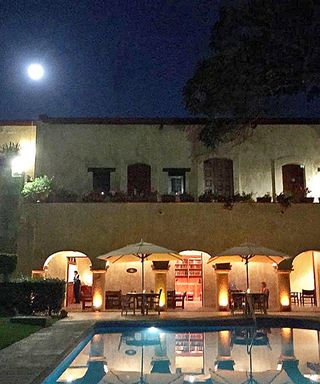
    Ending our tour in Oaxaca with a full moon and full hearts.  Thank you, California friends and Oaxaca friends, it was a joy to spend these days with you.

    If you'd like to schedule a tour in Oaxaca and would like to experience a cooking class with this most wonderful of teachers, please let me know.  I'd be happy to plan an itinerary for your group.

    Looking for a tailored-to-your-interests specialized tour in Mexico? Click here: Tours.
  • Mexico Cooks!’ Winter Tour to Oaxaca, 2016 Part IV: Tlacolula Market and Teotitlán del Valle. Food! Food! Food!

    Tlacolula Bolsas de Pla?stico
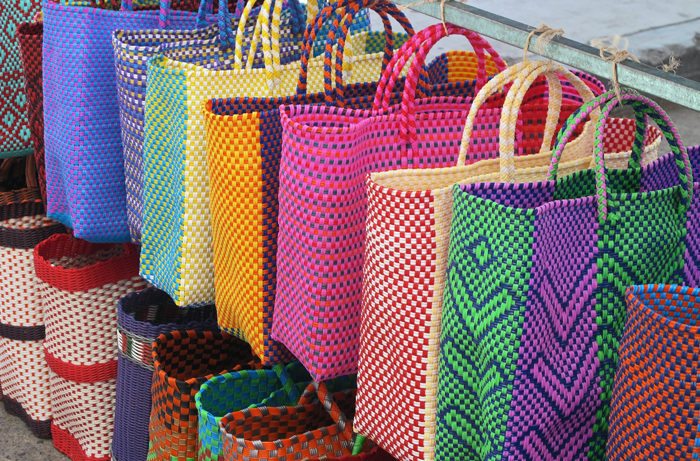
    You can get anything you want–including these highly colorful, durable plastic shopping bags–at the exciting Sunday market in Tlacolula, Oaxaca.  In Mexico Cooks!' opinion, the Tlacolula Sunday market is the best market in all of Mexico, a do-not-miss whenever visiting the central valley of Oaxaca.  Located about 30 kilometers (17 miles) from the city of Oaxaca, it's an easy trip on a Sunday morning.  Take a bus or a colectivo (shared) taxi, or hire a driver and make a day of it.  Best of all options, let Mexico Cooks! take you on a three-part Sunday outing: Tlacolula, Teotitlán del Valle, and Santa María del Tule.

    Tlacolula Metates
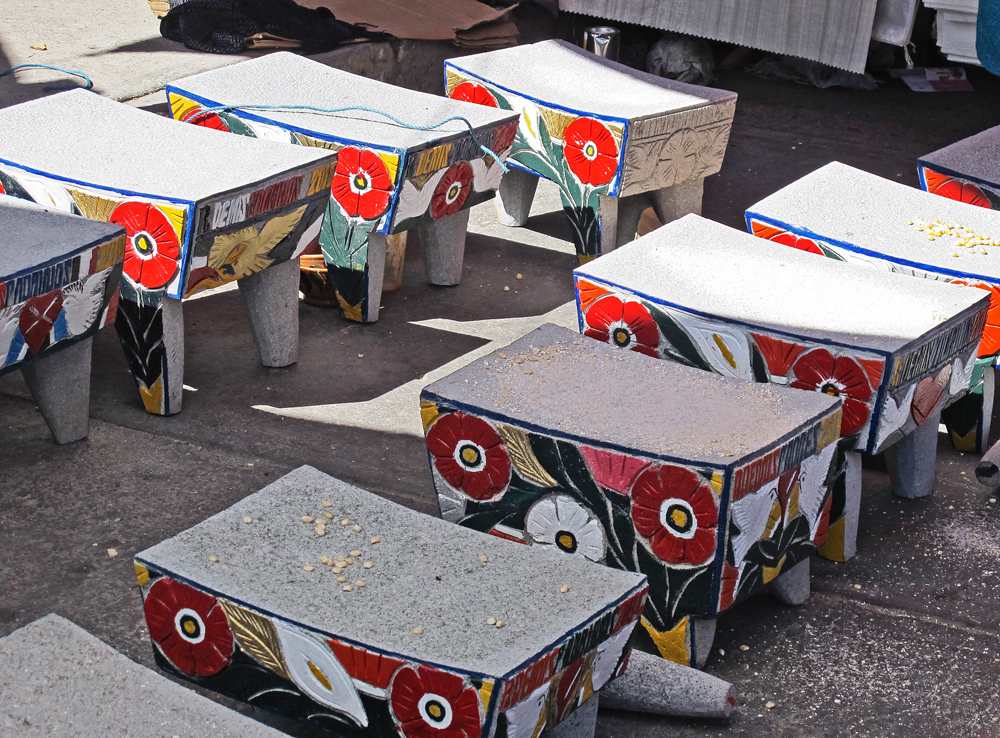
    Metates, Oaxaca-style, carved and painted with colorful flowers.  These volcanic rock grinding stones (and their manos [grinding pins]) are always tempting to bring home. They're used to grind everything from nixtamalize-d corn to chocolate and from beans to toasted tomatoes, onions, and chiles.  Unfortunately, they are also extremely heavy and impractical to carry if one is traveling by plane.  Next time I drive to Oaxaca, though, temptation might get the better of me.
    Mercado Benito Jua?rez Molinillos
    Groups of like objects fascinate me.  These are the business ends of molinillos, the wooden hot chocolate frothers used in Oaxaca and most other parts of Mexico. Like everything else pictured, they're for sale in the Tlacolula market.

    Zaachila Otra Vendedora
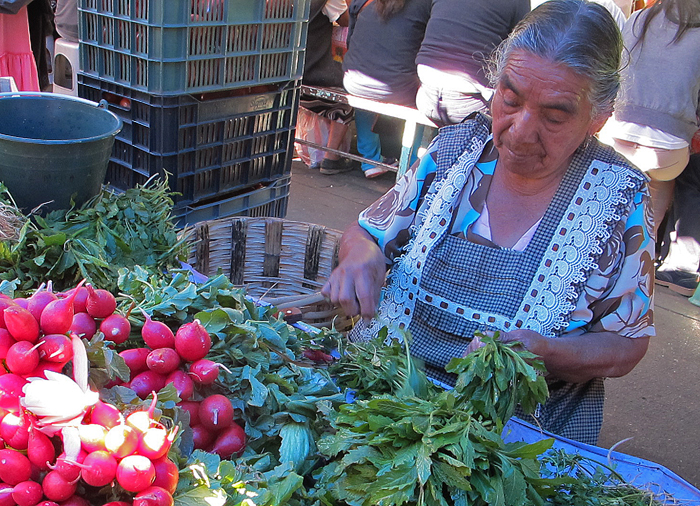
    A market vendor sorts through her goods.  She's selling beautiful radishes, verdolagas (purslane) and many kinds of herbs, including epazote (for seasoning dried beans during the cooking process and for adding to quesadillas and other dishes) and hierba buena (one type mint).

    Zaachila Mercado Gallina con Huevos
    Inside this gallina (laying hen) you can see egg yolks of every size, from pin-head to the mature yolk that we see in the eggs we eat (foreground).  The majority of people who buy eggs at a store, either by the kilo or by the carton, are astounded by the formation process of an egg. First the yolk grows to its mature size, then the albumin (egg white) collects around the egg, and then, less than a day prior to the egg being expelled by the hen, the shell forms around the yolk and albumin.  A few hours later, boom: breakfast!  Click on any photo to enlarge it for a better look at the detail.

    Big Pink Pig Head Mercado San Juan Morelia
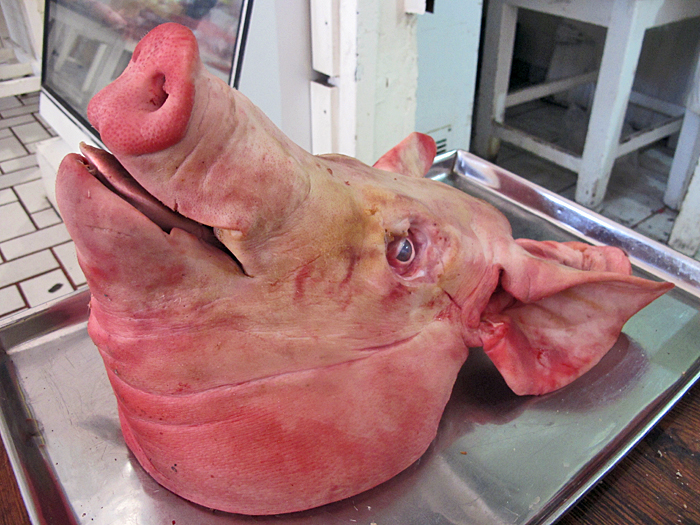
    A pig head, ready to be long-simmered with chiles and other herbs and spices to make pozole.  

    Flor de Calabaza MC
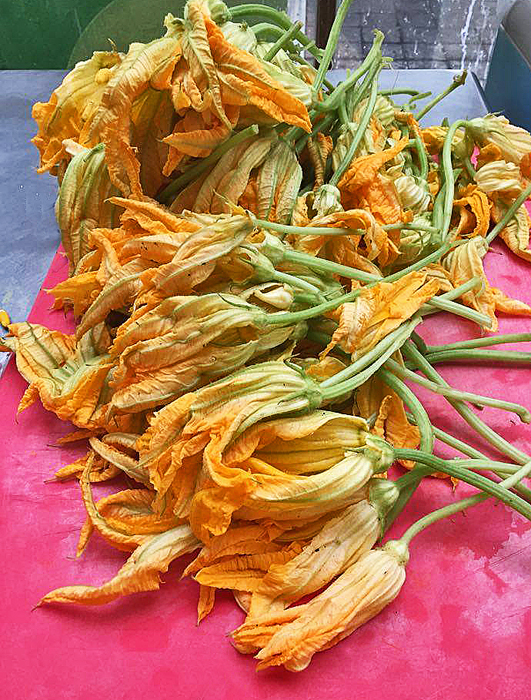
    Flor de calabaza (squash flowers), ready to use in any number of traditional Oaxaca dishes: quesadillas, sopa de guías,or stuffed with requesón (similar to ricotta cheese) and fried.  Only the male flowers are cut; the female flowers are left on the squash plant to develop calabacitas (little Mexican squash much like zucchini).

    Mercado San Juan Morelia Mamey
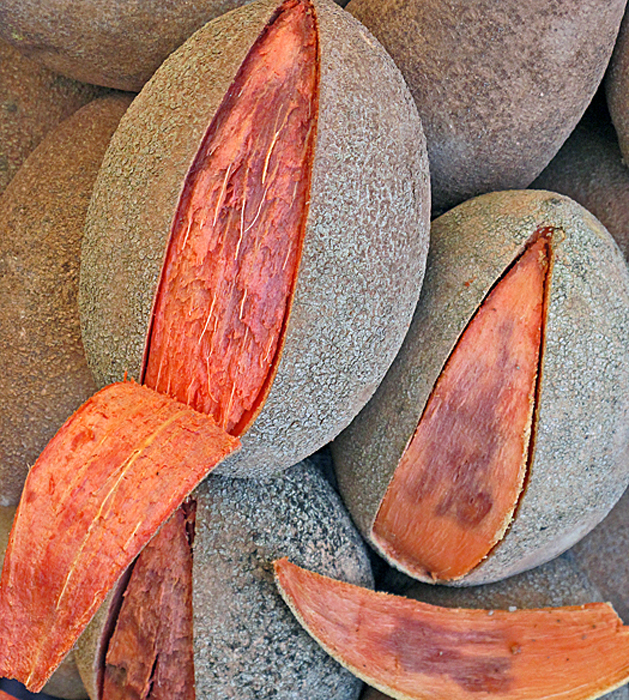
    Mamey fruits were everywhere in the Sunday market at Tlacolula.  These fruits, which look like small, slightly fuzzy footballs, are deep orange inside and taste quite a bit like baked sweet potato.  The flesh is used to make licuados (smoothies) or to eat out of hand; the seeds are used to make tejate, an iconic drink from Oaxaca.

    Mercado Tlacolula Tejate
    This tejate stand at the Mercado Tlacolula is unusual in that the vendor prepares tejate made of the standard chocolate, but also sells tejate made of coconut (middle back).  I tried them both; the coconut is excellent, but I still prefer the chocolate.

    We were on a deadline at the market: our appointment for comida in Teotitlán del Valle was waiting.  I had talked with Restaurante Tlamanalli's Rufina Mendoza several weeks prior to our anticipated arrival to make certain that the Mendoza sisters would be there to greet the group and make sure that we had a wonderful meal. As we walked from the heat of Oaxaca's mid-February sun into the cool shade
    of the restaurant, I saw Abigail, Marcelina, and Rufina at work in the kitchen.  It's so wonderful to see good friends after an absence!

    Las Hermanas Mendoza
    Left to right (clockwise) in the photo: Marcelina, Rufina, and Abigail Mendoza Ruíz, the hearts and soul of Restaurante Tlamanalli in Teotitlán del Valle, Oaxaca.

    Carta Tlamanalli MC 2016
    The restaurant's daily menu, hand-written on the Tlamanalli chalkboard.  There are just a few offerings for soup and main dishes, but when what's on the menu is as fabulous as the food at Tlamanalli, no one cares.  Mexico Cooks! dined on sopa de guías (squash flower soup), segueza de pollo (a delicious pre-Hispanic tomato and corn sauce served with post-Hispanic chicken), rice, and beans.  

    Abigail Botanas con Mezcal MC
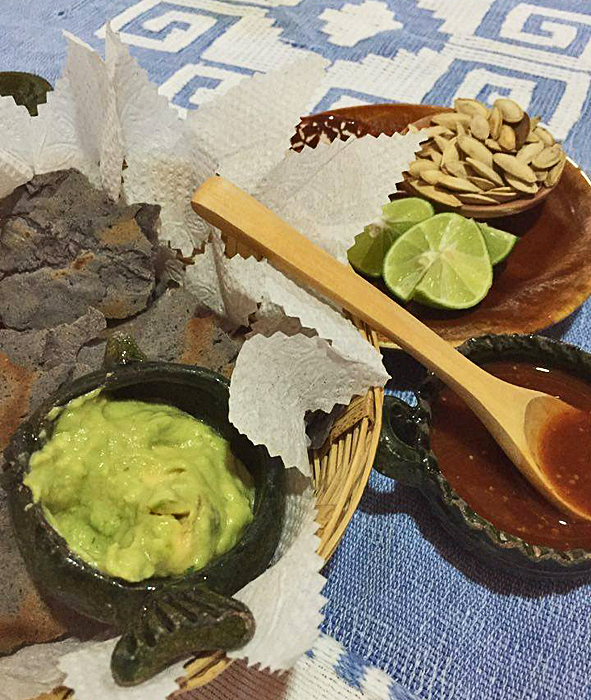
    All of our group enjoyed the house mezcal and guacamole with totopos (in this case, house-made blue corn chips) and pepitas (squash seeds) before and during our meal.

    Abigail Sopa de Gui?as 2
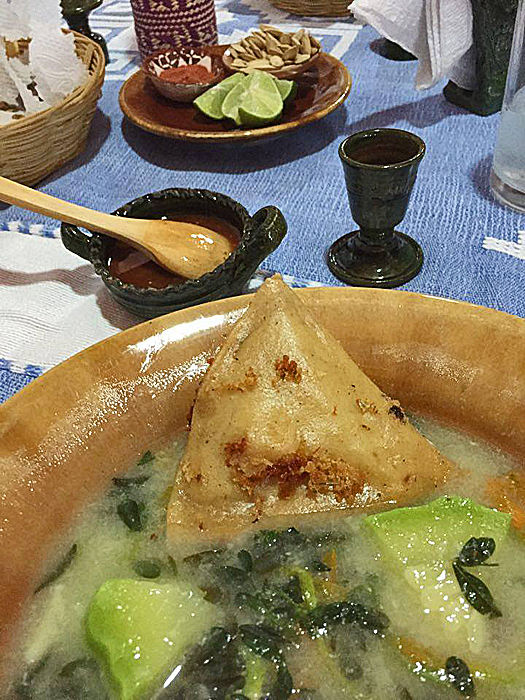
    Sopa de guías (squash tendril soup), with pieces of squash, the tender shoots, and squash flowers.
    Abigail Mole Zapoteco
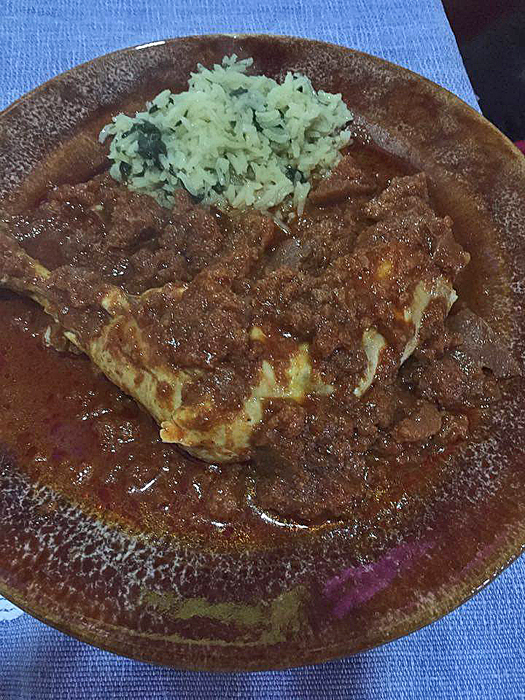
    Mole zapoteco (Zapotec-style mole with chicken).  This is a relatively simple mole to prepare, but it has a marvelous fresh and complex flavor.

    Abigail Sequeza de Pollo
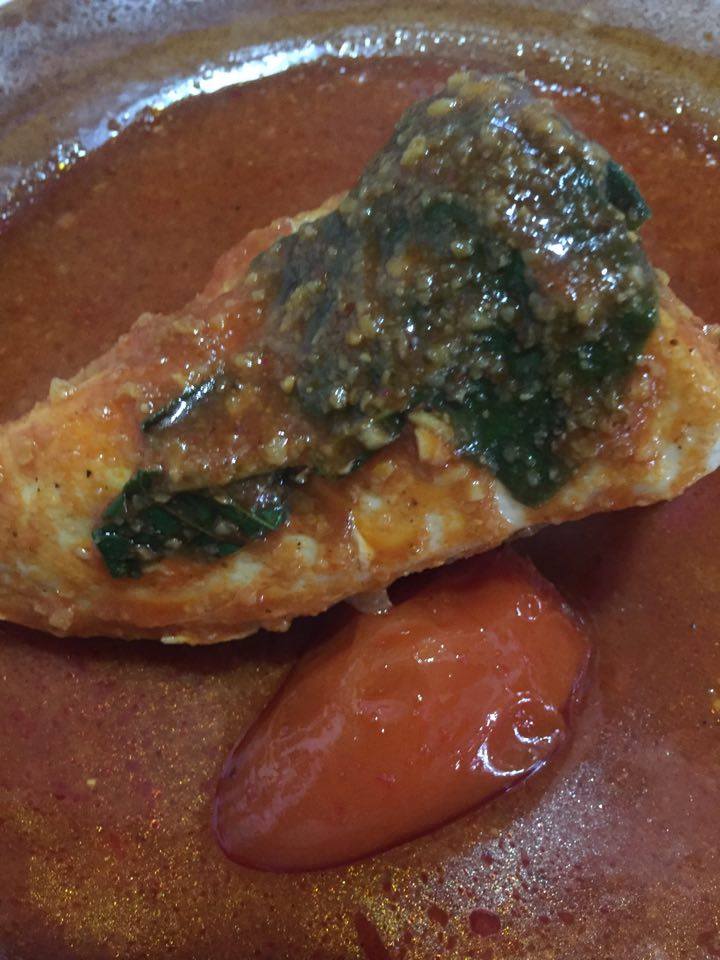
    Segueza de pollo, with a roasted tomato afloat in the delicious tomato broth.  The broth is thickened with toasted and ground corn and is prepared with hoja santa (an anise-flavored leaf) and other herbs.  In pre-Hispanic days, the dish would have been prepared with native turkey or rabbit, as there were no chickens in Mexico until the Spanish brought them from Europe.
    Abigail Mendoza Oaxaca 2014
    I would love to take you to Teotitlán del Valle to introduce you to Abigail Mendoza (photo) and her family, and of course to have a meal at Tlamanalli!

    Next week: A cooking class, filled with recipes, nostalgia, and beautiful memories.

    Looking for a tailored-to-your-interests specialized tour in Mexico? Click here: Tours.